Governance crisis cannot be treated by old formula of changing faces
An old piece that I could not post earlier:
Commenting on the melting state of the economy, a reputed economic analyst stated how the “deplorable state of governance” was responsible for the “mismanagement of public goods”. Luckily, he also reiterated how such accountability was best undertaken through an election. A common misnomer that plagues public discourse relates to how “governance” is viewed as the job of an elected government and that the state and the government are interchangeable entities. It is important to note that the state of Pakistan — post-colonial, encroached and bitten by its non-state offspring — remains the dominant power centre and most elected governments have been at subordinate to these permanent interests.

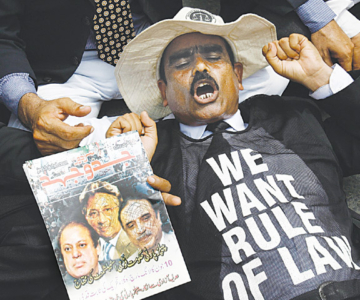
The most glaring manifestation of this reality came about when the federal government in the memo-case (concerning the alleged treasonous act of authoring a memo addressed to the US against Pakistan’s security establishment) submitted before the Supreme Court that it had no control over the operations of the military and the premier spy agency — the Inter Services Intelligence (ISI). This has been said before as well in other judicial proceedings but not so directly. Everyone knew that but the government’s admission makes it clear that ‘constitutional governance’ is but a pipedream in the land of the pure. Without prejudice to any institution, this has been the case for decades and is not going to change overnight.
A new state within the state may have emerged. During the hearing of the same case, an honourbale judge of the Supreme Court remarked in his obiter dicta that the Judiciary was not answerable to anyone but the ‘people’. This statement defies logic as judges are not ‘elected’ by the people; and they are also servants of the state, paid by the taxpayers who are represented by the Parliament. These developments have prompted a beleaguered government and its Prime Minister to announce that Parliament was supreme and that there ‘states within states’ cannot be tolerated.
Leaving aside the torrential decade of 1970s, the evolution of an autonomous power centre within the state apparatus in the form of the intelligence agencies is a well-recognised fact. A martial state since 1950s has been a player in the global power games in the region; and the redirection of state unlike India was almost inevitable. The 2008 elections were, therefore, a transitional moment and during transitions from military to civilian rule, power is shared and not exercised by the elected officials. The addition of another power-centre i.e. the Judiciary is a recent and in its nascent stage of development. Its future course remains unclear whether it can arrest the dominance of the military-intelligence complex. (more…)

Much has been elaborated on the binding constraints faced by Pakistani democracy. Conventional wisdom suggests that the civil-military imbalance has left little space for democratic institutions to grow and flourish. There can hardly be any disagreement with this point of view. In fact, decades of centralised martial rule have resulted in the militarisation of the society to such an extent that one can hardly discuss anything pertaining to Pakistan without a mention of the Pakistan Army and its role in the country.
We continue to bemoan the failure of democratic norms to take root in our governance culture. True, that the repeated extra-constitutional interventions and direct or indirect military rule have rendered democratic governance as a distant and seemingly unattainable goal. In addition, the emergence of non-state actors, sometimes more powerful than the state itself has also led to formidable and multiple centres of power. In such a milieu, achieving the sustainability of democratic process is a Herculean task. Whilst the intentions of our unelected state institutions and their overt and covert non-state partners are clear, the behaviour of the political elites is confounding.
linguistic ghosts that apparently are alive and kicking.


Recent Comments