Jaipur, Faiz and Ali Sethi
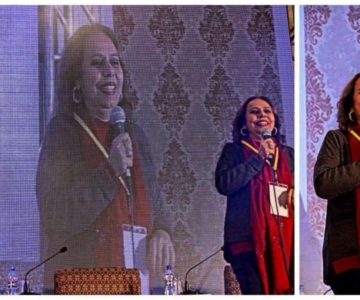
Ali Sethi recently attended the Jaipur literary festival and his extraordinary performance is now accessible to those who were not there. I should thank him for sharing this video. Ali's instructions were also meticulous but I will not post them here except his concluding comment: the whole of the rest of the session is fantastic, and includes an excellent performance by Shabana Azmi as well as a very funny story told by Javed Akhtar about his first meeting with Faiz Sahib..
Click and enjoy!
Farewell Haqqani Saheb – forgive your peers and colleagues
A personal favourite, Irshad Ahmad Haqqani is dead. This is a huge loss to Urdu journalism as he was the last of sane voices in the vernacular industry. I often disagreed with his centre-right views but his tone was measured and he remained a staunch supporter of democracy. May God bless his soul.
I stumbled on this post at Cafe Piyala that also talks about Haqqani but the best part of it was what Haqqani's peers and junior collegaues had to say about him. I think some of the comments were so shameful that I could not even laugh with an easy conscience. I am quoting the last part of that post here that also is quite a treat:
Whatever they might say about him, he did invent the modern Urdu column, which is half analytical drivel, half dinner menus. Only during the last week, for example, Jang columnist Haroon-ur-Rashid (according to his column) demanded and got desi murghi from the Azad Kashmir prime minister, and Hamid Mir (according to his column) discovered new insights into judicial activism over a Kashmiri dish. I forget the name of the dish but according to Jang / Geo’s brightest star, it is made of mooli and shaljam and served with rice. The host was the Lahore High Court Chief Justice Khwaja Sharif.
Qurratulain Hyder – it is as if she were an oracle
It is not a coincidence that Qurratulain Hyder, grand dame of Urdu literature, is remembered whenever we are faced with crises of state and society. Hyder was not just a fiction writer but a chronicler, for her sense of history remains unparalleled in the annals of South Asian vernacular literature. Her magnum opus “Aag Ka Darya” (AKD) was written and published in the highly contested milieu of the post-partition Indian subcontinent, when the new nation states were re-writing their historical discourses. In Pakistan, AKD was a sensation right from the time when it was published in the late 1950s. The controversy it created remains pertinent despite the passage of five decades.
Hyder’s nuanced and highly sophisticated vision was not easily apparent to officialdom or to state-sponsored literary critics in Pakistan.
Hating Arundhati Roy
Why We Love To Hate Ms Roy - (OUTLOOK)
Arundhati Roy certainly has a stomach for controversy. By writing several articles and providing an introduction to a book defending Mohammad Afzal Guru (13 Dec, A Reader: The Strange Case of the Attack on the Indian Parliament), the main accused in the December 13, 2001, attack on the Indian Parliament, she has stuck her neck out again. Ever since the lady made her views on the matter public, many furious friends have called. "Who does that woman think she is?" they have thundered, accusing her of "passing off conspiracy theories as investigations". As far as they are concerned, Roy should be the first citizen in their rogue’s gallery of ‘anti-national’ elements. No other writer inspires as much anger and mountains of hate mail to publications where she writes as this ‘petite woman’.
The tributes continue – remembering Qurratalain Hyder
The literati in India and Pakistan are grappling with the larger question of Qurratulain Hyder's stature in Urdu, and some would say, World literature. The Daily Times, Pakistan has published an appropriately titled editorial, Quratulain Hyder, Urdu's greatest novelist. This paragraph struck me:
...her view of culture was intensely pluralistic, explaining Muslim culture too in a transmigratory technique in her big novel Aag Ka Darya. The Pakistani public paid her a back-handed compliment by making her books bestsellers in Pakistan; but most of them were pirated, meaning that someone other than her got rich selling them. She was always a chronicler, a kind of Tolstoy in Urdu that our critics have ignored. When someone asked her in Bombay to write about the Iran-Iraq war she naturally began with the Arab conquest at Qadissiya.
Outlook India had to say this:
Only a few days back, to mark the 60 years of Independence, when we asked an eminent jury to pick out 60 Great Indians in 60 years of our Republic, the name of Qurratulain Hyder was introduced prominently as Urdu's Marquez."Through her novels and short stories, this prolific writer gave Urdu fiction a brave and endlessly inventive new voice," we wrote, and quoted the London Times: "Her magnum opus, Aag Ka Darya (River of Fire), is to Urdu fiction what A Hundred Years of Solitude is to Hispanic literature
In C M Naim's piece, published in the Outlook:
What counts, for her, is the human spirit and the relationships it generates and nurtures. That is where the linearity of time seems to curve into a spiral, urging us to recognize a past that never quite disappears.....What, then, is our choice as individuals? Here it may be worthwhile to recall the characteristically modest, even self-mocking, remarks that Hyder made in 1991 in her acceptance speech at the Jnanpith Award function: "My concern for civililzational values about which I continue writing may sound naive, wooly-headed and simplistic. But then, perhaps, I am like that little bird which foolishly puts up its claws, hoping that it will stop the sky from falling."
and he concludes with this superb analysis:
...what Hyder tacitly offers us is nothing but that wise Candidean response: even in the best of all possible worlds, it is best not to neglect to tend our garden. Certainly, through the several thousand pages of her writings, she has shown herself to be an eloquent witness to that truth.
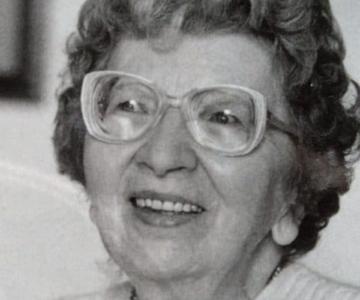
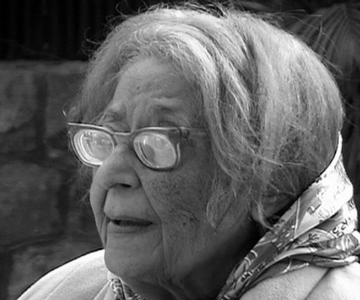
(photo left- Gauri Gill 2005) The Indian Prime Minister Manmohan Singh also expressed the sense of loss: "..In her unfortunate passing away the country especially Urdu literature has lost a towering literary figure. She will be truly missed in literary circles in the country.'
Read Jawed Naqvi's piece in the DAWN; and reactions of various writers in the daily NEWS . Rediff has published an article entitled, She was one of a Kind. Javed Akhtar, the eminent Indian lyricist has paid this grand tribute and held that she was a true genius and rightly said that he felt sorry for those people who read fiction but had not read Hyder:
"When I say that it is a great loss, it's not only to Urdu literature, not only to Indian literature, but to the word literature. I am not exaggerating at all.. the years to come, Haider's novels will reach everywhere."
"The kind of work she has done... its only because she was born in a third world country and wrote in a language that is not of the imperialistic powers, her novels have not reached everywhere. I am sure the time will come when they will reach..".
The blogosphere is also remembering Ainee Apa with great respect. Desicritics published An Enigmatic Icon, Adnan wrote a lovely piece on Ainee Apa and her books entitled A legend passes away and 3 Quarks Daily also remembered her. Urdu India has a brilliant post here and another tribute can be found here. Pakistaniat carried my post - click here to see the comments. And the best was from Delhi Walla, who went to the Jamia graveyard and took some great photos.
This will continue given the sad traditions of our literature - the literary and civilizational merits of authors and poets have often been discovered after they left this world. Having said that Ainee had established herself given her powerful voice and unique style of writing. But her real stature as Javed Akhtar says is yet to be discovered.
About the photo (top left): Gauri Gill in the Outlook writes:
Qurratulain Hyder was first photographed by Prashant Panjiar in what was a coup of sorts, everyone talked of how elusive and difficult she could be. When I met her last week to persuade her, she said, 'Tell the magazine I'm a difficult woman.' I told her that was her reputation anyway. For the first time that afternoon she cracked a grin. She seemed flattered.
Feryal Ali Gauhar – femme fatale
Conversations with novelist, filmmaker, feline aficionado, and femme fatale, Feryal Ali Gauhar, as she prepares to launch her second novel
Who doesn't know Feryal Ali Gauhar? A novel at the top of The New York Times international bestseller list, years of television appearances and a highly publicised marriage to Jamal Shah that became fodder for countless gab sessions, have caricatured and made famous her persona. Had I not known her personally, I too may have fallen for the half-imagined tales littering the drawing rooms of socialites in this land of the pure. But I have had the pleasure of Feryal's acquaintance for years, and not a moment of our friendship has resembled the images painted by petty gossip and lazy misinformation.
Feryal is a celebrated actor, filmmaker, journalist, activist, development worker and above all, a renowned novelist. Our recent meeting in her Zaman Park, Lahore residence took place after a long interlude. That afternoon, with the winter sun at our backs, we sat in her garden and talked with abandon while several of her cats and pet dogs meandered in and out of the plant-life; silent witnesses to our conversation and its occasional unfettered laughter.
Feryal is the youngest child of dynamic, accomplished parents. Her late mother, Khadija Gauhar, was a leading intellectual in Lahore who came to the city from South Africa after marrying her father, Sayyid was a military man from the NWFP who later retired from the army and took to farming. Her elder sister, Madiha Gauhar, is a talented theatre personality who founded theAjoka theatre group and has managed it for over two decades. Feryal was initially associated with Ajoka as its first female actor. The sisters also have an older brother, Aamir, an industrial engineer who operates a business in alternative energy products.
As a young woman Feryal attended the Lahore American School. Her experiences there included a reaction to the school’s requirement that all students, regardless of nationality, pledge allegiance to the United States. In response to this practice, the eight year old Feryal insisted that the Pakistani national anthem be played for the entire school as well. Later, Feryal was the first Pakistani and first female to head the school’s Student’s Council. She was an honour role student and captain of several sports teams. Several scions of leading feudal families at Aitchison College at that time remember Feryal leading her team into the school grounds to play soccer. What they especially remember is the soccer team uniform which revealed a rather shapely pair of legs. “Some have never forgotten that sight,” she chuckles.
Only a few days back, to mark the 60 years of Independence, when we asked an eminent jury to pick out 60 Great Indians in 60 years of our Republic, the name of Qurratulain Hyder was introduced prominently as Urdu's Marquez."Through her novels and short stories, this prolific writer gave Urdu fiction a brave and endlessly inventive new voice," we wrote, and quoted the London Times: "Her magnum opus, Aag Ka Darya (River of Fire), is to Urdu fiction what A Hundred Years of Solitude is to Hispanic literature