Posts Tagged Urdu

A universe with four moons

20 January 2012

By Raza Rumi

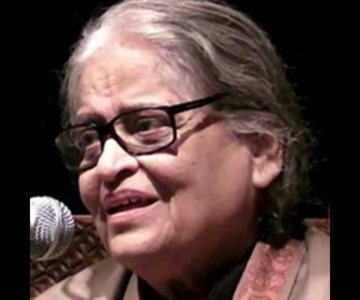
Neelam Ahmad Basheer is best known as a short story writer with a new voice in Urdu fiction. She has been writing all her life but established herself after she moved back to Pakistan from the United States during the 1980s. She spent a “lifetime” in the US married to a doctor who was not appreciative of her writing talents. And, we now know her better through the publication of Char Chaand (four moons) – a collection of autobiographical sketches and essays on her life, family and friends. Barring a few exceptions, few women venture to be as candid in Urdu writing as Neelam is in her new book. There is certainly no glorification, self-promotion or desperation to weave a halo around her persona. In fact, the author emerges as a vulnerable, melancholic and nostalgic character at the outset. The honest and self-fledgling tone of these sketches makes Char Chaand more than just a memorable book. It is in fact a testament to the tribulations of middle class women in private and public spaces and the kinds of struggles they have to wage to survive in a patriarchal society such as Pakistan.

Article Box

Article Box

Neelam’s greatest and perhaps the most ever-lasting influence is her father late Ahmad Basheer, a revolutionary writer, journalist and film-maker who was widely respected in Lahore’s literary and journalistic circles. One gets to know him through Neelam’s loving recollections in Char Chaand, also the title of the leading sketch. The four moons here are Neelam and her sisters: the uber-talented Bushra Ansari, Sumbal, a singer and known TV persona now; and Asma who has made her name in performing arts (but is unforgettable for her legendary performance in the famous parody of Malika Pukhraj and Tahira Syed with Bushra Ansari). Neelam weaves the narrative as if it were a piece of fiction and recreates her inner sanctum where this well-knit family lives in a relatively more tolerant Pakistan. It is amazing to read that Ahmad Basheer Saheb insisted that his wife should be trained in classical music; and an Ustad was hired for this purpose. The four girls grew up with this set of highly cultured parents. Ahmad Basheer was also a radical man at home. Neelam recounts how she was forced to go out of the house by the father when she was a teenager to run errands and how petrified she was to travel alone in a bus. Remarkable for the urban middle class culture where unmarried girls rarely leave the house without a male companion. Neelam is brutally honest about her insecurities growing up with prettier and bolder sisters who are eccentric in their own ways. She tells us how quiet and responsible she was as the eldest them of all. (more…)

More on the Urdu poet Mustafa Zaidi

4 December 2011

  I wrote a piece on Urdu poet Mustafa Zaidi six years ago. Since then I have received immense feedback. Zaidi’s relatives, friends and admirers across the globe have contacted me and provided documents, information and related anecdotes. It is all turning into a book of sorts that hopefully will be written one day.

I had mentioned in my post that the cause of Zaidi’s death was shrouded in mystery while most believed that he committed suicide. As I have learnt, the circumstances of his death suggest otherwise. News reports and eyewitness accounts point to the absurdity of the claim that he died in a hotel as family members claim that he was found dead in his own home. Thanks to Zaidi’s ardent fan Abeer Zaidi, I have come to know of more precise facts. I remain grateful for that.

Zaidi, at his time of death had produced several outstanding, original collections of poetry. He was married to a woman of German descent and had two children but his last companion was a woman named Shehnaz, the love of his life. His last five poems titled ‘Shehnaz’  immortalised her. That October day in 1970, Shehnaz was found unconscious along with Zaidi’s dead body.

Following are the circumstances of his demise and the lack of evidence to support the commonly held view that he committed suicide:

On March 20, 1971, under the headline ‘Evidence of Zaidi’s nephew recorded’, the newspaper Dawn reported: “Mr. Shahid Raza, nephew of the former CPS officer and well known poet Mr. S.M. Zaidi yesterday said that there were signs of a struggle having taken place in the room in which his uncle’s body was discovered last October 12. He was testifying in the Court of the District Magistrate, Mr. Kunwar Idris, in the committal trial of Mrs. Shehnaz Saleem, Wife of Mr. Saleem Khan, who is charged with the murder of Mustafa Zaidi.”

The report goes on to say that Mr Raza entered his uncles house with police official and a maternal uncle the morning after his death and found the body lying on the bed. The receiver of the phone was dangling off the hook and the cord stretched across his body. There were stains of blood on his back as well as on the bed sheet and furniture. The room was scattered and a sofa was overturned.

The writer Laurel Steel has mentioned this report in her book, ‘Relocating the Post-Colonial Self’ and has also published some letters written by Zaidi to his wife in Germany to help him get a visa to join his family in Germany. Additionally Steel also mentions that on the day of his death he rose at 8 am and washed his car. Later in the day he received visitors including Shehnaz Gul and afterwards told his servant to go home to return the next morning. The question this must be asked, can this demeanor be that of a man bent on committing suicide in hotel room?

Decades later, this case is still an enigma and has left many of those who appreciated his life and work in denial and doubt.

To read my earlier article which was published in The Friday Times in 2005, please click here.

P.S. This post also addresses the issue raised by Kidvai saheb here. Many thanks for his appreciation of my earlier piece.

Taj Mahal – a poem by Sahir Ludhianvi (reposted)

25 October 2011

Today is Sahir Ludhianvi’s death anniversary. Am reposting this poem for the readers.

Sahir Ludhianvi’s immortal poem Taj Mahal has always fascinated me. It takes a most unconventional take at this beautiful monument where the poet protests at the choice of a romantic rendezvous.

Today, I found a lovely translation of this poem. I am reproducing it below – but first a few lines from Urdu:

Yeh chaman zar yeh jamna ka kinara yeh mahal
Yeh munaqqash dar-o-deevar yeh mehrab yeh taaq
Aik shahanshah nay daulat ka sahara lay ker
Hum ghareebon kee mohabbat ka uraya hai mazaaq

Taj Mahal

The Taj, mayhap, to you may seem, a mark of love supreme
You may hold this beauteous vale in great esteem;
Yet, my love, meet me hence at some other place! (more…)

That easy intimacy

15 October 2011
By Raza Rumi
A Pakistani re-discovers Bangladesh.
alt
Image: Carey L Biron

As a Pakistani, there is a part of you that reacts instantly to the word Bangladesh: guilt, remorse or, in some cases, nostalgia can suddenly take over. I am from the generation that was spared the horrors of Pakistan Army actions, of information blackouts on the massacre of Bengalis in the name of Pakistani nationalism. But what does it mean to be half a Pakistani, without East Bengal – especially when you know a bit of history and have managed to see through the falsities of the textbooks? It means nothing or it means a lot; it depends on which way you want to look at the other half, now a proud, vibrant country.

Working in international development is what took me to Bangladesh for the first time, nearly five years ago. Prior to that, I had been familiar with the country’s mythical music, rich poetry and tales of its golden sunsets and singing rivers, but had never touched its soil. Bengal’s magic is embedded in the Subcontinental imagination, and these images and literary references long shaped my view of the country. However, my romantic notions were severely jolted when I arrived in Dhaka – at first glance, an overcrowded concrete jungle typically lacking in urban planning. More of the same, I concluded: big cities, despite their buzz, can let you down.

Still, my disappointment did not last, as I soon undertook to seek out the city’s various corners, its hidden spaces of beauty and comfort; above all, what I found was an engaged citizenry marching on. Discovering the University of Dhaka and its surroundings came as a much-needed connection, though older parts of Dhaka are also quite mesmerising. The gulmohar (or krishnachura) trees, almost on fire, greet a visitor on nearly every street, as does a tremendous volume of rickshaws.

Then there is the Shaheed Minar, the monument marking Bengali resistance founded on linguistic identity. The physical monument is modern, and by itself is not particularly exciting. However, its significance is truly monumental, marking as it does Bengali nationalism from 1948 to 1971 under the misrule of West Pakistan elites. Given movements for ethnic, linguistic and provincial identities ongoing in today’s Pakistan, the Shaheed Minar is a powerful reminder of how centralised rule and marginalisation of cultural identities lead to festering problems.

A colleague who took me to see these sites was most polite with me. He was fervently nationalistic but chose his words carefully – at least until I asked him to drop the formalities and just say what he wanted. Then the floodgates opened, and out came his personal memories and renditions from Bengali oral histories. I even found myself apologising, though I then laughed at myself for such a delusional gesture – my few words of apology meant nothing against the horrors of Bengali suffering. Luckily, the charms of the place and the krishnachura trees came to my rescue. And so, I brushed the dark side of our shared histories under the proverbial carpet, just the way that Pakistan has done. For many people in Pakistan, 1971 is today an invisible event, a deliberately ignored footnote in our collective memory, despite being one that should remain understood as a moment of reckoning for the entire country. After all, majority provinces seldom secede; it is usually the other way around. (more…)

“Love is not yet a taboo in Pakistan” – Mohammad Hanif

28 August 2011

By Raza Rumi:

In a few days, Mohammad Hanif’s new novel will be available in Pakistan. Last week, I met him at his house in Karachi. The grand dame of Urdu literature, Qurratulain Hyder, used to make fun of people who would ask writers what were they writing about. “Are writers cooks that they should be subjected to senseless questions,” she remarked in one of her essays. With this sentence lurking somewhere in the corner of my mind, I was most hesitant to ask Hanif questions about his new novel. In any case, Hanif is not known for responding to inane questions either. We found ourselves locked in this battle: me not wanting to ask; and Hanif avoiding to pontificate about his latest book. Awkward? No. Funny, Yes.

We found ourselves locked in this battle: me not wanting to ask; and Hanif avoiding to pontificate about his latest book. Awkward? No. Funny, Yes

Dressed in a flamboyant pair of shorts and a funky T-shirt, Hanif and I spoke about everything under the sun. He had been to an Iftaar party in North Nazimabad and a part of him was terribly inspired by the event. This was the ‘roza-kushai’ (breaking the first time fast) of a child and a wedding hall was the venue for a lavish Iftaar. He cited the discussions he had with a ‘buzurg’ (an elder) and quoted him. Writers play with their memories and recreate them in a most innovative manner. Thus the delightful tales of the elderly gentleman’s commentary on Karachi, its random violence, literature and society was most amusing.
(more…)

The lives of others

29 July 2011

By Raza Rumi

The first half of the 20th century witnessed a transformation in Urdu literature with the emergence of the short story as the choicest medium of literary expression, reflecting the shifting contours of Indian society. Urdu was not a communal language then. The Muslims and Hindus of pre-1947 India preferred the language for its subtlety, richness and aesthetic qualities. This was the age of Prem Chand’s realism, the romanticism of Rajinder Singh Bedi and Krishna Chandar, the irony and brutal directness of Ismat Chughtai and Manto and of course the prescient visions of Ghulam Abbas.


Article Box

Article Box

Coffee House By Irfan Javed Sang-e-Meel Publication, Lahore, 2011 Price Rs. 400

The art of storytelling and creating ‘real’ characters was a huge shift from the idyllic, escapist and courtly expression of the 18th and 19th centuries. These new storytellers were children of Syed Ahmad Khan, Hali, Shibli and the modernists who modernized the Urdu idiom and brought it closer to the people and their evolving everyday dialect, now interpreted as Hindustani. The 20th century was also a time of ideological upheavals and movements inspired by the October 1917 revolution, leading to the creation of the first Communist state. Therefore, the realism of later writers like Ahmad Nadeem Qasimi was inspired by the literary debates on what literature ought to be doing and saying. This genre of short story gradually gave way to post-Partition traumas and the emergence of other styles that relied on symbolism and allegory, especially when Pakistan was pushed into martial rule in the 1950s. (more…)

The tragic story of Urdu

29 July 2011

By Raza Rumi

What makes translating Urdu literature a rare indulgence has also kept it closeted from global appreciation.

Ralph Russell, the legendary British scholar of Urdu literature, whose tireless efforts to explore the Byzantine layers of Urdu will always serve as a reference point for global Urdu-walas, once summed up the eternal dilemma of achieving a perfect translation of Urdu literature into English. He pointed out that the work of Indian and Pakistani translators suffered from a lack of command in either language. “The English-knowing products of what in India and Pakistan are generally called ‘convent schools’ have acquired their nearly (but not quite) perfect English at the cost of losing full command of their mother tongue,” he wrote in 1996.

This is not to say that translations of Urdu literature have not been accomplished. In fact, there are many 20th century writers whose works have been translated by competent men and women. Key examples are the translations of the short stories of Saadat Hasan Manto and Ismat Chughtai. Their poignant and non-conformist writings have found a wide readership in predominantly English-reading Indian middle classes and western readers attempting to understand the nuances of South Asia’s literary output. The contribution of The Annual of Urdu Studies – edited by Muhammad Umar Memon and published every year from the US – has been immense in this regard. Some writers and poets whose works have been translated include Abdullah Hussein, Patras Bukhari, Shamsur Rahman Faruqi, Rajinder Singh Bedi, Ghulam Abbas, Hajra Masroor, Premchand, Qudratullah Shahab, Intizar whose contribution and devotion to the translation of Urdu literature remains unparalleled and who has provided fine examples of literary translations, leaving out no major contemporary Urdu writer. His academic journal, The Annual of Urdu Studies, continues to publish translated works from Urdu every year.

Literary magazines are a great introduction to young and fresh voices in Urdu. One can observe a constant process of experimentation in language and expression. Short story writer Ali Akbar Natiq, one of Urdu’s most important new voices, and Mohammad Khalid Toor, who is critical newly- rediscovered voice, have been introduced to readers by Urdu literary magazines. (more…)

My session with Intizar Husain: Karachi Literature Festival 2011

19 February 2011

Huma Imitiaz has summed up the session I moderated at the KLF. Huma has been kind to me but I am just a humble student of literature and facing Intizar Saheb in this session would remain a milestone in my imagined literary journeys, yet to start…

“There are two forces that have risen in Pakistan: women and mullahs,” said writer and journalist extraordinaire Intizar Husain, at the Karachi Literature Festival. The crowd roared in approval, and Husain smiled. At his session, held on the second day, the room was nowhere near full capacity, but those in attendance were hanging on to his every word. In a one on one discussion with writer Raza Rumi, Husain talked about a variety of subjects, from writing techniques to the Lahore that once was.
(more…)

Waiting for the Tomorrow’s Happy Dawn – Ali Sardar Jafri

24 August 2010

I had posted Ali Sardar Jafri’s lovely poem and now a reader Farah Aziz directed me to this blog where a beautiful translation of the poem has been shared.

The setting imperial sun
broke into two parts
On this very Border, yesterday.
The dawn of freedom was wounded
On this very Border, yesterday.
This is the Border of blood,
Tears, sights, and sparks,
Where we had sown hatred
And reaped a harvest of swords.
Here, stars struggled
In the eyes of dear ones.
Here, beloved faces
Flickered in streams of tears.
Here, a mother lost her sons,
A brother, his sister.
This border thrives on blood,
Breathes flames of despise
She slithers like a snake
On the bosom of our land.
She comes to the battlefield
Crested with all her weapons .

I stand on this Border
Waiting for the Tomorrow’s  Happy Dawn.

Manmohan Singh’s ignorance

18 August 2010

Manmohan Singh whom I have always held in high regard, disappointed millions in South Asia with his distastefully ill-timed hard talk during his Independence day address. As if Pakistan’s current misery was a time to blow India’s trumpet. He surely was also unaware of what his patriotic Indian poet, Ali Sardar Jafri had written years ago -Dialogue Souldn’t Cease. Here is an Urdu version with a full translation. Perhaps, someone should pass a copy of this poem to the exalted Prime Minister of India.

GUFTGOO BAnD NA HO
BAAT SE BAAT CHALEY
SUBH TAK SHAAM-E-MULAAQAAT CHALEY
HUM PE HAnSTI HUEE
YE TAAROn BHARI RAAT CHALEY (more…)

My candle burns at both ends

11 August 2010

Who will listen to the tale of my woeful heart?
Far and wide have I wandered on the face of this earth
And I have much to impart

It is not a coincidence that the earliest novels of the Subcontinent dealt with the intense and memorable characters of ‘nautch girls’. Essentially a colonial construct, a nautch girl referred to the popular entertainer, a belle beau who would sing, dance and, when required, also provide the services of a sex worker. The accounts on the marginalised women from the ‘dishonourable’ profession are nuanced, concurrently representing the duality of exploitation and empowerment.

Long before feminist discourse explored and located the intricacies of sex workers’ lives and work, male novelists during the 18th and 19th centuries were portraying the strong characters of women in the oldest profession. Stereotypes of the hapless and suffering prostitute rarely find mention in texts from that time, but one early novel, written in Urdu, is Mirza Muhammad Hadi Ruswa’s Umrao Jan Ada. While the Lucknow-based poet Ruswa is said to have persuaded Umrao to reveal her life history, many critics have surmised that the narrative was authored by Umrao herself. The tone and candour of the story suggests that Umrao played a significant role in drafting this semi-documentary piece. (more…)

Music sans frontiers

14 May 2010

by GEETA NANDAKUMAR

Song of the soul Farida Khanum

‘Aaj jaane ki zid na karo, haaye mar jaayenge ham to lut jaaenge, aisii baatein kiyaa na karo’.
Strains of her most popular ghazal in all the grandeur of her voice wafted all over the room. Rehearsing for a concert organised by the Indian Council for Cultural Relations and the NGO ‘Routes to Roots’ at the FICCI auditorium in New Delhi this week, Pakistan’s legendary ghazal icon Farida Khanum, looked svelte and poised even in her 70s. She was busy chiding the tabla accompanist, asking him to tone down the percussion. “Flow gently with the music,” she told him. Turning to me with a welcoming smile and immense warmth, she said, “There is too much cacophony and too little mellifluous music these days. Often, I am completely put off by the raucous play of percussion and refuse to sing even in Pakistan.” The irritation was palpable. The rehearsal continued as I soaked in the rich voice. Music that is manna! Age has only added to the infinite variety of her music. Finally, she broke off and asked for another percussionist. (more…)

Two poems from the work of Faiz Ahmed Faiz

5 May 2010
A Prison Evening

Each star a rung,
night comes down the spiral
staircase of the evening.
The breeze passes by so very close
as if someone just happened to speak of love.
In the courtyard,
the trees are absorbed refugees
embroidering maps of return on the sky.
On the roof,
the moon – lovingly, generously -
is turning the stars
into a dust of sheen.
From every corner, dark-green shadows,
in ripples, come towards me.
At any moment they may break over me,
like the waves of pain each time I remember
this separation from my lover.
This thought keeps consoling me:
though tyrants may command that lamps be smashed
in rooms where lovers are destined to meet,
they cannot snuff out the moon, so today,
nor tomorrow, no tyranny will succeed,
no poison of torture make me bitter,
if just one evening in prison
can be so strangely sweet,
if just one moment anywhere on this earth.
English Translation by Agha Shahid Ali (more…)

Karachi Literary Festival: Spring in the land of suicide bombers and charlatans

10 April 2010

Who says Pakistani literature was a relic of the past? If anything, Pakistani authors have a global audience today, and our writers are now the greatest harbingers of Pakistan’s complexity and nuance in a way that the embedded media can scarcely fathom.

The first literary festival took off in our cosmopolitan melting pot, Karachi, in March. The Oxford University Press’ dynamic head Ameena Saiyid, and the British Council, together organised this event. Asif Farrukhi, the premier litterateur of the metropolis was central to the festival. Farrukhi’s comprehensive command of Urdu and English literary currents, and the stature which he has earned with his hard work, ensured that we were all set for a fabulous gala.

Earlier, the festival faced the usual hurdles: the Indians were issued visas rather late in the day and my friend Sadia Dehlvi was denied a visa at the last minute, despite earnest efforts by the organisers. The iron curtain was rigidly in place. But the other regional and international delegates arrived as planned. The last minute finalisation of the schedule meant that due notice could not be given to many participants. However, the OUP team, especially Raheela Baqai, were adept at getting things done. Saiyid herself used Facebook to advertise the event. She’s obviously keeping up with technology and its changing frontiers.

We arrived just in time for the launch ceremony that was held at the British Consulate. It was quite a journey from the Carlton Hotel to old-world Clifton – a mini-bus that dazzled with literary icons of our time: Iftikhar Arif, Intezar Hussain, Masood Ash’ar and Shamsur Rehman Farooqi from the world of Urdu. The front seats were occupied by the petite and resplendent Bapsi Sidhwa, the contemplative Zulfiqar Ghose and the younger British Pakistani writer Sarfaraz Manzoor, whose book ‘Greetings From Bury Park’ has created waves across the English reading (more…)

Wandering between two worlds – Karachi Literary festival

1 April 2010

Ghazi Salahuddin’s write up for the NEWS makes interesting points about the festival and also mentions me as one lost between the English and Urdu worlds

Far from the unruly crowds we watch on our news channels, playing hide and seek with an equally enraged and rowdy police, a select group of book lovers was able to retreat, during the last weekend, to the wonderland of literature. This, of course, was the Karachi Literature Festival sponsored by the Oxford University Press and the British Council. And all of us who were there were grateful for a memorable experience.

The two-day festival was held at a hotel tucked into a corner in Defence, by the side of the creek. It also bills itself as a resort. In that sense, being there did enforce a sense of distance from the disarray that pervades our daily existence. It was, thus, a lot of fun, and real pleasure was derived from casual encounters that flourished on the sidelines, with so many distinguished Pakistani writers and poets in attendance.

Now, when I underline this manifestly elitist aspect of the festival, I am not being critical of how it was designed. In fact, the location made the festival possible in spite of security concerns and the overall ambience greatly facilitated the discourse on otherwise rather sombre issues. Besides, the balance in the audience did tilt towards the readers of English and they could find easy access to the location. This is what would be expected of an event organised by the OUP and the British Council. (more…)

Next Page »