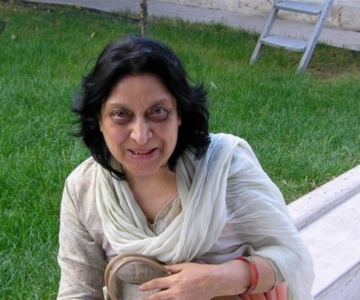
The tributes continue – remembering Qurratalain Hyder
The literati in India and Pakistan are grappling with the larger question of Qurratulain Hyder's stature in Urdu, and some would say, World literature. The Daily Times, Pakistan has published an appropriately titled editorial, Quratulain Hyder, Urdu's greatest novelist. This paragraph struck me:
...her view of culture was intensely pluralistic, explaining Muslim culture too in a transmigratory technique in her big novel Aag Ka Darya. The Pakistani public paid her a back-handed compliment by making her books bestsellers in Pakistan; but most of them were pirated, meaning that someone other than her got rich selling them. She was always a chronicler, a kind of Tolstoy in Urdu that our critics have ignored. When someone asked her in Bombay to write about the Iran-Iraq war she naturally began with the Arab conquest at Qadissiya.
Outlook India had to say this:
Only a few days back, to mark the 60 years of Independence, when we asked an eminent jury to pick out 60 Great Indians in 60 years of our Republic, the name of Qurratulain Hyder was introduced prominently as Urdu's Marquez."Through her novels and short stories, this prolific writer gave Urdu fiction a brave and endlessly inventive new voice," we wrote, and quoted the London Times: "Her magnum opus, Aag Ka Darya (River of Fire), is to Urdu fiction what A Hundred Years of Solitude is to Hispanic literature
In C M Naim's piece, published in the Outlook:
What counts, for her, is the human spirit and the relationships it generates and nurtures. That is where the linearity of time seems to curve into a spiral, urging us to recognize a past that never quite disappears.....What, then, is our choice as individuals? Here it may be worthwhile to recall the characteristically modest, even self-mocking, remarks that Hyder made in 1991 in her acceptance speech at the Jnanpith Award function: "My concern for civililzational values about which I continue writing may sound naive, wooly-headed and simplistic. But then, perhaps, I am like that little bird which foolishly puts up its claws, hoping that it will stop the sky from falling."
and he concludes with this superb analysis:
...what Hyder tacitly offers us is nothing but that wise Candidean response: even in the best of all possible worlds, it is best not to neglect to tend our garden. Certainly, through the several thousand pages of her writings, she has shown herself to be an eloquent witness to that truth.
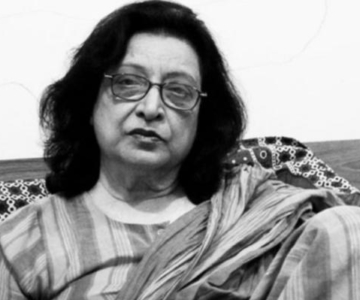
(photo left- Gauri Gill 2005) The Indian Prime Minister Manmohan Singh also expressed the sense of loss: "..In her unfortunate passing away the country especially Urdu literature has lost a towering literary figure. She will be truly missed in literary circles in the country.'
Read Jawed Naqvi's piece in the DAWN; and reactions of various writers in the daily NEWS . Rediff has published an article entitled, She was one of a Kind. Javed Akhtar, the eminent Indian lyricist has paid this grand tribute and held that she was a true genius and rightly said that he felt sorry for those people who read fiction but had not read Hyder:
"When I say that it is a great loss, it's not only to Urdu literature, not only to Indian literature, but to the word literature. I am not exaggerating at all.. the years to come, Haider's novels will reach everywhere."
"The kind of work she has done... its only because she was born in a third world country and wrote in a language that is not of the imperialistic powers, her novels have not reached everywhere. I am sure the time will come when they will reach..".
The blogosphere is also remembering Ainee Apa with great respect. Desicritics published An Enigmatic Icon, Adnan wrote a lovely piece on Ainee Apa and her books entitled A legend passes away and 3 Quarks Daily also remembered her. Urdu India has a brilliant post here and another tribute can be found here. Pakistaniat carried my post - click here to see the comments. And the best was from Delhi Walla, who went to the Jamia graveyard and took some great photos.
This will continue given the sad traditions of our literature - the literary and civilizational merits of authors and poets have often been discovered after they left this world. Having said that Ainee had established herself given her powerful voice and unique style of writing. But her real stature as Javed Akhtar says is yet to be discovered.
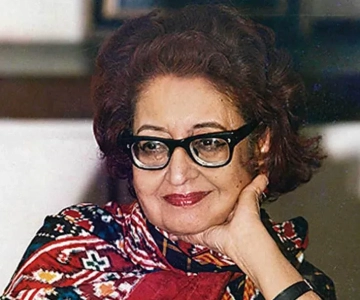
About the photo (top left): Gauri Gill in the Outlook writes:
Qurratulain Hyder was first photographed by Prashant Panjiar in what was a coup of sorts, everyone talked of how elusive and difficult she could be. When I met her last week to persuade her, she said, 'Tell the magazine I'm a difficult woman.' I told her that was her reputation anyway. For the first time that afternoon she cracked a grin. She seemed flattered.
We Are All Dr Faustus – Parveen Shakir
Last month, in the freezing climes of Islamabad, we talked about Parveen Shakir, Pakistan's popular poet who died at a young age.
One of Parveen's poems invokes the legend and metaphor of Dr Faustus:
'The name 'Faust' has become deeply rooted in European mythology as the name of a man who sold his soul to the devil in return for eartly power and riches. The Faust legend has been embellished and retold in many formats ...'
I found this skillful translation of her poem - We Are All Dr Faustus - by another noteworthy poet Alamgir Hashmi on this site.
We Are All Dr Faustus
In a way we are all
Dr Faustus.
One from his craze
and another helpless from blackmail
barters away his soul.
One mortgages his eyes
to trade in dreams
and another offers
his mind as collateral.
All that one may need sense
is the currency of the day.
So a survey of life's Wall Street says
that among those with the buying power these days
self-respect is very popular.
The Urdu version was found with the translation

This is an appropriate commentary on what constitutes self-respect and the all-pervasiveness of Wall Street culture in our contemporary existence.
As I hold the recently published “The Oxford Book of short stories” in my hands, I cannot help bemoan the fact that Urdu literature has been almost invisible from the arena of global literature. Admittedly, translation is difficult; the tediousness of translation daunts many a brave heart. Having said that, there have been a handful of remarkable translators such as Khalid Hassan, Alamgir Hashmi, CM Naim, Aamer Hussain, Umer Memon and Rakhshanda Jalil, to name a few. But a wide corpus of Urdu literature lies forlorn and hidden from global readership, which alas is dominated by English language readers. For this very reason, Amina Azfar has done a remarkable job of compiling a collection of Urdu short stories. Her earlier translations have been competent and quite often lyrical. For instance, Akhtar Hussain Raipuri’s Gard-e-Rahh (the dust of the road) and Sajjad Zaheer’s Roshnai ( the Light ) are noteworthy for their tone.
Only a few days back, to mark the 60 years of Independence, when we asked an eminent jury to pick out 60 Great Indians in 60 years of our Republic, the name of Qurratulain Hyder was introduced prominently as Urdu's Marquez."Through her novels and short stories, this prolific writer gave Urdu fiction a brave and endlessly inventive new voice," we wrote, and quoted the London Times: "Her magnum opus, Aag Ka Darya (River of Fire), is to Urdu fiction what A Hundred Years of Solitude is to Hispanic literature