My Lahore is bleeding again – an eyewitness account
I am grateful to Khurram Siddiqi for his timely and rather chilling account of what Lahore underwent this evening. Our thoughts and prayers are with the victims of Lahore tragedy. Raza Rumi
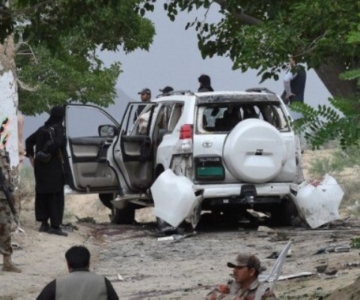
Today, two bombs struck Allama Iqbal Town's 'Moon Market'- a place that I remember from my childhood when our family used to visit Lahore- many members of which, at the time, lived close to. My cousin Usman was actually at a store in the market when the blast went off, and survived by some miracle. He came home shocked and changed from a full grown man- into a tepid young boy again; he said that he had just witnessed hell itself. I was taking a nap since I've been sick over the last few days- and woke to the sound of a cacophony of ambulance sirens; I now live almost across Jinnah Hospital. The bomb went off in Iqbal Town; I've tried to illustrate where all of this happened on the map here:
View Moon Market Blasts in a larger map
I walked across to Jinnah Hospital's emergency ward- not that I condone people amassing together when they shouldn't be there- but I wanted to capture some of the sounds of the aftermath of mass murder. What you'll hear in the audio linked below is police officers trying to get people to clear out (I was standing clear of the entrance)- and make way for an ambulance that was about to pull in. Audio Link
Land of My Dreams – of Mushirul Hasan’s woes
This is such a well written piece. I had read it a few months ago and now my friend ARK sent it via email. I am sharing it for the readers who may not have seen it. Reading Mushir ul Hasan and about him is always a pleasure. The comments on Boston Globe that published it are equally revealing as they reek of bigotry and fundamentalism that the writer is trying to depict in her piece. In a way, the non-resident-Indian (NRI) mindset is quite amusing as it shows that education and success and living in 'open' societies has little to do with socialised attitudes.
Islamic liberalism under fire in India Martha C. Nussbaum
As it became clear that Pakistani Muslims perpetrated the horrendous terrorist attacks in Mumbai last November, many feared a wave of violence against India’s own Muslim community. The community, which represents 13.4 percent of Hindu-;majority India, suffers from poverty and systemic discrimination, as the government’s recent Sachar Commission report documents. It has also been targeted by the Hindu right, which, in 2002, murdered as many as 2,000 people, mostly Muslims, in the state of Gujarat.
That violence, like the violence of Hindu-;right mobs against Christians in the eastern state of Orissa in 2008, surely deserves the name of “terrorism.” Yet, in India as elsewhere, the word “terrorism” is now frequently confined to the actions of Muslims, and Muslims are suspects almost by virtue of their religion alone. There was reason, then, to fear that mobs would take the Mumbai blasts as the occasion for a renewed assault on an already beleaguered minority.
US assistance needs an alternative paradigm
An oped published by The NEWS
The gods are smiling at Pakistan's development industry once again. Such a moment was experienced almost a decade ago when Pakistan's strategic location made it into a hub of post-9/11 investments to secure the world peace. However, this time the United States of America has undertaken a historic step of aiding the civilian government and addressing the structural imbalances such as poverty, unemployment and lack of opportunity that quite rightly fuel militancy and promote factories of suicide bombers. Some would think this is naive in view of the imperial occupation of Afghanistan and the rather schizophrenic and counterproductive policies of the US elsewhere in the Muslim world.
This is not an invalid position taken by the rejectionists of US assistance. But this is an equally naive postulate for it is far more important to invest in civilian governance than hi-tech arms and domestic war machine. Haven't we reaped the disastrous
Literature in the time of terror
My piece that appeared in The Friday Times (May 29-4 June, 2009 issue). I have argued that the silence of Pakistani writers on terrorism and extremism is finally breaking
![]() |
|
|
‘Fallen Indus’, a painting by the author |
|
![]() |
|
|
‘Ignorance Is Bliss’, a miniature by Saira Wasim |
|
Since the invasion of Afghanistan by the United States and the global hysteria about 'terror' and 'terrorism', Pakistan has faced the greatest of existential challenges after its dismemberment in 1971. As a frontline ally of the US in the war on terror, Pakistani society and polity have been engulfed by growing militancy and acts of violence. Whilst there is no single definition of 'terrorism', the mainstream media and policymakers – in the service of imperial rhetoric aimed to justify and perpetuate the occupations of Afghanistan and Iraq – have established terrorism as the major threat to domestic and regional peace in South Asia. Acts of premeditated and organised violence in India, Pakistan and Bangladesh have thus assumed a central place in discourse on regional cooperation or its converse: the rivalries between the constructed nation states and their irresponsible power-elites.
In this milieu, South Asian citizens have been the victims of violence, uncertainty and acrimony that have only led to the exacerbation of poverty, inequality, ascendancy of militarism and the war-mantra. All of this is taking place when globalization is relentlessly seeping into domestic economies, cultures and social systems. Where does this leave the writers and poets of the
This is a long war
Published in The NEWS
By Raza Rumi
This is a critical moment in our history perhaps unmatched for its severity and its brutal reality. The experiential nightmare that our country is passing through is perhaps unparalleled for the enemy is neither foreign nor fully identifiable. At the same time, never has there been a clear backing of a military campaign against domestic agents of subversion and anarchy. Forget the doctored samples of opinion polls, often conducted by foreign agencies. That by itself should make us ashamed for our proclivity to accept what others have to analyse and determine for us. Even ignore the fringe voices of dissent led by those who neither have credibility or sagacity to comprehend the existential crisis faced by Pakistan. The army has shown vision and displayed courage in tackling a menace that alas is a home-grown cancer due to our short-sighted strategies in pursuit of phantom depths. The battle to be won is now the country itself.
The political consensus of sorts that has accompanied the military action against the Taliban is also remarkable. Notwithstanding the spin doctors posing as analyst-anchors on the idiot box, the political class has recognised that its survival is embedded in the battle against extremism that predicates itself on elimination of sane, moderate and secular politics itself. This was the Swat model – blow the polity to bits and create a vacuum for a takeover. An age-old recipe employed by the hordes from Central Asia that invaded Muslim Delhi again and again during Sultanate and Mughal periods of our common histories which refuse to be partitioned.
Falsehoods about terrorism
I was fascinated by my dear friend Adnan's post - Falsehoods about terrorism: 'Islamic' and 'un-Islamic' terrorists [Indian Muslims and Media] - that was a breath of fresh air. In a non-ideological, dispassionate manner he critiques the media power and association of the word Muslim with terrorism. I have known Adnan since I started blogging. Even though I have never met him in real life, I know that we could have been great actual (as opposed to virtual) friends had the walls of borders, distrust and competing nationalisms not stood between us. But cyberspace has allowed us to be friends and this is remarkable by itself. Perhaps the tone of his post has to do with the essential good manners that come with the Ganga-Jamni tehzeeb (high Indo-Muslim culture) of which Adnan is a torchbearer. He is equally into politics, activism as much as he is steeped in the culture of internalising Urdu poetry and its refined nuances. See his blogs with the finest selections from Urdu poets.
Back to Adnan's excellent post. I am reproducing an excerpt here:
Believe me, had any of these attacks involved a Muslim, it would have been termed a Terrorist attack and for days, we would have been shown images of 'trained Muslim youths', their links, cell phone records, the masterminds, the names of obscure organisations with Arabic names and what not.
"...I would request you to just have a look at the frequency of attacks mentioned below:
1. 11 CISF personnel gunned down in Naxal attack on NALCO bauxite mine in Orissa (April 13) [Link courtesy The Hindu]
Amankaar Tehrik (peace movement) in Pakistan challenges the status quo
Courtesy Fouzia Saeed
DISSPELLING THE MYTHS ABOUT TALIBAN
Myth: The root cause of Terrorism is extreme poverty and lack of education
Reality: This is not true. There are many countries in the world that suffer from extreme poverty but do not have terrorist groups. Within Pakistan many areas are more poor than Swat, but have not become violent. On the other hand people who have become terrorists are not doing anything to eradicate poverty or provide education. Terrorists merely use the resentment of the marginalized and those resentful of other state actions in the initial phase of their ideological campaign. Once in control, they tax the poor, destroy school buildings and stop girls from going to schools. Most of those who have been killed due to militant attacks are women, peasants and the poor.
Brewing storms
Raza Rumi laments the tragedies of our times, and says that the state cannot be absolved of its responsibility to protect citizens against terrorism (The Friday Times)
Lahore has finally been encircled by the layers and tremors of violence. If the events of March 2009 were not enough, there is now a concerted effort to create panic in the city. In the past few weeks, girls’ schools have been threatened that they would face the music for educating girls and promoting co-education. How can children and their middle-class urban parents survive these gruelling times? (pic left:Pir Baba’s shrine is now closed to visitors )
Civil society speaks
Zinda dilaan-e-Lahore say no to Talibanisation, reports Raza Rumi
Never before have we citizens been traumatised with an uncertain future and the knocks of destruction at our door as is the case in the year 2009. The celebrated twenty first century has, if nothing else, blown the contradictions of Pakistani society and state right into our faces. One hundred and eighty million people cannot be spectators to the imperial great games and a callous state that gropes in the dark trying to locate the ‘enemy’ outside, instead of looking into its own crevices and cracks.
Not that Lahore has been a haven of peace in recent years – the inequities, the crime levels have been on the rise. However, March 2009 witnessed two full-scale terror attacks in the city of gardens, shrines and a centuries-old tolerant culture. Media gurus were quick to involve India, RAW, the Americans, everyone under the sun except the enemy within. First the friends of Pakistan – the Sri Lankans and then the ill-equipped and vulnerable Police Academy at Manawan, were attacked by trained assassins who espouse a version of Islam that no sane Muslim can ever live with.The panic and fear generated by these two incidents had not ended when the brutal video of Chand Bibi getting lashed on the streets of Swat was released.
Fighting terror
Today it is Chaand Bibi - the unfortunate victim in Swat and tomorrow it could be civilisation itself or whatever remains of it in the rest of the country.
The citizens of Lahore and the numerous groups will get together tomorrow to protest on the Mall Road. Similar rallies are being organised elsewhere most notably in Karachi by the People's Resistance group.
This is a chance for you to stand up and be counted against the forces of extremism and aggression who are hellbent on destroying our beloved city Lahore and the country. If we will not raise our voices then we are condemned to be victims of history.
Let us march on the Mall tomorrow, to counter darkness with peaceful protest with OUR STATE MUST FIGHT THE TERRORISTS
Date: Saturday, April 4, 2009
Time: 4:00pm - 5:00pm
Location: The High Court/GPO Chowk
Street: Mall Road
City/Town: Lahore, Pakistan
Lahore is burning
Raza Rumi
[reportedly] 27 dead and dozens injured - no respite for us.
Once again, in less than a month Lahore has been ravaged by terrorists. Who said that Pakistan was a hub of terrorism - we are now the greatest victim of terror and militancy. The residents of Lahore are scared and the vibrant city seems to be enveloped in a mist of uncertainty and fear.
The Mumbai and later Lahore 3/3 model seems to be in vogue now. Extremely well trained commandos, with sophisticated weapons and not afraid of death are let loose on the society. The media is hysterical as well and following the Indian media's cue[s] is now a participant and embedded in the so-called operation.
Sad times in Lahore

Raza Rumi
What a sad day it was - a city that usually glows with spring colours and crisp air was a death-zone. Everyone was afraid and depressed after the morning killings. The wound is far deeper than it appears. It has to do with how our country is moving towards anarchy and mayhem. And, we all continue to be bystanders at best screaming spectators. There were brave policemen today which was a silver lining. These men of courage offered their lives to protect the guests from Sri Lanka. Cricket fans were devastated for what will happen to the favourite sport? Who will come to Pakistan.
But more importantly, this is not what Lahoris and Pakistanis deserve. The great games outside and inside have made us hostage to grand,vested interests. About time, we spoke about it and registered that we count.
Apologies to the people of Sri Lanka. We tried to protect your team but failed. Hope you will understand that we are now unable to protect ourselves.
Photocredit: Mohsin Raza/Reuters - funeral of the policemen who were killed by the terrorists.
Remembering Benazir Bhutto
Raza Rumi retraces the bittersweet legacy of Benazir Bhutto (published in the Friday Times)
It was only yesterday that we were mourning for the loss of an icon of our times. The much loved, and passionately hated Benazir Bhutto whose tragic murder in broad daylight was the greatest metaphor of what Pakistan has turned into: a jungle of history, ethnicity and extremism. Little wonder that Bhutto’s worst enemies cried and lamented the loss of a federal politician whose life and times were as unique as her name. The populist slogan – charon soobon ki zanjeer (the chain of the four provinces, literally) could not have been truer than the most tested of axioms. As if her death were not enough, the state response was even more brutal. Why did she participate in public rallies? On that fateful day of December 27, 2007, why did she invite death by sticking her neck out – literally and metaphorically? This was tragedy compounded by invective and betrayal. After all, had she not received a tacit understanding from the then military President, General Pervez Musharraf?
The official machinery then went to work in a super-efficient frenzy. Within hours, the murder scene had been washed away, right opposite the Liaqat Bagh in Rawalpindi where Pakistan’s first Prime Minister, Liaquat Ali Khan, was also shot dead. If anything history repeated itself with a bang – only to restate that Pakistani Prime Ministers are dispensable accessories of the power game. The misogynistic thirst for blood-letting once quenched, patriarchy dictated that the autopsy of a woman became an issue of honour, confusion and violation of the law. How telling, that the laws of the land remain subservient to the imperatives of culture and tradition.
Within a day, Pakistan shook and the world also felt the tremors from an already stinking cesspool of violence, terror and global mischief. Many Pakistanis think these labels are of imperialist manufacture, reeking of hogwash. But the case has been made: Pakistan is a rogue and failing state and no one is safe.
9 Is Not 11

I am completely under the spell of this fabulous piece of writing, brutally honest and eminently sensible.
essay: terror in mumbai
![]()
9 Is Not 11
![]()
(And November isn't September)
![]()
ARUNDHATI ROY
We 've forfeited the rights to our own tragedies. As the carnage in Mumbai raged on, day after horrible day, our 24-hour news channels informed us that we were watching "India's 9/11". And like actors in a Bollywood rip-off of an old Hollywood film, we're expected to play our parts and say our lines, even though we know it's all been said and done before.
As tension in the region builds, US Senator John McCain has warned Pakistan that if it didn't act fast to arrest the 'Bad Guys' he had personal information that India would launch air strikes on 'terrorist camps' in Pakistan and that Washington could do nothing because Mumbai was India's 9/11.
But November isn't September, 2008 isn't 2001, Pakistan isn't Afghanistan and India isn't America. So perhaps we should reclaim our tragedy and pick through the debris with our own brains and our own broken hearts so that we can arrive at our own conclusions.
Islamabad: “This too shall pass”
bemoans Islamabad's fall from grace
![]() |
|
|
Many of the new roads in Islamabad have nothing to offer to those who do not own cars |
|
![]() |
|
|
The view outside the Diplomatic Enclave |
|
![]() |
|
|
Contitution Avenue, Islamabad |
|
![]() |
|
|
The Serena Hotel, an architectural gem, is no longer accessible to |
|
| Today, sleepy Islamabad, with its clear skies and majestic hills, has turned into a classic capital under siege. It is not just under siege from Islamists; internal forces are also set to eat it up in pursuance of a suicidal streak that runs along the faultlines of Margalla-land | |
|
Chiding me for returning to Pakistan when its end is nigh, this corporate type endlessly complained about what a s**t hole Pakistan had become. Predictions of decay and disintegration flowed out as his clean, nimble fingers played with a BlackBerry |
|
Not long ago, Delhi and Lahore were vulnerable to hordes of foreign invaders. The Mongol fear was overwhelming and indeed Delhi, the capital of the Caliphate for nearly eight centuries, was time and again ravaged by Central Asian fortune hunters. The builders and beneficiaries of idyllic Islamabad may have forgotten the shrill lesson of history: once the central throne was weak and maladministration at its peak, invasions and insurgencies were almost a natural consequence.
Today, sleepy Islamabad with its clear skies and majestic hills has turned into a classic capital under siege. It is not just under siege from the Islamists; the internal forces are also set to eat it up in pursuance of a suicidal streak that runs along the fault-lines of the Margalla-land.
After a long time away, a day in the capital was a trip into a fear-zone. Although it was admittedly for work reasons, the experience was nevertheless insightful and a little melancholic, especially when one has lived in Isloo during peaceful times. It is not pleasant to see a loveable city turn into a ghetto of barricades, echoing of trepidation; and incessantly wobble on the slippery foundations of civilian power-sharing arrangements. Since the suicide bombing at the Chief Justice's reception last summer, the slide of the city's law and order into chaos has been remarkably swift and unrelenting. The Lal Masjid saga, its location, proximity to the invisible force of the power market and bungled operations were clearly reflective of the seething unrest within the polity.
My parents were locked inside the house and recounted those few days with curfews, blackouts, nightly explosions and panic in the air. This had never happened before and a new history akin to the mainland was being scripted for the capital. The rest is history as they say – from the targeting of foreign missions, restaurants, hotels and not to mention the excesses against the sitting Chief Justice and later the lawyers and the media personnel.
This has surely made the proverbially oxymoronic Constitution Avenue a no-go area. On the crisp Thursday morning when I arrived in the city to attend a meeting in the besieged diplomatic enclave, the multiplicity of barricades was astounding. The Serena Hotel, an architectural gem, is no longer accessible to the public; in fact, normal traffic cannot pass on the road that leads to Constitution Avenue. The diplomatic enclave, now proposed to be a gated hamlet within the capital, is also nearly impossible to enter unless you have passes, stickers on vehicles and various identifications ready for inspection.
I wonder what the inhabitants of the diplomatic enclave feel. Apparently, nervousness is rampant despite the sense of adventure that many an international staff share as a life trait. Once inside, life within the compounds replicates "home" with ex-pat clubs, festivals and international nights, or so I am told. My friend, LA, from Canada, is undaunted as she continues to attend parties and even sneak into local markets with Pakistani friends and acquaintances. Not all ex-pats are so lucky: most have sent their families back to the countries of their residence and are barred from going to local markets and restaurants. Essentially, they are limited to the securer circles of work and living.
The obvious question that evades the attention of foreign missions is how much are they, if at all, responsible for all that is happening to Pakistan, particularly Islamabad. If the NATO allies are unable to control Afghanistan despite the massive amounts spent on the war machine, then there is something wrong somewhere. And, if billions in relief, emergency and development aid have been unable to alleviate the miseries faced by Afghan people, then the aid architecture should be revisited or perhaps scrapped to avoid senseless technical assistance on sophisticated government machinery in a country where millions are maimed, hungry and shelter-less.
Policy shifts not war
Raza Rumi
The dastardly attacks in Mumbai have irritated the old wounds and replayed the familiar, jingoistic tunes across the Indo-Pak borders. The Pakistanis, clamouring for friendship with their larger and problematic neighbour, have condemned these attacks in no uncertain terms. Who could be a worse victim of terrorism than Pakistan in these extraordinary times? Yet, the Indian media and sections of its establishment are quick to involve ‘Pakistan’ as the key perpetrator of the terror regime. This has obviously angered some and allowed a few Cold-War practitioners to call for self-defence and fighting with India till the last. The truth is that much of Pakistan does not want war. Hopefully, the Indian citizens are also not looking at war as a solution, or so it seems.
It is almost a cliché to state that war is not a solution to the current imbroglio despite the hysterical calls by the Hindu right to ‘neutralise’ Pakistan. The saner elements in India have already pointed to the implicit and deep-seated issues of misgovernance, short-termism and the mess of Partition that were neither carefully deliberated nor rectified during all these decades. The non-state actors in both India and Pakistan have gained ascendancy due to the power distance of the Raj induced steel-frame structures of governance. If there are dozens of districts in India that operate beyond the writ of the formal state, there are areas in Pakistan that are not just outside the scope of the formal state but in a state of rebellion due to the war on terror.
The native returns
Unaffected by the prophets of doom, a Lahori decides the city is the place to be
Twenty years ago, I left Lahore. Excited by prospects of quality higher education and the adolescent yearning for freedom, this was a moment that only with age I have understood. A flash that alters the life-path even when one is not aware of it. As I grew up and visited Lahore from a multitude of cities and continents, Lahore's provincialism and inward-looking ethos irked me. However, the splendour of its lived history and multi-layered present fascinated me endlessly. A false sense of fatalism whispered that my exile was going to cover a life-span.
The last few years were spent abroad: so dejected I was that not living in Lahore would mean living just anywhere. When I decided this summer to return to Pakistan, I was astounded by the reactions from all and sundry. I was told that I am 'mad' to have chosen to return to a burning, imploding and crashing Pakistan. Such is the power of global corporate media that even the discerning and schooled Pakistanis have started to believe in the failed state mantra scripted outside Pakistan.
My own parents, temporary residents of Islamabad, scared by the blasts advised me against it. Others from the more indulgent school of thought were aghast with my decision to return to a country where power outages, crumbling urban infrastructure and pollution define urban living. Of all the nightmares cited was that who knows if the country would survive? Such cynicism and unmasked pessimism about Pakistan is always disturbing, yet familiar. My question is when was the country not about to unravel since 1947?
Such has been the level of insecurity propagated by the state and of late its international partners or the ubiquitously infamous band of its 'friends'? After all, if this was such a grave situation then I might as well be with the loved and the familiar instead of living a life of an unrequited exile?
Lahore blasts fail to terrorise Lahoris
Posted by Raza Rumi
Having lived two days in Lahore as a 'resident', the three low intensity blasts are a rude reminder that there is a war all over the country..It does not matter whose war it is; what matters is that it is real and not a fantasy and that it continues to harm ordinary, unarmed citizens who perhaps have no hand in formulating policies in Pakistan.
The fodder of terrorism - home grown and external - are innocent victims, children and more often than not, the poor..
What can be done, is the issue. And, the answers to this ostensibly simple question are in short supply.
Delhi and Islamabad blasts: Deadly tale of two cities
Islamabad is burning – down with terrorism
What jihad, what Islam and what kind of Muslims these butchers are - they kill innocent people, the underclass outside a posh hotel in Islamabad and think that they are serving some cause. And, this is the month of Ramzan when the Satan is apparently locked up....
The numbers of dead and injured are mounting - there is blood everywhere and a commentator has termed it Pakistan's 9/11.
About time Pakistani government weeds them out and saves us all from this menace.
Horrific. Barbarity at its worst.
ISLAMABAD, Sept. 20 (Xinhua) -- A blast occurred outside Marriott hotel in the center of Pakistan's capital Islamabad on Saturday evening, leaving at least 30 dead and scores of people injured, said the Pakistani Adviser to Prime Minister on Interior Rehman Malik.
Pakistan Suicide Bombings: The narratives of terror
An overwhelming majority of Pakistan's population finds itself hostage to narratives of terror that are either alien to its ethos or are constructed by its home-grown theologians and opinion-makers. This is not to say that the issue of suicide bombings is easy to define and understand. They are essentially complex and located in decades of Pakistan's evolution into a society that is difficult yet again to label: Islamic in name, struggling to be democratic and a republic it is not, well, not yet.
If we take the viewpoint of liberals, it is our war as much as a war of others. If we were to hear the west, it is about countering terror and preserving world peace; and if we listen to Pakistan's right it is someone else's battle fought on our land 'the land of the pure' lest we forget.
Where does this leave the confused, battered citizen who now has to strive for personal security among other daily struggles of existence? There are no clear answers and if one were to probe further, the questions are as murky as their geneses.
One thing is clear though: to identify the recurrent suicide bombings in the name of theological, tribal and imperial grievances is at best a half-truth. The genie is far more complex than a response to the reductionist narrative of âwar against terror and such other imperial phraseology. At the core of this phenomena, if one were to be rather blunt, lies an exclusive, bigoted ideology of a few men of holy intentions orchestrating a script written by others.
The Pakistani state policy of nurturing jihad factories over the decades is staring back at its architects, supporters and sponsors. Zafar Hilaly, a close aide of the late Benazir Bhutto, recently divulged in his memoirs that BB had confessed how the support to the Taliban was perhaps her most regrettable mistake. She could recognise it was more of a function of being out of the power ambit for nearly a decade. The compulsions of exercising power and playing it by the rules set by the national security obsessed state are perhaps germane to Pakistan's creation as an insecure postcolonial state that was neither prepared not committed to reverse the colonial modes of governance.


Published in The Friday Times