Jahane Rumi In search of the unsearchable: O, my soul! where would you find your house?

25Feb/100

His form has passed away and he has become a mirror (Rumi)

Sunlight has recently offered two versions/translations of Rumi's Mathnawi story of the dervish Bayazid Bestami
~~~~~~~~~~~~~~~~~~~~~~~~~~~~~~~~~~~~~~~~~
BESTAMI
That magnificent dervish, Bayazid Bestami,
came to his disciples and said,
"I am God."
It was night, and he was drunk with his ecstasy.
22Oct/092

Urdu short stories – ‘The Myna of Peacock Garden’

Published in The Friday Times last week:

A new collection of translated short stories reminds us how Urdu literature needs to connect with a global audience, says Raza Rumi

As I hold the recently published “The Oxford Book of short stories” in my hands, I cannot help bemoan the fact that Urdu literature has been almost invisible from the arena of global literature. Admittedly, translation is difficult; the tediousness of translation daunts many a brave heart. Having said that, there have been a handful of remarkable translators such as Khalid Hassan, Alamgir Hashmi, CM Naim, Aamer Hussain, Umer Memon and Rakhshanda Jalil, to name a few. But a wide corpus of Urdu literature lies forlorn and hidden from global readership, which alas is dominated by English language readers. For this very reason, Amina Azfar has done a remarkable job of compiling a collection of Urdu short stories. Her earlier translations have been competent and quite often lyrical. For instance, Akhtar Hussain Raipuri’s Gard-e-Rahh (the dust of the road) and Sajjad Zaheer’s Roshnai ( the Light ) are noteworthy for their tone.

The book has a nice little foreword by Aamer Hussain, who is correct in stating that Azfar’s collection provides a fine introduction to the genre of the Urdu short story. The stories selected encompass a range of various experiments undertaken by the great Urdu writers. The stark realism of Munshi Premchand is counterpoised by Khaleda Hussain’s two short stories that are allegorical and somewhat postmodern in their sensibility. Iftikhar Arif, the renowned poet-bureaucrat, in his formal introduction quotes Dr Jamil Jalibi, terming the selected short stories “in the category of the very best”.

25Sep/090

The romance of Raja Rasalu

Book: The Romance of Raja Rasalu and Other Tales
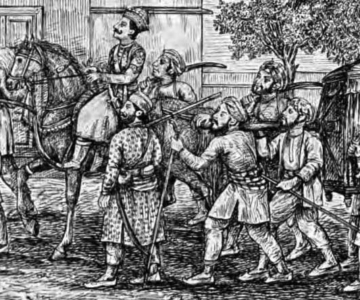
Story telling has been a primordial urge, never quite expressed in its fullest measure, but always lingering and floating like life. There was a sub-continent before the colonial interaction that brought in its wake an aesthetic hardened by the industrial revolution and its uniformity of life and space. This was a world rich with myriad identities, of whispers and tales all interlaced in a peculiarly complex kaleidoscope. Since the 19th century that particular aspect of folk story telling and transfer of generational accounts gave way to what is now known as education and knowledge - instruments and reflections of power and a linear world view set elsewhere but adapted awkwardly to the local context.
This is why Simorgh Women’s Resource and Publication Centre in Lahore, under the leadership of Neelum Hussain, have undertaken the challenging task of reclaiming the rich heritage that lies in our folklore especially that of the Punjab. “The Romance of Raja Rasalu and Other Tales” is a stunning compilation of the romance of Punjab’s legendary hero, Raja Rasalu and, while it draws heavily on the colonial storytellers, the book twists the narrative in a manner that brings us closer to the origins of our cultural sensibilities. The tales are sheer magic. The romance, the intrigue, the bravery and the integrated nature of human existence where it finds communication even with birds and trees comes to a full life throughout the narrative.
It is one thing to produce an admirable compendium but it is another matter to ensure that the purpose and spirit of the tales are adequately reflected in the illustrations. This particular touch of originality is provided by the eminent artist Laila Rehman whose breathtakingly attractive illustrations add a new layer of meaning and sensibility to the folk stories. It is, therefore, as has been rightly stated in the introduction, a book for pleasure: a pleasure that moves beyond the immediate and the momentary and merges into the real or imagined pleasure of living. Laila’s paintings and sketches are evocative enough to generate a parallel story within the larger narrative. It is as if the reader is traversing into several worlds. One minute
1May/086

Love Stories of the Risalo of Shah Latif – Noori Jam-Tamachee

Contribution by Naveed Siraj

The Risalo of Shah Latif is divided into chapters called Surs which are composed on the lines of musical notes. Each sur is based on symbols taken from stories which are part of Sindhi folklore. Sur Kamod in the Risalo of Shah Latif is based on the love story of Noori Jam-Tamachee:

Noori Jam-Tamachee

King Jam Tamachi was a Samo ruler of lower Sind at the end of the 14th century A.D. While on a shooting expedition, he chanced to see a fisher girl named Noori, falling madly in love with her and offered to married her, his love for her blind to the social disparity between them.

When they returned back to his capital, he was made aware of the general disapproval of this match. He merely observed that the detractors did not know her as much as he did. In order to display her character and appease the cynics, one day, he announced to his queens, that he would take one of them for a ride on an outing.