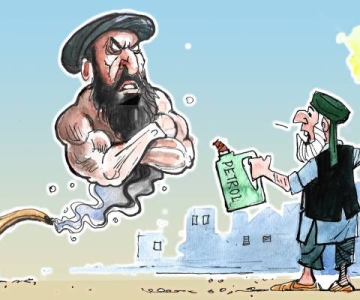
Killing Shias is not jihad – stop this carnage in Pakistan
The Speech of Mr. Sris Chandra Chattopadhya (Opposition to Objectives Resolution, Constitutent Assembly of Pak, 12 March 1949)
This is a historic speech and a document that posterity will re-examine. Seldom has one piece of legislation caused so much trepidation. Thanks to my firebrand friend Usman Qazi, I got to read this speech that I had heard about from many people. Here is the text of the address of Sris Chandra Chattopadhya (Opposition to Objectives Resolution, Constitutent Assembly of Pak, 12 March 1949).
Mr. Sris Chandra Chattopadhya (East Bengal : General) : Mr. President, I thought, after my colleague, Mr. Bhupendra Kumar Datta, had spoken on the two amendments on behalf of the Congress Party, I would not take any part in this discussion. He appealed, he reasoned and made the Congress position fully clear, but after I heard some of the speakers from the majority party, viz, Muslim League Party, the manner in which they had interpreted the Resolution, it became incumbent on me to take part in this discussion.
I have heard Dr. Malik and appreciate his standpoint. He says that "we got Pakistan for establishing a Muslim State, and the Muslims suffered for it and therefore it was not desireable that anybody should speak against it". I quite agree with him. He said; "If we establish a Muslim State and even if we become reactionaries, who are you to say anything against it?" That is a standpoint which I understand, but here there is some difficulty. We also, on this side, fought for the independence of the country. We worked for the independence of the entire country. When our erstwhile masters, Britishers, were practically in the mood of going away, the country was divided – one part became Pakistan and the other remained India. If in the Pakistan State there would have been only Muslims, the question would have been different. But there are some non-muslims also in Pakistan. When they wanted a division there was no talk of an exchange of population. If there was an exchange of population, there would have been an end of the matter, and Dr. Malik could establish his Pakistan in his own way and frame constitution accordingly. It is also true that the part of Pakistan in which Dr. Malik lives is denuded of non-Muslims. That is clear.
Dr. Omar Hayat Malik: On a point of order, Sir, I never said that. He has understood me quite wrongly.
Mr. Omar Hayat Malik: I never said that Pakistan was denuded of non-Muslims. My friend on the opposite has misunderstood me.
How instability is garnered
My latest analysis published by The News
We continue to bemoan the failure of democratic norms to take root in our governance culture. True, that the repeated extra-constitutional interventions and direct or indirect military rule have rendered democratic governance as a distant and seemingly unattainable goal. In addition, the emergence of non-state actors, sometimes more powerful than the state itself has also led to formidable and multiple centres of power. In such a milieu, achieving the sustainability of democratic process is a Herculean task. Whilst the intentions of our unelected state institutions and their overt and covert non-state partners are clear, the behaviour of the political elites is confounding.
Not unlike the past, the divisiveness of Pakistan’s political elites has entered into a decisive phase. Fissures are apparent in the post-2008 political accord that led to the unanimous election of the Prime Minister, Yousaf Raza Gilani. The first cleavage, now a recurrent pattern, has emerged in Sindh where the coalition partners — the Pakistan People’s Party (PPP) and the Muttahida Qaumi Movement (MQM) — are pitted against each other for political control of urban Sindh. The latest skirmish is rooted in the evolving arrangements for the local governments and who will end up controlling the third tier of government. However, there is an ethnic dimension to it as well. Karachi remains besieged by sectarian, provincial, and
linguistic ghosts that apparently are alive and kicking.
The second disruption in the political compact that led to a transition towards representative rule is unfolding in the shape of a brewing discord between the ruling PPP and the opposition Pakistan Muslim League (Nawaz). The PML-N rules the Punjab and thereby has a stake in the system and power matrix but it is also striving to maintain its ‘opposition’ status. This is why a dual strategy is evident where a few firebrand leaders of PML-N take a hard line against the federal government and the President Asif Ali Zardari. The party does not want to rock the system it says but also considers ‘options’ that lead to a mid-term election or even the premature exit of the President from the office in the wake of Supreme Court rulings on the National Reconciliation Ordinance.
To undo the vicious past
It's about time a civilian Pakistan functions as a peaceful country with fair share of resources put into people's welfare by Raza Rumi (published in the News on Sunday)
That Pakistan's endemic political instability is a function of its inherent power imbalances is well known. The continued spells of authoritarian rule have also retarded the growth of political parties and other necessary institutions essential for democratic governance. We are a country trapped in our history, our self-fulfilling conspiracies and intrigues that are also rooted in the various phases of colonial era. Our geo-political situation, celebrated by a rentier state, has not helped us either. From the 1950s we have been in close partnership with global powers that are viewed as the ultimate saviours of a dysfunctional polity.
In 1971, we lost half the country. While the seeds of discord in East Pakistan had been laid by West Pakistan's ruling elites, our vengeful neighbour took full advantage and supported the Bangladeshi liberation movement. By all accounts, this was an avoidable tragedy had the national security-obsessed state dominated by West Pakistani vested interests could have seen the writing on the wall and fixed the issues of federalism that still haunt us.
what is there to celebrate?
Today was a usual day despite the platitudes churned out by the media and the struggle to ‘celebrate’ something. Naeem Sadiq’s email was instructive as it said many things that I wanted to write today:
I decided not to celebrate the 14th August this year, to record my personal grief, shame and solidarity with the innocent citizens of Gojra, who were killed , wounded and burnt, for belonging to the same God, but a different religion. In my room I will fly the
My city, my trees
![]() |
|
|
The ‘Lahore bachao tehreek’ may be ‘too little, too late’ |
|
![]() |
|
|
Traffic snarls like this one are a common occurence in Lahore |
|
|
It is absolutely unacceptable that Lahore is the most polluted city of Pakistan. New data ... reveals that Lahore takes the cake when it comes to air pollution and the attendant dangers to public health |
|
My piece published in The Friday Times
Moaning about Lahore’s most elitist enclave, GOR-I, is a contentious undertaking. On the one hand, it was, until recently, the best of what the British left us – lovingly adorned with diverse species of trees, home to glorious specimens of ecologically-friendly architecture and an old-world-charm unparalleled for its simplicity and elegance. On the other hand, it was also a symbol of the extractive, Punjab-centric colonial state of the nineteenth century, lorded over by the agents of the Indian civil service.
But when one has lived in those sublime environs, not as the scion of a landed, aristocratic clan but rather as a member of a middle-class, professional family, what is one to do? GOR-I was a lonely plant of sorts amid the sprawl of Lahore, with trees, birds and orchards one would not have expected to find in an Asian mega-city. In the spring, we strolled amid the just-bloomed shrubs; in the summer, amaltas trees and shady, mythical jamuns greeted us at every corner. In winter, GOR-I was a misty, freezing locale, reminiscent of the little hill-stations nurtured by the British while they controlled the destiny of India.
We would often step out of the little lanes of GOR-I and walk all the way to Ferozsons bookshop on the Mall to browse through the new titles. This was an age when video games had not captured the energies of the young, when the internet had not even been dreamt of, and when the television, in those dark years of General Zia-ul-Haq, was a daily booster shot of boredom. This is not the case anymore, for by now one has already mourned the loss of Lahore to rampant and senseless greed, the vagaries of the land mafia and the absolute failure of the civic authorities. It is inconceivable now to walk anywhere along the Mall without inhaling toxic fumes, or worse, being hit by a speeding vehicle. Decay is all around us. Its foremost manifestation can be seen in the way the Lahori elites and residents have slowly poisoned their city.
Much could be said on the suicidal tendencies of the natives in general, for it is not with Lahore alone that we are concerned. Suicide is evident all over the place. From a young, brainwashed lad who blows himself up in search of paradise to a state that is its own worst enemy, our irrational behavior is simply mind-boggling. One had learned from dear Darwin that evolution was about the survival of the fittest. But the global destruction of the
Pakistani state: reform or perish
My op-ed for The NEWS
Raza Rumi
On the face of it, the Pakistani state with the clear endorsement of political parties and the majority of its citizenry is fighting a battle against militant Islamism. However, it is not as simple a formulation as it appears to be. The state is also cracking under extreme pressure for having lost its capacities and effectiveness a long time ago. The central tenet of state policy and implementation is adhocism that keeps a mammoth, oversized, under-paid and snail-paced elephant going. With Mughal and pre-industrial social structures reflecting in a colonial organisation, the Pakistani state is an unattended patient lying on an Elliotesque table, waiting for a surgery.
The fact that ragtag groups have the audacity to challenge the state and its mighty armed forces speaks a lot for where we stand today. That a relatively small number of bandits can wreak havoc and make us look like pariah country with nervous neighbours is by itself a parable of our times. Add to this the dysfunctional police that simply cannot discharge their functions let alone tackle the suicide missions launched by jihad laboratories. Services – health, education, water and justice – are abysmally delivered to the lucky ones who have access to them. Otherwise, it is pretty much a jungle out there. In a context where insecurity and lack of faith in the state pervades the body politique, the current war can accentuate the pressures on the state, leading to a near-collapse situation: assuming, rather charitably, that it still functions as an arbiter between citizen interest and the legitimate use of violence.
Brewing storms
Raza Rumi laments the tragedies of our times, and says that the state cannot be absolved of its responsibility to protect citizens against terrorism (The Friday Times)
Lahore has finally been encircled by the layers and tremors of violence. If the events of March 2009 were not enough, there is now a concerted effort to create panic in the city. In the past few weeks, girls’ schools have been threatened that they would face the music for educating girls and promoting co-education. How can children and their middle-class urban parents survive these gruelling times? (pic left:Pir Baba’s shrine is now closed to visitors )
Fighting terror
Today it is Chaand Bibi - the unfortunate victim in Swat and tomorrow it could be civilisation itself or whatever remains of it in the rest of the country.
The citizens of Lahore and the numerous groups will get together tomorrow to protest on the Mall Road. Similar rallies are being organised elsewhere most notably in Karachi by the People's Resistance group.
This is a chance for you to stand up and be counted against the forces of extremism and aggression who are hellbent on destroying our beloved city Lahore and the country. If we will not raise our voices then we are condemned to be victims of history.
Let us march on the Mall tomorrow, to counter darkness with peaceful protest with OUR STATE MUST FIGHT THE TERRORISTS
Date: Saturday, April 4, 2009
Time: 4:00pm - 5:00pm
Location: The High Court/GPO Chowk
Street: Mall Road
City/Town: Lahore, Pakistan
Lost Imaginations
By Raza Rumi
Sixty one years have gone by but the creation of Pakistan is still a heated debate: contested, fractured and bitter. That history has been the preserve of the victors and the powerful is well known. But to spin and whirl the truth to the extent that it becomes empty and farcical is an art form practiced by the Pakistani state and its mock-historians.
In early January of this new year, a heated controversy entered the public domain. A famous Urdu columnist writing for the largest vernacular newspaper reiterated the widely-known fact that the pragmatic Mr Jinnah had accepted the Cabinet Mission Plan and given up the demand for Pakistan in 1946. However, it was the
1971: the forgotten silence
The NEWS: Friday, December 19, 2008
by Raza Rumi
This week marks the 37th anniversary of the tragic events of 1971 that led to the dismemberment of Pakistan and creation of Bangladesh. This time the sixteenth day of that deadly December invited little attention in the mainstream media as the new Pakistan struggles to manage the multiple crises of statehood, governance and cohesion.
Whether we like it or not, history and its bitter truths have to be confronted. When the united Punjab was being ruled by the Unionists and the Congress and the NWFP had a chief minister from the congress-Khudai Khidmatgar alliance, and almost all the custodians of South Asian puritanical Islam were opposed to Pakistan, the peasantry and the intelligentsia of East Bengal were spearheading a movement for Pakistan. There were indeed economic reasons, but there was an unchallengeable mass support for and belief in Pakistan. What happened after 1947 is well known; and within two decades or so, those who wanted Pakistan in the first place were subjected to state excesses and brutal treatment by the groups and elites that had actually little commitment to Pakistan or its idea. Nothing could be more ironical.
It is of little significance to remember the exact chronology of events or to indulge in a blame-game. The truth is that we as a state and society lost our majority province after pushing its people into a situation where independence through a War of Liberation was the only choice. India, of course, played a huge role in transacting this deal, but the West Pakistani elites had prepared the ground, sown the seeds of mistrust to a great degree. Thus the Pakistan created by its founding members was no more in 1971, further subdividing the Muslims of the subcontinent. A bitter lesson of history was in the making. If only, we were capable of paying heed to it.
Policy shifts not war
Raza Rumi
The dastardly attacks in Mumbai have irritated the old wounds and replayed the familiar, jingoistic tunes across the Indo-Pak borders. The Pakistanis, clamouring for friendship with their larger and problematic neighbour, have condemned these attacks in no uncertain terms. Who could be a worse victim of terrorism than Pakistan in these extraordinary times? Yet, the Indian media and sections of its establishment are quick to involve ‘Pakistan’ as the key perpetrator of the terror regime. This has obviously angered some and allowed a few Cold-War practitioners to call for self-defence and fighting with India till the last. The truth is that much of Pakistan does not want war. Hopefully, the Indian citizens are also not looking at war as a solution, or so it seems.
It is almost a cliché to state that war is not a solution to the current imbroglio despite the hysterical calls by the Hindu right to ‘neutralise’ Pakistan. The saner elements in India have already pointed to the implicit and deep-seated issues of misgovernance, short-termism and the mess of Partition that were neither carefully deliberated nor rectified during all these decades. The non-state actors in both India and Pakistan have gained ascendancy due to the power distance of the Raj induced steel-frame structures of governance. If there are dozens of districts in India that operate beyond the writ of the formal state, there are areas in Pakistan that are not just outside the scope of the formal state but in a state of rebellion due to the war on terror.
Hazrat Ali’s letter on governance and citizenship
The common stories about Islam or Muslims have to do with the chopping of arms and killing of infidels. We are told that Muslims had a great empire, after many conquests and subjugation of the 'infidels'. And what have we learned in the textbooks: Ali (AS) was a brave general with a legendary sword? Have we heard this:
Do not close your eyes from glaring malpractice of officers, miscarriage of justice and misuse of rights, because you will be held responsible for the wrong thus done to others. In the near future, your wrong practices and maladministration will be exposed, and you will be held responsible and punished for the wrong done to the helpless and oppressed people.
Fahmida Riaz is Pakistan's premier female poet. She became a sensation in the early 1970s when her bold, feminist poetry created a stir in the convention ridden world of Urdu poetry. Riaz was expressive, sometimes explicit, and politically charged. She created a completely new genre in Urdu poetry with a post-modern sensibility. Later, she remained prominent with her defiance of General Zia's martial law, her exile to India and the continuous evolution of her fiction and poetry.
Since the late 1990s, Fahmida Riaz has discovered Jalaluddin Rumi, the 12th century Turkish poet and jurist, and now an international celebrity. Her recent publication “ Yeh Khana-e aab-o-gil" is a unique translation of Rumi's ghazals in the same rhyme and meter. Since her navigation of the Rumi universe, she has explored another dimension of her individual and cultural consciousness, where the influence of Islamic scholars and Sufis is paramount.
Last winter, she read a letter by Hazrat Ali bin Abi Talib (AS), the fourth Caliph and son-in-law of the Prophet Mohammed (PBUH), while browsing a translation of Nahaj ul Balagha (a collection of sermons, letters and sayings of the Caliph). Later, in an email, she related to her friends across the globe how angry she felt for not knowing about this letter all her life, and how the real jewels of Muslim history were concealed generation after generation.
At the time she was preparing for a Conference at Heidelberg, Germany. Lo and behold, she made a dramatic speech about Ali's (AS) letter at the international moot. Thereafter she showed the text of the letter to Dr Patricia Sharpe, a US-based writer who was impressed by it and immediately paraphrased and uploaded it to on her website under the title Good Governance Early Muslim Style.
Ali (AS) had written a comprehensive letter articulating principles of public policy for the guidance of the newly appointed Governor to Egypt, Maalik al Ashtar. In this fascinating directive, Ali (AS) advises the new governor that his administration will succeed only if he governs with concern for justice, equity, probity and the prosperity of all. There is a timeless applicability of this famous letter. Selected passages from the text are reproduced below:
Religious tolerance: Amongst your subjects there are two kinds of people: those who have the same religion as you [and] are brothers to you, and those who have religions other than yours, [who] are human beings like you. Men of either category suffer from the same weaknesses and disabilities that human beings are inclined to; they commit sins, indulge in vices either intentionally or foolishly and unintentionally without realising the enormity of their deeds. Let your mercy and compassion come to their rescue and help in the same way and to the same extent that you expect Allah to show mercy and forgiveness to you .