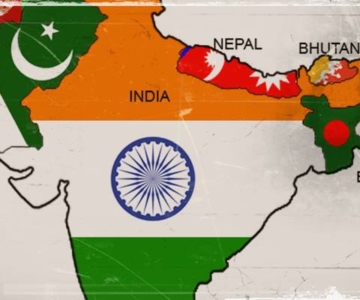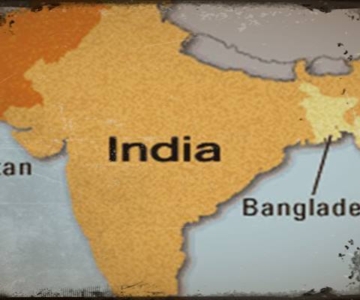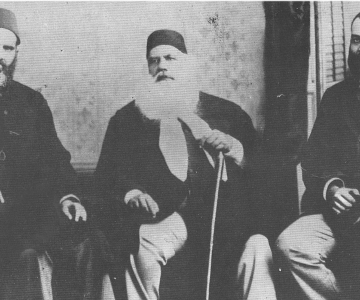
As I have elaborated before, the Asiatic Mode of Production (AMP) in India is based on the caste system. The caste system in turn is based on the confinement of a particular people to a particular occupation. This requires the intense control of women’s sexuality because if castes are allowed to intermarry, it will destroy the entire caste division of labour of that society. Thus, the fundamental basis for the maintenance of the caste system is through ensuring endogamy, that is, marrying within your own caste/biraderi.
Rickshaw and truck poetry from Pakistan
Rail to link Dhaka, Delhi, Lahore?
Qurratulain Hyder – it is as if she were an oracle
It is not a coincidence that Qurratulain Hyder, grand dame of Urdu literature, is remembered whenever we are faced with crises of state and society. Hyder was not just a fiction writer but a chronicler, for her sense of history remains unparalleled in the annals of South Asian vernacular literature. Her magnum opus “Aag Ka Darya” (AKD) was written and published in the highly contested milieu of the post-partition Indian subcontinent, when the new nation states were re-writing their historical discourses. In Pakistan, AKD was a sensation right from the time when it was published in the late 1950s. The controversy it created remains pertinent despite the passage of five decades.
Hyder’s nuanced and highly sophisticated vision was not easily apparent to officialdom or to state-sponsored literary critics in Pakistan.
the new e-conflict zone for Indian, Pak netizens?
Times of India has quotes my post on Varun Gandhi today. Well, I know media-wallas have to find stories and sell. It was good to see my name in a prestigious paper but the intent ascribed was not too flattering. I believe in peace and reconciliation between India and Pakistan as the only way forward for South Asia. And, I will condemn extremism wherever it raises its ugly head - in India, in Pakistan and elsewhere.
What is good is that at least we - the citizens/bloggers - are being heard. (RR)
Elections, the new e-conflict zone for Indian, Pak netizens (PTI - in TOI today)
NEW DELHI: It's a virtual war in the cyber space. As the election scene hots up in the country, netizens especially in Pakistan are watching the scene keenly and letting out their views on all issues ranging from elections, candidates to Varun Gandhi and his controversial speeches.
Contemporary Pakistani literature in the ‘age of terror’
I am posting the synopsis of my paper entitled Silhouetted Silences - contemporary Pakistani literature in the ‘age of terror’, that I presented at the SAARC writers' festival held in Agra, India (March 13-17, 2009). The full paper needs to be edited and referenced so that will posted a little later.
Round my neck,
from time to time, there was the hallucination
of a noose, and now and then, the weight
of chains binding my feet.
Then one fine day
love came to drag me, bound and manacled,
into the same cavalcade as the others (Faiz)
Since the invasion of Afghanistan by the United States and the global hysteria about ‘terror’ and ‘terrorism’, Pakistan has faced the greatest of existential challenges after its dismemberment in 1971. As a frontline ally of the US in the war on terror, Pakistani society and polity have been engulfed by growing militancy and acts of violence commonly branded as terrorism. Whilst there is no single definition of ‘terrorism’, the mainstream media and policymakers – in the service of imperial rhetoric aimed to justify and perpetuate the occupations of Afghanistan and Iraq – have established terrorism as the major threat to domestic and regional peace in South Asia. Acts of premeditated and organised violence in India, Pakistan and Bangladesh have thus assumed a central place in discourse on regional cooperation or its converse: the rivalries between the constructed nation states and their irresponsible power-elites.
In this milieu, the South Asian citizens have been the victims of violence, uncertainty and acrimonies that have only led to exacerbation of poverty, inequality, ascendancy of militarism and war-mantra. All of this is taking place when globalization is relentlessly seeping into domestic economies, cultures and social systems. Where does this leave the writers and poets of the region who grapple with the complex, confusing and fast changing social and political realities? Whilst the community of South Asian writers – traditionally the forbearers of intellectual and political movements – is beleaguered by corporate media industry, it has struggled to respond to challenges that events have created.
In Agra – attending the SAARC writers’ moot
Finally managed to reach Agra to attend the SAARC Literature festival organised by the inimitable Ajeet Caur. It is a lovely event with people from all over the region bemoaning what has happened to the region when it should be taking off.
The news from Pakistan are disturbing to say the least and the headlines here are not all that flattering. Alas, we are in a tight corner once again.
As part of my paper entitled Silhouetted Silences - contemporary Pakistani literature in the ‘age of terror’. While I am still refining my paper, here is an excerpt:
The current political and social milieu has created deep contradictions for the writers and the poets of contemporary Pakistan. If on the one hand they are bruised by the widespread violence and desecration of humanity, on the other they are equally aware of the public mood on the way imperial powers are playing another great game in their neighbourhood. This is what makes the task of the poets and writers extremely difficult.
I quoted this powerful poem called A Mourning poem for Bajaur by Pakistan’s eminent poet Kishwar Naheed here:
Coffins have become so numerous
That the city is shrinking
The eye is oozing
And not even a word of association
Like an open wound
On the lips.
The sky looks over everything
And remains silent.
Why does it go on believing
That mankind will awake once again
From its deep slumber
And laughter will ring again
On the threshold of houses.
No, it was not yesterday
But many years ago,
We held hope with our hands
We sat in the shadow of wide-awake walls
And used to think:
Yellow-gold wheat smiles and laughs
In our court-yards
We have the same court-yards, the same threshers
But bullets jump through them,
Riddle holes in my fields
and in the bodies of my children
With my tear-soaked pillow
I sit in the court-yard, watching
Coffins have become so numerous
That the city is shrinking.
Translated by Asif Farrukhi
More later....
Capitulating Rajas: why Taliban might not be resisted

My new piece for The Friday Times
South Asian history is a tale of capitulation of local elites before external invaders. Be it the Aryans, the Mongols or East India Company officials, we have always relented, and sometimes quite painlessly. This is an area of history that remains less explored as it conflicts with the grand narratives of ‘resistance’ and nationalist myths we love to construct.
A phrase locked into our cultural memory – Hunooz Dilli Door Ast (Delhi is as yet far away) explains this historical pattern. It has become a metaphor for the insularity of the elites and the powerlessness of the common people. The complacency that Delhi, the capital of the Islamic empire was not accessible to the hordes of invaders, was the tragic reaction by debauched kings, local Rajas and their henchmen who were either men of straw or active collaborators.
Patriarchy and Caste System
found this excellent piece at Virodhi's blog on caste, casteism and love authored by Taimur Rahman
Revisiting the concept of Jihad in Islam
By Maulana Wahiduddin Khan
(Translated from Urdu by Yoginder Sikand)*
The word 'jihad' is derived from the root juhd, which means 'to strive' or 'to struggle'. It denotes the exertion of oneself to the utmost, to the limits of one's capacity, in some activity or for some purpose. This is how the word is understood in Arabic grammar.
Because fighting against one's enemies is also one form of this exertion or striving, it is also sometimes referred as jihad. However, the actual Arabic word for this is qital, not jihad. Fighting with one's enemies is something that might happen only occasionally or exceptionally. However, jihad, properly understood, is a continuous action or process that animates every day and night of the life of the true believer. Such a person does not let any hurdle affect his life, including desire for gain, the pressure of customs, the demands of pragmatism, lust for wealth, etc.. All these things serve as hurdles in the path of doing good deeds. Overcoming these hurdles and yet abiding by the commandments of God is the true jihad, and this is the essential meaning of the concept of jihad. There are many references to jihad, as understood in this way, in the collections of sayings attributed to the Prophet Muhammad.
Pseudo-Messianic Movements in Contemporary Muslim South Asia
This new book by Yoginder Sikand has been published by Global Media Publications in 2008.
Messianic hopes and expectations are common to almost all religions. Jews expect the Messiah to arrive to re-establish their temple in Jerusalem; Christians pray for Jesus to return to earth in his 'Second Coming'; Hindus believe that Kalki, the tenth and last avatar of Vishnu, would appear just before the end of times; and the advent of the Imam Mahdi, who will usher in the end of the world, is a cardinal tent of the faith of Shia and many Sunni Muslims.
The messianic figure that almost all religions expect to arrive some time towards the end of the world is generally portrayed as representing the forces of good, as an agent of God and as eventually vanquishing, in a war of global and cosmic proportions, the forces of evil.
Beyond Borders – with Shubha Mudgal and Tina Sani
My article published in the Friday Times (Aug11-18)
Days after the recent skirmishes at the Line of Control, when the composite dialogue between India and Pakistan was threatened, an alternative reconciliation was underway in Lahore. Music became the metaphor of shared ground between the two countries, challenging divides between them that can become violent.
Lahore hosted the legendary vocalist Shubha Mudgal for a few days. The crusade launched by Beyond Borders Television, a production house and sister company of The Friday Times and Good Times, is a unique development in Pakistan's media world. It is Beyond Borders' mission statement to produce programming for regional channels that promotes understanding between peoples. Undaunted by visa restrictions and overcoming official barriers, Beyond Borders organised Mudgal's visit to Lahore to record a tripartite discussion between Mudgal, Tina Sani and Jugnu Moshin, the compere.
The night before the recording, there was a get-together at the home of Jugnu Mohsin and Najam Sethi. It was a typical July evening, marked by the promising stillness of the monsoon. The fragrance of tuberoses, motia and lillies had made the atmosphere surreal and when the power breakdown happened, and candles were lit, it was like a slice out of some previous age.
Delhi by the book
Writing about the textbook enemy, the 'other', is but a daunting task. Facing the grandiose Humayun's tomb on a chilly January morning this year, I decided to write a book on Delhi.
It was not before I had visited the ancient city that I knew what it symbolised. In Pakistan, we were influenced by the glories of Lahore, my beloved city. Reconstructed histories had kept Delhi invisible. The seat of the Sultans, Mughals and the Raj, precursor of the modern united In
dia and originator of the Indo-Islamic civilization was a mere phantom, best ignored.
Over several visits to Delhi, I realised that invisibility was also a shared curse. A good number of Delhi wallahs I met, had no clue where they lived or crossed the streets. Erasure, blank spaces in textbooks had rendered their own city a mythical other-world existing only in erudite books, rare cultural soirees and among the fading memories of old-Delhi.
When I looked for the house where Urdu's legendary poet Mir Taqi Mir lived, no one knows it. Those living in Hauz Khas are unaware of what it was. There are thousands, perhaps more, who have never visited Nizamuddin Bastee let alone the dargah there. Tracing history through books resembles a two-dimensional vision. Lived histories add other dimensions to the inner kaleid
oscope. But there are so few who can help me.
I am pained when I am taken to the tomb of India's first female ruler Razia Sultana (1236 - 1240). Only centuries later another woman Indira Gandhi was to rule the Centre. Razia's grave languishes on an abandoned, filthy cul-de-sac. Many don't care. I wonder, should I?
As I have ventured out to write, the enormity of Delhi -- the idea -- haunts me. Where do I start? The layered construction of Indian, and Muslim identities in the subcontinent emanate from the ridges and Hades of Delhi. The saints buried under
The pursuit of the Southasian past
Moving beyond the colonial-era understanding of the history of the Subcontinent gives us a whole new way of looking at the Subcontinent’s past. This now includes not just the usual explorations of politics and economy, but also of social, cultural and religious issues – as well as the writing of history in the first place.
By : Romila Thapar (courtesy Himal Magazine, July issue)
Sixty years ago, at the time of Indian Independence, we in the region inherited a history of the Subcontinent shaped by two substantial views of the past: the colonial and the nationalist. Both were primarily concerned with chronology and with sequential narratives. The focus was on those in power, a focus that has been basic to much of the writing of history. There was information on the action of kings and dynasties, on governors-general and viceroys, and on various national leaders. On these, there was broad agreement. What was contested, although only partially, was the colonial representation of early Indian society. The colonial view was a departure from earlier Indian historical traditions, and drew on European preconceptions of Indian history. The use of history to legitimise power had changed from the rule of dynasties to colonial and nationalist definitions of power.
SURVEY: South Asian countries not too happy, survey finds
SAJA Forum has this interesting post:
Bangladesh, India and Pakistan ranked 64th, 68th and 81st in the latest World Values Survey published by the United States National Science Foundation which surveyed people from 97 countries to discover who is happiest.
Denmark became the happiest country with a 4.24 mean score. The United States ranked 16th with a 3.55.
Bangladesh scored 1, India scored 0.85 and Pakistan scored -0.30, a negative score which indicated "predominantly unhappy or dissatisfied publics."
Click here to see the full list(PDF version). Watch political scientist Ronald Inglehart talk about how economic growth, democratization and social tolerance lead to happiness.
Also, I should mention how Bhutan's Gross National Happiness Commission, which was the subject of a WSJ article this past March, is making an attempt to gauge its citizens' happiness and boost their morale as the country heads towards a new direction.
Ghalib’s grave – treasury of meanings is under the ground

The inscription on Ghalib's tomb-stone in Arabic and Persian followed by translation:
a hai'yii ya qaiyuum
rashk-e-'Urfi va faKhr-e-Talib murd Asadullah Khan Ghalib murd
kal maiN Gham-o-andoh meN baa khaatir-e-maHzuuN
tha turbat-e-ustaad pe baiTha hua Ghamnaak
dekha jo mujhe fikr meN taareeKh ke, Majruuh
haatif ne kahaa *ganj-e-ma'ani hai tah-e-Khaak*
the qita (composed four verses) is by Mir Mahdi Majruuh; the phrase contains the chronogram of 1285 AH
---
The Alive, The Eternal [these are two of the names of Allah]
the envy of Urfi and the pride of Talib has died, Asadullah Khan Ghalib has died
[Urfi and Talib were Persian-Indian poets]
yesterday in sadness and mourning, grief-afflicted too
I sat by the Master's grave with sorrow profound
seeing me thinking of a tareeKh, Majruuh [taareeKh = chronogram]
a heavenly voice said, "treasury of meanings is under the ground"
Vandana Shiva on Farmer Suicides….
Indian farmers have never committed suicide on a large scale. It's something totally new. It's linked to the last decade of globalization, trade liberalization under a corporate-driven economy. The seed sector was liberalized to allow corporations like Cargill and Monsanto to sell unregulated, untested seed. They began with hybrids, which can't be saved, and moved on to genetically engineered Bt cotton. The cotton belt is where the suicides are taking place on a very, very large scale. It is the suicide belt of India.
And the high cost of seed is linked to high cost of chemicals, because these seeds need chemicals. In addition, these costly seeds need to be bought every year, because their very design is to make seeds nonrenewable, seed that isn't renewable by its very nature, but whether it's through patenting systems, intellectual property rights or technologically through hybridization, nonrenewable seed is being sold to farmers so they must buy every year.
More here
Pakistan’s rich dissident literary tradition
Himal Magazine had published this article on the resistance poetry in Pakistan. I had uploaded it on the Pak Tea House some time back. However, I just realised that it should be published here as well..
The long spells of authoritarian rule in Pakistan have nurtured a rich dissident literary tradition. This tradition has its roots in the Progressive Writers' Movement, which originated in colonial India with major Urdu poets and writers as its vanguards. Faiz Ahmed Faiz was, of course, the best-known torchbearer of this tradition, while other luminaries included Sajjad Zaheer, M D Taseer, Rashid Jahan, Kaifi Azmi, Ismat Chughtai, Sahir Ludhianvi and Ahmed Nadeem Qasmi, to name only a few.
With the post-Independence Pakistani state continuing the old-style approach to ruling over the masses, the progressive movement too carried on its dissent long after 1947. Those who had migrated to Pakistan faced a new reality, which, in the words of Faiz, was far from the dawn for which they had hoped. "This blemished light, this dawn by night half-devoured," Faiz wrote ruefully. "surely not the dawn for which we were waiting."
Sufi Qawwali – Mehr Ali and Sher Ali
Sadi has written a wonderful post here - I am cross posting it here.
Couple of nights back (24, April, 08) came an unanticipated opportunity to watch and listen to two of great contemporary pakistani sufi Qawwali singers at famous UCLA Royce Hall. The concert was titled, Qawwali Music of Pakistan: Sufi devotional music.Among the audience was both americans and sub-continental audience. What was striking, is Qawwali's ability to transcend language with its sheer power and captivating devotion. The nature of improvisation makes each Qawwali, even if its sung by the same group of singers, very unique and every new listening is a new experience.Sometime the depth of the verses, fused with the presentation takes audience to an otherly high which was felt last night too. At times there were goosebumps and surges with the strong emotion that is created in Qawwali performance. The Sufi Qawwalis are considered as zikr or Divine remembrance if listened with spiritual understanding and depth.:: What is Sufi Qawwali? | Qawwali is derived from the Arabic word qaul, literally meaning "saying" but has taken on the meaning of "belief"or "credo" in South Asian languages. Qawwali is spiritual in essence; it is the devotional music of the Sufis to attain trance and mystical experience - originating in the 10th century and blossoming into its present form from the 13th century onwards.
Sahir Ludhianvi’s Taj Mahal
Sahir Ludhianvi's immortal poem Taj Mahal has always fascinated me. It takes a most unconventional take at this beautiful monument where the poet protests at the choice of a romantic rendezvous.
Today, I found a lovely translation of this poem. I am reproducing it below - but first a few lines from Urdu:
Yeh chaman zar yeh jamna ka kinara yeh mahal
Yeh munaqqash dar-o-deevar yeh mehrab yeh taaq
Aik shahanshah nay daulat ka sahara lay ker
Hum ghareebon kee mohabbat ka uraya hai mazaaq
Taj Mahal
The Taj, mayhap, to you may seem, a mark of love supreme
You may hold this beauteous vale in great esteem;
Yet, my love, meet me hence at some other place!
How odd for the poor folk to frequent royal resorts;
'Tis strange that the amorous souls should tread the regal paths
Trodden once by mighty kings and their proud consorts.
Behind the facade of love my dear, you had better seen,
The marks of imperial might that herein lie screen
You who take delight in tombs of kings deceased,
Should have seen the hutments dark where you and I did wean.
Countless men in this world must have loved and gone,
Who would say their loves weren't truthful or strong?
But in the name of their loves, no memorial is raised
For they too, like you and me, belonged to the common throng.
These structures and sepulchres, these ramparts and forts,
These relics of the mighty dead are, in fact, no more
Than the cancerous tumours on the face of earth,
Fattened on our ancestor's very blood and bones.
They too must have loved, my love, whose hands had made,
This marble monument, nicely chiselled and shaped
But their dear ones lived and died, unhonoured, unknown,
None burnt even a taper on their lowly graves.
This bank of Jamuna, this edifice, these groves and lawns,
These carved walls and doors, arches and alcoves,
An emperor on the strength of wealth, Has played with us a cruel joke.
Meet me hence, my love, at some other place.
Translation by K.C. Kanda, appeared in Masterpieces of Urdu Nazm published by Sterling Publishers Pvt. Ltd. - found here
The tributes continue – remembering Qurratalain Hyder
The literati in India and Pakistan are grappling with the larger question of Qurratulain Hyder's stature in Urdu, and some would say, World literature. The Daily Times, Pakistan has published an appropriately titled editorial, Quratulain Hyder, Urdu's greatest novelist. This paragraph struck me:
...her view of culture was intensely pluralistic, explaining Muslim culture too in a transmigratory technique in her big novel Aag Ka Darya. The Pakistani public paid her a back-handed compliment by making her books bestsellers in Pakistan; but most of them were pirated, meaning that someone other than her got rich selling them. She was always a chronicler, a kind of Tolstoy in Urdu that our critics have ignored. When someone asked her in Bombay to write about the Iran-Iraq war she naturally began with the Arab conquest at Qadissiya.
Outlook India had to say this:
Only a few days back, to mark the 60 years of Independence, when we asked an eminent jury to pick out 60 Great Indians in 60 years of our Republic, the name of Qurratulain Hyder was introduced prominently as Urdu's Marquez."Through her novels and short stories, this prolific writer gave Urdu fiction a brave and endlessly inventive new voice," we wrote, and quoted the London Times: "Her magnum opus, Aag Ka Darya (River of Fire), is to Urdu fiction what A Hundred Years of Solitude is to Hispanic literature
In C M Naim's piece, published in the Outlook:
What counts, for her, is the human spirit and the relationships it generates and nurtures. That is where the linearity of time seems to curve into a spiral, urging us to recognize a past that never quite disappears.....What, then, is our choice as individuals? Here it may be worthwhile to recall the characteristically modest, even self-mocking, remarks that Hyder made in 1991 in her acceptance speech at the Jnanpith Award function: "My concern for civililzational values about which I continue writing may sound naive, wooly-headed and simplistic. But then, perhaps, I am like that little bird which foolishly puts up its claws, hoping that it will stop the sky from falling."
and he concludes with this superb analysis:
...what Hyder tacitly offers us is nothing but that wise Candidean response: even in the best of all possible worlds, it is best not to neglect to tend our garden. Certainly, through the several thousand pages of her writings, she has shown herself to be an eloquent witness to that truth.
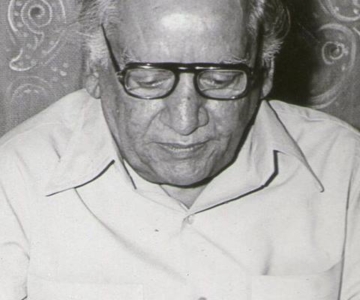
(photo left- Gauri Gill 2005) The Indian Prime Minister Manmohan Singh also expressed the sense of loss: "..In her unfortunate passing away the country especially Urdu literature has lost a towering literary figure. She will be truly missed in literary circles in the country.'
Read Jawed Naqvi's piece in the DAWN; and reactions of various writers in the daily NEWS . Rediff has published an article entitled, She was one of a Kind. Javed Akhtar, the eminent Indian lyricist has paid this grand tribute and held that she was a true genius and rightly said that he felt sorry for those people who read fiction but had not read Hyder:
"When I say that it is a great loss, it's not only to Urdu literature, not only to Indian literature, but to the word literature. I am not exaggerating at all.. the years to come, Haider's novels will reach everywhere."
"The kind of work she has done... its only because she was born in a third world country and wrote in a language that is not of the imperialistic powers, her novels have not reached everywhere. I am sure the time will come when they will reach..".
The blogosphere is also remembering Ainee Apa with great respect. Desicritics published An Enigmatic Icon, Adnan wrote a lovely piece on Ainee Apa and her books entitled A legend passes away and 3 Quarks Daily also remembered her. Urdu India has a brilliant post here and another tribute can be found here. Pakistaniat carried my post - click here to see the comments. And the best was from Delhi Walla, who went to the Jamia graveyard and took some great photos.
This will continue given the sad traditions of our literature - the literary and civilizational merits of authors and poets have often been discovered after they left this world. Having said that Ainee had established herself given her powerful voice and unique style of writing. But her real stature as Javed Akhtar says is yet to be discovered.
About the photo (top left): Gauri Gill in the Outlook writes:
Qurratulain Hyder was first photographed by Prashant Panjiar in what was a coup of sorts, everyone talked of how elusive and difficult she could be. When I met her last week to persuade her, she said, 'Tell the magazine I'm a difficult woman.' I told her that was her reputation anyway. For the first time that afternoon she cracked a grin. She seemed flattered.
Abida Parveen sings Bulleh Shah’s teray ishq nachaya..
As I recited Bulleh Shah's poetry this evening, a friend sent a link to another video of Abida Parveen singing Bulleh's mystic poetry in her inimitable style. Lo and behold, I also found an online translation of the verse:
Here is a translation of the verse rendered in this video:
O Physician, come back! my life is ebbing away.
Compelled by love, I dance, I dance.
This love has set up camp inside me.
It is I, who filled the cup with this poison and drank it.
Come back right away, else, I will surely die.
Compelled by love, I dance, I dance.
The sun has set, its glow remains.
Grant me a sight of you again! I would die for it!
What a mistake I made, not going with you.
Compelled by love I dance, I dance.
Mother do not bar me from this love.
Whoever turns back unloaded boats that have left?
How foolish I was, not going with the boatman.
Compelled by love I dance, I dance.
Peacocks sing in the groves of love.
My beautiful beloved is my Ka'ba, my Qibla.
He injured me, then turned away.
Compelled by love I dance, I dance.
Bullhe Shah, I sit at Inayat's door,
He clothed me in robes of green and red.
When I stamped my heel, I found him.
Compelled by love I dance, I dance.
(and now the video).
Here is the source of translation
For another version of Punjabi and English, please click here.
Only a few days back, to mark the 60 years of Independence, when we asked an eminent jury to pick out 60 Great Indians in 60 years of our Republic, the name of Qurratulain Hyder was introduced prominently as Urdu's Marquez."Through her novels and short stories, this prolific writer gave Urdu fiction a brave and endlessly inventive new voice," we wrote, and quoted the London Times: "Her magnum opus, Aag Ka Darya (River of Fire), is to Urdu fiction what A Hundred Years of Solitude is to Hispanic literature