Jahane Rumi In search of the unsearchable: O, my soul! where would you find your house?

7Apr/090

Whatever shrine I go to

Another readable piece by Dr Sher Zaman Taizi

This poem in ghazal form is very simple and direct. It starts with a direct address to God and gradually moves on to ethical values, human needs and human nature. I will try to transliterate the original Pushto verses into English with the hope that readers will be able to appreciate its meaning.

Not for a single moment, am I indifferent to You! Not indifferent to Your invocation and reflection! Whatever shrine I go to, I have You in mind!

I am not interested in any pilgrimage to mosque or temple!

29Mar/090

Shah Hussain, Madhu Lal and the festival of lights

Lahore is celebrating Mela Chiraghan - the death anniversary of the elusive saint Shah Hussain who is also known as Madhu Lal Shah for his life long association with a Hindu disciple called Madhu Lal. Each year in spring the festival of lights is attended by thousands of people.

Lighting of lamps is a metaphor for killing the inner darkness that we live with. By invoking spiritual light through love and self-knowledge, we can overcome ourselves and attain the mystical state of union with the beloved.

Madhu Lal's syncretic shrine represents the long-gone era of spirituality rising above religious identities and rituals. Here is a kaafi poem with translation on this blog. A few lines :

They alone know what is love and longing,
Who have it in their lives.
Like digging a well in dry land,
With no cart to carry away the sand.

28Mar/091

Nightingale of Peshawar falls silent

My piece published in The Friday Times

The bombing of Rehman Baba’s shrine is more proof that we are slipping, inch by inch, into an abyss. It is as if the soul of Peshawar, and by extension that of the whole of Pakistan has been scarred by those barbaric bombs and grenades. Among other ironies of the situation, this one stands out: the late Baba was instrumental in disseminating the message of Islam in the Khyber valley and beyond. And today the zealots destroy his shrine for being un-Islamic! A poet of love and tolerance, of amity and forgiveness to be treated in this manner displays how brutal we have become as a society and how fissured our state is. Otherwise a successor of a mighty steel frame, the indigenised state has surely given up to the hordes that are now hell bent on destroying Pakistan.


Rahman Baba was born in 1632 A.D. at Bahadur Kala, a village close to Peshawar. The Pashtuns hold his work in high esteem and his rank in Pashto poetry matches that of Hafiz Shirazi in Persian literature. The simple, down to earth and universal messages of his poetry have been revered by the Pashtuns as well as many adherents of the Sufi creed in South Asia and elsewhere.

In Afghanistan too, Rehman Baba was an icon and his muse was referred to as the ‘heart-beat’ of every Afghan. A friend told me how Saidu Baba, the famed saint of the now destroyed Swat valley, remarked that if the Pashtuns were to pray from a book other than the Holy Quran it would definitely be Rahman Baba’s work. But nothing describes Baba better than what Janes Enveldson had named him: the “Nightingale of Peshawar.” Alas, nightingales do not sing in gardens that have been ruined by long, harsh winters or other cataclysms such as hatred and violence.

7Mar/0910

“Desecration of Rahman Baba’s tomb is desecration of humanity”

The SCN press release echoes my sentiments at the disgusting act of vandalism in Peshawar. It is a befitting metaphor for the barbaric bigotry and the ineffectual state - a dangerous mix.

It is a matter of national shame for Pakistan to have sunk this low. Rahman Baba (1653 -1711 AD) commands a universal following for his mystic syncretism, has now fallen prey to the cannibalistic doctrine of bigotry and intolerance.

15Feb/097

Data Ganj Baksh: Lahore’s oldest guide

Perhaps the greatest of the experiences at Data Darbar is to find oneself connected to a stream of humanity, shoulder to shoulder, with a shared sense of spirituality that cuts across ethnicity, sect, ritual and even religion at times. Despite the mayhem, the serenity of the place is soothing

Raza Rumi
Last week, accompanying a visitor from the Mecca of Sufis, Delhi, I reconnected with the Data Darbar or the royal pavilion of the great saint of Lahore, Ali bin Usman Al Hajveri. This shrine is the oldest and perhaps the most vibrant cultural marker of the past one millennium in Lahore. The title of Ganj Bakhsh was bestowed by the saint of the saints Khwaja Moin ud din Chishti of Ajmere, whose ascendancy in the Chishtia Sufi order is recognised by all and sundry. Pilgrimage to Ajmere by itself is a matter of spiritual attainment for the majority of Muslims in the subcontinent. It is not difficult to imagine then what the stature of Lahore’s Data Darbar is in this esoteric yet real and lived Islam in South Asia. While Khwaja Moin ud din Chishti honoured the Lahori saint with the title “bestower of treasure,” ordinary folk on Lahore’s streets were more direct by naming the saint as Data, the one who facilitates the fulfilment of aspirations.

Living nearly 11 centuries ago, Syed Ali bin Usman Al Hajveri was not a Lahori but a resident of Lahore’s cultural step-cousin, Ghazni, until he arrived in India and wandered in northern India before settling in Lahore for the last 34 years of his life. This was the time when mystics from Central Asia, in their constant urge to discover new vistas of spiritual exploration, started to travel and settle in different parts of the Indian subcontinent. It remains a mystery as to why Data Ganj Bakhsh would have chosen Lahore as the final stop in his life long journey. Perhaps the secular interpretation could be that Lahore was an inevitable stop over for all the Central Asian and Turkic caravans and armies and provided the right kind of environment for a foreign mystic to amalgamate into. A little before Ganj Bakhsh’s arrival, Lahore had been resurrected from the earlier ravages of time by the Ghaznavid ruler Mahmood and his son Masood.

1Dec/081

Lahore’s oldest guide

My piece published in the Friday Times

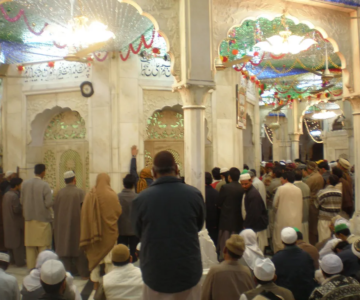
The interior of Data Darbar

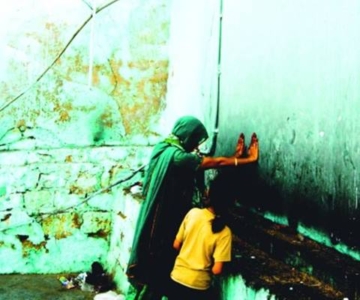
The grave of the saint

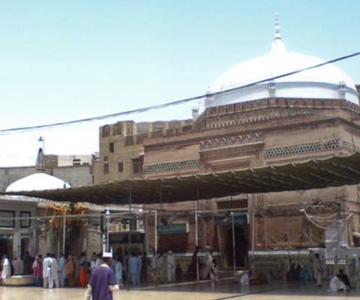
Outside the shrine,

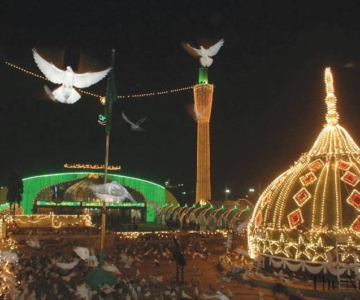
The shrine at night

Perhaps the greatest of the experiences at Data Darbar is to find oneself connected to a stream of humanity, shoulder to shoulder, with a shared sense of spirituality that cuts across ethnicity, sect, ritual and even religion at times. Despite the mayhem, the serenity of the place is soothing

"To traverse distance is child's play: henceforth pay visits by means of thought; it is not worth while to visit any person, and there is no virtue in bodily presence"

Last week, accompanying a visitor from the Mecca of Sufis, Delhi, I reconnected with the Data Darbar or the royal pavilion of the great saint of Lahore, Ali bin Usman Al Hajveri. This shrine is the oldest and perhaps the most vibrant cultural marker of the past one millennium in Lahore. The title of Ganj Bakhsh was bestowed by the saint of the saints Khwaja Moin ud din Chishti of Ajmere, whose ascendancy in the Chishtia Sufi order is recognised by all and sundry. Pilgrimage to Ajmere by itself is a matter of spiritual attainment for the majority of Muslims in the subcontinent. It is not difficult to imagine then what the stature of Lahore's Data Darbar is in this esoteric yet real and lived Islam in South Asia. While Khwaja Moin ud din Chishti honoured the Lahori saint with the title "bestower of treasure," ordinary folk on Lahore's streets were more direct by naming the saint as Data, the one who facilitates the fulfilment of aspirations.

Living nearly 11 centuries ago, Syed Ali bin Usman Al Hajveri was not a Lahori but a resident of Lahore's cultural step-cousin, Ghazni, until he arrived in India and wandered in northern India before settling in Lahore for the last 34 years of his life. This was the time when mystics from Central Asia, in their constant urge to discover new vistas of spiritual exploration, started to travel and settle in different parts of the Indian subcontinent. It remains a mystery as to why Data Ganj Bakhsh would have chosen Lahore as the final stop in his life long journey. Perhaps the secular interpretation could be that Lahore was an inevitable stop over for all the Central Asian and Turkic caravans and armies and provided the right kind of environment for a foreign mystic to amalgamate into. A little before Ganj Bakhsh's arrival, Lahore had been resurrected from the earlier ravages of time by the Ghaznavid ruler Mahmood and his son Masood.

Lahore's fame had also spread deep into the rugged, mountainous climes of Central Asia. Its old fortified city, the banks of a gushing river and the motley collection of artisans, masons, artists, poets and musicians were all too well known.

During the 34 years of his Lahore residence, Ali Hajveri became the most revered of dervishes whose inclusive and tolerant mystical path attracted the majority of its non-Muslim population. Let us not forget that the non-Muslim population was also a subject of a pernicious caste hierarchy where access to templar gods and clerical blessings was denied to a good number of the population. This was the beginning of a centuries' long process of peaceful conversions. Islam's egalitarianism and its larger message of equality before God was quite a magical idea for many, not to mention that the Sufi path did not require conversion per se. This is why Data Darbar has been a hub of inter-communal quests for spiritual attainment.

Other than that, Ali Hajveri's important contribution to the corpus of documented mystical thought is the treatise that he authored and left for posterity. Known as Kashf- al- Mahjub, or "Unveiling of the Hidden," it is a monumental document striking for its communicative tone and systematic way of discussing mysticism.

Through the dynasties that were to follow Mahmood Ghaznavi's controversial military campaigns, the primacy of Ali Hajveri's shrine continued. Its centrality to the evolution of Muslim rulers meant that the origins of Islam were paradoxically not rooted in the capture of power. Voluntary conversions at Sufi khanqahs and dergahs were a constant process. The Sultans of Delhi and the Moghuls were all enamoured by the mythical might of the saint, and while the imperial grandeur continued, the ordinary Lahoris had already renamed Lahore as "Data ki Nagri"- Data's city. Khawaja Moin ud din Chishti undertook 40 day long meditative exercises at this shrine before he moved to Ajmere to carry on the Sufi mission of spreading love, tolerance and harmony and of re-emphasising the indivisible equality of man. The Moghul prince and heir apparent Dara Shikoh, like his great-grandfather Akbar, was also a true devotee of Data Ganj Bakhsh.

The decline of the Moghul Empire did not impact the energy of the shrine. In fact, the formidable Punjabi leader, Maharaja Ranjit Singh, like his predecessors, invested in the upkeep and expansion of the shrine complex. The rulers dare not afford the wrath or displeasure

24Apr/081

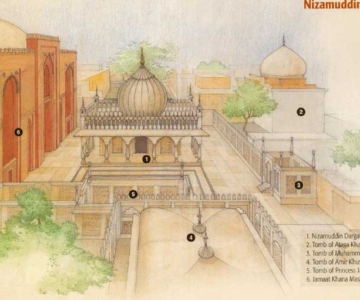
The sanctuary

Nizamuddin's shrine and the dergah complex is a source of comfort. Each time I have been there, I have felt uncanny sense of comfort and solace. Found this terrific image here -

2Sep/073

Lal Shahbaz Qalandar of Sehwan

Lal Shahbaz Qalandar's shrine is full of devotees these days. His Urs is a major cultural event in Sindh. The Qalandar has followers across the Central and West Asia and his shrine and festivities around the Urs are an important part of Sindh's spiritual and cultural landscape. The Qalandar was also a part of the wider Chishtia movement in the subcontinet in the twelfth and thirteenth centuries.

His shrine even today is an inclusive space for all religions, classes and castes.

This report paints an interesting picture:

In the colourful crowd, Sunnis rub shoulders with Shias and Muslims eat and drink with Hindus, using same plates and glasses. The Sufi culture of the Subcontinent, which breaks the barriers of cast, colour and creed, is witnessed in its most magnificent and harmonious way during the celebrations.

"Neither the power of crowns and kings nor the might of armies equals the force of a Qalandar."

Source

Update: Sadly, I just read that there were deaths today due to sheer mismanagement and negligence at the shrine. What a pity! May God bless the souls of those who died in such unfortunate (and uncalled for) circumstances.

22Jan/071

More on Data Ganj Bakhsh of Lahore

Further to yesterday's post on Data Saheb,  Shirazi Saheb from Lahore has sent this story related to Data Ganj Baksh. The incident seems to have taken place in the early twentieth century.

I am reproducing it below:

Before independence Rae Bahadar Ram Saran Das lived near the shrine of Data Gang Bukhsh. He was one of the rich landlords of Punjab and a philanthropist who would not discriminate between Hindus, Muslims, Sikhs or Christians. His three sons caught Influenza when epidemic spread all around during World War I. Doctors including Colonel Sundar Land, husband of Maharaja Ranjit Singh's grand daughter Bampa Daleep Singh who was the principal Kind Edward Medical College Lahore, did not know what to do.

Ram Saran's sons were isolated in one room. Ram Saran narrates that one night he woke up and saw a pious person praying in the room. "Who are you," Ram Saran asked perplexed. "I am your neighbour Data Gang Bukhsh. I could not see your dilemma and have come to pray for your sons. Do not worry. Allah willing they will get better" ,Data Gang Bakhsh assured him.

Next day his sons started recovering. Soon they were all right. Roop Chand was one of Ram Saran's sons who later served as Indian ambassador to Afghanistan.
Ram Saran Das arranged the electrification of Data Gang Bakhsh Shrine complex in gratitude.

Thanks to Shirazi Saheb for sending this. I also discovered a great site with some amazing photos of Data Darbar.

5Jan/071

Nizamuddin Auliya – for Marta Franceschini

My post on the pictures of Nizamuddin Auliya's dergah (shrine) attracted a visitor whose devotion to the great Nizamuddin is quite touching. Marta wrote:

"...picture of the Dargha is next to my bed, first thing I see in the morning and last in the evening. .... No one ever loved me like he does. To experience the power of his love is something impossible to express with words, something that has changed completely the perspective of my life."

Commenting further on the pictures, Marta said:

".....The best gift for Christmas. I am not muslim, nor christian, or anything else, but however my heart is full of love for God which, I am sure, is One and Overwhelming. And does embrace me all time long. If my presence doesn't offend anyone in your site I will be glad to come back again, and possibly talk to anyone close to the Great Chisthy Saint."

Her full comment can be found here

I visited this remarkable place recently spending my evenings and all the spare time at the shrine. I have met more and more people at the dergah including a devotee who also runs the Sufi Inayat Khan Center nearby. I will write more about that later.

Now that I have had some time to sort out my pictures, I am posting a few more here. These are dedicated to Marta and I hope she will find them inspiring again...

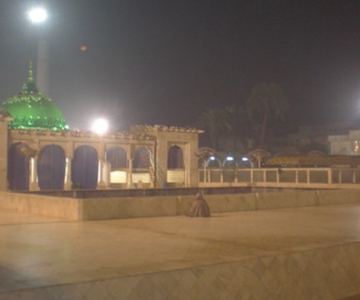
And this is the last one - the renovated mosque that looks ethereal in the night time.