Posts Tagged Sehwan

Pakistan’s Sufis Preach Faith and Ecstasy

15 April 2009

Read this great blog and was tempted to cross-post a few bits here:

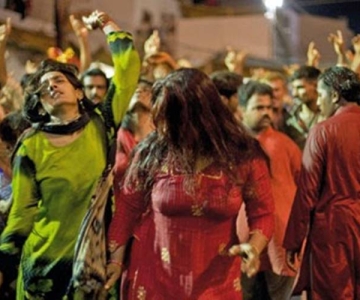
Every year, a few hundred thousand Sufis converge in Seh- wan, a town in Pakistan’s southeastern Sindh province, for a three-day festival marking the death of Lal Shahbaz Qalandar, in 1274. Qalandar, as he is almost universally called, belonged to a cast of mystics who consolidated Islam’s hold on this region; today, Pakistan’s two most populous provinces, Sindh and Punjab, comprise a dense archipelago of shrines devoted to these men. Sufis travel from one shrine to another for festivals known as urs, an Arabic word for “marriage,” symbolizing the union between Sufis and the divine. (more…)

Imagined homeland

5 February 2009

It irks me when I hear simplistic platitudes on Pakistani society, state or people. The heterogeneity of Pakistan is by itself an anthropologist’s dream, a planners’ headache and a sociologist’s challenge. Despite the sixty-one years of drumming the uniform nationalism mantra, Pakistan’s regions and their peoples refuse to toe the line sponsored by the official textbook masters. This is why one minute there is a delightful speech on being a Pakistani and the other minute caste, tribe or ethnicity raise their discrete heads and the linear formulae dissolve into thin air.

Recently I was in Karachi and discovered that the drawing room chattering there was vastly different from that of Lahore’s. The immediate urban crises of the Sindhi capital overshadow discussions that the Punjabi heartland loves to indulge in. The war mongering that has been a recent pastime on TV channels and in influential quarters of Lahore, is looked at with suspicion and, dare I say, contempt by many Karachi wallahs. It was refreshing to be reminded that, much in line with South Asian history, Pakistan is a diverse, multifarious place. That this country cannot be boxed easily and therefore appointed labels dissipate easily. (more…)

Of saints and sinners

2 January 2009

James Astill writing for the Economist says that the Islam of the Taliban is far removed from the popular Sufism practised by most South Asian Muslims

Declan Walsh

“NORMALLY, we cannot know God,” says Rizwan Qadeer, a neat and amiable inhabitant of Lahore, Western-dressed and American-educated, eyes shining behind his spectacles. “But our saints, they have that knowledge.” (more…)

On Damadam Mast Qalandar

20 November 2008
Renuka Narayanan writing for the Hindustan Times
So many wake-up calls

The unrelenting terror trail across India recalls young Pakistani author Raza Rumi’s wistful remark that Hindu-Muslim amity seems like “a fairy tale from Never-Never land”. But surely India can wake up and recall how she managed things? Here’s an old story about one of modern India’s favourite songs, Damadam Mast Qalandar. Runa Laila of Bangladesh, Reshma of Pakistan and the Wadali Brothers of India have all sung it. The song came back this month with Ruby, Reshma’s daughter, who was in Delhi to sing at a Deepavali party held in a Muslim gentleman’s house.

The fact is that Jhuley Lal and Lal Shahbaz Qalandar are the patron saints of both Hindus and Muslims. Jhuley Lal (or Udero Lal/Amar Lal/Lal Sain) is said (more…)

Lal Shahbaz Qalander of Sindh

24 August 2008
Shahbaz Qalandar was born in Marwand to a dervish, Syed Ibrahim Kabiruddin whose ancestors migrated from Iraq and settled down in Mashhad, a center of learning and civilization, before migrating again to Marwand. (more…)

Lal Shahbaz Qalandar of Sehwan

2 September 2007

Lal Shahbaz Qalandar‘s shrine is full of devotees these days. His Urs is a major cultural event in Sindh. The Qalandar has followers across the Central and West Asia and his shrine and festivities around the Urs are an important part of Sindh’s spiritual and cultural landscape. The Qalandar was also a part of the wider Chishtia movement in the subcontinet in the twelfth and thirteenth centuries.

His shrine even today is an inclusive space for all religions, classes and castes.

This report paints an interesting picture:

In the colourful crowd, Sunnis rub shoulders with Shias and Muslims eat and drink with Hindus, using same plates and glasses. The Sufi culture of the Subcontinent, which breaks the barriers of cast, colour and creed, is witnessed in its most magnificent and harmonious way during the celebrations.

Neither the power of crowns and kings nor the might of armies equals the force of a Qalandar.”

Source

Update: Sadly, I just read that there were deaths today due to sheer mismanagement and negligence at the shrine. What a pity! May God bless the souls of those who died in such unfortunate (and uncalled for) circumstances.