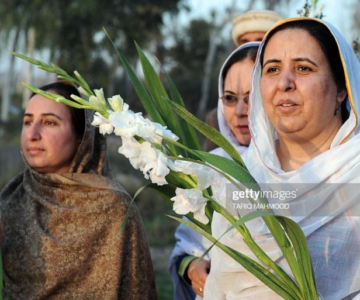
Mystical Form of Islam Suits Sufis in Pakistan
A New York Times' piece where I was quoted.
Nightingale of Peshawar falls silent
My piece published in The Friday Times
The bombing of Rehman Baba’s shrine is more proof that we are slipping, inch by inch, into an abyss. It is as if the soul of Peshawar, and by extension that of the whole of Pakistan has been scarred by those barbaric bombs and grenades. Among other ironies of the situation, this one stands out: the late Baba was instrumental in disseminating the message of Islam in the Khyber valley and beyond. And today the zealots destroy his shrine for being un-Islamic! A poet of love and tolerance, of amity and forgiveness to be treated in this manner displays how brutal we have become as a society and how fissured our state is. Otherwise a successor of a mighty steel frame, the indigenised state has surely given up to the hordes that are now hell bent on destroying Pakistan.
|
|
|
![]() |
Rahman Baba was born in 1632 A.D. at Bahadur Kala, a village close to Peshawar. The Pashtuns hold his work in high esteem and his rank in Pashto poetry matches that of Hafiz Shirazi in Persian literature. The simple, down to earth and universal messages of his poetry have been revered by the Pashtuns as well as many adherents of the Sufi creed in South Asia and elsewhere.
In Afghanistan too, Rehman Baba was an icon and his muse was referred to as the ‘heart-beat’ of every Afghan. A friend told me how Saidu Baba, the famed saint of the now destroyed Swat valley, remarked that if the Pashtuns were to pray from a book other than the Holy Quran it would definitely be Rahman Baba’s work. But nothing describes Baba better than what Janes Enveldson had named him: the “Nightingale of Peshawar.” Alas, nightingales do not sing in gardens that have been ruined by long, harsh winters or other cataclysms such as hatred and violence.
Of saints and sinners
James Astill writing for the Economist says that the Islam of the Taliban is far removed from the popular Sufism practised by most South Asian Muslims
|
|
|
![]() |
|
“NORMALLY, we cannot know God,” says Rizwan Qadeer, a neat and amiable inhabitant of Lahore, Western-dressed and American-educated, eyes shining behind his spectacles. “But our saints, they have that knowledge.”
On Damadam Mast Qalandar
The unrelenting terror trail across India recalls young Pakistani author Raza Rumi’s wistful remark that Hindu-Muslim amity seems like “a fairy tale from Never-Never land”. But surely India can wake up and recall how she managed things? Here’s an old story about one of modern India’s favourite songs, Damadam Mast Qalandar. Runa Laila of Bangladesh, Reshma of Pakistan and the Wadali Brothers of India have all sung it. The song came back this month with Ruby, Reshma’s daughter, who was in Delhi to sing at a Deepavali party held in a Muslim gentleman’s house.
The fact is that Jhuley Lal and Lal Shahbaz Qalandar are the patron saints of both Hindus and Muslims. Jhuley Lal (or Udero Lal/Amar Lal/Lal Sain) is said
Sachal Sarmast’s sufi kalaam – live recording
Cross posted from here
I recorded a few bits of performances of sufi siant Hazrat Sachal Sarmast's kalaam (poetry) at his tomb in Daraza Sharif, some 50 kms outside Khairpur Mirs.
A trip to Khairpur cannot be complete without exploring many of its spiritual treasures. Khairpur itself is a calm, quiet city. You can feel the stillness of the air.
The Dating Season
I have heard that this stillness becomes slightly oppressive at around this very time of the year - the hot summers - when the area transforms into a gigantic dates bazaar. In the heat and stillness, dates - the prime agricultural product of Khairpur - come to ripen. Temporary shack cities spring up in the area as pickers and traders come in droves. Many use the by-products of the dates industry - the barks and the gigantic leaves - to make woven baskets, sweepers, and other handcrafted products.

Sufi Music - Live Recording at the Tomb
But I digress. I recorded several bits of music and this one is my favorite. I used an iRiver MP3 player+radio+recorder to capture the music. The night was calm and beautiful, and our small circle sat with their heads one their knees and eyes closed - in a state of absorption. in our group was Sindh's popular activist Amar Sindhu, her faithful friend the gentle-natured Arfana Mallah, my journalist friend Afia, and our kind hosts the Joyos.
The Real Sufi was Standing Up
I shouldn't forget to mention that I went to the tomb to learn more about "sufis." I found that we had a
Mian Mir’s 384th Urs
Mian Mir's death anniversary celebrations are commencing today.
Mian Mir is regarded as one of the greatest Sufi saints of the Subcontinent. He belonged to the Qadiria order of the Sufis. He was famous for being a spiritual instructor to Dara Shikoh, the eldest son of Mughal Emperor Shah Jahan, who also held Mian Mir in great esteem.
Dara Shikoh was a devoted disciple of the saint. His father, Shah Jahan, often requested the saint to pray for his empire.
Mian Mir was the earliest Sufi saint who promoted the Qadiria order in Lahore.
He shunned worldly selfish men and proud high-ups of his time. He used to post his mureeds (disciples) at the gate of his house to stop rich people from entering.
Once Emperor Shah Jahan, with his attendants, came to pay homage to the great dervish. Mian Mir's disciples stopped the emperor at the gate and requested him to wait, until permission was given. Shah Jahan felt insulted, but controlled his temper and composed himself.
Put thy eyes into mine…..Shah Hussain
My wrist in the beloved's grip,
I cannot ask Him to leave hold.
Dark is the night, the cloud is dripping,
I suffer it for lack of a messenger,
The tyrant has sent a call.
They alone know what is love and longing,
Who have it in their lives.
Like digging a well in dry land,
With no cart to carry away the sand.
Carrying loads everyday,
You will leave at last.
Says Husain, the humble fakir,
Put thy eyes into mine, O love.
(Translated by Sant Singh Sekhon)
Shah Ast Hussain
Khawaja Ghareeb Nawaz's immortal verses on the status of Hazrat Imam Hussain (AS)
Shah ast Hussain, Badshah ast Hussain
Deen ast Hussain, Deen Panah ast Hussain
Sardad na dad dast, dar dast-e-yazeed,
Haqaa key binaey La ila ast HussainAnd a rough translation -
Ruler is Hussain, Emperor is Hussain,
Faith is Hussain , guardian of faith is Hussain .
Offered his head and not the hand to Yazid.
Indeed, Hussain is the foundation of La-ilah
Ajmer – my scuttled travel plans
Ajmer Shareef is a spiritual centre-point in South Asia. It is not just another Muslim Saint's dergah but represents the glorious tradition of inclusiveness and spirituality beyond the formal boundaries of religion, caste and creed. This is why it has become a fascinating rallying point for South Asians, regardless of what religion they profess and/or practice.
Next week, the death anniversary celebrations of Khawaja Moinuddin Chishti will start in Ajmer. Yesterday I was told that my visa processing would take ages and the outcome will be uncertain. The near-impossibility of getting there made me a little depressed. Yes I was planning to undertake this [mini]-pilgrimage this month.
Damn these visas and official hurdles. At the end of the day these have proved to be meaningless, only adding to the bad blood between the people of the two countries.
My friend Salman who lives next to the dergah and is from the line of shrine-keepers, wrote a piece for the Hindustan Times where he talks of the forthcoming Urs, its significance and place in India. Salman is a young and dynamic student of Sufism. May he stay the course! Read his article here.
Photo above was taken in 2006: On a crisp sunny-wintry afternoon, the pilgrim Qawwals sang in praise of the Khawaja. This was such an impromptu performance - I recall a verse - sab ki bigri hui, bana dey - Khawaja (Help all those who come to you - oops, this is a horrendous translation)...
More on Data Ganj Bakhsh of Lahore

Further to yesterday's post on Data Saheb, Shirazi Saheb from Lahore has sent this story related to Data Ganj Baksh. The incident seems to have taken place in the early twentieth century.
I am reproducing it below:
Before independence Rae Bahadar Ram Saran Das lived near the shrine of Data Gang Bukhsh. He was one of the rich landlords of Punjab and a philanthropist who would not discriminate between Hindus, Muslims, Sikhs or Christians. His three sons caught Influenza when epidemic spread all around during World War I. Doctors including Colonel Sundar Land, husband of Maharaja Ranjit Singh's grand daughter Bampa Daleep Singh who was the principal Kind Edward Medical College Lahore, did not know what to do.
Ram Saran's sons were isolated in one room. Ram Saran narrates that one night he woke up and saw a pious person praying in the room. "Who are you," Ram Saran asked perplexed. "I am your neighbour Data Gang Bukhsh. I could not see your dilemma and have come to pray for your sons. Do not worry. Allah willing they will get better" ,Data Gang Bakhsh assured him.
Next day his sons started recovering. Soon they were all right. Roop Chand was one of Ram Saran's sons who later served as Indian ambassador to Afghanistan.
Ram Saran Das arranged the electrification of Data Gang Bakhsh Shrine complex in gratitude.
Thanks to Shirazi Saheb for sending this. I also discovered a great site with some amazing photos of Data Darbar.


Dara Shikoh was a devoted disciple of the saint. His father, Shah Jahan, often requested the saint to pray for his empire.
My
I visited this remarkable place recently spending my evenings and all the spare time at the shrine. I have met more and more people at the dergah including a devotee who also runs the Sufi Inayat Khan Center nearby. I will write more about that later.
Now that I have had some time to sort out my pictures, I am posting a few more here. These are dedicated to Marta and I hope she will find them inspiring again...