Jahane Rumi In search of the unsearchable: O, my soul! where would you find your house?

22Nov/090

Sub-Continent’s Berlin Wall

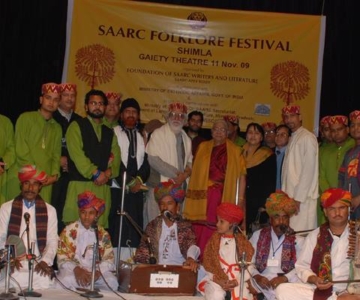
I am posting Shivani Mohan's article where I have been quoted with reference to the recent folklore festival held under the aegis of SAARC. Another piece on the folk performances can be accessed here.

This fortnight saw the 20th anniversary celebration of the fall of the Berlin Wall. So liberating and decisive, when a vast multitude of people chose to see sense and forget trifles that generally incense mankind, when the similarities between two peoples became more important than the differences; when cultural affinity conquered meaningless rivalry.

So it was at the recently concluded SAARC Folklore Festival. Writers, scholars and folklore artistes from eight SAARC countries — Afghanistan, India, Sri Lanka, Maldives and Bangladesh, Bhutan, Nepal, Pakistan- converged to Chandigarh for four days full of rapturous singing and dancing and ?discussing folklore.

16Nov/090

Borderless world: Musing on South Asian folklore

Jaskiran Kapoor's report on the recent folklore festival that I attended in Chandigarh

It’s a borderless world, veins and arteries connected to one heart, one soul; scholars at the Saarc Folklore Festival seminars bring down the walls & spearhead a cellular movement

Nepal's struggling with a change in power. Bangladesh is coming to terms with hunger and poverty while Pakistan is still grappling with the Taliban attack. If Raza Rumi finds the Vande Mataram fatwa ‘nonsense’, then Prof Abhi N Subedi is not kicked by Monisha Koirala joining Nepal’s political wing. On the other hand, writers Selina Hossain, Rakshanda Jalil and Sayman Zakaria are trying to bring in change with the power of the written word. It’s a confluence of culture, of tradition,

21Sep/092

Rail to link Dhaka, Delhi, Lahore?

This seems to be a refreshing piece of news. One hopes that this plan is implemented and not scuttled by the bureaucratic hostilities. RR
Srinand Jha, Hindustan Times: Sixty-two years after Partition, India has initiated a novel scheme to stitch together closer ties with Pakistan and Bangladesh.
The Indian Railways has proposed a South Asian regional train service linking Dhaka, New Delhi and Lahore. The proposal was first put forward at a SAARC transport ministers’ conference in Sri Lanka earlier this month.
19Jun/093

Literature in the time of terror

My piece that appeared in The Friday Times (May 29-4 June, 2009 issue). I have argued that the silence of Pakistani writers on terrorism and extremism is finally breaking  


‘Fallen Indus’, a painting by the author


‘Ignorance Is Bliss’, a miniature by Saira Wasim


Since the invasion of Afghanistan by the United States and the global hysteria about 'terror' and 'terrorism', Pakistan has faced the greatest of existential challenges after its dismemberment in 1971. As a frontline ally of the US in the war on terror, Pakistani society and polity have been engulfed by growing militancy and acts of violence. Whilst there is no single definition of 'terrorism', the mainstream media and policymakers – in the service of imperial rhetoric aimed to justify and perpetuate the occupations of Afghanistan and Iraq – have established terrorism as the major threat to domestic and regional peace in South Asia. Acts of premeditated and organised violence in India, Pakistan and Bangladesh have thus assumed a central place in discourse on regional cooperation or its converse: the rivalries between the constructed nation states and their irresponsible power-elites.

 In this milieu, South Asian citizens have been the victims of violence, uncertainty and acrimony that have only led to the exacerbation of poverty, inequality, ascendancy of militarism and the war-mantra. All of this is taking place when globalization is relentlessly seeping into domestic economies, cultures and social systems. Where does this leave the writers and poets of the

31Mar/094

Postcard from Agra

Published in The Friday Times

As Indian TV channels broadcast stories on Pakistan's domestic infighting, and rumours of a new coup d' etat, my less perturbed alter-ego is calmed by Agra - the run down city that was once the capital of the Mughal empire. I have spent three days with a delightful group of South Asian writers, poets and academics who have congregated to celebrate the SAARC writers' festival organised by Ajeet Caur, the legendary Punjabi writer whose love for Lahore has not waned despite the iron curtain erected sixty one years ago. Caur has been managing the Foundation of South Asian Writers and Literature (FOSWAL) since 1992 and single-handedly she has challenged the many geographical and political barriers that have been erected. FOSWAL is now a platform for writers and poets on the margins of power-drama, lighting little lamps of hope. (picture above left : SAARC writers with Pakistani delegates Ustad Akhtar (middle), Parveen Atif (second from left) and Zahid Nawaz (extreme right)

I had been reading Caur's earthy, profound stories for decades, and always wondered if I would ever meet her. Therefore, receiving an invite from her a month ago, was a long cherished wish come true. In a few, scattered and sparkling conversations she told me how she had found me through my writings urging for Indo-Pak amity which, in the words of my cynical friends, are dreamy rants asking for the impossible. This March, the gods overseeing visas and border crossings were not too cantankerous. So I made it to Delhi the day before the conference was due to start.
26Mar/091

Contemporary Pakistani literature in the ‘age of terror’

I am posting the synopsis of my paper entitled Silhouetted Silences - contemporary Pakistani literature in the ‘age of terror’, that I presented at the SAARC writers' festival held in Agra, India (March 13-17, 2009). The full paper needs to be edited and referenced so that will posted a little later.

Round my neck,
from time to time, there was the hallucination
of a noose, and now and then, the weight
of chains binding my feet.
Then one fine day
love came to drag me, bound and manacled,
into the same cavalcade as the others (Faiz)

Since the invasion of Afghanistan by the United States and the global hysteria about ‘terror’ and ‘terrorism’, Pakistan has faced the greatest of existential challenges after its dismemberment in 1971. As a frontline ally of the US in the war on terror, Pakistani society and polity have been engulfed by growing militancy and acts of violence commonly branded as terrorism. Whilst there is no single definition of ‘terrorism’, the mainstream media and policymakers – in the service of imperial rhetoric aimed to justify and perpetuate the occupations of Afghanistan and Iraq – have established terrorism as the major threat to domestic and regional peace in South Asia. Acts of premeditated and organised violence in India, Pakistan and Bangladesh have thus assumed a central place in discourse on regional cooperation or its converse: the rivalries between the constructed nation states and their irresponsible power-elites.

In this milieu, the South Asian citizens have been the victims of violence, uncertainty and acrimonies that have only led to exacerbation of poverty, inequality, ascendancy of militarism and war-mantra. All of this is taking place when globalization is relentlessly seeping into domestic economies, cultures and social systems. Where does this leave the writers and poets of the region who grapple with the complex, confusing and fast changing social and political realities? Whilst the community of South Asian writers – traditionally the forbearers of intellectual and political movements – is beleaguered by corporate media industry, it has struggled to respond to challenges that events have created.

14Mar/091

In Agra – attending the SAARC writers’ moot

Finally managed to reach Agra to attend the SAARC Literature festival organised by the inimitable Ajeet Caur. It is a lovely event with people from all over the region bemoaning what has happened to the region when it should be taking off.

The news from Pakistan are disturbing to say the least and the headlines here are not all that flattering. Alas, we are in a tight corner once again.

As part of my paper entitled Silhouetted Silences - contemporary Pakistani literature in the ‘age of terror’. While I am still refining my paper, here is an excerpt:

The current political and social milieu has created deep contradictions for the writers and the poets of contemporary Pakistan. If on the one hand they are bruised by the widespread violence and desecration of humanity, on the other they are equally aware of the public mood on the way imperial powers are playing another great game in their neighbourhood. This is what makes the task of the poets and writers extremely difficult.

I quoted this powerful poem called A Mourning poem for Bajaur by Pakistan’s eminent poet Kishwar Naheed here:

Coffins have become so numerous
That the city is shrinking

The eye is oozing
And not even a word of association
Like an open wound
On the lips.

The sky looks over everything
And remains silent.
Why does it go on believing
That mankind will awake once again
From its deep slumber
And laughter will ring again
On the threshold of houses.

No, it was not yesterday
But many years ago,
We held hope with our hands
We sat in the shadow of wide-awake walls
And used to think:
Yellow-gold wheat smiles and laughs
In our court-yards

We have the same court-yards, the same threshers
But bullets jump through them,
Riddle holes in my fields
and in the bodies of my children

With my tear-soaked pillow
I sit in the court-yard, watching

Coffins have become so numerous
That the city is shrinking.

Translated by Asif Farrukhi

More later....

1Mar/094

29th SAARC Festival of Literature to debate terrorism

Source: The SAARC Festival of Literature is slated to begin from 12th March in the city of Taj Mahal, Agra and will come to close in Delhi on the 17th March 2009. Foundation of SAARC Writers and Literature is organizing the Festival at a time when expectations from creative fraternity and right-minded peace activists have soared high in the aftermath of unprecedented terrorists attack on Mumbai, and sensitivities of the creative fraternity across the SAARC region, particularly in India and Pakistan, are shaken and bruised.
FOSWAL has urged people to pledge with the creative fraternity to stand together for peace and tranquility in times of terror and to celebrate the continuity of culture and creative writings of the SAARC region. The Festival will cover a wide range of themes from role of wordsmiths in times of terror to its impact on popular culture, prevailing conditions of chaos and confusion, exploring history, resolving ethnic angst, poetry recitations, and readings of short stories.