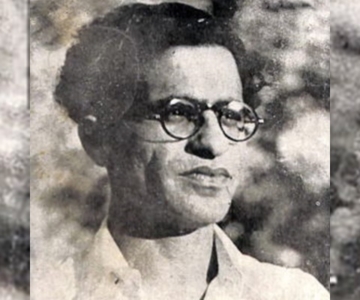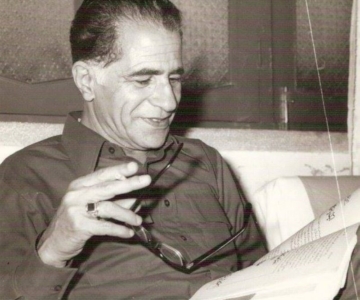
Ahmed Nadeem Qasmi (1916-2006)
I am republishing an old article that appeared in The Friday Times, Pakistan on the great Urdu poet Ahmed Nadeem Qasmi.
Ab aik baar to qudrat javaabdeh thehre
hazaar baar ham insaan aazmaaye gaye
Now Nature must be held accountable at least once
We humans have been held answerable a thousand times
Few men evoke such awe and respect as the departed poet and writer Ahmed Nadeem Qasmi who breathed his last on July 10 2006. His mastery over poetry – he has been equally prolific in traditional ghazal and nazm – and prose – as a short story writer, journalist and literary critic – stand at the pinnacle of Urdu literature and he has contributed to the language over 50 titles.
Born in 1916 amidst the scenic Soon-Sekasar valley in district Khushab, nature influenced the evolution of Qasmi’s poetic sensibilities. Exposure to the grim realities of rural India’s inequities also played their part in his development as a writer; the underlying theme of his poetry is human dignity and his short stories – regarded as next in line to another master, Munshi Prem Chand, for their directness and simplicity – portrayed the woes of the Punjabi peasantry and their interaction with power structures. Following his matriculation from Campbellpur in 1931, around the time when he wrote his first poem, he moved to the Sadiq Egerton College in Bahawalpur and graduated in 1935.
Two poems by Ali Sardar Jafri
Two poems of Ali Sardar Jafri found here
MY JOURNEY
Such a day will arrive again
[when] the lamps of the eyes will get extinguished;
the lotus of the hands will get withered
and each butterfly of speech and voice
will flee from the leaf of the tongue.
All faces that blossom like buds,
chuckle like flowers,
the circling of blood, the beats of heart,
all [such] symphonies will go to sleep
on the bed of a dark ocean.
And, this grinning diamond particle,
this paradise of mine, this earth
that is laid out on the velvet of the blue environ,
its morns, its evenings
will, unwittingly, unconsciously,
pass on shedding the tears of dew
[on the demise of] a handful of dust of a man.
Everything will be forgotten;
everything will be removed
from the exquisite idol-house of memories.
Then no one will ask:
Where is Sardar in the congregation?
Yet, I'll come here again;
[I] will talk with the mouths of the tots;
will sing in the tongue of the birds.
When seeds will grin beneath earth
and the sapling, with its fingers,
will vex the crusts of earth,
I'll open my eyes
in leaves and buds;
will take, in [my] verdant palm,
the dew drops.
I'll turn into the colour of henna, the tune of ghazal
[and] the style of poetry.
[I], like the hue of the cheek of a bride,
will filter from every stole.
When the winds of winter
will bring along with them
the season of autumn'
my laughter will be heard
from the dry leaves that will
be trampled under the robust feet of the passerby.
All the golden rivers of the earth;
all the azure lakes of the sky
will get filled with my being.
And the world will see
[that] every tale is [in fact] my tale;
here every lover is Sardar
[and] every beloved is Sultaanaa
Pakistan’s rich dissident literary tradition
Himal Magazine had published this article on the resistance poetry in Pakistan. I had uploaded it on the Pak Tea House some time back. However, I just realised that it should be published here as well..
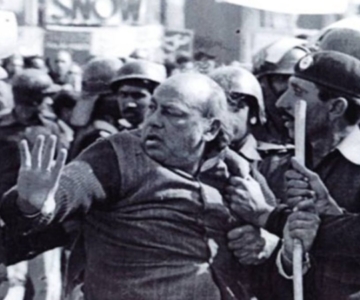
The long spells of authoritarian rule in Pakistan have nurtured a rich dissident literary tradition. This tradition has its roots in the Progressive Writers' Movement, which originated in colonial India with major Urdu poets and writers as its vanguards. Faiz Ahmed Faiz was, of course, the best-known torchbearer of this tradition, while other luminaries included Sajjad Zaheer, M D Taseer, Rashid Jahan, Kaifi Azmi, Ismat Chughtai, Sahir Ludhianvi and Ahmed Nadeem Qasmi, to name only a few.
With the post-Independence Pakistani state continuing the old-style approach to ruling over the masses, the progressive movement too carried on its dissent long after 1947. Those who had migrated to Pakistan faced a new reality, which, in the words of Faiz, was far from the dawn for which they had hoped. "This blemished light, this dawn by night half-devoured," Faiz wrote ruefully. "surely not the dawn for which we were waiting."