Posts Tagged painting

My painting as a magazine cover

28 September 2010

KIndle Magazine , originally uploaded by Jahane Rumi.

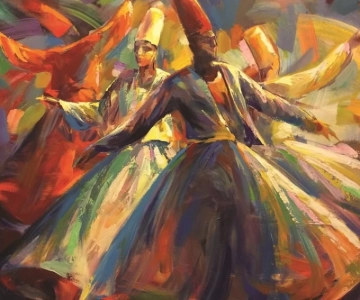
Kindle magazine has printed an excerpt from my forthcoming travel book. I has sent them a painting of mine to be used with the text but it was a pleasant surprise to see it as a cover for the magazine. It is an impression of Sarmad’s dargah from inside.

My contribution on Dara and Sarmad can be read here at the magazine website.

Elusive freedom – a painting by Anwar Saeed (’92)

20 July 2010

Elusive Freedom

A red card for the Secular Indian Muslim

14 March 2010
I am posting a brilliant piece (published by Indian Express) by my dear friend Rakhshanda Jalil - she is a bold yet sensitive writer based in Delhi. All power to her pen.

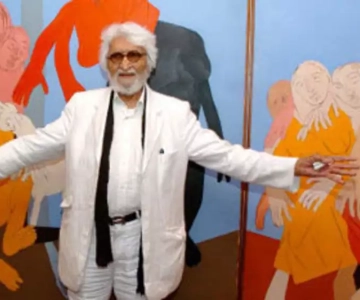
The controversy regarding the conferment of Qatari nationality upon M.F. Husain — and his acceptance of it — has given us the opportunity to revisit an old but neglected debate. The debate on being an Indian Muslim or a Muslim Indian is old hat; but the one concerning the “secular Indian Muslim” — the SIM? — needs our urgent attention. Those who doubt the existence of such a breed and view it as a contradiction in terms would do well to remember the legacy of a long line of distinguished people, from Mirza Ghalib, Hakim Ajmal Khan, Dr M.A. Ansari, Maulana Azad, Dr Zakir Husain to M.F. Husain, to name just a few. Then there are the nameless millions — doctors, lawyers, writers, journalists, teachers, wage earners who are living proof of Indian secularism. Husain is simply another link in this ganga-jamuni chain. He needs to neither establish his credentials nor protest his innocence; his work speaks for him.
Having established the credentials of this breed, let us set out the contours of its present dilemma: one, it exists in sufficiently large numbers to have escaped our notice yet, oddly enough, has never managed to establish a public profile for itself; nor has it, given its numbers, translated into a sufficiently large, and therefore woo-able, vote bank. Two, despite its largish presence (I imagine roughly half the population of Muslims in India), the breed is under severe threat.
One is not interested in establishing the presence of the SIM, for that one takes as a given. It has always existed in the weft of the Indian tapestry as the warp that runs alongside. In fact, what ought to concern us is the threat to its existence. That this threat is (more…)

In memoriam – Asim Butt (1978-2010)

1 March 2010

He was a man, take him for all in all,

I shall not look upon his like again

(Hamlet, Shakespeare)

It is only when Asim has gone that one takes measure of the legacy he has left for his troubled and torn country. A decade long association was lost on the fateful day of January when we heard of his untimely exit from this world. For hours, I sat in my office, numb. Not that Asim’s suicide was a surprise, for he had warned us all many times of this inevitable dénouement to his dramatic life.

Five years ago, when I wrote a piece on the Pakistani poet Mustafa Zaidi and the romance with nurturing a death wish, Asim wrote to me and said that I had no clue what this was all about. His words were: “loved and was deeply moved by your piece on Zaidi… saw so much of myself in his life story, hoping I don’t die unsung and on the fringes, and wondering why you of all people would have a death wish.” Asim had suffered and struggled with his inner demons with an intensity that most of us will never appreciate. This was the first time that I knew about the seriousness of his other side: a dialectical dark side to his otherwise cheerful, loving and warm persona. Asim cannot be mourned; he can only be celebrated. He would have hated the melodramatic statements that I am inclined to write in this remembrance.

Two of my dearest friends were close to Asim in a way that is difficult to understand. Nearly a decade ago I met Asim at Ali Dayan Hasan’s home in Karachi. I was passing through on one of my occupational breaks from my assignment in Kosovo. Ali had returned from England and joined the monthly Herald and was piecing his life together. I met this lean and quiet young man who had big, bright eyes and a unique smile. We did not talk much except for a small argument over something, perhaps about a book, but I could not help being thoroughly impressed with his viewpoint. Since then I have had a series of exchanges, verbal and electronic, in which Asim was always animated, off-beat and extremely gifted with words and ideas. No wonder his art work and many of his writings are a formidable legacy for us all.

Born into a regular upper middle class family, Asim Butt was always an exception. He was different, as he would tell me. Rejecting convention, tradition and the confines of societal expectations was therefore something that started way too early with Asim. To be fair, he did pursue a path chosen for him. He attended the Li Po Chun United World College where his gift for painting became polished, and at some level he had chartered his future course. There was some meandering: a degree in the first batch of B.Sc. in Social Sciences earned from the Lahore University of Management Sciences; and later an unfinished PhD in History from the University of California, Davis. He returned to Pakistan, wrote for the Herald and other publications, and finally enrolled himself at the Indus Valley School of Art and Architecture.Not surprisingly, Butt graduated with distinction in 2006. (more…)

Loveable Murree

13 May 2009


I was recently asked to write where I would spend my summer. For a few minutes I kept my anguish at Pakistan’s situation aside and wrote the following lines for the NEWS. Indulgent and nostalgic, it was fun nevertheless.

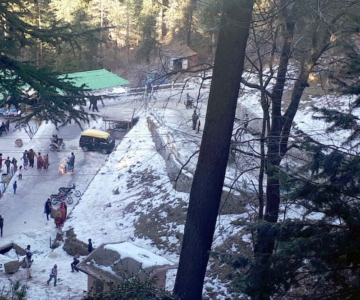
Hackneyed as it may sound but Murree remains my favourite destination for the summer.

Alas, the luxury of spending months at the alluring foothills of Himalayas is no longer available with the day-jobs, and other commitments. But there was a time, over a decade ago, when I lived in Murree for three glorious years. It was May when I moved there with a wild rose bush joyously waving with the (more…)

Shahid Jalal’s new paintings

23 March 2009

Jugnu Mohsin writing for The Friday Times says that Lahore’s most celebrated oasis is now the subject of enchanting paintings

You are truly amongst Lahore’s privileged if you receive an invitation to a harisa lunch on a winter afternoon at the home of Tahira Mazhar Ali Khan. No ordinary repast this, cooked as it is laboriously and lovingly over an evening and a night by Tahira herself. And only harisa is on the menu.
Originating in Kashmir, harisa is a purer cousin of haleem, without the spices and far more meaty and grainy. But as with all other Kashmiri offerings, harisa became a memorable dish only after its encounter with the Punjab. For hundreds of years, driven out by the harsh winter or latter day Dogra tyrants, Kashmiri Muslims and their families came down from the vale to Sialkot, Lahore and Amritsar and settled in their droves. Here, their customs, dress, language and cuisine underwent a metamorphosis. (more…)

Picasso on indifference

19 March 2009

My dear friend Isa D, has refreshed the memory of this fabulous quote from Pablo Picasso.

This quote is extremely pertinent to the current times when the choices are quite stark and paths unclear. Yet, silence shall not be the right response.

… Artists who live and work with spiritual values cannot and should  not remain indifferent to a conflict in which the highest values of humanity and civilization are at stake.” ~ Picasso

The image on the right is Picasso’s self portrait… courtesy artquotes.net

GulJee – what was the harm to you if you had lived a little longer!

29 December 2008

Jahane Rumi is priveleged to publish this exclusive piece contributed by Syed Naveed Abbas

t is the month of December and one’s heart weeps as one invokes the memory of Guljee. His work is a living testament to our times and the dignity of a proud nation. He was the painter from the day he was born. A profoundly earnest and sincere artist, he displayed a high seriousness tempered with tenderness and a love of simplicity. Nevertheless, he is perhaps best known worldwide for his abstract work, which is inspired by Islamic calligraphy and is also influenced by the action painting. The images that Guljee’s brush strokes produced are not only rich in symbolic meaning but visually so much variegated that the eye travels fascinated from point to point. His painting comes from a divine inspiration, giving it a dimension of space and movement. He carried the script with a flourish in all directions, giving it the power of space, vigour and volume. He has made the brush prove mightier than the sword, time and again, and with his brush on canvas he has earned accolades. Whatever Guljee had a hand in turned out to have an unquenchable spark of utter genius. (more…)

A brush with the new – Asim Butt’s Art

10 July 2008

What distinguishes Asim Butt from his generation and perhaps the preceding generations of artists is the sheer originality of his vision and an iconoclasm that is neither trumpeted nor made visible until the subtext of his lines is closely studied. This is why Asim has undertaken bold strides during the last 10 enriching years of painting. In the meantime, he also earned a degree or two in social sciences, a half-finished PhD at the University of California and formal training from Karachi’s Indus Valley Art school.

Art education in Pakistan, despite its deep- seated tradition of experimentation, does not allow the full exploration of originality. This is why the revival of miniatures has become another soft tool of marketisation and an out-of-wedlock union between art and commercialism. Rejecting what is on the horizon of Pakistani art, Asim Butt has stuck to his innate traumas and nightmares, sometimes indulging them, at others softening them with figures that blend the sensuous with the spiritual and the political with the existential.

his early works display a cracked sense of the self is not surprising. A rebel from his conventional background, Butt continues to defy the conformist meanings of family, career, security, sexuality and that elusive bourgeois pursuit of happiness. Inspired by the Stuckism movement of art, Asim holds painting as a powerful medium of communication. This standpoint brings our young Pakistani Stuckist at odds with the skin-deep novelty and claimed nihilism of “conceptual” art and postmodernism. The pursuit of art in this worldview thus merges into an impulse for a renewal of spiritual values in art and society, or what is known as “re-modernism.” In Asim’s own words: (more…)

World’s first oil paintings found in Afghan caves

27 January 2008

Bamiyan is no ordinary location. This was the place where the giant Buddhas that stood for centuries with their message of peace were destroyed by the Taliban. And, now this startling revelation. There is tragedy laced with irony here.

Forget Renaissance Europe. The world’s first oil paintings go back nearly 14 centuries to murals in Afghanistan’s Bamiyan caves, a Japanese researcher says.

Buddhist images painted in the central Afghan region, dated to around 650 AD, are the earliest examples of oil used in art history, says Yoko Taniguchi, an expert at Japan’s National Research Institute for Cultural Properties. (more…)

Ali Kazim – ‘our very own success story’

30 November 2007

“To look at one of Ali Kazim’s paintings is not only to look at something wonderful, something remarkable. It is also to look at something deeply intriguing. Kazim is a fine and highly skilled and accomplished painter, but he is also a deeply compelling and accomplished teller of mysterious and wondrous stories..” (Eddie Chambers in Secret Lives) (more…)

Art as hope – paintings on Southern Thailand

16 October 2007

Pearapong Khireewong is an extremely talented artist who hails from Southern Thailand and has captured the pathos of the bullets that were sprayed on the local populationand later the peace offensive by the now deposed Prime Minister Thaksin.

I was stunned by the light and statements that this canvas made. The painting above is entitled: The Bullet Holes in Narathiwat (Acrylic on canvas , 130 x 150 cm).

Another stunning work is entitled: Monument of the Selfless Heroes (Acrylic on canvas , 120 x 150 cm). Here the light conveys hope and the tidings of the renewal. The paper birds were used to calm the restive provinces. This news-item provides more detail:

“Military aircraft gently bombed southern Thailand with 100 million paper birds Sunday in a gesture intended to promote peace in mainly Muslim provinces where more than 500 people have died this year in attacks by separatist militants and countermeasures by security forces.” (more…)

Sufi Zikr – inspiration for a painting

8 July 2007

This is a painting that I revisited and converted its earlier abstract form into a calligraphic experiment. Now the challenge was that in addition to the lack of training in oil painting, I was also a novice in calligraphy. Anyway, the image inside Rumi’s tomb that I posted on this blog earlier as well as the three attributes of the Almighty helped me in putting this together. The letters in the centre are Hu (affirmation of the Divine presence and a Sufi chant) and its mirror image. In Rumi’s words:

Eternity is the mirror of the temporal, the temporal the mirror of pre-eternity – in this mirror those
two are twisted together like his tresses..(translated by Arberry).

This was truly inspirational as I remembered the lines with a brush in my hand. Another little flash was the three words that I have remembered abundantly thanks to a guide. Alas, I am out of touch with him.

The three words, familiar and lyrical, on the right side of the painting represent the key attributes of Allah : Ar-Rahman(the Beneficient), Ar-Raheem (the Merciful), Al-Kareem (the Generous).

Muslim mystics have chanted these names since centuries in the quest to attain inner peace and closeness to Divine consciousness.

With this little feat, I am sort of feeling peaceful myself.

View entry >>

Iqbal Hussain – Lahore’s controversial artist

6 February 2007

Iqbal Hussain from Lahore is one of the finest painters we have. Most of his paintings depict women from the Heera Mandi (literally the diamond market)- or the centuries old red-light district. I found the
above image on the Internet today. The news-item referred to Iqbal’s advocacy through his powerful art works:

..Others, who have emerged as spokespersons for the women of Heera Mandi, including leading artist Iqbal Hussain, whose own mother was a sex worker, emphasise their “lack of empowerment, exploitation and helplessness.

His works convey all of these emotions and bring to life extraordinary characters who are often neglected or spurned by the hypocritical culture of Pakistan. (images on the right and below are from here).

More on Iqbal Hussain here.

Endnote from here:

Being termed a controversial painter in Pakistan, Iqbal’s subjects sometimes tend to shock “puritan painters”, but Iqbal follows his own visions and continues to paint his unconventional and radically innovative paintings. He enjoys a great reputation as an artist in the international art world. His paintings have been requested by Jordanian Princess Wijdan Ali for the Jordanian Gallery of Fine Arts. His were the only ones selected for Unesco Headquarters Prize in 1995, Paris. In 1998, one of his paintings was auctioned at the Sotheby’s Auction House in London.