Posts Tagged Music

Heart to Heart: Remembering Naina Devi

15 January 2012


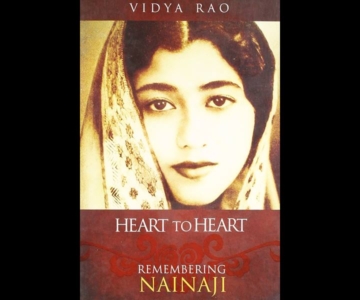
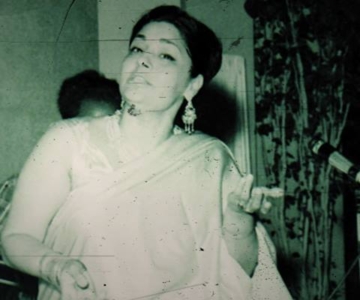
My dear friend Vidya Rao’s labour of love is finally out. She has been working on this project for quite a while. Her book Heart to Heart: Remembering  Naina Devi is a tribute to her teacher, Guru and inspiration who trained Rao as a singer..

Legendary singer, Naina Devi  was born into a Bengali Brahmo Samaj reformist family in the early years of the twentieth century. A childhood replete with music, dance, theatre and social reform gave way to the grandeur and seclusion of the life of a young queen of the Kapurthala royal family of Punjab. Despite seventeen  years of silence necess
itated by the norms of a royal household, she came back to music and a glorious career as a singer, arts-administrator, teacher and patron,  after the tragic death of her husband.

Heart to Heart, traces Naina Devi’s incredible story as she told it to her foremost disciple, Vidya Rao. Naina Devi’s  story traces the changes in the world of Indian classical music, women singers and women in Indian society  over the last century.  Learning seena-ba-seena, heart to heart, in a seamless blend of music and life-lessons,  Rao imbibed not
just a knowledge of her chosen form, Thumri,  but a sense of the very being of her teacher.

The evocative  narrative weaves back and forth between history  and memory,  past and present, and between Naina Devi’s voice and Rao’s own, to illuminate the power  and beauty of music, the lives of these two women and of many others,  of courage, pain, joy and love, and  of the deep bond between Rao and her beloved Guru.

Here’s a detailed review published here (more…)

Reclaiming the legacy of ZA Bukhari

18 October 2011

By Raza Rumi

Defining ‘Pakistani’ culture has been a problematic endeavour right from the inception of the country. Pakistan has straddled between 5,000 years of its ancient past, a thousand of years of Muslim rule in the Indian subcontinent, and the secular, plural reality that exists to date. Few individuals attempted to understand this. And fewer could actually lead the arduous process of articulating and shaping a truly nuanced and composite Pakistani culture. Zulfiqar Ali Bukhari, popularly known as ZA Bukhari, was one such Renaissance man who will always be remembered for his life and works, but more importantly for filling the void, which was created due to the truncation of Indo-Muslim identity in 1947. At the time of Independence, Pakistan was beset by the greatest of its challenges, ie of coming to terms with its past and deciding about its future trajectory, conflicts which remain unresolved despite six decades of fruitless struggles. (more…)

Sufi rock by an immensely talented band

19 December 2010

This video is from the band Da Saaz. Dhruv Bilal Sangari is singing and Raoul Amaar Abbas has directed, produced and shot all the trippy light

On ‘The Melodious Age of Mehdi Hasan’

18 October 2010

A book review published in DAWN mentions my piece on Mehdi Hasan:

… Raza Rumi’s piece ‘The Melodious Age of Mehdi Hasan’ discusses in reasonable detail the socio-cultural impact that Khan Sahib has had on Pakistani society.

Beginning from his birth (in the town of Luna in district Jhunjhunu, Rajasthan in 1927) he touches upon the early struggling phase of his life and then, in lyrical prose, talks about the society that he is a part of and how music in particular and the arts in general are looked upon.

He writes, ‘Our greatest artists, singers, poets and intellectuals have suffered at the hands of a conformist society and state captured by puritans especially since the late ’70s.

It is never too late for the intelligentsia of this country to mobilise public pressure on the state machinery so that it learns to respect cultural diversity and the imperative to nurture a creative, healthy and civilised society.’

Showering compliments on Khan Sahib, Raza Rumi rounds off his article by claiming, ‘Miyan Tansen must be proud of his new age prodigy.’
(more…)

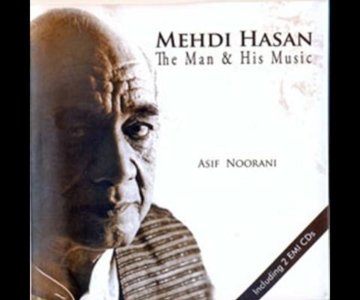
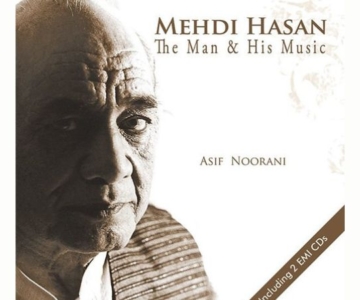
Mehdi Hasan: The Man & His Music

30 September 2010
A new book on Mehdi Hasan, originally uploaded by Jahane Rumi.

My essay on Mehdi Hasan has been published in this book compiled by Asif Noorani Saheb. This is a memorable collection of essays, reminisces and two CDs of choicest music from Mehdi Hasan. The greatest of Pakistan music icons deserves much more but this little offering brought tears to his eyes. Here is an excerpt from the essay which I will post after a permission from the publishers:

“But this has been our tragic tradition. Our greatest artists, singers, poets and intellectuals have suffered at the hands of a conformist society and state captured by puritans especially since late 1970s. It is never too late for the intelligentsia of this country to mobilise public pressure on the state machinery so that it learns to respect cultural diversity and the imperative to nurture a creative, healthy and civilised society.
Tansen taught us how music is a route to immortality. An ailing Mehdi Hasan in 2010 is fighting with death. His longevity is ensured. Tansen must be proud of his new age prodigy. “

Outstanding rendition – Khwaja meray Khwaja

11 July 2010

This is a fabulous, almost flawless performance by Sreeram, an aspirant for the Indian Idol selection. Originally rendered by A R Rahman, this young talent has given a new dimension to this ode to South Asia’s celebrated saint Khawaja Muinduddin Chishty of Ajmer.

Khwaja Mere Khwaja By SHREERAM

Music sans frontiers

14 May 2010

by GEETA NANDAKUMAR

Song of the soul Farida Khanum

‘Aaj jaane ki zid na karo, haaye mar jaayenge ham to lut jaaenge, aisii baatein kiyaa na karo’.
Strains of her most popular ghazal in all the grandeur of her voice wafted all over the room. Rehearsing for a concert organised by the Indian Council for Cultural Relations and the NGO ‘Routes to Roots’ at the FICCI auditorium in New Delhi this week, Pakistan’s legendary ghazal icon Farida Khanum, looked svelte and poised even in her 70s. She was busy chiding the tabla accompanist, asking him to tone down the percussion. “Flow gently with the music,” she told him. Turning to me with a welcoming smile and immense warmth, she said, “There is too much cacophony and too little mellifluous music these days. Often, I am completely put off by the raucous play of percussion and refuse to sing even in Pakistan.” The irritation was palpable. The rehearsal continued as I soaked in the rich voice. Music that is manna! Age has only added to the infinite variety of her music. Finally, she broke off and asked for another percussionist. (more…)

8th International Mystic Music Sufi Festival

20 April 2010

Sufi Music and Expression of Devotion from the Muslim World is one among a rare festival initiated in Pakistan by Rafi Peer Theatre Workshop.Performance Schedule (more…)

Iqbal Bano sings Nizami Ganjavi (Persian Sufi poet, 1141-1209)

20 March 2010

Mara ba ghamza kusht o qaza ra bahana sakht
Khud sooy e ma na deed o haya ra bahana sakht (more…)

The golden voice of Asha Bhosle (2008 concert in LA, USA)

20 March 2010

NPR has featured Asha Bhosle (12,000 songs and the greatest of Bollywood divas) and her fabulous voice – this is what the text has to say (full article here and recording at Los Angeles on Ashaji’s 75th birthday)

Asha sang naughty songs, and she had somewhat of a naughty personality, and she had a personal life that also had some naughtiness in it — the fact that she had run away from home and divorces and marriage and all of that.”

Bhosle made the vamp her specialty, and “Dum Maro Dum” is one of her most famous songs in that persona. It was written by composer R.D. Burman, who not only worked extensively with Asha Bhosle, but also married her. Burman took advantage of Bhosle’s vocal versatility and created songs for her that brought Western musical influences to Bollywood — combining, say, congas with tablas, or finding some of the grooviest psychedelic rock sounds. If anything cemented her reputation as a bad girl or turned people on, it was this song, writer Lavanya Shah says. (more…)

Nusrat Fateh Ali Khan – Man Kunto Maula

10 March 2010

Old Nusrat recordings dressed up in dub reggae beats

6 March 2010

Hear old Nusrat recordings dressed up in dub reggae beats by producer Gaudi – courtesy NPR

(more…)

Allah Hoo by Nusrat Fateh Ali Khan

4 March 2010

“Allah Hoo” from the Monsoon Wedding soundtrack (courtesy NPR)

Farida Khanum Singing Raga Kamod – Manna for the Soul

23 February 2010

I am cross-posting my dear friend Fawad’s excellent post from here. The links here are worth visiting and the music is fabulous for those who have the ear for extraordinary melodies from Indo-Pakistan. Raza

The internet is a remarkable treasure trove and I continue to marvel at the doors of culture, information and connectivity that it has opened. My recent discovery is a wonderful collection of Hindustani Classical music on the file sharing site esnips. I have been spending hours listening to pieces I love and discovering unknown treasures of the sub-continent’s greatest vocalists.

Here’s my selection of the day; Farida Khanum singing Raga Kamod. This is unfortunately the kind of performance by the the sister of Mukhtar Begum and a disciple of Ustad Ashiq Ali Khan (son of the founder of the Patiala Gharana Ustad Fateh Ali Khan, one half of the legendary duo Aliya Fattu) that Pakistani audiences have witnessed only rarely. In a country with almost no appetite for classical music she shifted her focus to lighter forms of singing decades ago. (more…)

Jaipur, Faiz and Ali Sethi

14 February 2010

Ali Sethi recently attended the Jaipur literary festival and his extraordinary performance is now accessible to those who were not there. I should thank him for sharing this video. Ali’s instructions were also meticulous but I will not post them here except his concluding comment: the whole of the rest of the session is fantastic, and includes an excellent performance by Shabana Azmi as well as a very funny story told by Javed Akhtar about his first meeting with Faiz Sahib..

Click and enjoy!

Jaipur Literature Festival 2010

Next Page »