Jahane Rumi In search of the unsearchable: O, my soul! where would you find your house?

24Jan/100

Saadat Hasan Manto – part II

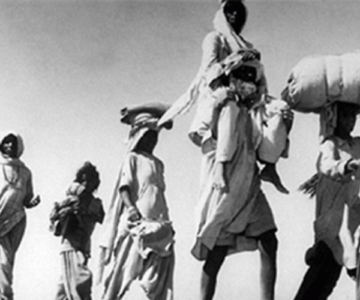
After partition of India Saadat Hassan Manto arrived in Lahore sometime in early 1948. In Bombay his friends had tried to stop him from migrating to Pakistan because he was quite popular as a film writer and was making reasonably good money. Among his friends there were top actors and directors of that age—many of them Hindus—who were trying to prevail upon him to forget about migrating. They thought that he would be unhappy in Pakistan because the film industry of Lahore stood badly disrupted with the departure of Hindu film-makers and studio owners. But the law and order situation post-partition of British India was such that many Muslims felt insecure in India, just as many Hindus felt insecure in newly created Pakistan. That was the reason that Manto had already sent his family to Lahore and was keen to join them. Manto and his family were among the millions of Muslims who left present-day India for the newly created Muslim-majority nation of Pakistan.

23Jan/103

Saadat Hasan Manto- Writer of Stark Realities

(Courtesy Iftikhar Chaudri) Saadat Hassan Manto (May 11, 1912 – January 18, 1955) was a Pakistani Urdu short story writer, most known for his Urdu short stories , 'Bu' (Odour), 'Khol Do' (Open It), 'Thanda Gosht' (Cold Meat), and his magnum opus, Toba Tek Singh'. Unfortunately having spent life on both sides of the border he was portrayed as an Indian writer in Pakistan and in India he was portrayed as a Pakistani writer. But truely he was a writer of the subcontinent above distinctions of coutry or religion.
He was also a film and radio scriptwriter, and journalist. In his short life, he published twenty-two collections of short stories, one novel, five collections of radio plays, three collections of essays, two collections of personal sketches.

22Oct/092

Urdu short stories – ‘The Myna of Peacock Garden’

Published in The Friday Times last week:

A new collection of translated short stories reminds us how Urdu literature needs to connect with a global audience, says Raza Rumi

As I hold the recently published “The Oxford Book of short stories” in my hands, I cannot help bemoan the fact that Urdu literature has been almost invisible from the arena of global literature. Admittedly, translation is difficult; the tediousness of translation daunts many a brave heart. Having said that, there have been a handful of remarkable translators such as Khalid Hassan, Alamgir Hashmi, CM Naim, Aamer Hussain, Umer Memon and Rakhshanda Jalil, to name a few. But a wide corpus of Urdu literature lies forlorn and hidden from global readership, which alas is dominated by English language readers. For this very reason, Amina Azfar has done a remarkable job of compiling a collection of Urdu short stories. Her earlier translations have been competent and quite often lyrical. For instance, Akhtar Hussain Raipuri’s Gard-e-Rahh (the dust of the road) and Sajjad Zaheer’s Roshnai ( the Light ) are noteworthy for their tone.

The book has a nice little foreword by Aamer Hussain, who is correct in stating that Azfar’s collection provides a fine introduction to the genre of the Urdu short story. The stories selected encompass a range of various experiments undertaken by the great Urdu writers. The stark realism of Munshi Premchand is counterpoised by Khaleda Hussain’s two short stories that are allegorical and somewhat postmodern in their sensibility. Iftikhar Arif, the renowned poet-bureaucrat, in his formal introduction quotes Dr Jamil Jalibi, terming the selected short stories “in the category of the very best”.