New Education Policy
A policy matter published in the iWrite Magazine
Raza Rumi responds to the new education policy for Pakistan
Yet another educational policy has been announced for Pakistan and its hapless citizens. We should not cast aspersions on the motives of an elected government, for we have been bitten by endless rounds of authoritarian rule which have not only destroyed the institutions of civilian governance, but have also demolished the integrity of our curriculum and mode of instruction. Decade after decade, dictators chose to glorify martial rule and later legitimized the abuse of jihad and violence. Even those who have studied at elite, expensive schools have somehow been doctored by the same curse of malicious textbooks. The surreal curricula have glorified looters and plunderers like Mahmud Ghaznavi only because they happened to be Muslims by a sheer coincidence of birth. Not to mention the Hindus, with whom we have coexisted for nearly a thousand years; they have been painted as treacherous, villainous and vile creatures ready to destroy the Muslims.
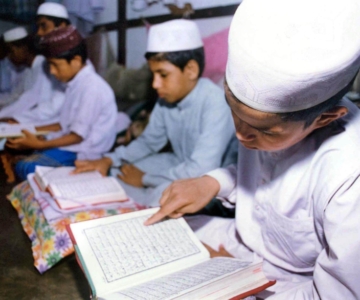
One would have expected that a legitimately elected government, representing the aspirations and pluralism of Pakistan's small provinces would take a strong stance on the revision of pernicious curricula. Alas, this is now a distant, buried dream for all. The policy is silent on that. This is a government that is waging wars on terrorism rather successfully and with clarity of purpose, but the educational policy makes little mention of the madrassa reform which is now an imperative for the very survival of Pakistan as a viable state. Thousands of madrassas scattered all over the place, funded by external powers preach hatred, bigotry and a reversion to the Dark Ages. Who will reform these madrassas if the national education policy does not even bother to lay out a strategy and provide resources? The new policy promises that by 2015, the budgetary allocation for education would increase to seven percent of the GDP from the current 2.1 percent of the GDP. This is surely promising but how can a policy not envision the need or the strategy to mobilize such resources? Have we not heard such sanguine proclamations in the past?
Issues in Madrassa Education in India
Yoginder Sikand's new book Issues in Madrasa Education in India published by Hope India, Gurgaon is a promising publication. Here is a review by Nasir Khan:
A number of books have been recently published on the madrasas of India, and, in addition to this, madrasas have become a subject of considerable debate in the mass media. This latest addition to the writings on Indian madrasas makes a valuable contribution to our understanding of the subject.
The issue of madrasa reform is much debated today, and several of the articles in this volume examine the question from various angles. The opening article of the volume, titled 'A Day in Deoband', based on the author's visit to the Dar ul-Ulum madrasa in Deoband, India's largest madrasa, suggests that even many traditionalist ulema, wrongly berated as being wholly opposed to change, actually do support madrasa reforms to some extent, although the way in which they imagine the project of reform substantially differs from that advocated by many outside the madrasa system. This emerges even more clearly in the following article, titled 'The State and Madrasa Reform: An Indian Deobandi Perspective'. The point is reiterated in subsequent articles, such as one on a Deobandi madrasa in Kashmir which is engaged in providing new forms of technical education in addition to traditional religious instruction, another on traditionalist madrasas in Kerala that have launched innovative experiments to combine religious and secular education, and yet another, on the educational model of the founder of the Jamaat-e Islami, Syed Abul Ala Maududi. A piece on the growing number of women's madrasas in India makes the argument that promoting women's rights from within a broader Islamic paradigm is also part of the project of madrasa reforms as even several traditionalist ulema see it. The author argues that this might have important consequences
in the future for the nature of religious authority as well as gender-relations among the Indian Muslims.