Posts Tagged lawyers

Asma Jahangir – A formidable fighter

8 November 2010

Fearless and a formidable fighter, Asma Jahangir personifies the struggles Pakistanis have initiated against shameful cultural practices, discriminatory legislation and executive excess. A frail woman has kept the torch of public liberties, freedom and democracy alive for decades. Born on January 27, 1952, in Karachi, Asma Jahangir during the last forty years has become a champion of women, child and minority rights and in many ways the conscience of Pakistan.

A leading Pakistani lawyer and an advocate of the Supreme Court of Pakistan, Jahangir is most renowned for her role as a human rights activist, a role which has made her confront military dictatorships of General Zia-ul-Haq and General Pervez Musharraf and the civilian autocrats. In 1972, Asma Jahangir was only 18 when she filed her first petition to have her father — who had been arrested for denouncing the genocide in Bangladesh — released from prison. In a landmark judgment ten years later, she won the case. In fact, the earliest and perhaps the only judgment against a military coup is now attributed to her name. Her resistance to army’s role in politics (more…)

Asma Jahangir’s election: A step towards a progressive Pakistan

30 October 2010

Asma Jahangir’s victory in the Supreme Court Bar Association elections is a momentous event in the country’s political and legal landscape. Even the worst of her critics grudgingly admit that her principled stance has remained consistent in a country where intellectual honesty and integrity are in short supply. More importantly, her reasoned approach to recent bouts of judicial activism has been a source of strength for stakeholders in the democratic process. Almost every progressive Pakistani has been overjoyed with her election as head of a professional body which was on the verge of losing its credibility due to indulgence in partisan politics.

Since the lawyers’ movement created a stir in 2007, the bars had started to assume the role of a political party with an exaggerated notion of their power. Instead of focusing on what ailed legal education and the maligned profession, the regulators had turned into rowdy mobs, televangelists and spokespersons of the free and restored judges. Encouraged, a Supreme Court judge reportedly remarked how ‘popular will’ was above the Constitution. The pinnacle of this approach was the judgment in the NRO case. Asma Jahangir and a few other sensible lawyers highlighted the problematic aspects of the verdict. This was a game-changer and Jahangir was at the centre of this rational discourse. (more…)

This night bitten dawn

2 April 2009

By Raza Rumi

The triumph of a popular movement on March 16 has marked a new beginning. The retreat of an intransigent government and the wise response by the PML-N and the lawyers averted a major crisis that could have been violent, and also a potential recipe for harming the parliamentary system in its infancy. There was a sigh of relief among the public for a long-standing issue appeared to have been resolved. This has been a monumental achievement by all standards.

However, the inherent imbalances within Pakistan’s power structure and the state of its polity are yet to be addressed and the contradictions of how our power is exercised stared us as the good news rolled out through the ubiquitous TV channels and their zealous presenters. The way quintessentially political issues and turf-wars between the PPP and PML-N were battled and resolved through a stage-managed process only concealed the bitter power-realities of Pakistan. (more…)

Suicide Democrats

5 March 2009

Raza Rumi

I am appalled by the recent events that have yet again stirred instability and uncertainty into Pakistani politics. Those of us who voted in last year’s elections expected that the political leaders and Pakistan’s political elites would learn a lesson from our unfortunate history.

We also expected the lawyers’ movement, headed by men of extraordinary calibre, to display sagacity and vision and contribute to the consolidation of a democratic culture. However, what we witnessed was a complete rejection of the Feb 18 polls by the leading lights of the movement, and a few other naïve political actors. When the electorate voted in large numbers and returned the two mainstream political parties to the parliament, the lawyers, instead of accepting that they were wrong to boycott elections, insisted on their narrow and bourgeois interpretation of the term “rule of law.” (more…)

Guest Stars at the Long March

29 June 2008

My article that appeared in Dawn. here.

THE enthusiasts for the long march towards Islamabad are justifiably feeling let down by the grand posturing, thundering rhetoric and the subsequent retreat from agitation outside the dreary citadels of power in Islamabad’s dark heart.

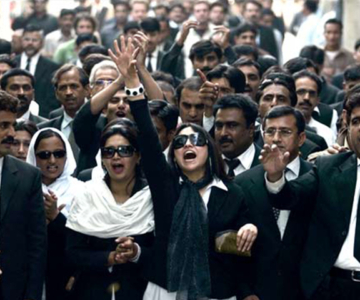
A Bastille, which was not meant to be? Interpretations abound and explanations are flowing in from the motley groups who ventured to change the contours of state-society relations. The lawyers’ movement is profoundly significant. It constitutes the finest historical ‘moment’ in our troubled history. However, many observers have hinted at its limitations and the problematic phase that the movement has now entered.

Unlike China, Pakistan’s long marches have been nefarious for their results. Orchestrated by political and non-political actors to undermine the democratic process, we are well aware of this stratagem. This time it was different, complex and refreshingly path-breaking alas with similar results: pressurise the beleaguered PPP government still trying to find the proverbial power-ground beneath its truncated legs. In that sense, the march was a roaring success. From the sloganeering against the much maligned Asif Zardari, to de-legitimising three decades of PPP’s valiant struggle against dictatorship culminating in the assassination of Benazir Bhutto.

Irony, that all is now a forgotten snippet of history. What is indeed more pressing, as we are told time and again, are the sacrifices made by the honourable judges. Indeed they have altered the parameters of the state and perhaps buried the subordination of the judiciary to the all powerful executive. Well, one may ask what about Asif Zardari and his eleven and a half years in jail without a single conviction? Therefore the vilification of Zardari by anti-Musharraf sections of the media and by the historical long march is symbolic. It is a testament to the deep-seated middle class trend of demonising politicians and party politics that are prerequisites for democracy and means to establish the ‘rule of law’.

The opportunism of individuals and groups jumping onto the lawyers’ bandwagon is also alarming. It is most convenient to have been all-powerful army chiefs, heads of the ISI and former honchos of the civilian bureaucratic monolith and once the party is over, re-christen yourself as firebrand democrats. The patriotic Hameed Guls, Aslam Begs and Faiz Ali Chishtis and the neo-constitutionalist Roedad Khans and right-wing ambassadors (who slept while Afghans were killed for strategic depth), must be questioned by the anti-Musharraf movement for it was their historical culpability that undermined civilian governance. Is it not important that circumspection be exercised while letting them be the spokespersons of the new vanguard? If Zardari has to be isolated then these dubious characters must also be questioned. (more…)

Naeem Bokhari – More sinned against than sinning

28 September 2007

Yesterday, All Things Pakistan published my little protest against the uncalled for treatment of the much maligned Naeem Bokhari. A few excerpts here..

we read the news that Bokhari was manhandled by his ‘black-coated’ fraternity when he re-appeared in the Courts after a long break. Naeem Bokhari broke the silence and wrote in The News on what exactly transpired on that fateful day when the Rawalpindi lawyers’ ‘fury’ resulted in his humiliation and ruthless thrashing.

Bokhari painted a harrowing picture of his treatment. He alleges that he was forcibly pushed out of the courtroom and hit on the head again and again. At the end of this mob frenzy, Bokhari and his associate were severely beaten. Symbolically Bokhari’s coat was snatched and his shirt was torn. Humiliating as it is, the whole incident is reminiscent of tribal notions of justice.

While the misgivings against the perceived collaborators of the executive may be justified, such abusive treatment is not. It is plainly out of the ambit of the laws and code of conduct under which the legal profession is regulated. In fact, such incidents can taint the heroic image that the lawyers’ bodies have earned through their relentless, spectacular struggle.

And..

Would it be too much to ask that the Supreme Court should take suo moto notice of this incident and reaffirm that it is the ultimate guardian of constitutional rights and that it will not let its law-officers, especially in their name, behave the way an unaccountable executive governs.

Read the full article and comments here