Dholavira: A Harappan Metropolis
Found this interesting post on Shunya
The road to Dholavira goes through a dazzling white landscape of salty mudflats. It is close to noon in early April and the mercury is already past 100F. The desert monotones are interrupted only by the striking attire worn by the women of the nomadic and semi-nomadic pastoral tribes that still inhabit this land: Ahir, Rabari, Jat, Meghwal, and others. When I ask the driver of my hired car to stop for a photo, they receive me with curious stares, hoots, and giggles.
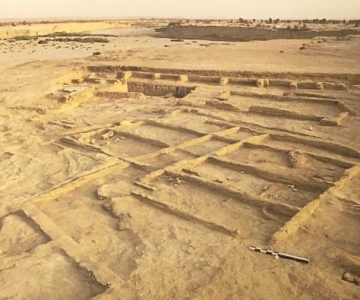
This is the Rann of Kutch, an area about the size of Kuwait, almost entirely within Gujarat and along the border with Pakistan. Once an extension of the Arabian Sea, the Rann ("salt marsh") has been closed off by centuries of silting. During the monsoons, parts of the Rann fill up with seasonal brackish water, enough for many locals to even harvest shrimp in it. Some abandon their boats on the drying mudflats, presenting a surreal scene for the dry season visitor. Heat mirages abound. Settlement is limited to a few "island" plateaus, one of which, Khadir, hosts the remains of the ancient city of Dholavira, discovered in 1967 and excavated only since 1989.
Entering Khadir, we pass a village and find the only tourist bungalow in town. It hasn't seen a visitor in three days; I check in and head over to the ruins. I've planned this for months; even the hottest hour of the day cannot temper my excitement for the ruins of this 5,000 year-old metropolis of the Indus Valley Civilization. While hundreds of sites have been identified in Gujarat alone, this is among the five biggest known to us in the entire subcontinent, alongside Harappa, Mohanjo-daro, and Ganeriwala in Pakistan, and Rakhigarhi in India. Read more here
Capitulating Rajas: why Taliban might not be resisted

My new piece for The Friday Times
South Asian history is a tale of capitulation of local elites before external invaders. Be it the Aryans, the Mongols or East India Company officials, we have always relented, and sometimes quite painlessly. This is an area of history that remains less explored as it conflicts with the grand narratives of ‘resistance’ and nationalist myths we love to construct.
A phrase locked into our cultural memory – Hunooz Dilli Door Ast (Delhi is as yet far away) explains this historical pattern. It has become a metaphor for the insularity of the elites and the powerlessness of the common people. The complacency that Delhi, the capital of the Islamic empire was not accessible to the hordes of invaders, was the tragic reaction by debauched kings, local Rajas and their henchmen who were either men of straw or active collaborators.
Saving Kahoo Jo Daro
Read this impassioned appeal in the press - it also alerted me to the situation that haunts this ancient relic.
The city is built beside an old Buddhist metropolis of 4th century. There are remnants of the Stupa in ancient city known as Kahoo Jo Daro.
The Stupa on Moen Jo Daro , Kahoo Jo Daro and some other un-excavated Stupas can be classified as the lower Indus basin sites. They are different in art & material. Mud & terracotta is widely used instead of stone.
On Damadam Mast Qalandar
The unrelenting terror trail across India recalls young Pakistani author Raza Rumi’s wistful remark that Hindu-Muslim amity seems like “a fairy tale from Never-Never land”. But surely India can wake up and recall how she managed things? Here’s an old story about one of modern India’s favourite songs, Damadam Mast Qalandar. Runa Laila of Bangladesh, Reshma of Pakistan and the Wadali Brothers of India have all sung it. The song came back this month with Ruby, Reshma’s daughter, who was in Delhi to sing at a Deepavali party held in a Muslim gentleman’s house.
The fact is that Jhuley Lal and Lal Shahbaz Qalandar are the patron saints of both Hindus and Muslims. Jhuley Lal (or Udero Lal/Amar Lal/Lal Sain) is said
Extracts from Empires of the Indus by Alice Albinia
From the Guardian
Water is potent: it trickles through human dreams, permeates lives, dictates agriculture, religion and warfare. Ever since Homo sapiens first migrated out of Africa, the Indus has drawn thirsty conquerors to its banks. Some of the world's first cities were built here; India's earliest Sanskrit literature was written about the river; Islam's holy preachers wandered beside these waters. Pakistan is only the most recent of the Indus valley's political avatars. I remember the first time I wanted to see the Indus, as distinctly as if a match had been struck in a darkened room. I was twenty-three years old, sitting in the heat of my rooftop flat in Delhi, reading the Rig Veda, and feeling the perspiration running down my back. It was April 2000, almost a year since the war between Pakistan and India over Kargil in Kashmir had ended, and the newspapers which the delivery man threw on to my terrace every morning still portrayed neighbouring Pakistan as a rogue state, governed by military cowboys, inhabited by murderous fundamentalists: the rhetoric had the patina of hysteria. But what was the troubled nation next door really like? As I scanned the three-thousand-year-old hymns, half listening to the call to prayer, the azan, which drifted over the rooftops from the nearby mosque (to the medley of other azans, all slightly out of sync), I read of the river praised by Sanskrit priests, the Indus they called 'Unconquered Sindhu', river of rivers. Hinduism's motherland was not in India but Pakistan, its demonized neighbour.
At the time, I was studying Indian history eclectically, omnivorously and hastily – during bus journeys to work, at weekends, lying under the ceiling fan at night. Even so, it seemed that everywhere I turned, the Indus was present. Its merchants traded with Mesopotamia five thousand years ago. A Persian emperor mapped it in the sixth century BCE. The Buddha lived beside it during previous incarnations. Greek kings and Afghan sultans waded across it with their armies. The founder of Sikhism was enlightened while bathing in a tributary. And the British invaded it by gunboat, colonized it for one hundred years, and then severed it from India. The Indus was part of Indians' lives – until 1947.
The city is built beside an old Buddhist metropolis of 4th century. There are remnants of the Stupa in ancient city known as Kahoo Jo Daro.