Shah Hussain, Madhu Lal and the festival of lights

Lahore is celebrating Mela Chiraghan - the death anniversary of the elusive saint Shah Hussain who is also known as Madhu Lal Shah for his life long association with a Hindu disciple called Madhu Lal. Each year in spring the festival of lights is attended by thousands of people.
Lighting of lamps is a metaphor for killing the inner darkness that we live with. By invoking spiritual light through love and self-knowledge, we can overcome ourselves and attain the mystical state of union with the beloved.
Madhu Lal's syncretic shrine represents the long-gone era of spirituality rising above religious identities and rituals. Here is a kaafi poem with translation on this blog. A few lines :
They alone know what is love and longing,
Who have it in their lives.
Like digging a well in dry land,
With no cart to carry away the sand.
Imam Hussain: The Beloved of the Beloved
by Syed Salman Chishty
Shah Ast Hussain
Among the Belivers are Men ,who delivered their promise to Allah
(Ayah 23/ Surah Al-Ahzab)
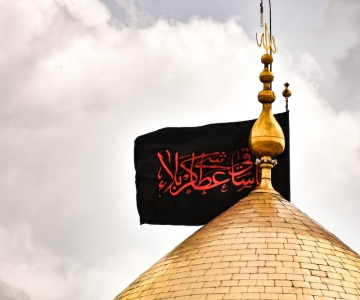
On the 10th of Muharram, 61 after Hijrah (680 AD) Hz.Imam Hussain was martyred by the army of Yazid. This tragedy shook the Muslim world and continues to be remembered by those who love the Prophet (saw) and his family. The death of Hz.Imam Hussain , his struggle for truth, justice and the greatness of Islam is still remembered and commemorated today.
The Battle of Karbala (Mir Anis)
Mir Anis is a classical master of Urdu poetry whose elegies on the struggles between Imam Hussain, prophet's grandson and the usurper, callous monarch Yazid are immortal. Today is the 10th of Muharram signifying the epic Karbala battle and the martyrdom of Imam Hussain. The mourning for Hussain and his family is not complete without a reference to Anis and his peer Dabeer. Luckily I found a Marthiyaa of Anis, that has been translated into English David Matthews, published by Rupa Co.
Shah Ast Hussain
Khawaja Ghareeb Nawaz's immortal verses on the status of Hazrat Imam Hussain (AS)
Shah ast Hussain, Badshah ast Hussain
Deen ast Hussain, Deen Panah ast Hussain
Sardad na dad dast, dar dast-e-yazeed,
Haqaa key binaey La ila ast HussainAnd a rough translation -
Ruler is Hussain, Emperor is Hussain,
Faith is Hussain , guardian of faith is Hussain .
Offered his head and not the hand to Yazid.
Indeed, Hussain is the foundation of La-ilah
Shah Ast Hussain
10th Moharram is a day of mourning for all Muslims. The tragic incident at Kerbala where the righteous Hussain refused to submit to the autocracy of Yazid is an event laden with deep symbolism. Hazrat Imam Husain and his faithful companions preferred to die on the banks of river Euphrates and upheld the struggle of good against the evil.
Khawaja Muinuddin Chisty's powerful verses epitomise the reverence and devotion of Muslims towards Imam Hussain:
Shah ast Hussain, Badshah ast Hussain
Deen ast Hussain, Deen Panah ast Hussain
Sardad na dad dast, dar dast-e-yazeed,
Haqaa key binaey La ila ast Hussain
Loosely translated
Ruler is Hussain, Emperor is Hussain,
Faith is Hussain , guardian of faith is Hussain .
Offered his head and not the hand to Yazid.
Truly, the mirror of faith is Hussain
As Adil Najam writes on All Things Pakistan:
Growing up in Pakistan, the night of Ashura was always defined for me by the Majlis i Shaam i Gharibaan (often by Allama Naseer ul Ijtihaadi) on PTV on the night of dasveen Muharram, which was followed immediately - and at right about midnight - by Syed Nasir Jahan's soulful recitation of Salam-i-Akhir.
Bachay to aglay baras hum hain aur yeh gham phir hai
Jo chal basay tou yeh appna salam-i-akhir hai
His soulful voice, so pregnant with a deep and heartfelt pain, always echoes in my head when I read of continuing sectarian violence and the instigation of sectarian hatred.
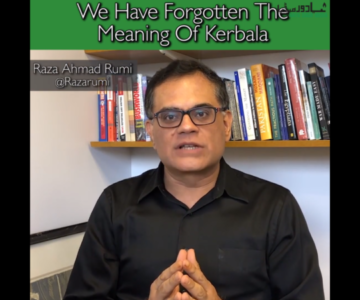
However, the ugly face of sectarianism is now haunting the entire Islamic world. There have been deaths in Pakistan recently and I have forgotten the number of people dying each day in Iraq. Forgotten? Yes, it sadly increases by the day..
And the true spirit of this sacrifice by Prophet's family gets clouded by politics and imperial projects.
And for the poor Iraqis, Kerbala is not an event from their distant past.
As I hold the recently published “The Oxford Book of short stories” in my hands, I cannot help bemoan the fact that Urdu literature has been almost invisible from the arena of global literature. Admittedly, translation is difficult; the tediousness of translation daunts many a brave heart. Having said that, there have been a handful of remarkable translators such as Khalid Hassan, Alamgir Hashmi, CM Naim, Aamer Hussain, Umer Memon and Rakhshanda Jalil, to name a few. But a wide corpus of Urdu literature lies forlorn and hidden from global readership, which alas is dominated by English language readers. For this very reason, Amina Azfar has done a remarkable job of compiling a collection of Urdu short stories. Her earlier translations have been competent and quite often lyrical. For instance, Akhtar Hussain Raipuri’s Gard-e-Rahh (the dust of the road) and Sajjad Zaheer’s Roshnai ( the Light ) are noteworthy for their tone.