Posts Tagged Governor

Last chance for Pakistan

9 January 2011

Taseer’s brutal murder has exposed every faultline of contemporary Pakistan

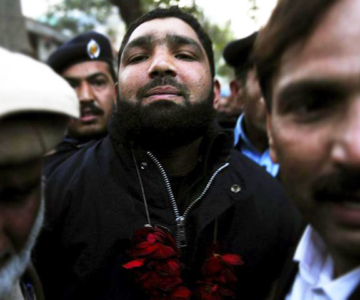
The brutal assassination of Governor Punjab, Salmaan Taseer by a staff member of Punjab’s supposedly, professional ‘elite force’, has virtually exposed every fault line of contemporary Pakistan. That a constitutional figurehead of a province with no executive authority or legislative power could be murdered simply for dissenting with the extremist worldview, is shocking to say the least. However, the tragedy has compounded further, much like the dark denouement of a Greek tragedy. The well-organized, ruthless and all-powerful extremist forces have jumped into the fray, and challenged the actuality of a cold-blooded murder. Clerics of all shades and varieties have tried to condone this act of barbarity and reactionary lawyers have promised to defend ‘Ghazi’ Mumtaz Qadri – a self-confessed killer – free of cost. Above all, public opinion has never been shamelessly manipulated in Pakistan as it is being done today by sections of electronic media who have gone out of their way to dilute the immensity of this event, and short of condoning it, have attempted to justify the motives of the criminal Qadri and his followers (which alas, are in the millions across Jinnah’s Pakistan).

Identity Mess

Much has been said about Pakistan’s warped identity, and it is a cliché to say that it is a tottering society in search of an identity. It should be clear to all and sundry now that large numbers of its residents, thanks to state-led indoctrination and a poisonous educational system, have espoused the right-wing interpretation of Pakistan as a theocratic state and that too, of a particular variant of Sunni Islam. This dangerously imagined polity excludes a large number of Muslims who belong to different schools of thought within the plural and complex range of Islamic faith. The minorities in Pakistan have suffered throughout their history, and their invisibility and insecurity is now a given fact of life.

Taseer struggled to raise voice from his public office and challenged the hegemony of Islamicist discourse, which makes this imploding ‘fortress of Islam’ as a repository of a faith-based nuclear bomb, thousands of armed militants ready to die in Jihad and irrationality driving all forms of decision-making – from foreign policy and economy, to municipal issues (such as the regulation of loud speakers in neighborhoods). In effect, Jinnah’s Pakistan is long dead and Zia’s Pakistan lives on in its full glory. (more…)

Another blow to Pakistan: Salmaan Taseer killed by extremism

4 January 2011

Punjab Governor Salmaan Taseer’s brutal murder at the hands of a security personnel is a cruel reminder of where we have landed ourselves: in a dark morass of irrationality lorded over by pernicious ideologies.

He was a brave man and stood for a liberal, tolerant and progressive Pakistan where economic and political freedoms could be upheld. He has paid for his life for his bold stance on the blasphemy law and countering Talibanisation. He was our hope and without him Jinnah’s Pakistan – NOT a theocracy – is in grave danger.

His legacy will be remembered by history and he will go down in history as a major icon of progressivism.

May he rest in peace. PTH mourns his loss and condemns this attack. The federal and provincial government should immediately investigate this murder and punish the criminal as well as the network behind him.

The war against extremism will have continue – otherwise, we are headed towards anarchy, more sectarianism and utter chaos.

Long live Pakistan!

Pakistan: turmoil,implosions and drama

26 February 2009

Pakistan is once again in political turmoil. Two popular Punjabi leaders are disqualified by a court that has been maligned over the last few months. Governor’s rule has been imposed in the larger province – epicentre of Pakistani power.

Overall these recent developments do not bode well for democratic development – after all it has only been a year but it seems that our political elites have learnt no lesson from history and even their personal tribulations. Both Zardari and Sharif have suffered over the last decade and their parties were in the wilderness. And, now they cannot resolve their differences. What a shame. It does not matter who is right or wrong – the country gave a split mandate last February and both parties had the obligation to cooperate and perform. It appears that our expectations from the elected leaders were way too many. They remain their old, bickeringselves.

At my other blog-zine Pak Tea House, I have posted a few interesting analyses. Do visit if you want to see how the debate is unfolding: the rationalist argument, the political insight and a ‘scathing comment on the Sharifs of the situation.

The story of an ivory chair – Murshidabad’s gift to Hastings

5 June 2008

Dr Amin Jaffer, the expert on Indian arts and furniture, currently working at Christie’s holds forth in a conversation below. The chair above is a fine work of craftsmanship and amalgamation of Eastern and Western aesthetics in the eighteenth century India. The chair was presented to the infamous Warren Hastings by the female Rani (ruler) of Murshidabad. Amazing that it survives…

we’re very lucky to have found a group of correspondence relating to Warren Hastings and the ruler of Murshidabad, the old princely capital of the state of Bengal and she was the regent, she was called Mani Begum, who was originally a dancing girl and she married the Nawab and when the Nawab died and there was a sort of power vacuum, Warren Hastings installed her as the regent and she thanks Hastings and his wife Marion by giving them, over a number of years, pieces of very, very high quality ivory furniture.
And when Hastings comes back to England, it’s his agent in Calcutta who’s transacting the shipping of the furniture and Hastings asks him repeatedly to give letters to the Begum to thank her or to tell her how fantastic the furniture looks in the house in Dalesford – Warren Hastings’ great house which he built in the Cotswolds and that’s how we really know that this piece, one of a pair, belonged to this great important commission.
(more…)

Hazrat Ali’s letter on governance and citizenship

7 December 2007

The common stories about Islam or Muslims have to do with the chopping of arms and killing of infidels. We are told that Muslims had a great empire, after many conquests and subjugation of the ‘infidels’. And what have we learned in the textbooks: Ali (AS) was a brave general with a legendary sword? Have we heard this:

Do not close your eyes from glaring malpractice of officers, miscarriage of justice and misuse of rights, because you will be held responsible for the wrong thus done to others. In the near future, your wrong practices and maladministration will be exposed, and you will be held responsible and punished for the wrong done to the helpless and oppressed people.

Fahmida Riaz is Pakistan’s premier female poet. She became a sensation in the early 1970s when her bold, feminist poetry created a stir in the convention ridden world of Urdu poetry. Riaz was expressive, sometimes explicit, and politically charged. She created a completely new genre in Urdu poetry with a post-modern sensibility. Later, she remained prominent with her defiance of General Zia’s martial law, her exile to India and the continuous evolution of her fiction and poetry.

Since the late 1990s, Fahmida Riaz has discovered Jalaluddin Rumi, the 12th century Turkish poet and jurist, and now an international celebrity. Her recent publication “ Yeh Khana-e aab-o-gil” is a unique translation of Rumi’s ghazals in the same rhyme and meter. Since her navigation of the Rumi universe, she has explored another dimension of her individual and cultural consciousness, where the influence of Islamic scholars and Sufis is paramount.

Last winter, she read a letter by Hazrat Ali bin Abi Talib (AS), the fourth Caliph and son-in-law of the Prophet Mohammed (PBUH), while browsing a translation of Nahaj ul Balagha (a collection of sermons, letters and sayings of the Caliph). Later, in an email, she related to her friends across the globe how angry she felt for not knowing about this letter all her life, and how the real jewels of Muslim history were concealed generation after generation.

At the time she was preparing for a Conference at Heidelberg, Germany. Lo and behold, she made a dramatic speech about Ali’s (AS) letter at the international moot. Thereafter she showed the text of the letter to Dr Patricia Sharpe, a US-based writer who was impressed by it and immediately paraphrased and uploaded it to on her website under the title Good Governance Early Muslim Style.

Ali (AS) had written a comprehensive letter  articulating principles of public policy for the guidance of the newly appointed Governor to Egypt, Maalik al Ashtar. In this fascinating directive, Ali (AS) advises the new governor that his administration will succeed only if he governs with concern for justice, equity, probity and the prosperity of all. There is a timeless applicability of this famous letter. Selected passages from the text are reproduced below:

Religious tolerance: Amongst your subjects there are two kinds of people: those who have the same religion as you [and] are brothers to you, and those who have religions other than yours, [who] are human beings like you. Men of either category suffer from the same weaknesses and disabilities that human beings are inclined to; they commit sins, indulge in vices either intentionally or foolishly and unintentionally without realising the enormity of their deeds. Let your mercy and compassion come to their rescue and help in the same way and to the same extent that you expect Allah to show mercy and forgiveness to you . (more…)