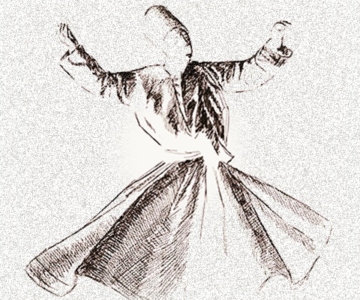
I am a child of love
I profess the religion of love,
Love is my religion and my faith.
My mother is love
My father is love
My prophet is love
My God is love
I am a child of love
I have come only to speak of love
- Jalaluddin Rumi
Ask us about the lion of God
This caravan is not bringing our baggage -- it has
none of the fire of our Friend.
Though the trees have all turned green, they
have caught no scent of our spring.
Your spirit may be a rosegarden, but its heart
has not been wounded by our thorn.
Your heart may be an ocean of realities, but its
boiling does not compare with that of our shore.
Although the mountains are very steady -- by
God, they do not have our steadiness.
The spirit drunk with the morning wine has not
even caught a scent of our winesickness.
Venus herself, the minstrel of heaven, has not
the capacity for our work.
Ask us about the lion of God -- every lion has
not our backbone.
Show not Shams-I Tabrizi's coin to him who
has not our fineness!
-- Ghazal (Ode) 695
Translation by William C. Chittick
"The Sufi Path of Love"
SUNY Press, Albany, 1983
The Destruction of Holy Sites in Mecca & Medina – Destroying Islamic Heritage
The Asian Age: The Arabian Peninsula, the cradle of Islam, is being demolished by hardliners. In countries such as Saudi Arabia almost all of the Islamic historical sites are gone, but this is not the first time they have been destroyed.Out, Out, Damned Atheists – Karen Armstrong weighs in on God
Mir Taqi Mir’s discovery of Simurgh
Tha woh to rashke hoor-e-behesti hameen mein Mir!
Samjhe na hum to fahm ka apne qusoor tha
(That hoor from paradise was part of my being.
I blame it on my utter lack of comprehension of the Ultimate Truth).
Mir, like other great Urdu poets, has seen Simurgh.
Bauls of Bengal
Found this translation and music video here
The famous Bengali author Rabindranath Tagore was influenced by Bauls. He translated the following Baul verse into English in his book The Religion of Man. The quote highlights the mystic Sufi focus on celestial love:
Where shall I meet him, the Man of my Heart?
He is lost to me and I seek him wandering from land to land.I am listless for that moonrise of beauty,
which is to light my life,
which I long to see in the fulness of vision
in gladness of heart.
On Krishna and Ranjha – the syncretic Punjab
I am posting an article by Manzur Ejaz that was published by The Friday Times. This is a great piece:
Fascination with the naughty butter-thief Krishna in the Punjab remained the undercurrent of the cultural milieu for so long that Waris Shah’s Ranjha appears to be a reincarnation of Krishna in many aspects. Khawaja Ghulam Farid, the great Sufi poet, also considered Krishna a sacred prophet of the Hindus like all other prophets. But the question is how did the dark skinned Lord come to dominate the land of the fair Aryans who believed that a dark man ‘seen seated in the market-place [is] like a heap of black beans.’
GOD-FORSAKEN RELIGIONS
A poem by Cecil Rajendra
Any religion
that sidelines
excludes
any one.
Any religion
that does not
open doors to
every one.
Any religion
that targets
fingerpoints
some one.
Any religion
that claims
it’s “the one
and only one”.
Any religion
whose language
is “we” / “they”
and not “us”.
All such religions
run against God
who is Oneness
& abhors divisions.
This Love — Quatrain from Rumi
This Love is the king,
yet a throne cannot be found.
It is the essence of the Koran
yet a verse cannot be found.
Any lover hit by the Hunter's arrow
will bleed all over,
yet a wound cannot be found.
-- Version by Jonathan Star and Shahram Shiva
"A Garden Beyond Paradise"
Bantam Books, 1992
O my Lord, if I worship you
Today I was directed to this excellent blogsite devoted to Rabia Basri's poems - found this bold poem by Rabia, an early Sufi from Iraq and one the better known women Sufi poet:
O my Lord,
if I worship you
from fear of hell, burn me in hell.
If I worship you
from hope of Paradise, bar me from its gates.
But if I worship you
for yourself alone, grant me then the beauty of your Face.
Sufi Qawwali – Mehr Ali and Sher Ali
Sadi has written a wonderful post here - I am cross posting it here.
Couple of nights back (24, April, 08) came an unanticipated opportunity to watch and listen to two of great contemporary pakistani sufi Qawwali singers at famous UCLA Royce Hall. The concert was titled, Qawwali Music of Pakistan: Sufi devotional music.Among the audience was both americans and sub-continental audience. What was striking, is Qawwali's ability to transcend language with its sheer power and captivating devotion. The nature of improvisation makes each Qawwali, even if its sung by the same group of singers, very unique and every new listening is a new experience.Sometime the depth of the verses, fused with the presentation takes audience to an otherly high which was felt last night too. At times there were goosebumps and surges with the strong emotion that is created in Qawwali performance. The Sufi Qawwalis are considered as zikr or Divine remembrance if listened with spiritual understanding and depth.:: What is Sufi Qawwali? | Qawwali is derived from the Arabic word qaul, literally meaning "saying" but has taken on the meaning of "belief"or "credo" in South Asian languages. Qawwali is spiritual in essence; it is the devotional music of the Sufis to attain trance and mystical experience - originating in the 10th century and blossoming into its present form from the 13th century onwards.
Einstein on Religion and Science
Came across this brilliant quote from Einstein:
In their struggle for the ethical good, teachers of religion must have the stature to give up the doctrine of a personal God, that is, give up that source of fear and hope which in the past placed such vast power in the hands of priests.
The excerpt from The New Horizon blog was a great discovery. Writing about articles on science and religion by Einstein it stated, and quite rightly:
Any Scientific minded person who considers himself as a religious or an atheist, should read these wonderful articles of Albert Einstein.
Sufi Zikr – inspiration for a painting
This is a painting that I revisited and converted its earlier abstract form into a calligraphic experiment. Now the challenge was that in addition to the lack of training in oil painting, I was also a novice in calligraphy. Anyway, the image inside Rumi's tomb that I posted on this blog earlier as well as the three attributes of the Almighty helped me in putting this together. The letters in the centre are Hu (affirmation of the Divine presence and a Sufi chant) and its mirror image. In Rumi's words:
Eternity is the mirror of the temporal, the temporal the mirror of pre-eternity - in this mirror those
two are twisted together like his tresses..(translated by Arberry).
This was truly inspirational as I remembered the lines with a brush in my hand. Another little flash was the three words that I have remembered abundantly thanks to a guide. Alas, I am out of touch with him.
The three words, familiar and lyrical, on the right side of the painting represent the key attributes of Allah : Ar-Rahman(the Beneficient), Ar-Raheem (the Merciful), Al-Kareem (the Generous).
Muslim mystics have chanted these names since centuries in the quest to attain inner peace and closeness to Divine consciousness.
With this little feat, I am sort of feeling peaceful myself.
Shah Abdul Latif Bhitai
If you are seeking Allah
If you are seeking Allah,
Then keep clear of religious formalities.
Those who have seen Allah
Are away from all religions!
Those who do not see Allah here,
How will they see Him beyond?
Let us go the land of Kak
Where love flows in abundance,
There are no entrances, no exits,
Every one can see the Lord!
There is no light nor day
Every one can see the Lord!
Those who love the Lord
The world cannot hold them.
Palaces do not attract them,
Nor women nor servants
Nothing binds them:
The renouncers leave everything behind.
A message came from the Lord:
A full moon shone
Darkness disappeared
A new message came from the Lord:
It does not matter what caste you are
Whoever come, are accepted.
Where shall I take my camel,
All is Light...
Inside there is Kak, mountain and valley,
The Lord and the Lord: there is nothing but the Lord.
(translated from Sindhi by D. H. Butani)
Legacy of Shah Latif is a recent book on Bhitai's life and works. In a recent book review, Anwar Abro writes:
"Two and a half centuries after his death, the celebrated Sindhi philosopher-poet Shah Abdul Latif Bhittai (1689-1752 AD) continues to inspire and influence the lives and activities of the peace-loving mystic souls of Sindh. Intellectual activities, social, political or ideological discourses are considered meaningless without the recitation of his poetry. Shah Latif has become an essential part of the day-to-day life of the people of Sindh so much so that everyone wants to find out more about his life, his principles and beliefs and discover the true interpretation of his mesmerisingly meaningful poetry..."
read more here
Picture above right is courtesy Himal Magazine
The Universalism of Kabir
Troubled by the ongoing middle east crisis, the destruction of Lebanon and the acrimony generated by the tragic Mumbai blasts, I am reminded of this poem by Kabir:

Allah and Rama
If Khuda inhabits the mosque,
then whose play-field is the rest of the world.
If Rama lives in the idol at the pilgrim station,
then who controls the chaos outside?
The East is Hari's domicile, they say,
the West is Allah's dwelling place.
Look into your heart, your very heart:
That's where Karim-and-Rama reside.
All the men and the women ever born,
Are nothing but Your embodied forms:
Kabir's a child of Allah-and-Rama
They're his Guru-and-Pir
(translated by Vinay Dharwadker in Kabir: The Weaver's Songs)

My
I visited this remarkable place recently spending my evenings and all the spare time at the shrine. I have met more and more people at the dergah including a devotee who also runs the Sufi Inayat Khan Center nearby. I will write more about that later.
Now that I have had some time to sort out my pictures, I am posting a few more here. These are dedicated to Marta and I hope she will find them inspiring again...