Jahane Rumi In search of the unsearchable: O, my soul! where would you find your house?

13Feb/101

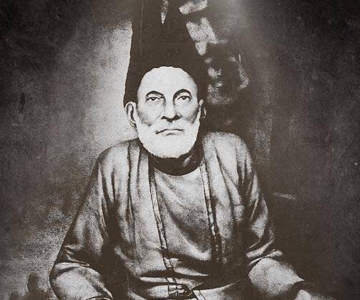
A rare portrait of Ghalib

Ghalib the Urdu poet who  described himself as a man-bitten muse, remains  immortal by way of his Urdu and Persian poetry and his modern witty prose. His religious views were secular even by the twenty first century standards - I wrote about his eclectic  poetry and also posted a piece on his little,  neglected Haveli in Delhi. Thanks to Aniket Alam, I discovered his photograph and am posting it here.

27May/091

Ghalib: Heart is a Mirror and Mirror a Heart

Ghalib: Heart is a Mirror and Mirror a Heart

I am absolutely mesmerised by this post and the verse that I only read after ten years at Mehr-i-Niimroz blog. Am just too tempted to cross post it here.

az mihr taa bah-;zarrah dil-o-dil hai aa))inah
:tuu:tii ko shash jihat se muqaabil hai aa))inah

1) from sun to sand-grain-- heart; and heart is a mirror
2) {from / by means of} the six directions, a mirror confronts the parrot

Translation and commentary on Desertful of Roses. Parallel commentary on The South Asian Idea.

25May/092

Cast the paradise into hell…(Ghalib)

Courtesy mehr-i-niimroz, I found one of my favourite verses from Ghalib

taa((at me;N taa rahe nah mai-o-angabii;N kii laag
doza;x me;N ;Daal do ko))ii le kar bihisht ko

1) so that, in obedience/worship, the attachment/desire of wine and honey does not remain
2) take Paradise, and cast it into Hell

Commentary here

16Nov/085

Fahmida Riaz: A neglected genius

My op-ed for The NEWS

Whilst my earlier piece on the IMF programme and the tremendous discussion it has invoked deserves a rejoinder, I want to write on a completely different subject this week. I am perturbed by the fact that thousands of jobs have been recreated for those who were rightly or wrongly dismissed in the earlier dispensations; there is silence about one luminary, a towering one at that, who lost state employment twice. Fahmida Riaz's name is yet to appear amongst the reinstated ones.

Following the physical departure of the leading Urdu poets – Qasmi, Munir and Faraz – Fahmida Riaz is arguably the greatest living poet of Pakistan. Controversial though this statement might be, her originality and path-breaking poetry has yet to find an equal in the turbulent waters of the Pakistani cultural river. It is hardly surprising that Fahimda Riaz has been targeted all through her otherwise illustrious creative career by state and society alike. She was branded as unpatriotic when she had to run for her life in the Zia-ul-Haq days and live in exile. In India, she was termed as a Pakistani agent since she criticised the communal tensions that the Indian state had encouraged.

22Oct/0812

Ode to Benaras – Ghalib’s grand vision

A Brahmin resident of Benaras

Ghalib

Benaras: “forever spring”

It is incredible that a Muslim poet who prided himself on his Turkic ancestry and invoked the “warrior” past in his day-to-day conversation (through his letters) could compare the divine light at Mount Sinai to the lamps at Benaras

The cancer of communalism and bigotry in South Asia continues to haunt us. These days, the Muslims are once again a subject of intense, though not always fair, scrutiny in India: their loyalties are being questioned and many are potential terrorists if not already abettors of violence. The post 9/11 world has contributed to the demonising of the Muslim identity and history to surreal heights.

The recent bomb blasts in Delhi have placed the communal discourse on the front pages. The invaders and violent Muslims have done it again. A friend called me from Delhi and narrated the profiling that takes place at marketplaces and how the gulf between different communities is widening.

There was a time, not in the ancient past, when in Delhi the greatest of Urdu poets Mirza Ghalib (1796-1869) lived in an age when Hindus and Muslims shared common saints, dargahs and even popular gods and goddesses. Written accounts of this age – the mid to late 19th century – relate how intimate co-exitence of “Mussalmans” and “Hindoos” had led to a relative amalgamation of customs among the common people. And poets like Ghalib could see the commonalities of spiritual streams:

I n the Kaaba I will play the shankh (conch shell)

In the temple I have draped the ahraam (Muslim robe)

The verse above delineates the Sufi concept of fana (or dissolution of the self in divine reality) and the unity articulated by the ancient Indian texts such as the Vedanta. Sufis were to elaborate this as the wahdat-al-wajood (Unity of Being) philosophy.

25Sep/088

Ode to Mirza Ghalib’s Haveli

This excellent post brought found here back so many memories - of my two memorable visits to the famed but neglected Haveli

Gali Qaasim Jaan was wrapped in fading darkness. A few tattered curtains hung listlessly on some doors. Pigeons flew overhead and some kids fought over marbles. Somewhere a goat tethered to a threshold, bleated timidly.This was Ballimaaran in the walled city of Delhi more than 150 years ago where one of the greatest masters of Urdu Poetry, Mirza Ghalib once lived.Mirza gave a whole new dimension to the world of Urdu Poetry, and has been hailed as one of the the true Masters. My desire to visit Mirza’s Haveli was soon going to be realized. Regardless of how well one knows the streets of Delhi, it is no joke to locate Gali Qasim Jaan where Mirza’s Haveli still stands.
It is a crying shame that what once was a two-storey Haveli has been reduced to barely a neglected remnant. Years of government indifference has led to severe misuse of the place.

Finally, the Archaeological Society of India took matters into its own hands and two ushers now look after the Haveli. Visiting hours are observed for tourists who long to feel the air, which still echoes with Mirza’s recitals.

28Jul/0810

Delhi by the book

Writing about the textbook enemy, the 'other', is but a daunting task. Facing the grandiose Humayun's tomb on a chilly January morning this year, I decided to write a book on Delhi.

It was not before I had visited the ancient city that I knew what it symbolised. In Pakistan, we were influenced by the glories of Lahore, my beloved city. Reconstructed histories had kept Delhi invisible. The seat of the Sultans, Mughals and the Raj, precursor of the modern united India and originator of the Indo-Islamic civilization was a mere phantom, best ignored.
Over several visits to Delhi, I realised that invisibility was also a shared curse. A good number of Delhi wallahs I met, had no clue where they lived or crossed the streets. Erasure, blank spaces in textbooks had rendered their own city a mythical other-world existing only in erudite books, rare cultural soirees and among the fading memories of old-Delhi.
When I looked for the house where Urdu's legendary poet Mir Taqi Mir lived, no one knows it. Those living in Hauz Khas are unaware of what it was. There are thousands, perhaps more, who have never visited Nizamuddin Bastee let alone the dargah there. Tracing history through books resembles a two-dimensional vision. Lived histories add other dimensions to the inner kaleidoscope. But there are so few who can help me.

I am pained when I am taken to the tomb of India's first female ruler Razia Sultana (1236 - 1240). Only centuries later another woman Indira Gandhi was to rule the Centre. Razia's grave languishes on an abandoned, filthy cul-de-sac. Many don't care. I wonder, should I?

As I have ventured out to write, the enormity of Delhi -- the idea -- haunts me. Where do I start? The layered construction of Indian, and Muslim identities in the subcontinent emanate from the ridges and Hades of Delhi. The saints buried under

11Jul/088

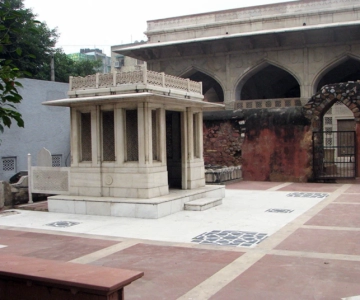
Ghalib’s grave – treasury of meanings is under the ground

The inscription on Ghalib's tomb-stone in Arabic and Persian followed by translation:

a hai'yii ya qaiyuum

rashk-e-'Urfi va faKhr-e-Talib murd Asadullah Khan Ghalib murd

kal maiN Gham-o-andoh meN baa khaatir-e-maHzuuN
tha turbat-e-ustaad pe baiTha hua Ghamnaak

dekha jo mujhe fikr meN taareeKh ke, Majruuh
haatif ne kahaa *ganj-e-ma'ani hai tah-e-Khaak*

the qita (composed four verses)  is by Mir Mahdi Majruuh; the phrase contains the chronogram of 1285 AH

---

The Alive, The Eternal [these are two of the names of Allah]

the envy of Urfi and the pride of Talib has died, Asadullah Khan Ghalib has died

[Urfi and Talib were Persian-Indian poets]

yesterday in sadness and mourning, grief-afflicted too

I sat by the Master's grave with sorrow profound

seeing me thinking of a tareeKh, Majruuh [taareeKh = chronogram]

a heavenly voice said, "treasury of meanings is under the ground"

15Jan/085

Journeying into mysticism (noted as one the best articles of 2007)

Indian Muslims Blog is now two years old. The IM team have compiled the best articles published at the blog in 2007. Shameless as it sounds, one of my guest articles - Journeying into Mysticism is included in the category. As the editor Mohib, said the "colorful downloadable pdf file is worth reading for the diversity of views and opinions. IM blog team has been most kind to allow me to occasionally contribute to the space. In the process I have learnt a lot about the country and its Muslim population. But most importantly, I have found a few good friends from Lucknow, Kakori, Bhopal, and Bihar among other places. wah wah, kiya kehnay blogosphere ke...

To blow my own little trumpet in this seamless and infinite blogosphere, here is my piece for those readers who may not have read it earlier.

Journeying into mysticism


I turn my face towards the monsoon breeze and lament that I'm in Delhi for work. How will I manage the sightseeing agenda? The faint scent of champa flowers seems hauntingly familiar and I am reminded of Lahore. Despite my efforts, visa hassles and my non-Indo-Pak-peace-brigade status have prevented this journey from materialising for years. Driving through Delhi at night, I almost start the litany of superficial judgments but stop for fear of falling into the abyss of cliches. Nevertheless, I cannot help but notice the images of exotic India, or the official Incredible India. Yes, incredible is the word.

The Maurya Sheraton hotel is a haven of comfort totally removed from the real Delhi world. This is what I resent about luxury hotels in developing countries: the sense of disconnectedness, the ultimate denial of what lies beneath. Maurya is packed with party-hoppers as there is a huge weekend bash at the hotel. The Delhi party-goers are far more free-spirited than the Pakistani lot. They appear at ease with what they wear and do, and conduct themselves in a remarkably unselfconscious manner. The hotel driver, Uttam Ram, warned me that the 'real' India is different, that this crowd is too Westernised and the influence of Bollywood is to be blamed. . . but how can I agree? I live on Bollywood myself. The journey has been too long and that first night in Delhi, I crash on the huge four-poster bed. I am not a party boy after all!

Sunday morning passes in work - yes, I work on Sundays and have often thought of killing myself for accepting such terms in my mortal life. After an afternoon nap, I wake up to a sense of regret for having wasted a day in Dilli. I get in touch with Sadia Dehalvi, hoping for her company during my visit to Nizamuddin Auliya's tomb. She is already planning to go there and we plan to meet a little before sunset.

I reach Mathura Road in an hour and soon find myself wading through its distinctly medieval ambience: labyrinthine alleys, crowds of beggars and street-vendors, a bazaar mood. To my delight, I spot a sign pointing towards Ghalib's mazaar . This is a traditionally Muslim area: there are several signs offering Umra packages and most signs are in Urdu. The stereotype of suffering Indian Muslims gains currency here. I try not to notice all that and walk around until I find Ghalib's mazaar . Having being fixated on Ghalib and his poetry for the better part of my life, I am a little disappointed by the matter-of-factness of the place. Even though the tomb has recently been renovated after a court order, it is quite low-key. Nevertheless, the area retains a unique atmosphere and the building itself is somewhat alluring. Near it is the Ghalib Academy, but I rush to Nizamuddin's dargah and follow the scent of desi roses until I find my way to the tomb.