Posts Tagged ‘Delhi’
My soul has come on my lips
Amir Khusrau’s Khabaram Raeeda translated by Annemarie Schimmel
Tonight there came a news that you, oh beloved, would come –
Be my head sacrificed to the road along which you will come riding!
All the gazelles of the desert have put their heads on their hands
In the hope that one day you will come to hunt them….
The attraction of love won’t leave you unmoved;
Should you not come to my funeral,
you’ll definitely come to my grave.
My soul has come on my lips (e.g. I am on the point of expiring);
Come so that I may remain alive -
After I am no longer – for what purpose will you come?
(trans. A. Schimmel)
sent by JZ via email
Tags: Amir, Delhi, India, Khusrau, mystic, poem, Poetry, spiritualism, sufi, Sufism, Sultanate
Amir Khusro’s lasting tryst with love
PRANAV KHULLAR writing here
At the heart of the Sufi mystical experience lies the Zikr or remembrance of God.
In its musical expression through the Qawwali , it has become synonymous with the name of Amir Khusro, whose musical idiom facilitated a unique synthesis of the Persian and Hindu-Braja cultures. His prodigious literary and musical experimentation is a unique effort at creating a universal Sufi language of Love and he forged a new mystical Sufi consciousness. This could have been a forerunner of the Nirguna Bhakti movement.
Khusro’s compositions are rooted in the theme of separation from the Beloved, a metaphor for the God within. His verses bring out the intense Sufi longing to merge into this state of mind. His Qawwali music touches that inner space in every listener, transporting him to a different dimension beyond the outer world of duality. Read the rest of this entry »
Tags: Amir, Delhi, India, Khusro, Music, sufi, zikr
Ode to Benaras - Ghalib’s grand vision
![]() |
|
|
A Brahmin resident of Benaras |
|
![]() |
|
|
Ghalib |
|
![]() |
|
|
Benaras: “forever spring” |
|
|
It is incredible that a Muslim poet who prided himself on his Turkic ancestry and invoked the “warrior” past in his day-to-day conversation (through his letters) could compare the divine light at Mount Sinai to the lamps at Benaras |
|
he cancer of communalism and bigotry in South Asia continues to haunt us. These days, the Muslims are once again a subject of intense, though not always fair, scrutiny in India: their loyalties are being questioned and many are potential terrorists if not already abettors of violence. The post 9/11 world has contributed to the demonising of the Muslim identity and history to surreal heights.
The recent bomb blasts in Delhi have placed the communal discourse on the front pages. The invaders and violent Muslims have done it again. A friend called me from Delhi and narrated the profiling that takes place at marketplaces and how the gulf between different communities is widening.
There was a time, not in the ancient past, when in Delhi the greatest of Urdu poets Mirza Ghalib (1796-1869) lived in an age when Hindus and Muslims shared common saints, dargahs and even popular gods and goddesses. Written accounts of this age – the mid to late 19th century – relate how intimate co-exitence of “Mussalmans” and “Hindoos” had led to a relative amalgamation of customs among the common people. And poets like Ghalib could see the commonalities of spiritual streams:
I n the Kaaba I will play the shankh (conch shell)
In the temple I have draped the ahraam (Muslim robe)
The verse above delineates the Sufi concept of fana (or dissolution of the self in divine reality) and the unity articulated by the ancient Indian texts such as the Vedanta. Sufis were to elaborate this as the wahdat-al-wajood (Unity of Being) philosophy.
Tags: Benaras, Calcutta, Delhi, Ghalib, Hindus, Islam, mathnavi, Muslims, Pavan, Persian, poem, Poetry, tolerance, Varma, wahdatalwajood
The dilemma of an educated [Indian] Muslim youth
, a patriotic Indian writes here on the predicament of those who want to stay away from the missions, the purges and typecasting of Indian media:
Terrorists once again played with deadly bombs in Delhi on September 13, bringing the usual destruction of life and property. By now, we Indians have become quite accustomed to death and destruction — man made or natural.
My very first reaction was: Will it be Indian Mujahideen (IM) once again? Within minutes of the blasts IM claimed it was behind the savagery. I felt like crying and shouting from the rooftop that whatever the terrorists have done in the name of Islam was wrong; that I am an Indian, who also happens to be a Muslim. I would not rejoice at the bleeding of my very own countrymen. Read the rest of this entry »
Tags: blasts, Delhi, India, Indian, Indian Mujahideen, Islam, Muslim, SIMI, youth
Ode to Mirza Ghalib’s Haveli

This excellent post brought found here back so many memories - of my two memorable visits to the famed but neglected Haveli
Gali Qaasim Jaan was wrapped in fading darkness. A few tattered curtains hung listlessly on some doors. Pigeons flew overhead and some kids fought over marbles. Somewhere a goat tethered to a threshold, bleated timidly.This was Ballimaaran in the walled city of Delhi more than 150 years ago where one of the greatest masters of Urdu Poetry, Mirza Ghalib once lived.Mirza gave a whole new dimension to the world of Urdu Poetry, and has been hailed as one of the the true Masters. My desire to visit Mirza’s Haveli was soon going to be realized. Regardless of how well one knows the streets of Delhi, it is no joke to locate Gali Qasim Jaan where Mirza’s Haveli still stands.
It is a crying shame that what once was a two-storey Haveli has been reduced to barely a neglected remnant. Years of government indifference has led to severe misuse of the place.Finally, the Archaeological Society of India took matters into its own hands and two ushers now look after the Haveli. Visiting hours are observed for tourists who long to feel the air, which still echoes with Mirza’s recitals.
Tags: Ballimaran, Delhi, Ghalib, Haveli, India, literature, Mirza, Mughal, old Delhi, poet, Poetry, Urdu
Delhi and Islamabad blasts: Deadly tale of two cities
Tags: blasts, deadly, Delhi, India, islamabad, pakistan, SouthAsia, terrorism
recollections of Annemarie Schimmel
Rehana Hyder writing for the Friday Times
My first recollection of Annemarie Schimmel was as a teenager in Delhi in 1969, in the year of the Ghalib Centenary celebrations, when my mother sent me to her hotel room with a single long-stemmed rose and a note with “ sher o shairi, ” the usual mode of communication between the two literary ladies. I remember her as striking and sparkling, tall and blonde, always wearing something reminiscent of strawberries, sunshine and cream. She had probably even seen me as a toddler during my parents’ previous posting in India. The only person I know who has known her longer is my old friend Anadil Rashidi, whom Annemarie Schimmel blessed like the proverbial Fairy Godmother at her birth in the sacred, Sufi land of Sindh, her favourite part of Pakistan.
Thereafter, Annemarie Apa was woven into the fabric of my life, and intricately so when we lived in her country of origin, Germany, in the early 1970s. I learnt with wonder how, in Saxony as a girl, she had written and painted the Orient, East and South Asia in particular, under the encouraging eyes of her enlightened “eltern.” Her Mother, whom we all came to call “Mama,” and she resided in an old, spacious, light-filled apartment, Lennestrasse 42, overlooking a tree-lined avenue near the University in Bonn. Read the rest of this entry »
Tags: Annemarie Schimmel, books, Delhi, East, German, India, Islam, Mysticism, Orient, pakistan, sufi, Sufism
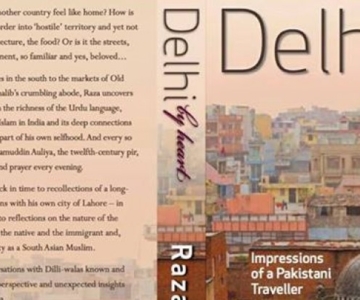
Delhi by the book
Writing about the textbook enemy, the ‘other’, is but a daunting task. Facing the grandiose Humayun’s tomb on a chilly January morning this year, I decided to write a book on Delhi.
It was not before I had visited the ancient city that I knew what it symbolised. In Pakistan, we were influenced by the glories of Lahore, my beloved city. Reconstructed histories had kept Delhi invisible. The seat of the Sultans, Mughals and the Raj, precursor of the modern united In
dia and originator of the Indo-Islamic civilization was a mere phantom, best ignored.
Over several visits to Delhi, I realised that invisibility was also a shared curse. A good number of Delhi wallahs I met, had no clue where they lived or crossed the streets. Erasure, blank spaces in textbooks had rendered their own city a mythical other-world existing only in erudite books, rare cultural soirees and among the fading memories of old-Delhi.
When I looked for the house where Urdu’s legendary poet Mir Taqi Mir lived, no one knows it. Those living in Hauz Khas are unaware of what it was. There are thousands, perhaps more, who have never visited Nizamuddin Bastee let alone the dargah there. Tracing history through books resembles a two-dimensional vision. Lived histories add other dimensions to the inner kaleid
oscope. But there are so few who can help me.
I am pained when I am taken to the tomb of India’s first female ruler Razia Sultana (1236 - 1240). Only centuries later another woman Indira Gandhi was to rule the Centre. Razia’s grave languishes on an abandoned, filthy cul-de-sac. Many don’t care. I wonder, should I?
As I have ventured out to write, the enormity of Delhi — the idea — haunts me. Where do I start? The layered construction of Indian, and Muslim identities in the subcontinent emanate from the ridges and Hades of Delhi. The saints buried under Read the rest of this entry »
Tags: book, Culture, Delhi, Ghalib, heritage, History, India, Mir Taqi Mir, Nizamuddin, pakistan, Razia Sultan, South Asia
The invisibility of the Mughal princesses
My piece published by the Himal Magazine
The limitations of Southasia’s historical record can be seen in the indifference towards two notable Mughal princesses, Jahanara and Zebunnissa.
History – that mosaic of tales and fables that is generally, though not entirely, agreed upon – will always be contested and debated, often in the blood-lined bazaars of power. Indian history, which serves as the broad banner for the histories of Southasia, is certainly no exception in this. After all, Indian history has largely been one of power laced with the force of religion. In addition, during the course of this history, the rulers, ministers, clerics and soldiers have, with rare exceptions, all been male. Indeed, the annals of the sultanate and Mughal history, both medieval and modern, are largely tales of powerful and quarrelsome men vying for power and patronage. The local patriarchal society, influenced by the zeal of West Asian Islam, ensured the almost complete invisibility of women.
The brief reign of Razia Sultan (1236-1240) was an exception, though her ascension to the Delhi sultanate throne and subsequent dethronement and exile, as well as the continuous resistance of clergy and nobles to her political persona, only reinforced the predominance to patriarchy. Other than Razia Sultan and Queen Nur Jahan, who both gave up purdah and participated in the brutal politics of men, rarely did a woman rise to a position of authority or influence. For her part, Nur Jahan (1577-1645) experienced particular success, but her precedent was not the norm – she was Persian, after all, and was considered a particularly wily player of power politics. And Nur Jahan is demonised as a power-hungry monster, who supposedly subjugated the masculinity of her emperor husband to assume charge of the Mughal Empire. Indeed, in the words of that husband, Jahangir, the kingdom had been ‘sold’ to his wife for a cup of wine and a bowl of soup. Nur Jahan has also been accused of misdeeds that were common to powerful men of that age: bribery, nepotism and the weaving of court intrigues. Such faint praise aside, all the while her lasting contributions to the Mughal court – the cuisine, lifestyle and trends of that age – have been largely overlooked, to appear as little more than ‘feminine’ footnotes in the main narrative of Southasian power.
Lahore is where Nur Jahan and Jahangir married, and where they established their royal home. As a Lahorite, the childhood memories of this writer are inextricably mixed with those of many visits to Jahangir’s tomb. But the name of this much-celebrated monument is also particularly symbolic: it is not just the final resting place of Jahangir, but also that of the queen who lovingly designed the buildings and surrounding gardens, to their very last detail. Many of the architecturally significant additions made to the Lahore Fort, such as the zenana (female) quarters, have never been attributed to her. The irony, of course, is that Nur Jahan was the only queen who actually spent the majority of her royal life in Lahore. Other Mughal Emperors and Empresses lived in Agra or Delhi, save a few years of Akbar’s sojourn in Lahore. However, the histories of Lahore inevitably reduce Nur Jahan’s era to a brief footnote or an unread appendix.
Rilasa-i-Jahanara
But there is more to this story of the neglected women of the Mughal court than Razia Sultan and Nur Jahan. Buried within the folds of history is the tale of two princesses who have always remained well out of sight of the mainstream historical narratives of the Mughals. In recent decades, historians and novelists have indeed begun to explore the lives of princesses Jahanara and Zebunnissa, but the scanty primary sources available have largely thwarted these endeavours. Nonetheless, the stories of these extraordinary Mughal women dazzle through the mists of time, and their central paradox cannot be overlooked: the princesses were royal, and hence noteworthy, and yet they are almost completely invisible in what Southasians know as ‘history’. Read the rest of this entry »
Tags: Agra, Aurangzeb, clergy, Delhi, History, Jahanara, Jehangir, Lahore, Mughal, Nizamuddin Auliya, Nur Jehan, patriarchy, princesses, Razia Sultan, sufi, Zebunnissa
Ghalib’s grave - treasury of meanings is under the ground

The inscription on Ghalib’s tomb-stone in Arabic and Persian followed by translation:
a hai’yii ya qaiyuum
rashk-e-’Urfi va faKhr-e-Talib murd Asadullah Khan Ghalib murd
kal maiN Gham-o-andoh meN baa khaatir-e-maHzuuN
tha turbat-e-ustaad pe baiTha hua Ghamnaak
dekha jo mujhe fikr meN taareeKh ke, Majruuh
haatif ne kahaa *ganj-e-ma’ani hai tah-e-Khaak*
the qita (composed four verses) is by Mir Mahdi Majruuh; the phrase contains the chronogram of 1285 AH
—
The Alive, The Eternal [these are two of the names of Allah]
the envy of Urfi and the pride of Talib has died, Asadullah Khan Ghalib has died
[Urfi and Talib were Persian-Indian poets]
yesterday in sadness and mourning, grief-afflicted too
I sat by the Master’s grave with sorrow profound
seeing me thinking of a tareeKh, Majruuh [taareeKh = chronogram]
a heavenly voice said, “treasury of meanings is under the ground” Read the rest of this entry »