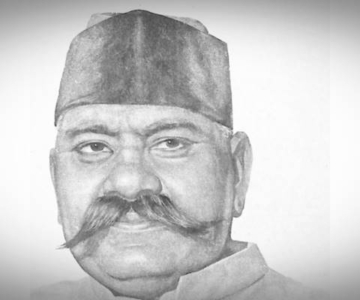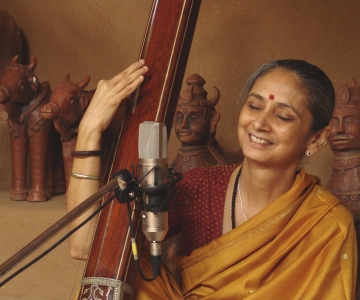
Farida Khanum Singing Raga Kamod – Manna for the Soul
I am cross-posting my dear friend Fawad's excellent post from here. The links here are worth visiting and the music is fabulous for those who have the ear for extraordinary melodies from Indo-Pakistan. Raza
The internet is a remarkable treasure trove and I continue to marvel at the doors of culture, information and connectivity that it has opened. My recent discovery is a wonderful collection of Hindustani Classical music on the file sharing site esnips. I have been spending hours listening to pieces I love and discovering unknown treasures of the sub-continent's greatest vocalists.
Here's my selection of the day; Farida Khanum singing Raga Kamod. This is unfortunately the kind of performance by the the sister of Mukhtar Begum and a disciple of Ustad Ashiq Ali Khan (son of the founder of the Patiala Gharana Ustad Fateh Ali Khan, one half of the legendary duo Aliya Fattu) that Pakistani audiences have witnessed only rarely. In a country with almost no appetite for classical music she shifted her focus to lighter forms of singing decades ago.
Tau kiya yeh tay haye… (Gulbahar Bano singing)
A piece of Urdu poetry that has remained with me through seasons, years and all the vicissitudes...
This is an extraordinary ghazal (rhymed poem in Urdu composed in classical style). The poet is perhaps Saleem Kausar whose expression is subtle yet brutal. There is a sense of finality in the lyrics - a denouement that is being challenged and hence a dynamic is created that allows the tragedy of two people parting their ways to turn into a moment of absolute beauty. The sadness of the verse is augmented by Gulbahar Bano's unique voice that brings out the depth of meaning in the lines.
I can only translate the first couplet:
Tau kiya ye tay haye ke ab umr bhar nahee milna
Tau phir ye umr bhi kiyon, tum se gar nahee milna
Is it now agreed that we shall not meet for life
But what good would be living if I will not be with you
As I rendered this literal translation, I wanted to curse myself for being so inadequate with words.. Those who can understand Urdu or Hindi would know what exactly I am complaining about. I dedicate this to someone special who remains as close as time itself. In fact, I am grateful to this muse who sent it the other day bringing back the smell of summer heat, the shades of white and all the flowers that bloomed and were tucked into thick books.
Here is the ghazal
another version found on youtube:
Reclaiming melody
![]() |
|
|
Labourers of love: Mushtaq Soofi, Izzat Majeed & Christoph Bracher |
|
![]() |
|
|
Mian Yusaf Salahuddin’s Haveli, where Tarang was launched |
|
![]() |
|
|
Christoph Bracher testing equipment at Sachal Studios |
|
![]() |
|
|
|
|
![]() |
|
|
Revival of the orchestra by Sachal Studios is a landmark in Pakistan’s music industry |
|
![]() |
|
|
Izzat Majeed: patron of music |
|
![]() |
|
|
Singers and musicians showcasing their skills at Sachal Studios |
|
![]() |
|
|
Humaira Channa |
|
|
Izzat Majeed was raised in a household where good music was an object of reverence. His late father, Mian Abdul Majeed was an avid music fan, and from an early age his son was introduced to the finer details of sub-continental classical music. Mian Abdul Majeed was a student of Ustad Akbar Ali Khan and introduced Izzat to the layers and nuances of Indian film music that continue to guide him in his tastes and sensibilities |
|
Started as a labour of love, Sachal Studios has released ‘Tarang,’ a collection of music that brings together the best musicians from all over Pakistan, and Humaira Channa’s competent voice. Of late, Channa has been a victim of commercial success and the quality compromises that define Pakistan’s derelict film music. Sachal’s production is a relief; a fresh departure from the usual, and the melodic results are impressive.
At the Old Lahore Haveli, Channa with her family and associates were accorded the respect they deserve. In a similar vein, immensely talented artists, such as the tabla maestro Billoo Khan and Pakistan’s leading sitar player, Ustad Nafees Ahmed Khan also attracted the attention of the star-studded guest list and Lahore’s usual chatterati. It was on a dimly lit terrace of the Haveli that I was introduced to Izzat Majeed, who looked pleased with himself and his Sachal partners as notes from the latest album mixed with the spring air.
Inspired by the Abbey Road Studios in London, Majeed and Soofi have been working for the last six years with Christoph Bracher, a scion of a German musicians’ family, to design and set up Sachal Studios. A state of the art music studio in Lahore is a landmark, for it heralds a new trend of post-production finesse that has hitherto been missing from the Pakistani music production process. A major contribution of Majeed is his introduction of the concept of ‘music-producers’. The norms of the industry have tragically reduced the role of a producer to an investor, from that of someone who drives the quality, provides technical inputs and steers the overall aesthetic of a musical experience.
Majeed related to me how he was raised in a household where good music was an object of reverence. His late father, Mian Abdul Majeed was an avid music fan, and from an early age his son was introduced to the finer details of sub-continental classical music. His father was a student of Ustad Akbar Ali Khan and introduced Majeed to the layers and nuances of Indian film music that continue to guide him in his tastes and sensibilities.
As he reminisced about the lost eras, Majeed told me how Jazz captured his imagination in his youth. “Believe it or not, great performers such as Louis Armstrong visited Lahore, and played fabulous music at the United States Information Services office on Queen’s Road,” he recalled. But he laments the fact that the vacuum that the local music scene is trapped in is gigantic. Ustad Mehdi Hasan does not sing any more, Madame Noor Jehan is dead and the great golden voices are getting lost in the onslaught of new trends in the music industry. He conceded that the pop scene is vibrant, but a bulk of those productions are “pure electronic noise”. Majeed is right, because the Pakistani state has demolished, brick by brick, the secular, composite culture of the Indus Valley and replaced it with a crippling “ideology” where no flowers bloom, where no bulbul sings.
This is why Sachal Studios is such an important intervention. It flies in the face of the state’s enforced desertification of culture; it seeks to encourage younger singers like Feriha Pervaiz, Ali Raza and Zaheer Abbas amongst others, to become heirs of the traditions that have historically defined musical consciousness in the popular domain. Izzat Majeed is also a poet in Punjabi and English, and so is Mushtaq Soofi. The two music aficionados have lent their verse to the myriad compositions of Sachal Studios.
Sachal’s efforts to build an orchestra have been rewarding. There is joy and unabashed triumph in Majeed’s tone when he says that in 2003 only 10 violinists were available in Lahore; the number has now increased to 30, providing extraordinary ground to the Sachal orchestra on which it can expand and deepen its range. The glorious sub-continental tradition of employing grand orchestras to enhance melodies, used by legends such as Naushad Ali, Madan Mohan, Khayyam, Shankar Jaikishen and Salil Chaudhry has become extinct except perhaps in the works of the genius, A R Rehman. In Pakistan, Majeed has picked up the tradition of serious film music of yesteryear, and has revitalised it; one hears the endangered violin instead of the plain electronic synthesiser in works produced by Sachal Studios.
But Majeed makes no grand claims. “I am not a crusader; I create music for the pleasure of music itself,” he says. This is an unusual statement in a country where bragging is a national pastime. It is easy to understand why Majeed’s partnership with Mushtaq Soofi has been fruitful. Soofi, a notable Punjabi poet, with vast experience in music production at Pakistan Television (PTV), is as self-effacing as Majeed. I met Soofi at the Sachal Studios premises, where he talked to me about his passion for music, sitting at his desk, chain-smoking, books with subjects ranging from pre-Islamic Persia to sources of the English language lying on his lacquered table. Like Majeed, he has also been immersed in music for the better part of his life. And after a long stint at PTV he has devoted his energies to Sachal. The prospect of pursuing music unencumbered by bureaucratic obstacles has set Soofi free.
Earlier, my visit to Sachal was quite an experience. Amid the ramshackle automobile workshops and Warris Road limits, which are constantly shrinking due to encroachments, stood the refurbished building, not too high yet modern in character. Like its vision, the environs and facilities of the studios were also ground-breaking. The state-of-the-art arrangements and impeccable acoustics have led to high quality results. I recalled
Noor Jehan & Khurshid Anwar
I loved Fawad's post "A Divine Musical Collaboration - Noor Jehan & Khurshid Anwar" and here it is:
In the wake of Khalid Hasan's death, the great Pakistani songstress Noor Jehan (Wikipedia) has been much on my mind. Khalid Hasan was a great admirer of the late Madam and wrote a much quoted tribute essay on Noor Jehan. Perhaps more importantly he translated Saadat Hasan Manto's great portrait of Noor Jehan's early years as a rising diva in pre-partition Bombay under the title "Nur Jehan: One in a Million" (unfortunately this link is to a scan of the essay and hard to read but the essay is included in the collection "Stars from Another Sky"). "Stars from Another Sky" includes other translations of Manto's brilliant Urdu sketches published in "Ganjay Farishtay" and "Loudspeaker" on film industry icons like Ashok Kumar, Nargis, Naseem Bano (Dilip Kumar's wife, Saira Bano's mother) and Shyam.
Let the cynics froth and fume
My piece published in The Friday Times
This is the magic of Lahore and its deep-rooted cultural mores. No other city can boast of such individuals, movements and trends. Hopefully, the music will live on. The interest of younger generations and their experiments with various forms of music hold great promise
Last week the breezy environs of the majestic Lawrence Gardens once again swayed to the tunes of Hindustani classical music. A week long music festival organised by the All Pakistan Music Conference attracted musicians, vocalists and enthusiasts from all parts the country, as well as from the imagined "enemy" India. How could it not be the case when musical traditions emerged out of a cultural synthesis of 700 years or more?

The leading light of APMC was Hayat Ahmad Khan, whose sad demise in 2005 was interpreted as an end to the glorious tradition of subcontinental streams of music in Pakistan. However, 83 years of hard work and philanthropic contributions was not in vain. He left behind a powerful institution and a network of committed individuals and aesthetes who have kept the torch ablaze. Not a small feat in the troubled waters of a Pakistani cultural landscape constantly under attack by nation-state ideology and extremism that consider music to be too "Indian" or, even worse, un-Islamic.
This is the greatest irony of our existence: the Muslims in India contributed to what is known today as Indian classical music and innovations such as the sitar and the tabla. The Qawwal bache trained at the shrine of Nizamuddin Auliya in Delhi under the tutelage of Amir Khusrau became the founders of what was to later evolve as the sophisticated Khayal style of music. In dire times of the Sultanate and Mughal periods, these musicians had to take refuge in the princely states, and this is how the various gharanas, or schools of music, originated. This loose network of musicians organised along the lines of kinship or teacher-pupil bonds, sustained by court patronage and eclectic and secular in appeal, led to some fine moments. Tansen at Akbar's court, Mohammad Shah Rangeela's patronage and later the Kingdom of Oudh defined the high-points of this fused and seamless culture beyond religion, communal and sectarian divides.

To keep this tradition alive in post-independence Pakistan was a Herculean task. Pakistan was a moth-eaten and truncated country in the words of its founder Mohammad Ali Jinnah. The psychological trauma and barbarity of the Partition had jolted everyone and the traditional patronage of the state was missing. It was under these circumstances that on September 15 1959, music-inspired citizens met at the famous Coffee House of Lahore and launched a voluntary organization called The All Pakistan Music Conference. Eminent personas such as Roshan Ara Begum were among the illustrious list of its founders.
It should be noted that this was also the age when the maestro Ustad Bade Ghulam Ali Khan migrated to India and Roshan Ara Begum was almost about to give up the passion of her life. Thus
Faiz’s Aaj bazaar mein pa-bajo-lan chalo … translated & explained
Another translation of Faiz rendered by a Toronto based poet - Anis Zuberi. This is a timeless poem or nazm, aaj bazaar main pa ba jolan chalo has been translated and explained below. I am also posting a video that shows Faiz reciting the poem followed by a beautiful rendition by Nayyara Noor.