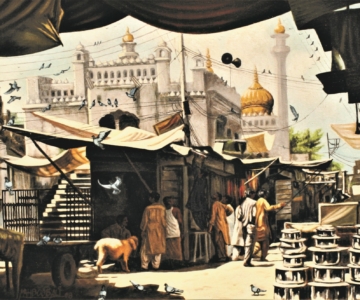
A red card for the Secular Indian Muslim
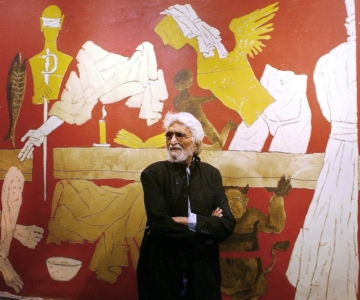
The controversy regarding the conferment of Qatari nationality upon M.F. Husain — and his acceptance of it — has given us the opportunity to revisit an old but neglected debate. The debate on being an Indian Muslim or a Muslim Indian is old hat; but the one concerning the “secular Indian Muslim” — the SIM? — needs our urgent attention. Those who doubt the existence of such a breed and view it as a contradiction in terms would do well to remember the legacy of a long line of distinguished people, from Mirza Ghalib, Hakim Ajmal Khan, Dr M.A. Ansari, Maulana Azad, Dr Zakir Husain to M.F. Husain, to name just a few. Then there are the nameless millions — doctors, lawyers, writers, journalists, teachers, wage earners who are living proof of Indian secularism. Husain is simply another link in this ganga-jamuni chain. He needs to neither establish his credentials nor protest his innocence; his work speaks for him.
Having established the credentials of this breed, let us set out the contours of its present dilemma: one, it exists in sufficiently large numbers to have escaped our notice yet, oddly enough, has never managed to establish a public profile for itself; nor has it, given its numbers, translated into a sufficiently large, and therefore woo-able, vote bank. Two, despite its largish presence (I imagine roughly half the population of Muslims in India), the breed is under severe threat.One is not interested in establishing the presence of the SIM, for that one takes as a given. It has always existed in the weft of the Indian tapestry as the warp that runs alongside. In fact, what ought to concern us is the threat to its existence. That this threat is
In memoriam – Asim Butt (1978-2010)
He was a man, take him for all in all,
I shall not look upon his like again
(Hamlet, Shakespeare)
It is only when Asim has gone that one takes measure of the legacy he has left for his troubled and torn country. A decade long association was lost on the fateful day of January when we heard of his untimely exit from this world. For hours, I sat in my office, numb. Not that Asim’s suicide was a surprise, for he had warned us all many times of this inevitable dénouement to his dramatic life.
Five years ago, when I wrote a piece on the Pakistani poet Mustafa Zaidi and the romance with nurturing a death wish, Asim wrote to me and said that I had no clue what this was all about. His words were: “loved and was deeply moved by your piece on Zaidi... saw so much of myself in his life story, hoping I don’t die unsung and on the fringes, and wondering why you of all people would have a death wish.” Asim had suffered and struggled with his inner demons with an intensity that most of us will never appreciate. This was the first time that I knew about the seriousness of his other side: a dialectical dark side to his otherwise cheerful, loving and warm persona. Asim cannot be mourned; he can only be celebrated. He would have hated the melodramatic statements that I am inclined to write in this remembrance.
Two of my dearest friends were close to Asim in a way that is difficult to understand. Nearly a decade ago I met Asim at Ali Dayan Hasan’s home in Karachi. I was passing through on one of my occupational breaks from my assignment in Kosovo. Ali had returned from England and joined the monthly Herald and was piecing his life together. I met this lean and quiet young man who had big, bright eyes and a unique smile. We did not talk much except for a small argument over something, perhaps about a book, but I could not help being thoroughly impressed with his viewpoint. Since then I have had a series of exchanges, verbal and electronic, in which Asim was always animated, off-beat and extremely gifted with words and ideas. No wonder his art work and many of his writings are a formidable legacy for us all.
Born into a regular upper middle class family, Asim Butt was always an exception. He was different, as he would tell me. Rejecting convention, tradition and the confines of societal expectations was therefore something that started way too early with Asim. To be fair, he did pursue a path chosen for him. He attended the Li Po Chun United World College where his gift for painting became polished, and at some level he had chartered his future course. There was some meandering: a degree in the first batch of B.Sc. in Social Sciences earned from the Lahore University of Management Sciences; and later an unfinished PhD in History from the University of California, Davis. He returned to Pakistan, wrote for the Herald and other publications, and finally enrolled himself at the Indus Valley School of Art and Architecture.Not surprisingly, Butt graduated with distinction in 2006.
Farewell, Asim
Dear Asim: you left us in such a hurry - you will be missed, always..RIP

Asim Butt: A rebel from his conventional background, Butt continues to defy the conformist meanings of family, career, security, sexuality and that elusive bourgeois pursuit of happiness. Inspired by the Stuckism movement of art, Asim holds painting as a powerful medium of communication. This standpoint brings our young Pakistani Stuckist at odds with the skin-deep novelty and claimed nihilism of “conceptual” art and postmodernism. The pursuit of art in this worldview thus merges into an impulse for a renewal of spiritual values in art and society, or what is known as “re-modernism.” More here
The romance of Raja Rasalu

colonial storytellers, the book twists the narrative in a manner that brings us closer to the origins of our cultural sensibilities. The tales are sheer magic. The romance, the intrigue, the bravery and the integrated nature of human existence where it finds communication even with birds and trees comes to a full life throughout the narrative.Rediscovering Zahoor ul Akhlaq (1941-1999)
|
|
![]() |
|
|
Zahoor ul Akhlaq: “the most significant influence on contemporary art” |
|
![]() |
|
|
Akhlaq with his daughter, Jahanara |
|
![]() |
|
|
Sheherezade, and a guest lighting a lamp on the tenth death anniversary |
|
![]() |
|
|
Zahoor ul Akhlaq and Sheherezade: reflections of times past |
|
![]() |
|
![]() |
|
|
Jinnah from Akhlaq’s Triptych |
|
![]() |
|
|
Friends at Akhlaq and Jahanara’s tenth anniversary: Naazish Ata-Ullah, Naeem Haq and Salima Hashmi (inset) the dancing lamps |
|
![]() |
|
|
|
|
|
Ten years ago, on a grey, brutal January day, the great artist, Akhlaq, and his gifted daughter, Jahanara were shot dead … the innate humanism of Akhlaq and his family was shattered to bits, much like the splintered state of Pakistan, where art and life are either marginalised, silenced or blown to pieces |
|
|
We as a society excel at tottering on the shores of forgetfulness; and as a state we are constantly in denial, quick in erasing history lest it haunt us and ask unsettling questions. The National Art Gallery in Islamabad, built after decades of inaction, needs to reclaim Akhlaq’s work and bring it back to Pakistan |
|
t is not easy to write about Zahoor ul Akhlaq (1941-1999), an artist whose life and work in so many ways encapsulates the troubled soul of Pakistan. Ten years ago, on a grey, brutal January day, the great artist Akhlaq and his gifted daughter, Jahanara, were shot dead. This was not a run-of-the-mill incident. The innate humanism of Akhlaq and his family was shattered to bits, much like the splintered state of Pakistan, where art and life are either marginalised, silenced or blown to pieces.On this January afternoon, Shahbaz Butt, an acquaintance of Pappu Sain, shot Jahanara and her fiancé, Al-Noor. Jahanara, 24 years old at the time, fell on the ground, to die. The noise, alarming Akhlaq and his fellow artist Anwar Saeed, sent them rushing in to see what had happened. Anwar Saeed was injured by Shahbaz, who shot Akhlaq. He died on the spot..Shahbaz now languishes in jail, while Pakistan is deprived of two inimitable souls. It is unclear what prompted Shahbaz to wreak this senseless violence: drugs, inability to cope with life or an extreme sense of inadequacy that could only be corrected through violence.
A decade later, Akhlaq’s immense legacy is all but invisible, thus marking a post-death demise. How and when did we come to such a pass? This is what the conspiracy of circumstance and the context of Pakistan have done. “The single most important influence on contemporary Pakistani art,” in the words of Salima Hashmi, renowned artist and Akhlaq’s close associate, is absent from art discourse. It is this apathy that I wish to remember on his tenth death anniversary, along with the infinite spaces that his art nurtured and created for generations to come.
As an avid student of Pakistan’s avante garde modernist, Shakir Ali, Akhlaq was destined to radicalise the sensibilities of art movements and pedagogy at Lahore’s famous National College of the Arts (NCA). The young artist, Akhlaq, had the good fortune to live in Shakir Ali’s home in Lahore’s Garden Town suburb for quite some time, and this is where he imbibed the iconoclasm and poetry of Ali’s work and continued the experimentation right into the mainstream of art education. Akhlaq’s early work bears testimony to the influences of the newly emerging school of modernism shaped by the visions of Shamza, Ali Imam, Ahmad Pervaiz, Moyene Najmi and others.
For this writer it was a gargantuan challenge to recount his legacy and re-discover him. Walking into the room where Akhlaq and Jahanara were ruthlessly murdered gave rise to mixed feelings. Akhlaq’s wife, the eclectic potter-artist Sheherezade has been struggling to deal with a life permanently altered on that fateful day of January 1999. The house, painted in bright colours, displays the vibrant world that Sheherezade has created; memory mixed with longing, recreating Jahanara’s dance, using colours from Zahoor’s palette for embellishment.
As we commenced our conversation, we soon found ourselves lost. The little corners of silence between sentences were filled with the mysteries of Akhlaq that still remain undiscovered, at least in large measure. Sheherezade told me about his journeys from Delhi to Karachi in the forties and eventually to the NCA in the sixties, where he found his voice. In 1966, Zahoor was awarded a British Council Scholarship and joined the Hornsey College of Art, to be followed by a stint at the Royal College of Art. This is where the interaction with the British Museum and its priceless, tragic collection of Mughal miniatures opened new vistas for Akhlaq. Once back in Pakistan, he started to imbibe the miniature forms, spaces and poetries into his style, as well as setting up the miniature department at the NCA.
As an exuberant and bohemian student, this was the time when Sheherezade met Akhlaq, found herself under his spell and defied her family to marry him at the Karachi flat of Shahid Sajjad, the eminent sculptor. Jamil Naqsh was also there and the group of friends had a long, fun-filled day on the shores of the salty Arabian Sea. Sheherezade had a glint in her eye as she narrated the event before she remarked: “Zahoor was the first and perhaps the last interesting, ah the most interesting, person I have ever met. I have never found anyone as enchanting as him.”
Akhlaq was a man of few words, another trait he might have inherited from Shakir Ali. Space, silences and reflection defined much of his time. This is not to say that he was not sociable. His closest friends were at the NCA, with whom he spent a fun-filled time when he was not delving into philosophy, or creating his masterpieces in states of frenzy, intoxication or exceptional lucidity.
Sheherezade further mused how the NCA and Zahoor developed a symbiotic relationship that was mutually transformational. Akhlaq was a “peculiar and an unusual husband, but he enabled me to develop a parallel life and thus expanded my life-experience”. Like his other relationships, the marital partnership was also intense yet parallel to his inner life. Zahoor needed a lot of space, “the space of night” in the words of his biographer, and sometimes he did not get it. It was one of those extraordinary experiences that entail a life of one’s own.
Added to this was Zahoor’s immense knowledge, spanning subjects as varied as art, history, philosophy and calligraphy, a discipline in which received training from an early age from the renowned calligrapher, Yousaf Dehlavi. His appreciation of the skill and intimacy with discipline therefore were passed on to him in his childhood. Behind the screen of tradition, and going back to the roots, was also the classic scar of migration and uprooting. Akhlaq’s family left their beloved Delhi for Karachi at the gruesome moment of Partition in 1947. The nostalgia and the sense of separation which underlies Akhlaq’s work were pervasive. Later, his various travels to different parts of the world intensified both the rootedness and the contemporaneousness in his work.
Such profound influences – of heritage, training, travel and intense relationships – enabled Akhlaq’s work to straddle both the traditional and the contemporary, encompassing visual traditions that represented as well as defied the geographical and political boundaries of Pakistan. Akhlaq could concurrently weave the discipline of Islamic geometry, the iconography of the Mughal manuscript, the well-worn genres of European painting and Pakistan’s colonial heritage all into one space, and yet there was space left over to express the contemporary artist of today. There is not a single moment when his work is bound by the constraints of the past or the woes of the present; there was synthesis, a fluid one, merging the thousand years of Pakistan’s heritage onto speaking canvases. Rashid Rana, the young artist of global recognition and an avid student of Akhlaq narrated how the latter helped his generation liberate itself from the onerous baggage of tradition by reinventing ‘tradition’ itself.
Along the fascinating journey of Akhlaq’s creativity, the two daughters of the couple, Jahanara and Nur Jehan, help deepen that quest for equilibrium, the synthesis of the old and the new; of creativity and the institution of marriage. Concurrently, Akhlaq’s genius flourished as an outstanding sculptor, printmaker and painter, and he received multiple awards within Pakistan and abroad. By the 1980s, he was criss-crossing disciplines and art forms, thus delving deeper into Islamic art, painting, printmaking and sculpture. In 1989, Akhlaq joined Yale University, USA, to pursue post-doctoral research at its Institute of Sacred Music, Religion and the Arts. After retiring from NCA as the head of the Fine Arts Department in 1991, Akhlaq proceeded to Bilkent University, Ankara, as a visiting professor, and by the mid nineties, the family had landed in Canada. Here, Akhlaq received an appointment at the Ontario College of Art in Toronto. The return to Pakistan in the late 1990s was the finest of hours, when he
GulJee – what was the harm to you if you had lived a little longer!
Jahane Rumi is priveleged to publish this exclusive piece contributed by Syed Naveed Abbas
t is the month of December and one's heart weeps as one invokes the memory of Guljee. His work is a living testament to our times and the dignity of a proud nation. He was the painter from the day he was born. A profoundly earnest and sincere artist, he displayed a high seriousness tempered with tenderness and a love of simplicity. Nevertheless, he is perhaps best known worldwide for his abstract work, which is inspired by Islamic calligraphy and is also influenced by the action painting. The images that Guljee’s brush strokes produced are not only rich in symbolic meaning but visually so much variegated that the eye travels fascinated from point to point. His painting comes from a divine inspiration, giving it a dimension of space and movement. He carried the script with a flourish in all directions, giving it the power of space, vigour and volume. He has made the brush prove mightier than the sword, time and again, and with his brush on canvas he has earned accolades. Whatever Guljee had a hand in turned out to have an unquenchable spark of utter genius.
Iqbal Hussain – Lahore’s controversial artist


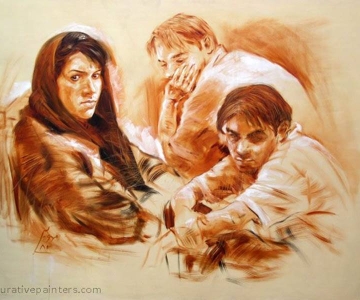
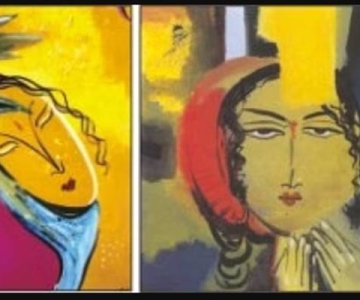
Iqbal Hussain from Lahore is one of the finest painters we have. Most of his paintings depict women from the Heera Mandi (literally the diamond market)- or the centuries old red-light district. I found the
above image on the Internet today. The news-item referred to Iqbal's advocacy through his powerful art works:
..Others, who have emerged as spokespersons for the women of Heera Mandi, including leading artist Iqbal Hussain, whose own mother was a sex worker, emphasise their “lack of empowerment, exploitation and helplessness.
His works convey all of these emotions and bring to life extraordinary characters who are often neglected or spurned by the hypocritical culture of Pakistan. (images on the right and below are from here).
More on Iqbal Hussain here.
Endnote from here:
Being termed a controversial painter in Pakistan, Iqbal's subjects sometimes tend to shock "puritan painters", but Iqbal follows his own visions and continues to paint his unconventional and radically innovative paintings. He enjoys a great reputation as an artist in the international art world. His paintings have been requested by Jordanian Princess Wijdan Ali for the Jordanian Gallery of Fine Arts. His were the only ones selected for Unesco Headquarters Prize in 1995, Paris. In 1998, one of his paintings was auctioned at the Sotheby's Auction House in London.
The controversy regarding the conferment of Qatari nationality upon M.F. Husain — and his acceptance of it — has given us the opportunity to revisit an old but neglected debate. The debate on being an Indian Muslim or a Muslim Indian is old hat; but the one concerning the “secular Indian Muslim” — the SIM? — needs our urgent attention. Those who doubt the existence of such a breed and view it as a contradiction in terms would do well to remember the legacy of a long line of distinguished people, from Mirza Ghalib, Hakim Ajmal Khan, Dr M.A. Ansari, Maulana Azad, Dr Zakir Husain to M.F. Husain, to name just a few. Then there are the nameless millions — doctors, lawyers, writers, journalists, teachers, wage earners who are living proof of Indian secularism. Husain is simply another link in this ganga-jamuni chain. He needs to neither establish his credentials nor protest his innocence; his work speaks for him.


Iqbal's matter-of-fact portraits have introduced the multiple nuances and shades of Lahore's red-light area to the world. The women subjects are mostly from the area and he paints them with stark candour and brings out the depths of expressions and emotions in his lines and brush-strokes.
Among his recent paintings is the portrait of actor-writer