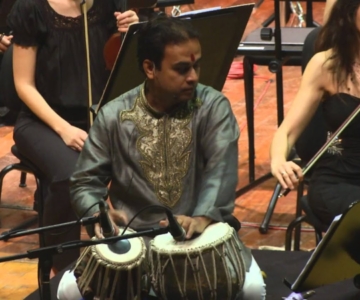
I had earlier posted a video of Abida Parveen singing Bulleh Shah. While that is an all time favourite, the global voice of Nusrat Fateh Ali Khan has also rendered Bulleh Shah with great ease and soulfulness. I am grateful to Cubano for opening the doors into this magical world of music. No words can capture the sheer beauty of this music. Videos are posted below (more…)
Found these two poems by Lalon Fakir - the singing mystic of Bengal who echoes Bulleh Shah, Kabir and the tradition of Bhakti.
A Strange Bird
Look, how a strange bird flits in and out of the cage!
O brother, I wish I could bind it with my mindís fetters.
Have you seen a house of eight rooms with nine doors
Closed and open, with windows in between, mirrored?
O mind, you are a bird encaged! And of green sticks
Is your cage made, but it will be broken one day.
Lalon says: Open the cage, look how the bird wings away!
Casteism
People ask, what is Lalon’s caste?
Lalon says, my eyes fail to detect
The signs of caste. Don’t you see that
Some wear garlands, some rosaries
Around the neck? But does it make any
Difference brother? O, tell me,
What mark does one carry when
One is born, or when one dies?
A muslim is marked by the sign
Of circumcision; but how should
You mark a woman? If a Brahmin male
Is known by the thread he wears,
How is a woman known? People of the world,
O brother, talk of marks and signs,
But Lalon says: I have only dissolved
The raft of signs, the marks of caste
In the deluge of the One!
I am grateful to Minos for sending me the link to this brilliant painting by Lapata. This is a fine composition with a dream-like quality depicting the three unfortunate but towering politicians of our times. And, this also brings together the South Asian dynastic hubris in a neutral, no-politics-in-your-face manner.
Wish I could get this one - hate this consumerist urge; but the struggle is pretty engaging as well. Let me also reproduce the few lines that introduce our accomplished artist:
Lapata (pronounced ‘láh-putt-áh’), the artist’s takhallus, or alias, is Urdu for “missing,” or “absconded,” as in “my luggage is missing,” or “the bandits have absconded.She also writes for the blog Chapati Mysteryand posts many of her paintings there. Lapata grew up in a family of artists in western Massachusetts, some whose work adorns the surfaces of chinaware and brightens up the waiting rooms of dentists’ offices, and others whose artistic output has found more select audiences.
“Siavash Mahvis” is a contemporary Iranian artist and a university professor. He owes his acquaintance with the world of line and design to realist artists. “Daumier”, the great French designer, has had a great influence on his mind.
He is fascinated by the bitter social humor and black, white, and gray relationships between the figures of Daumier’s design works. Daumier’s quick etching with a few sharp lines and powerful spots excite him a lot.
Babar, the founder of Mughal dynasty in India was an unusual character of his times. A poet, writer and a free soul, he was so modern and some would say post-modern in an era otherwise categorised as medieval. I was delighted to find this piece authored by Ashfaque Naqvi.
An interesting book has landed at my table. As the title, Zaheeruddin Muhammad Babar, is about the person who laid the foundations of the Mughal Empire in the sub-continent. Written by the eminent Indian educationist, Qamar Rais, it gives a different picture of the man from what we gather about him from his self-written, Tozak-i-Babri…..
As Prof Qamar Rais says in the foreword, he had for long been studying the works of Ali Sher Nawai and such other classical poets of Uzbekistan but realized during his stay in that country that those people revered Babar more for being an intellectual and a lyrical poet. In fact, even during the Soviet era, he saw Babar’s pictures hung in most homes showing him holding a book and sunk in deep thought. As a consequence, he directed his studies in that field.
… even today, Babar is held in esteem and considered a hero both in Afghanistan and Uzbekistan. He even quotes Pandit Nehru as having said that the greatness of Babar lay not in capturing India but in capturing the hearts of Indians. (more…)
The India International Centre, where Hussain’s ‘Mughal India’ painting series are on dispaly, suspended the exhibition for Saturday after it received the threats from Bajrang Dal, sources said.
The IIC had received the Bajran Dal threat which said it has to face ‘serious consequences’ if the capital’s high-profile cultural organisation continued to exhibit the works of the controversial artist, they said.
Bordering between abstract and socio-political, Shaheen Sultan Dhanji’s photography, painting and writings are at once striking to readership. Her art transforms the humble into amazing objects of desire.
Sultan’s large scale of black and white photographs are at once contemporary, mingled with socio-political messages. Themes of war, poverty, women and sanitation, globalisation and various pressing subjects are provocatively captured on film. She has had some of her works exhibited in Ottawa and Toronto Canada.
Luminous yet subtle abstract and figurative paintings reveal a fusion cultural influences, and experiences endured in Sultan’s journey in assmililating between life in Africa and North America.
Her art punctuates and pierces a wave of questions of human dignity, colossal loss of wars, life of a courtesan and major other social themes. Sultan is senstive to light and colour. Her work can be calssified with using strong oil base, and lots of blues, yellows, red and burnt orange.
Apart from visual art, Sultan is a writer for several newspaper. Her subjects include politics, literature, poetry and eastern philosophy. She does not shy away in dialoguing concerns facing wars in Iraq and Afghanistan, not to mention the genocides in Congo. A constant worker, Sultan is convinced that tenacity and perserverance are the deepest, firmest pillars to create the enigma out there.
JR is grateful that Dhanji has shared the images of her two recent paintings that are shown above. The write up has been adapted from a review of her works.
The piece on the left has been described as “one of the oldest, rarest and most beautiful works of art from the ancient world.”
Described by Sotheby’s as diminutive in size, but monumental in conception, The Guennol Lioness was created around 5,000 years ago — around the same time as the first known use of the wheel — in the region of ancient Mesopotamia.
“This storied figure, in its brilliant combination of an animal form and human pose, has captured the imagination of academics and the public since ..the late 1940s,” …
The figure depicts a standing lioness looking over her left shoulder, her paws clenched in front of her muscular chest.
Experts have speculated that the figure may have played a role in some ancient belief system or mythology in Mesopotamia, which today lies in parts of modern day Iraq, Syria, Turkey and Iran.
“To look at one of Ali Kazim’s paintings is not only to look at something wonderful, something remarkable. It is also to look at something deeply intriguing. Kazim is a fine and highly skilled and accomplished painter, but he is also a deeply compelling and accomplished teller of mysterious and wondrous stories..” (Eddie Chambers in Secret Lives) (more…)
In an era when most British officials were interested only in exploiting India, a few remarkable men celebrated Hindu art and culture. William Dalrymple explores the rich legacy of their collections and commissions. See more.
Pearapong Khireewong is an extremely talented artist who hails from Southern Thailand and has captured the pathos of the bullets that were sprayed on the local population (more…)
ATP has published my post on Saira Wasim’s extraordinary art:
Saira Wasim is a prominent Pakistani miniaturist. I found a link to her website hidden in my unread emails. Some of her recent paintings are terrific. The image below is borrowed from here. It is dedicated to Queen of Meldoy, Noor Jehan.
“There is an eclectic mix of realism, comedy and circus - there is movement and drama alive in the miniature format.….Wasim is expanding the frontiers of the traditional genre of miniature painting. It is a tremendous service to keep this art form alive and relevant.”
It is disturbing that there is no writ of the government in Swat - otherwise a stunningly beautiful valley. Considering that the army is engaged in a battle with the militants in these areas, the Buddhist relics would be least of government’s priorities.
Yet, they are not unimportant. In fact, it is imperative that the government should protect them as a symbol of our rich past and to send a message to the lunatics who pretend that the cause of [their] Islam would be served. Nonsense - in this day and age and in an overwhelmingly Muslim majority area. What threat they pose and whose ‘eemaan’ is endangered?
It is painful to see how a bunch of extremists are pushing us towards that.
A dynamic and enlightened friend suggests that we should write here, here and UNESCO to register our protest. Notwithstanding the limited chances of any action or corrective measures, at least we would have made the effort!
Khalid Hasan writes on the great Pakistani master, Sadequain, in the current issue of the Friday Times:
“It is 20 years this year since Sadequain’s death. He would have been 77. When he died at the age of 57 (of what can only be called too much living), it was not his death that was surprising but how he had lived so long, given the white hot intensity with which he lived and painted, wrote and loved. He burned his candle at both ends, and had there been a third end, he would have burned it from that end too.”
And this great anecdote -
“…There are hundreds of Sadequain stories, but the one recounted by journalist Nasrullah Khan Aziz is characteristic. One day in Karachi, a man came up to Sadequain and said that he had a family to feed but nothing to feed it with. The only thing he knew was how to drive a rickshaw. Sadequain gave him 15 thousand rupees to buy a rickshaw, as long as he agreed to take him wherever he wanted to go. That arrangement lasted for some time, but one day, Sadequain said to him, “You are free. You don’t have to drive me around anymore.”