Auliyaa mansoor kahaawey
Ramz anal-haq aap bataaway
Aapey aap noon soolee charhaaway
Te kol khaloke hasdaa nee
Meyndaa Dholann maahee
Behad Ramzaan dasda nee,
Meyndaa Dholann maahee
Boundless signs He reveals
My Beloved Lover
In [letter] ‘M’ His dwelling conceals*
My Beloved Lover
As a saint Mansur gets Himself hailed
As the metaphor ‘I am Truth’ gets Himself hanged
On the gallows gets Himself impaled
Standing nearby with laughter He peals
My Beloved Lover
Boundless signs He reveals
My Beloved Lover
In ‘m’ His dwelling conceals
My Beloved Lover ( Translation by Prof Muzaffar Ghaffaar)
* The letter meem phonetically M in English is a mystical letter and meant to contain Divine mysteries apparent only to the ones who develop the inner eye through mystical knowledge. Another verse speaks of Meem as the only difference between Ahad (Singularity of God) and Ahmad (another name for Prophet Mohammad- who accordint to some was the foremost mystic/Sufi in Islam)
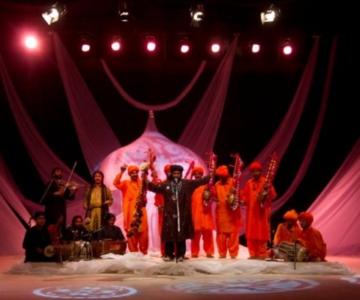
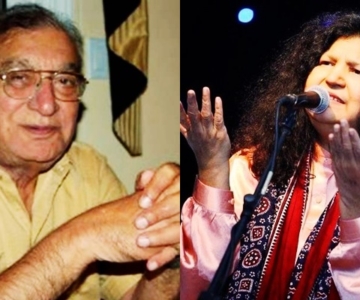
Someone once said Abida Parveen is not a singer or an artist… she is an experience….. her voice and expression takes you to a different universe… when she collaborated with India’s ace filmmaker, poet, artist, revivalist, musician and activist Muzaffar Ali the result had to be something divine … something out of ordinary, something that transcends all boundaries… it was purest of the pure Raqs-e-Bismil (dance of the injured)… totally unforgettable and soulful … In Abida’s own words Raqs-e-Bismil has the glow of Almighty in it…one can become wali by listening to it…. sufi poetry has a magic that is beyond any explanation, any comprehension … it fascinates me as each time it takes me into a new realm of discovery.
I am sharing my favorite ghazal from the album with translation… although each piece is a priceless gem yet this ghazal has the power to take you beyond yourself. Abida is at her best here.
The English translation is done by Muzaffar Ali himself.
Hairat mara ze har do jahan be niaz kard
Een khab kaare daulat e bedaar meekunad
(Rumi)
Bewilderment has absolved me of both the worlds
This is the consequence of awakening from my dreams
Khuli jab ki chashm e dil e hazeen,
to vo nam raha na teri rahi
Hui hairat aisi kuch aankh par ki asar ki be asari rahi
Pari goshe jaan mein ajab nida ki jigar na bejigari rahi
Khabare tahhayyur e ishq sun na junoon raha na pari rahi
Na to tu raha na to main raha jo rahi bekhabari rahi…
(Khamsa by Nazeer Akbarabadi for Siraj Aurangabadi)
The eyes of an anguished heart open…
No longer moist.. Bereft of tears
The perplexed vision
Remained unmoved.. Devoid of response
The soul heard.. An unusual sound
That took the pluck of life away
As wondrous love revealed itself
The fairy vanished..The ecstasy lost
Nor you remained.. Nor I was found
mere oblivion was all there was…
Mujhe bekhudi ye tune bhali chashni chakhayi
Kisi aarzoo ki dil mein nahi ab rahi samayi
O surrender in love,
You have given me a taste that pales all worldliness
No desire remains
In the heart filled with submission
Na hazar hai na khatar hai, na raja hai ne dua hai
Na khayaal e bandagi hai na tamana e khudai
Neither distance nor fear…
neither hope nor prayer
neither thoughts of subjugation
nor desire of godliness
Na muqqam e guftagu hai na mahhall e justaju hai
Na wahan havaas pahunche na khirad ko hai rasai
No place for exchange of words…
no occasion for further quest
Where neither consciousness reaches
nor thoughts transcend its realm
Na makin hai ne makan hai na zameen hai ne zaman hai
Dil e be nava ne mere jahan chhavni hai chayi
No one resides..Neither habitation exist…
Is where this wandering heart has come to camp
Na visaal hai na hijraan na suroor hai na gham hai
Jise kahiye khwab e ghaflat so woh neend mujh ko aayi
Where there is no union… No separation
no sorrow… no joy
What is said to be an endless oblivion
I enter such a slumber
In this kafi, the Sufi poet Bulleh Shah reveals the unbearble pain of seperation from his Beloved. He can not give up love and the seperation makes him restless and unable to sleep. So he hangs between life and death. Please find below the Punjabi version followed by English translations (from here).
Ab lagan lagi ki kariye?
Na ji sakiye te na mariye.
Tum suno hamaari baena,
Mohe raat diney nahi chaena,
Hun pi bin palak na sariye,
Ab lagan lagi ki kariye?
Eh agan birhon di jaari.
Koi hamari peedd nivaari.
Bin darshan kaise tariye?
Ab lagan lagi ki kariye?
Bulle payi musibat bhaari,
Koi kare hamaari kaari,
Ik ajihe dukh kaise jariye.
Ab lagan lagi ki kariye?
“I long for you, what can be done?
I cannot live, I cannot die.
I long for you.
Listen to my plea,
Night or day, I have no peace.
Not another moment can I exist without you.
I long for you, what can be done?
This separation-torment is unending!
Does anyone have a cure for it?
If I do not see him, how will I live?
I long for you, what can be done?
Says Bulha, I am in great distress,
O please find a remedy.
How can I endure such pain?
I long for you, what can be done?” (Translation By Suman Kashyap)
Another translation that might make the meaning a little clearer (more…)
Bulleh Shah of Kasur in Central Punjab is another towering voice that provided a mystical message beyond caste, institutionalized religion and ideologies of power. Born in 1860 in a Syed family, he found a Murshid (spiritual master) in Shah Inayat who was an Arain (a lower caste). This enraged his family and they almost disowned him. However, intoxicated with the love for his master and driven by ideas of Unity of existence and equality of humans, he rejected such notions and stuck to his humanism.
Bulleh’s poetry reflected his rejection of orthodox hold of mullahs over Islam, the nexus between the clergy and the rulers and all the trappings of formal religion that created a gulf between man and his Creator. A common theme of his poetry is the pursuit of self-knowledge that is essential for the mystical union with the Beloved.
The yearning for anonymity and connecting with the Beloved requires that there are no distractions, no priorities and no illusions of attachment. Bulleh Shah’s verse and its translation say it so directly and passionately -(thanks again to Shahidain for sharing the translations by Muzaffar Ghafar):
Chal Way Bullehya Chal O’thay Chaliyay
Jithay Saaray Annay
Na Koi Saadee Zaat PichHanay
Tay Na Koi Saanu Mannay
O’ Bulleh Shah let’s go there
Where everyone is blind
Where no one recognizes our caste (or race, or family name)
And where no one believes in us
Ab to jaag Musaffir pyare
Raeen gayi latke taare
Kar le aj karni da weera
Mod na ho si aawen tera…
Awake, dear traveller, you’ve got to move on.
Trailing its stars, the night is gone.
Do what you have to do, do it today.
You will never be back this way.
Your companions are calling.
“Let us go.”
Awake, dear traveller, you’ve got to move on.
Trailing its stars, the night is gone.
A pearl, a ruby, the touchstone and dice…
With all that you thirst by the waterside.
Awake, dear traveller, you’ve got to move on.
Trailing its stars, the night is gone. (more…)
“Main NeevaaN Mera Murshid Uccha…
Main UcchiyaaN naal sang laayee”
I am lowly my spiritual guide is lofty!
I have tied my fate to such lofty ones!
“Bulleh naaloN chullaah changaa
jis te ann pakaaee daa
ral faqeera majlas keetee
bhora bhora khaaee daa”
A stove is better than Bulleh
because at least you can cook food on it
Saints sit together to eat
and share their food with each other
“Bulleh Pi sharaab tey kha kabab,
par baal haddaan di ag,
Chooree kartay bhan ghar rab da,
ais thuggan de thug noo thug.”
O Bulleha, Drench yourself in wine and feast
ignite the fires flaming out of the bones.
stealing, break into the house of God
and swindle the cheat of cheats.
A friend, for the lack of a better term (why are we always hankering after labels and identities for some associations that lie beyond the act of defining), wrote this piece for Jahane Rumi. She is a follower of the Sufi creed and this is what created a bond between us that refuses to go away despite the different paths and lives we have led. The connection has stood the winds of time. There is an audio-link at the end as well.
Recently while going through some of my late grandfather’s books, I was struck by a feeble looking Deewan of Khowaja Fareed. Feeble because it bore the date of 1964 for its inclusion in his impressive book collection. Expressing the thrill of holding a book which had travelled 44 years in time to reach me is beyond words. Needless to say with what intensity the book’s contents kept me immersed in them for almost two hours with un -interrupted focus which is a rare event in an ever-reaching-out-to-meet-a-target kind of life style we are used to. (more…)
Delhi’s present day chaos cannot belittle its grand past, which created a civilisation and shaped the contours of Indo-Muslim identity
When travels come, they come in battalions. Such has been the trajectory of my recent sojourns to Delhi. Travel to India can be, at best, random and left to a game of chance, given how the officialdom on both sides of the border ensures that people don’t cross real and imagined boundaries. Coincidence, or as my less rational side would say, the calling of the Delhi and Ajmer Saints, enabled me to land in Delhi twice in less than three months.
My most recent visit is in some measure courtesy of TFT. My obituary on Urdu’s towering writer Qurratulain Hyder in TFT last August was read by the immensely talented Rakshanda Jalil, media coordinator at Jamia Millia Islamia. A few months later she sent me an invitation to talk and present a paper at a seminar on the legacy of Qurratulain Hyder. There was no way that I could have refused this invite. Ms Hyder is my all time favourite writer; Delhi, an incomparable city to visit; and above all the opportunity to explore Jamia, a historical seat of learning associated with luminaries such as Maulana Azad and Dr Zakir Hussain could not be missed.
Delhi is not an ordinary South Asian metropolis. Its present day chaos cannot belittle its grand past, which created a civilisation and shaped the contours of Indo-Muslim identity, nourished the Urdu language, produced the finest verse in Hindustani and Urdu and fashioned a fabulous architectural legacy. This is why Delhi fascinates me endlessly. Each time I visit, I find a mohallah of the old dilli that concerns an important event or personality. Even better, another hitherto unknown monument is introduced to me; it is like a newly discovered continuation of an enjoyable book. One has only to casually drive around the city to find that it is dotted with monuments. I cannot complain that they are neglected in India; considering that Pakistan’s mighty administrators erect Shaminaas on Mughal monuments for personal parties, how can one grumble about the infidel neighbours! (more…)
I had earlier posted a video of Abida Parveen singing Bulleh Shah. While that is an all time favourite, the global voice of Nusrat Fateh Ali Khan has also rendered Bulleh Shah with great ease and soulfulness. I am grateful to Cubano for opening the doors into this magical world of music. No words can capture the sheer beauty of this music. Videos are posted below (more…)
Mian Mir’s death anniversary celebrations are commencing today.
Mian Mir is regarded as one of the greatest Sufi saints of the Subcontinent. He belonged to the Qadiria order of the Sufis. He was famous for being a spiritual instructor to Dara Shikoh, the eldest son of Mughal Emperor Shah Jahan, who also held Mian Mir in great esteem. (more…)
Music and Love share a primordial bond. None other than the legendary and a genius of our times Allah Rakah Rahman, better known to the world as A.R. Rahman appreciates it at a much deeper level. The composer who has been honoured by the world and the subcontinent, he is a follower of the Chishty school of Sufism.
After a glorious career path and adding melody to South Asian music, A R Rahman has set up a music conservatory in India dedicated to none other than Khawaja Ghareeb Nawaz of Ajmer. Two letters, K and M, are lucky for Rahman and also reflect his devotion to the great Saint, his teachings and all-encompassing spirituality. (more…)
Sana’i ! If you don’t find a friend, be your own
friend! In this world of every kind of man and every kind of
task, be a man for your own task!*
Each member of this caravan is stealing his own
baggage — place your own self behind and sit before your
baggage!
People sell ephemeral beauty and buy
ephemeral love — pass beyond those two dry riverbeds and be
your own river!
These friends of yours keep on pulling you by
the hand toward nonexistence — steal back your hand and be
your own helper!
These beauties painted on canvas veil the
beauties of the heart-lift up the veil and enter: Be with your
own Beloved!
Be with your own Beloved and be a well-thinking,
good man! Be more than two worlds — dwell in your own
domain!
Go, do not become drunk with the wine that
increase arrogance — behold the brightness of that Face and be
soberly aware of your own Self!
Rumi
Translation by William C. Chittick
“The Sufi Path of Love”
SUNY Press, Albany, 1983
* Rumi refers to Sana’i’s discussion of good and evil companions
in his Hadiqat al-haqiqat.
This story dates back to the time when the Moghul Emperor, Shah Jahan ruled over Delhi. There was a wealthy potter named Tala, in Gujarat (a village in the Punjab), who had a beautiful daughter named Mahi (Suhni – the beautiful). About that time a handsome youth named Izzat Beg (Mehar), son of a merchant of Bukhara, had started on his Indian tour, and visited Lahore and Delhi, buying and selling merchandise. He chanced to pass through the village of Gujarat and fell madly in love with the potter’s daughter. So he stayed back indefinitely and forgot his home and profession.
He used to visit the potter’s house constantly on the pretext of buying the pots, and so oblivious was he of his financial state that in a short time he converted all his wealth into pottery. His home was now full of pots of all sized and shapes. Very soon he was obliged to open a shop and turn potseller to support himself.
But his heart being with Suhni, he could not attend to retailing earthenware and shop was closed and Izzat Beg came under the employment of Tala, whose daughter he loved. First they put him to knead the clay.
Then they gave him a herd of buffaloes to graze, which he did as a labour of love. At last one evening chance brought him face to face with the beloved, to whom he then confessed his feelings. Suhni was struck with his devotion towards her, and she gave her heart to her father’s servant. They met secretly thereafter but not for long. (more…)
I am grateful to Shahidain for introducing me to another majestic poem of Bulleh Shah with the translation and a preamble:
Ever since the soul has been seperated from its source, it has been pining to go back to it. The feeling of loneliness by man will not end till the soul unites back with the Lord. When God had not manifested himelf, all the the souls were united with Him. When they were seperated , there was a covenant between them, that He would reunite those with Him, who were really desirous to do so. So the Lord is as keen to end the period of seperation as is the yearning soul.
O Maid! Who is this well clad Person?
O Maid! Offer Him a seat and enquire Him sincerely
He has a staff in hand, a blanket on His shoulder
He has glowing eyes
He is not aservant but some one ecstatic
Ask Him politely and sincerely
Do not call Him a servant or a herdman
He is not without any deep secret
He seems seperated (from his Beloved) on the very first night of Union
He has come here looking for his Beloved, O Maid
O Maid! Who is this well clad Person?
O Maid! Offer Him a seat and enquire Him sincerely
He is neither a servant
nor has He any interest in tending buffaloes
He is neither fong of milk nor yoghurt
Neither He feels hungry nor thirsty, O Maid
O Maid! Who is this well clad Person?
O Maid! Offer Him a seat and enquire Him sincerely
Bulleh, the Beloved is hidden and sits aside
Neither He speaks nor reveals any secrets
My father is trying to find a fiance from Kheras
O Maid, whereas my Fiance is with me
O Maid! Who is this well clad Person?
O Maid! Offer Him a seat and enquire Him sincerely
(translated by Saeed Ahmad)
The original Punjabi version is posted below: (more…)
The legendary Sufi poet, Farid al-Din ‘Attar was born in Nishapur, in northeastern Iran, in 1142. He was beheaded by the invading Mongol army in 1221. His tomb at Shadyakh is visited by many. Rumi was also inspired by Attar. The best known work of Fariduddin Attar’s works is Manteq al-Tayr (Conference of the Birds)- Here is a synopsis of this work.
Led by the hoopoe, the birds of the world set forth in search of their king, Simurgh. Their quest takes them through seven valleys in the first of which a hundred difficulties assail them. They undergo many trials as they try to free themselves of what is precious to them and change their state. Once successful and filled with longing, they ask for wine to dull the effects of dogma, belief, and unbelief on their lives.
In the second valley, the birds give up reason for love and, with a thousand hearts to sacrifice, continue their quest for discovering the Simurgh.
The third valley confounds the birds, especially when they discover that their worldly knowledge has become completely useless and their understanding has become ambivalent. They cannot understand why both the mihrab and the idol lead to understanding. Devoid of their earthly measures, they lose their ability to distinguish right from wrong.
The fourth valley is introduced as the valley of detachment, i.e., detachment from desire to possess and the wish to discover. The birds begin to feel that they have become part of a universe that is detached from their physical recognizable reality. In their new world, the planets are as minute as sparks of dust and elephants are not distinguishable from ants.
It is not until they enter the fifth valley that they realize that unity and multiplicity are the same. And as they have become entities in a vacuum with no sense of eternity. More importantly, they realize that God is beyond unity, multiplicity, and eternity.
Stepping into the sixth valley, the birds become astonished at the beauty of the Beloved. Experiencing extreme sadness and dejection, they feel that they know nothing, understand nothing. They are not even aware of themselves.
Only thirty birds reach the abode of the Simurgh. But there is no Simurgh anywhere t o see. Simurgh’s chamberlain keeps them waiting for Simurgh long enough for the birds to figure out that they themselves are the si (thirty) murgh (bird). The seventh valley is the valley of depravation, forgetfulness, dumbness, deafness, and death. The present and future lives of the thirty successful birds become shadows chased by the celestial Sun. And themselves, lost in the Sea of His existence, are the Simurgh.