Jahane Rumi In search of the unsearchable: O, my soul! where would you find your house?

26Feb/104

Mystical Form of Islam Suits Sufis in Pakistan

A New York Times' piece where I was quoted.

By SABRINA TAVERNISE- LAHORE, Pakistan — For those who think Pakistan is all hard-liners, all the time, three activities at an annual festival here may come as a surprise.
Thousands of Muslim worshipers paid tribute to the patron saint of this eastern Pakistani city this month by dancing, drumming and smoking pot.
It is not an image one ordinarily associates with Pakistan, a country whose tormented western border region dominates the news. But it is an important part of how Islam is practiced here, a tradition that goes back a thousand years to Islam’s roots in South Asia.
15Feb/103

The closed minds that deny a civilisation’s glories – where I was quoted

I was most pleased to read this piece by Yasmin Alibhai-Brown entitled The closed minds that deny a civilisation's glories. I would like to thank Yasmin Alibhai, whom I have always respected for her integrity and courage, to have quoted a few hurried lines posted by me in response to tge butchery perpeterated by the extremists in Pakistan and elsewhere:

Muslims are seeing Koranic injunctions where none exist
Confused Dad Mohamed from somewhere in the US sends his dilemma to an Islamic guidance website through whom Allah apparently communicates his orders - on how we dress, what we do minute by minute, unholy TV programmes, wicked vitamins and even wickeder relations between males and females.
I paraphrase Mohamed's frantic appeal for clarity. His children watch cartoons, and have stuffed toys, quilts and pillow cases with Mickey Mouse on them. Is all that halal? Now many of us detest the addictive and manipulative Disney brand which targets young children. But this fully grown, procreative adult cannot trust his own mind and seeks instructions from unverified voices of authority. How abject is that?
These global sites control people, push through Maoist "cleansing". Miserable mullahs are closing down the Muslim mind and heart the world over. Meanwhile "true believers" desperately seek enslavement and thank their enslavers. The questions posed are startling in their naiveté. May we sing? Is it OK for a man to listen to a woman singer? Do I watch a female newsreader? Yes, says a wise one - as long as she is properly covered up and not wearing perfume. Don't laugh. It is tragic, not funny.
Somehow in the last decade or so, millions of believers have been persuaded that they are repositories of sin because they watch films, love music and paintings, read books, experience temporal pleasures and ecstasies. Remember the ferocity with which the Taliban destroyed all pre-Islamic treasures? Saudi Arabia is guilty of similar vandalism. Thus they seek to recreate the piety of triumphant Islam. Well they didn't have cameras, mobile phones, cars and computers then. Should these be banned too?
Muslim children are now programmed to obey - robbed of imagination, independent thought and refinement. UK Muslim parents are increasingly coming out against school visits, music and drama, novels, exercise, scientific facts. Teachers know these parental demands leave Muslim children under-educated and emotionally numbed, rendered unresponsive to artistic words, sights and sounds.
This is a travesty of our history, our love of truth and beauty, the intellectual energy that throughout history uplifted Muslim civilisations. The current Science Museum exhibition of Muslim inventions that shaped the modern world proves we were never the barbarians promoted in Western demonology. Some of the earliest manuals on surgery and optics, astronomy and flying machines came out of Muslim regions. And those same places were creative hubs producing great works of art, incredible buildings and intricate crafts.
There is no Koranic injunction against the depiction of the human form, yet pictures from previous ages would today not be painted - a kneeling, sensual angel by an Ottoman artist in the mid-16th century, a man filling his cup of wine. Passion plays were performed through the centuries in all main Arabian conurbations. Poetry was written and recited by both men and women. Music, devotional and romantic, was in every household. All that is under threat today.
The Pakistani blogger Raza Rumi writes: "Who are these butchers of culture? What religion do they follow? They have no religion except barbarism." Exactly. British Muslims for Secular Democracy (of which I am chair), supported by the British Council, is tomorrow organising a conference on artistic and cultural freedom at the School of Oriental and African Studies in London. Speakers include Miss Pakistan (who is also a professor), fashion designers, the entrepreneur Saira Khan, painters, stand-up comics, musicians, writers, others who are concerned. The event is open to all. Check the BMSD site. We will be launching an advisory guide for teachers on protecting the interests of the Muslim child.

14Feb/1015

Mazhub – a voice for peaceful South Asia

In 2006, I read this brilliant poem by Brijinder"Sagar (found here on Adnan's brilliant site). I had kept it with me for an adequate translation. I have been unable to do justice and therefore I will rework my draft to post here. In the meantime, this poem will be accessible to Urdu-Hindustani speakers. This poem is about bigotry and extremism in the name of religion that has overtaken India as well as other South Asian countries. Pakistan is no exception and Bangladesh is also witnessing the rise of Islamism, though not as alarming as India and Pakistan. Sri Lanka has also seen ethnic warfare, different in its manifestation but akin to the violence and death that comes in its wake. In such a charged environment, voices for peace are delightful.

Mazhub
Har haath main mazhub kay parcham
Har aaNkh main wehshat ka junooN
Lub pay haiN nafratoN kay sholay
KhyaaloN pay ik aawaaraa fusooN
Ik zehar ka baadal fazaa pay chaayaa hai
Khumaar-e-ghaphlat phir zehanoN pay aayaa hai
Har nighaah main bus ik swaal ki bu
Hindu ki aulaad hai ya muslim hai tu
Tarak subnay kiyay viraasat kay khazaanay
Woh Nanak ki wehdat Kabir kay taraanay
KahiN talwaaraiN to kahiN trishool aayaay
SadioN ki pehchaanaiN sub bhool aayaay
Bhai ko bhai kay qatl ki pyaas
NamooN har samt yahi ghurbat-e-ahsaas
Lahu phir apnay hi lahu say laraa hai
Waqt phir sehmaa saa ik aur ja kharaa hai
Abhi to bhray bhi na thay Zakhm tam_ddun kay
Abhi to bhoolay bhi na thay woh aleel ayaam
DariNda insaaN main uthaa tha yeh abhi kal ki baat hai
Aadam khud bika tha yeh abhi kal ki baat hai
Aur aaj phir utraa hai afreet-e-wehshat
Aur phir say lagaayay hai chehraa mazhub ka
Phir say hai hujoomoN pay ik shauq-e-bekaar
Phir say banaa mazhub bahaanaa nafrat ka
Kab talak paighaMbar yooN neelaam karogay?
Kab talak latkaingay masihay saleeb-e-yaas par?
Kab talak pinhaaN insaaN qattl hogaa?
Kab talak pashymaaN karogay apnaa wazood?
Kab talak?
10Feb/103

The Destruction of Holy Sites in Mecca & Medina – Destroying Islamic Heritage

The Asian Age: The Arabian Peninsula, the cradle of Islam, is being demolished by hardliners. In countries such as Saudi Arabia almost all of the Islamic historical sites are gone, but this is not the first time they have been destroyed.
In 1802, and army led by the sons of Muhammad ibn ‘Abd al-Wahhab (the founder of Wahhabism) and Muhammad ibn Saud occupied Taif and began a bloody massacre. A year later, the forces occupied the holy city of Mecca. They executed a campaign of destruction in many sacred places and leveled all the existing domes, even those built over the well of Zamzam. However, after the army left, Sharif Ghalib breached the truce, inciting the Wahhabis to re-occupy Mecca in 1805.
In 1806, the Wahhabi army occupied Medina. They did not leave any religious building, including mosques, without demolishing it, whether inside or outside the Baqi’ (graveyard). They intended to
18Nov/09Off

Iqbal – The Universal Reformer

23Sep/090

Pakistani blasphemy laws should be repealed

This is a pertinent post on my blog-zine Pak Tea House. Readers should take a closer look.

It is therefore quite clear that what is purported to be some sort of a defence against blasphemy has become a vehicle of oppression and persecution of minorities in Pakistan.  These laws are the most draconian in the world and have no justification even in Islamic jurisprudence.   It is time-  as one Pakistani MNA said- to repeal them for they have done more harm to Pakistan, Islam and humanity then good.   Indeed they haven’t done any good but have only reinforced negative stereotypes about Islam

20Sep/096

Conversations with History

This is quite an interesting account. Am posting it for the readers - Eid Mubarak

[youtube=http://www.youtube.com/watch?v=kfAGnxKfwOg]

18Sep/095

Virginia synagogue doubles as mosque for Ramadan

This news item courtesy The Associated Press made a lovely reading...
On Friday afternoons, the people coming to pray at this building take off their shoes, unfurl rugs to kneel on and pray in Arabic. The ones that come Friday evenings put on yarmulkes, light candles and pray in Hebrew.
The building is a synagogue on a tree-lined street in suburban Virginia, but for the past few weeks - during the Muslim holy month of Ramadan - it has also been doubling daily as a mosque. Synagogue members suggested their building after hearing the Muslim congregation was looking to rent a place for overflow crowds.
"People look to the Jewish-Muslim relationship as conflict," said All Dulles Area Muslim Society Imam Mohamed Magid, saying it's usually disputes between the two groups in the Middle East that make news. "Here is a story that shatters the stereotype."
16Sep/091

Out, Out, Damned Atheists – Karen Armstrong weighs in on God

By Lisa Miller | NEWSWEEK
Published Sep 11, 2009
From the magazine issue dated Sep 21, 2009
The latest salvo in the war between the atheists and the believers comes from the doyenne of religious intellectual history, Karen Armstrong. Her tone is one of high-minded irritation. Her argument is compelling. To oversimplify: "faith" and "reason" are not like political parties. You don't join one after having been convinced via argument of its validity. What the Greeks called logos and what they called mythos define two different aspects of the world and our experience in it: the knowable and the unknowable. You can believe in both. The bridge between them, Armstrong submits, is not the snarky badinage or righteous browbeating that has so defined faith-versus-reason debates of late, but practice. By practice she means not the occasional yoga class but genuine, difficult, repetitive practice, which over time gives the practitioner—even the reasonable practitioner—glimpses of the transcendent or the divine. Call it God.
The Case for God, which comes out this month, is Armstrong's 19th book, and it rides the crest of a wave of books meant to dismantle the arguments of the atheists Sam Harris, Christopher Hitchens, and Richard Dawkins. Armstrong is uniquely qualified to write on this subject, for having been a Roman Catholic nun, she then rejected faith. "For many years, I myself wanted nothing whatsoever to do with religion," she writes. "But my study of world religion during the last twenty years has compelled me to revise my earlier opinions…One of the things I have learned is that quarreling about religion is counterproductive and not conducive to enlightenment." Armstrong shows that for most of human history, "faith" and "reason" were not mutually exclusive and that even today all kinds people believe in a God that in no way resembles the God the atheists despise. "Jews, Christians, and Muslims all knew that revealed truth was symbolic, that scripture could not be interpreted literally, and that sacred texts had multiple meanings, and could lead to entirely fresh insights," she writes. "Revelation was not an event that had happened once in the distant past, but was an ongoing, creative process." This critique has not been articulated often or clearly enough: the new atheists are, in effect, buying into one particular modern, Western fundamentalist notion of God in order to make God look ridiculous and knock him (or her or it) down. For them to fail to concede that what William James called "religious experience" is far more complex than what certain contemporary believers preach is extremely disingenuous.
13Aug/091

Land of My Dreams – of Mushirul Hasan’s woes

This is such a well written piece. I had read it a few months ago and now my friend ARK sent it via email. I am sharing it for the readers who may not have seen it. Reading Mushir ul Hasan and about him is always a pleasure. The comments on Boston Globe that published it are equally revealing as they reek of bigotry and fundamentalism that the writer is trying to depict in her piece. In a way, the non-resident-Indian (NRI) mindset is quite amusing as it shows that education and success and living in 'open' societies has little to do with socialised attitudes.

Land of My Dreams
Islamic liberalism under fire in India Martha C. Nussbaum
As it became clear that Pakistani Muslims perpetrated the horrendous terrorist attacks in Mumbai last November, many feared a wave of violence against India’s own Muslim community. The community, which represents 13.4 percent of Hindu-;majority India, suffers from poverty and systemic discrimination, as the government’s recent Sachar Commission report documents. It has also been targeted by the Hindu right, which, in 2002, murdered as many as 2,000 people, mostly Muslims, in the state of Gujarat.
That violence, like the violence of Hindu-;right mobs against Christians in the eastern state of Orissa in 2008, surely deserves the name of “terrorism.” Yet, in India as elsewhere, the word “terrorism” is now frequently confined to the actions of Muslims, and Muslims are suspects almost by virtue of their religion alone. There was reason, then, to fear that mobs would take the Mumbai blasts as the occasion for a renewed assault on an already beleaguered minority.
This assault did not materialize—largely because India’s Muslim community strongly condemned the terrorist acts and immediately took steps to demonstrate its loyalty to the nation. Muslim cemeteries refused burial to the perpetrators. Muslims wore black armbands on Eid, showing solidarity with mourners of all religions and nationalities. The world saw a deeply nationalist community, one loyal to the liberal values of a nation that has yet to treat it justly.
It was not the first time India’s Muslims have demonstrated a peaceful embrace of the country’s founding values. The personal experience of Mushirul Hasan exemplifies the same commitment. A leader of the community, Hasan has been at the center of controversy for his liberal, secular views and has weathered attempts to force him out of his job as Vice-;Chancellor of Jamia Millia Islamia, a pluralistic university closely linked to Muslim contributions in India’s struggle for nationhood. His story illustrates three aspects of Indian and Muslim life that concerned Western observers regularly ignore.
First, the values we associate with classical liberalism—such as the defense of the freedom of speech, the freedom of conscience, and procedural due process—are not exclusively Western values. During the independence movement in India, they were reinvented by a colonized people who had seen just how little their Western masters honored such norms.
Second, these values are not tepid and centrist, as we sometimes hear, but rather, truly radical in a world of nations increasingly under pressure both from external violence and from internal quasi-;fascist forces.
And finally, Hasan’s story shows that there is a distinctive and genuinely Islamic form of liberalism, long-;lived and drawing inspiration from religious texts and their central concepts.
Hasan was born on August 15, 1949, exactly two years after the cohort of “midnight’s children” whose birth coincided with that of modern India on August 15, 1947. He spent his childhood in cosmopolitan Calcutta (now Kolkata), and later moved North with his family to the Aligarh Muslim University, where his father, a well-;known historian, had accepted a post. From early childhood, Hasan encountered the variety and plurality of Muslim life in India.
Then, as now, Muslims were respected as equal citizens by the nation’s laws and by some of its citizens, those who followed the lead of Gandhi and Nehru. But Muslims still encountered ubiquitous suspicion and discrimination, and, despite his middle-;class upbringing, Hasan was no exception. He once recalled to me how he and his brother were refused when they tried to rent a flat in South Delhi on the grounds that the smell of beef from Muslim kitchens would disgust the local (Hindu) inhabitants.
Hasan received a Ph.D. in history from Cambridge University in 1977 and quickly became one of India’s most accomplished and respected historians of the nationalist movement and the modern nation. At the age of thirty-;one, he was the youngest historian ever named to a professorial chair in India. He took a teaching position at Jamia Millia Islamia and has published a dozen or so well-;regarded books on the nationalist struggle, the Nehru family, and the ideas of Gandhi, Nehru, and the liberal Muslims who joined with them.
Hasan addressed the student body, telling them that “the answer to this is to be more secular, to be more liberal in your outlook, to be more enlightened in your perspective.”
In spite of its name, Jamia has never been a Muslim university. Its location, in a predominantly Muslim residential area, and its historical association with secular liberal Muslims who took leading roles in the independence struggle have made it, over the years, an appealing place for Muslim students, but there has never been preferential admission for Muslims—the admissions form does not even ask the religion of the applicant—and the guiding values of the institution are firmly secular and pluralistic. Today about 60 percent of Jamia Millia Islamia’s students and 75 percent of its faculty are Muslim, but inclusiveness is the watchword (as it often is not in Hindu-;majority institutions, where both Muslim and lower-;caste students routinely suffer stigmatization and harassment).
Rumki Basu, a Hindu woman from West Bengal who currently chairs the university’s distinguished Political Science department, explained to me that she never encountered any discrimination or disparagement—even though, right after she got there, she proposed a radical revision of time-;honored syllabi, the sort of thing that usually drives at least some colleagues crazy. At Jamia, however, department discussions were always democratic, respectful, and cordial. (“No,” she says, “I am not making this up.”) “Jamia,” she concludes, “has busted a lot of unfair stereotypes and myths others hold about Muslims in modern India.” “Debate, dialogue, and discuss,” these are the principles that define Jamia—and that should be more common at other Indian universities.
In October 1988 Salman Rushdie’s The Satanic Verses was banned in India. Hasan spoke out publicly against the ban, defending the freedom of speech. A group of radical students in the university, attempting to stop him from teaching, assaulted him physically, inflicting minor injuries. While pressing criminal charges against his assailants, Hasan, who was then Pro-;Vice-;Chancellor of the University, was forced to work from home. He was unable to resume administrative and teaching duties for more than four years. During this time he wrote the excellent book Legacy of a Divided Nation: India’s Muslims Since Independence.
Eventually he returned to the university, and the values for which he stood—always the institution’s dominant values—began to prevail even among its more radical students. Hasan dropped the criminal complaints against the ones who assaulted him (justice moves slowly in India, so by the time Hasan returned to Jamia, they were long since graduates with jobs and families to support), and his mercy made him a popular figure among students of all types. When the Congress Party took over in 2004, the President of the India, following the advice of a three-;member selection committee, asked him to become the Vice-;Chancellor of the university, equivalent to a U. S. university president.
In September 2008 police investigating a bomb blast in Delhi that had been tentatively linked to Islamic radicalism arrived at the off-;campus apartment of some Jamia students. In the ensuing violence, two suspects were killed, one a Jamia student; a police officer later died of his wounds. Two Jamia students were soon arrested on suspicion of aiding terrorism.The students were too poor to pay for competent legal counsel, and, while India’s constitution guarantees cost-;free legal assistance to “ensure that opportunities for securing justice are not denied to any citizen by reason of economic or other disabilities,” public defenders are low-;grade, and many had recently received threats of violence should they take any case associated with alleged Islamic terrorism. With no hesitation, Hasan said that the university would pay for their legal counsel. The university had done this in other cases, just as it pays students’ medical fees. No one objected on those earlier occasions.
But the political charge in the air ensured that this time would be different. The Bharatiya Janata Party (BJP), the political wing of the Hindu right, decided to make an issue of the legal support. Accusing Hasan of misusing public money (Jamia, like all Central Universities in India, is government-;funded), they demanded his resignation. Education Minister Arjun Singh quickly came to Hasan’s defense, noting that the money he was using did not come from the government, but from student activity fees and private donations. Like Hasan, he pointed out that the accused are innocent until proven guilty and have a right to a fair trial.
“What do you want us to do?” Hasan asked, “Stand on a terrace and announce that we are liberal Muslims and that we want to proclaim our loyalty to the nation?”
Meanwhile, Hasan addressed the student body, telling them that “the answer to this is to be more secular, to be more liberal in your outlook, to be more enlightened in your perspective.” He then led a peace march on the campus, a march so silent, so nonviolent and orderly, that even the press could find no incident of bad behavior to sensationalize. The national media have been decidedly unenthusiastic about Hasan’s defense of procedural due process and constitutional norms; they suggest, repeatedly, that he is part of some sinister Muslim cabal. (An honorable exception is The Hindu, India’s best daily, which published an editorial putting the matter in a balanced perspective; the Indian Express and Kolkata’s Telegraph published valuable op-;eds.)
Hasan’s fight for basic principles has been won for now, but he still faces a fight in the court of public opinion for the reputation of his university and the honor of its students and teachers. Stereotypes of the violent Muslim are so prevalent in India—as elsewhere in the world—that it is virtually impossible for Muslim liberals to be taken at their word when they say that they believe in free speech, pluralism, nonviolent persuasion, the rule of law, and the right of each person to a fair trial. ’Oh yes, a screen for darker motives,’ is the typical response, pervasive on Hindu blogs and common even in the mainstream press. You say you are a liberal, and that proves you are a radical Islamist.
Meanwhile, hooligans of the Bajrang Dal, a youth movement associated with the Hindu right, have been on a rampage in Orissa, murdering Christians who refuse to reconvert to Hinduism, but the media never refer to this carnage as “terrorism.” Nor did they use the term “terrorism” for the Gujarat pogrom. For the media, as for so much of our world, “terrorism” just means Muslim terrorism. To a skeptical Hindu journalist who had asked him why Muslim intellectuals do not condemn terrorism, Hasan (who had just finished condemning all terrorism, Hindu and Muslim alike) replied:
You probably don’t hear those voices because you don’t want to hear those voices. The media doesn’t represent those voices because the media is only interested in strident voices. They are not interested in the sane, liberal, rational voices. . . . What do you want us to do? Stand on a terrace and announce that we are liberal Muslims and that we want to proclaim our loyalty to the nation?
Hasan is a remarkable person, but his convictions are hardly sui generis. They are deeply rooted in Jamia Millia Islamia’s history: a home-;grown, tolerant, liberal pluralism has defined the institution from its anti-;colonial inception.
The university was born in internal struggles at Aligarh Muslim University, then a conservative institution very much under British control. Many wanted this situation to continue, holding that the mission of Aligarh ought to be to make Indian Muslims “worthy and useful subjects of the British Crown.” A group of younger intellectuals, however, inspired by Gandhi’s ideas and increasingly involved in resistance against the Raj, sought change. Part of their zeal was for Islamic politics: they took a passionate interest in the Khilafat movement, which worked to protect the Ottoman caliphate and sacred Muslim sites from British hijacking. But the Khilafat movement was inherently a campaign against British imperialism, and before long the young radicals of Jamia joined their Turkish concerns to Gandhi’s non-;cooperation movement, becoming apostles of nonviolent resistance to the local British rulers.
The campus soon split into two camps. The old guard, backed by the British, drove out the young radicals in 1920. Sir George Campbell, the district magistrate, confronted Mohammed Ali, one of the radical leaders, saying, “You want to bring up these students as disobedient boys.” Ali responded by reciting a verse of the eighteenth-;century Urdu poet Mir Taqi Mir that neatly epitomized the behavior of the Raj at this period (though tactfully omitting its heinous acts of violence):
To taunt and sneer and wound and speak unkindly,
She has all these accomplishments, my friend;
Friendship and love and graciousness and kindness
Are things she could never comprehend.
Jamia Millia Islamia was opened the following year. After a short time in Aligarh, it moved to Delhi.
Jamia was born radical. Its curriculum emphasized the study of nationalism as well as the study of Islamic history and the Qu’ran; its admissions policy welcomed male and female, Hindu and Muslim; its pedagogy emphasized debate and contestation in the teaching of all subjects, including religion, denouncing the mere “passive awareness of dead facts.” The school had strong links with theorists of progressive education such as Bertrand Russell and Rabindranath Tagore and thus gave substantial weight to the arts and vocational education. This philosophy was applied early, since the university included a residential primary school, where “learning by doing” was the progressive norm. One founder summarized: “We believe that formal instruction should serve as a support for the exercise of initiative, that the child’s mind should be active and responsive, not passive, that the body should be made efficient along with the mind.”
Older students, meanwhile, learned that the national ideal of independence from colonial domination could also become a personal ideal, as Ali stressed:
Jamia’s objective is that Muslims should [not] follow blindly the previous ‘fixed’ path . . . the Jamia has instilled hatred in the heart of every student—be he a Muslim or a Hindu—against subjugation by foreign powers. It has kept its air free of transgression and prejudice. For these reasons, the Jamia is both Jamia Millia Islamia and a national university.
The Jamians insisted that identity politics, with its preference for insiders, was foreign to Islam’s ideal universal brotherhood.
Jamia was coeducational from the start, but initially the number of female students was small. By 1930, however, the arrival of distinguished female faculty prepared the way for full integration. A later Vice-;Chancellor wrote of the way in which the university has helped women “not only break into the spaces which are male preserves, but also . . . fight back against male tyranny and violence.” Today, women compose about 25 percent of undergraduates, but more than 50 percent of those at the master’s degree stage.
Meanwhile, the institution’s progressive educational vision led to a stream of visitors from abroad. A distinguished British observer spoke of Jamia as having “an international breadth of vision” that most Britain-;oriented Indian universities lacked. Jamia’s degrees were not recognized by the British, but they were recognized in Germany, France, and the United States.
Teachers at Jamia report a glut of detentions and arrests of students. Politicians, the media, and the police try to paint a picture of the university as a hotbed of terrorism.
Jamia’s early years were marked by recurrent financial crises. To keep the young institution afloat, a group of distinguished scholars pledged to serve Jamia for twenty years, taking only a token salary. Chief among them was Zakir Hussain, an economist trained in Germany who became Vice Chancellor in 1928, serving for twenty-;one years (and who much later served as the third President of India). A man of tireless energy, enthusiasm, and self-;sacrifice, Hussain furthered both the university’s educational vision and the nationalist ideal, and did so in close conversation with Gandhi, who viewed Jamia as an important part of a tolerant India. In one letter to the university in 1930, Gandhi wrote:
Islam enjoins upon us tolerance towards others’ religions. It doesn’t say that other religions are false. He alone who does good to others is a true man. This is the principle of the [Qu’ran] as also the teaching of other religions. The students of the Jamia, I hope, will spread the message of unity and freedom throughout the country.
The teachers and students of Jamia were passionate about these ideas, as Gandhi acknowledged, saying, “When I come to the Jamia, I feel I have come home.” Again and again, the faculty wrote about the sort of nationalism they intended to foster: not “the jingo nationalism of the German or Italian type,” but “nationalism as a step to internationalism,” “nationalism of a liberal type.”
After Independence Jamia remained a favorite of the national leadership, Nehru in particular. In a letter of 1952 to Zakir Hussain, Nehru characterized Jamia as a pet project of Gandhi’s that he was committed to nurturing. He added a gloomy coda:
Whatever I can do for Jamia, I shall endeavour to do. The world seems a very dark, dismal and dreary place, full of people with wrong urges or no urge at all, living their lives trivially and without any significance. All the more, therefore, we seek the few sanctuaries and causes and try to derive sustenance from them.
And yet Jamia’s financial woes continued. Although some of its degree programs were recognized in 1945, and it achieved nationally recognized university status in 1962, it was only in 1988 that the university was recognized as a Central University, giving it access to more government funds. Having begun as a group of rebels departing from a government-;controlled institution (Aligarh), Jamia had finally achieved full recognition by the government of the independent nation.
When Hasan arrived at Jamia, it had a glorious past, but faced many contemporary challenges. Even after it began to receive funds from the central government, it had a hard time becoming the sort of first-;rank, cutting-;edge university that could compete successfully for students and faculty against Delhi’s other prestigious Central Universities, Delhi University and Jawaharlal Nehru University (JNU).
Apart from his massive fundraising efforts, for which he has a gift, Hasan has insistently emphasized the institution’s pluralistic, secular character, making it clear to faculty and students from all regions and religions that it can be a very good place to be. One of his successes has been to put Jamia on the map as a dream university for students from some of India’s poorest states and regions. Such students might lack the preparation required to get into JNU, but talent and ambition could get them a place in Jamia. Another way Hasan highlights pluralism is by naming buildings after individuals from other nations and religions—including the aforementioned Hindu politician Arjun Singh, who, as Education Minister, has strongly supported the growth of the institution. Meanwhile, empowering faculty such as Basu sends a signal of religious pluralism and sex equality that aids both student and faculty recruitment.
In regard to curriculum, Hasan has strengethened specific areas in which Jamia can compete with the best: thus, a renowned Academy for Third-;World Studies (founded in 1988, but bolstered under Hasan’s leadership); an unparalleled human rights program; and both core and optional courses in public administration, social work, education management, and journalism that are not available in any other university in Delhi. Finally, as Basu emphasizes, Hasan has pushed for an educational climate of tolerance, debate, and difference that few Indian universities, where students raised on rote learning all too often find more of the same, can match.
Hasan’s own scholarship has often focused on Jawaharlal Nehru and his accomplishments, so it is not surprising that he sought, for Jamia, the Centre for Jawaharlal Nehru Studies, the first institution of its kind in the country. The Centre opened in October 2004 (shortly after the electoral defeat of the Hindu right and the victory of Congress), with Sonia Gandhi, Congress Party chair, in attendance. In his dedicatory speech, Hasan said that Nehru’s legacy is more important in India now than ever because Nehru “argued for the moral value and legitimacy of nationalism in a form compatible with liberal democratic principles and institutions.” Hasan said that he feels it particularly important to honor Nehru at Jamia, in order to break with the tendency to partition India’s heritage by “saying to each other, Azad is ‘yours,’ Nehru is ‘ours,’ Tagore is ‘ours’ because we are Bengalis,” etc. “This must stop . . . . We should teach Mir and Ghalib in Bengal, and Tagore and Nazrul Islam in north India.” The Nehru Centre should be a reminder of India’s identity as “tolerant and inclusive,” through its invitation to contemplate Nehru’s “own eclectic and broad-;minded outlook and the liberal and scientific temper he created in a society that had strong illiberal and authoritarian traits.”
But Hasan also understands, as did Gandhi, that liberal values and nonviolence need to be alluring, not just morally right. Unlike Gandhi, however, Hasan is thoroughly secular, a bon vivant who has a great interest in Urdu poetry and literature. The home he shares with his wife, Zoya, a leading political scientist at JNU and a member of the National Commission for Minorities, is full of beautiful art. And both, as hosts, exemplify Mir’s notion of “graciousness and kindness.” Closer, then, to his hero Nehru, who, despite the bleak tone of many of his letters, was famous for wit and zest at dinner parties.
Hasan, in short, exudes the kind of joyfulness and playfulness that make peple feel that moral principles are not only a duty, but a delight. That is a gift, unfortunately lacking in most of the giants of the Western Enlightenment, though Martin Luther King, Jr., surely had it. Liberal politics is based on respect for the person, but if it does not have something else as well, something more akin to love, it will not capture the hearts of people who long for meaning.
In May a national election may bring to power a coalition government in which the Hindu-;nationalist BJP will play a leading role. If that happens the BJP will no doubt continue their current agenda: attacking moderate Islam, trying to convert what exists at Jamia into the bogeyman of their rhetoric. Only determined public pressure can save the day, ensuring that someone who shares Hasan’s commitments, if not he himself (since his term ends this summer), is at the helm during a crucial period of growth and transition for the university.
The story of nonreligious terrorism (for example, the Tamil Tigers) is underreported, and Hindu terrorism against both Muslims and Christians has yet to appear on the American radar screen.
Other needs are even more pressing in the short term. The National Human Rights Commission has notified the Delhi police that it is investigating the bloody September 2008 incident and wants a complete report. The police write-;up is, indeed, full of inconsistencies and gaps. For example, the police arrived at the student dwelling without backup and without bulletproof vests, as if they were not preparing to encounter armed terrorists—yet, in retrospect, they say this is exactly what they were doing. The dwelling where the policeman was shot had only one entrance, yet we are supposed to believe that, with police lined up at the door, two students managed to escape unharmed. The students in the house had submitted the usual residential questionnaire with correct names, dates of birth, etc., all rather odd if their student identities were a ruse and they were really members of a widespread Muslim terrorist organization (the Indian Mujahideen), as is alleged. Finally, the two students whose legal fees Jamia is paying have a clean record, and all who know them describe them as peaceful, even dreamy and impractical. So we urgently need to know the quality of the evidence linking them to the case.
Meanwhile, teachers at Jamia report a glut of detentions and arrests of students. Politicians, the media, and the police try to paint a picture of the university as a hotbed of terrorism, and large numbers of students in off-;campus housing have been asked to vacate their flats by landlords who fear police reprisals. Police presence all around the campus is distressing, disrupting the climate of instruction. The unfairness of disturbing an entire university of 14,000 students over the alleged actions of two of its members is obvious, but hardly anyone is complaining about it, apart from the teachers and students themselves.
Perhaps the most alarming aspect of the Jamia case is the atmosphere surrounding those who provide legal counsel to people accused of terrorism. One after another, bar associations in different parts of the country are announcing boycotts of terror suspects. In Madhya Pradesh, two suspects were forced to hire counsel from a different state after all local lawyers refused them. A leading state BJP official supported the boycott, saying that “a distinction must be made between criminals and terrorists.” So much for the presumption of innocence. In Uttar Pradesh, lawyers have been faced with threats to their safety if they take on terror cases. Legal and social activists believe that the Hindu right has profoundly infiltrated the mechanisms of criminal justice making it very difficult for Muslims to get a fair trial. Often, moreover, Muslims remain in detention without trial for years. Muslims constitute 18 percent of convicts in Indian prisons, 21.8 percent of those whose cases are currently being tried, and 37.2 percent of those in detention awaiting either trial or specific charges.
When the legal system works this badly, essential constitutional rights become mere words on paper. Moreover, the rhetoric of the Hindu right, which constantly equates arrest with conviction, suggests at best a tenuous commitment to the rule of law. The contention that offering legal aid means being “soft on terrorism”—a ubiquitous charge against Hasan, despite his repeated condemnations of terrorism in any form—is a communitarian idea that betrays impatience with the very idea of due process. When lots of people in a democracy think this way, there is danger. In India its source has been the same for decades: a Hindu right that never accepted the liberal values of equal respect, due process, and religious non-;establishment.
Hasan’s ordeal leaves us with four conclusions.
First, we should mistrust stereotypes of the violent Muslim. Current preconceptions, combined with media sensationalism, lead to selective reporting (in India as elsewhere). Stories of Muslim liberals, provoke boredom or skepticism. But the failure to report only confirms the preconceptions. Meanwhile, the story of nonreligious terrorism (for example, the Tamil Tigers) is underreported, and Hindu terrorism against both Muslims and Christians has yet to appear on the American radar screen. As Hasan points out, we need more prominent stories of Muslim nonviolence:
A whole auditorium can be filled up with books on Islam and violence but what about Islam and nonviolence? What about Gaffar Khan [a Muslim associate of Gandhi’s, who developed a philosophy of nonviolence using Islamic sources]? Does he not exist or is he of no consequence because he does not fit the stereotype that some people wish to create and perpetuate about an entire community?
For this reason, one of Hasan’s current priorities is the creation on Jamia’s campus of a museum of the nationalist struggle, devoted to the history elided at other museums: the prominent role played by Muslims in the nationalist movement. While we wait for the museum to be built, the book Partners in Freedom, which Hasan co-;authored with Rakhshanda Jalil, tells the story in both text and photographs.
Second, the stereotyping of Muslims as violent, when combined with economic and political discrimination, engenders among Muslims a justified anger that can all too easily spill over into unjustified violence. Gandhi knew well that the rage of his followers against the British had legitimate roots, yet he was able to convince people that the best response to oppression was nonviolent protest.
Mushirul Hasan follows Gandhi’s program. In fact, I am tempted to say, somewhat hyperbolically, that virtually the only place in today’s India where Gandhi’s ideas are being duly honored is on the campus of Jamia. But Hasan knows, like Gandhi, and like Martin Luther King, Jr., that anger will not go away, will not cease to create the possibility of violence, unless the subordination that fuels it is brought to an end.
Therefore, while working to promote nonviolence, one must also work to eradicate political and economic conditions that nourish the desire for violence. Noting the economic discrimination suffered by India’s Muslims (the lack of basic social services, such as clean water, in the poor residential areas surrounding Jamia is one ugly example)—now compounded by widespread political discrimination in the form of round-;ups on suspicion of terrorism (India’s analogue to the odious American tradition of racial profiling) and, more worrying, threats against lawyers who defend people accused of terrorism—Hasan says to that same skeptical reporter: “The fact that they are still liberals in this sort of situation—caught between the devil and the deep sea—you should give them a Padma award.” (The Padma Shri award is given by the Indian government each year to people who have performed some meritorious service to the nation. Hasan was awarded the Padma Shri in 2007.)
The third conclusion to be drawn from these events is the Gandhian one: the importance of the nonviolent response. Speaking about Muslim communities more generally, Hasan insists that the solution to Muslims’ problems lies in nonviolence and a grass-;roots demand for democracy:
The stranglehold of the orthodoxy, especially in its political and religious form, has to be loosened and slackened. The answer lies in more and more Muslim communities moving towards democracy. There is no short cut to democracy. . . . There is no place for pharaohs in the modern world.
Hasan thus joins such anti-;theocratic Muslims as Akbar Ganji of Iran in calling for a restructuring of Islamic nations through a popular demand for democratic self-;government, prominently including a commitment to the equality and empowerment of women. And he immediately adds that the move to democracy has been very much impeded by attempts on the part of the United States to impose democracy by force.
The final, and perhaps most important, lesson is that, following Gandhi, we must all rethink our understandings of strength and weakness, courage and timidity. Real strength, in an individual, is not manifested by bashing people over the head. Who does that? Only someone who feels threatened and weak. Real strength is manifested by the ability to show respect to others, to treat them as equals, and not to try to impose one’s will by force. Real strength in a community or a nation, similarly, is manifested not by a willingness to dispose of liberal values whenever violence seems easier or more fun, but by a commitment to them that does not bend when the going gets tough. That is radical. And if being radical means going “to the root” of the matter, it is the liberal, who subdues the violence and greed of the self, who is the true radical, while left and right communitarians casually allow the banal and constant desire for domination to carry the day.
In a world where so many anthems call for blood and equate manliness with abuse, here is what Jamia’s founders wrote for its students to sing as the official anthem of the university:
Here conscience alone is the beacon, . . .
It’s the Mecca of many faiths,
Travelling is the credo here, pausing a sacrilege, . . .
Cleaving against currents is the creed here,
The pleasure of arrival lies in countering crosscurrents.
This is the home of my yearnings,
This is the land of my dreams.
A radical song indeed.

Islamic liberalism under fire in India Martha C. Nussbaum

As it became clear that Pakistani Muslims perpetrated the horrendous terrorist attacks in Mumbai last November, many feared a wave of violence against India’s own Muslim community. The community, which represents 13.4 percent of Hindu-;majority India, suffers from poverty and systemic discrimination, as the government’s recent Sachar Commission report documents. It has also been targeted by the Hindu right, which, in 2002, murdered as many as 2,000 people, mostly Muslims, in the state of Gujarat.

That violence, like the violence of Hindu-;right mobs against Christians in the eastern state of Orissa in 2008, surely deserves the name of “terrorism.” Yet, in India as elsewhere, the word “terrorism” is now frequently confined to the actions of Muslims, and Muslims are suspects almost by virtue of their religion alone. There was reason, then, to fear that mobs would take the Mumbai blasts as the occasion for a renewed assault on an already beleaguered minority.

29Jun/090

Sacred Kerala–Transcending Communal Boundaries

Book Review


Name of the Book: Sacred Kerala—A Spiritual Journey

Author: Dominique-Sila Khan

Publisher: Penguin, New Delhi, 2009

Reviewed by: Yoginder Sikand


The southern Indian state of Kerala has a unique population mix. A little less than half of Kerala’s inhabitants are Hindus, who belong to various castes. The rest are Muslims and Christians, in roughly equal number, and a miniscule number of Jews, who form India’s oldest Jewish community. In contrast to much of north India, inter-community relations in Kerala have always been fairly harmonious, although the situation is beginning to change today. At the popular level, economic and social ties and inter-dependence between Kerala’s different religious communities have given birth to a strong sense of Malayali identity that transcends religious boundaries. This has been facilitated by the use of the Malayalam language by all of the state’s communities as well as a long-standing tradition of religious overlapping or shared religious identities, which is what this fascinating book is all about.

22Jun/094

Pakistan’s martial state is a self-perpetuating reality

The Taliban phenomenon was erroneously, and rather dangerously, projected as a herald of a new dawn

The Pakistani state policy of nurturing jihad factories over the decades is staring back at its architects, supporters and sponsors. Zafar Hilaly, a close aide of the late Benazir Bhutto, recently divulged in his memoirs that BB had confessed how the support to the Taliban was perhaps her most regrettable mistake. She could recognise it was more of a function of being out of the power ambit for nearly a decade. The compulsions of exercising power and playing it by the rules set by the national security obsessed state are perhaps germane to Pakistan's creation as an insecure postcolonial state that was neither prepared not committed to reverse the colonial modes of governance.

19Jun/093

Literature in the time of terror

My piece that appeared in The Friday Times (May 29-4 June, 2009 issue). I have argued that the silence of Pakistani writers on terrorism and extremism is finally breaking  


‘Fallen Indus’, a painting by the author


‘Ignorance Is Bliss’, a miniature by Saira Wasim


Since the invasion of Afghanistan by the United States and the global hysteria about 'terror' and 'terrorism', Pakistan has faced the greatest of existential challenges after its dismemberment in 1971. As a frontline ally of the US in the war on terror, Pakistani society and polity have been engulfed by growing militancy and acts of violence. Whilst there is no single definition of 'terrorism', the mainstream media and policymakers – in the service of imperial rhetoric aimed to justify and perpetuate the occupations of Afghanistan and Iraq – have established terrorism as the major threat to domestic and regional peace in South Asia. Acts of premeditated and organised violence in India, Pakistan and Bangladesh have thus assumed a central place in discourse on regional cooperation or its converse: the rivalries between the constructed nation states and their irresponsible power-elites.

 In this milieu, South Asian citizens have been the victims of violence, uncertainty and acrimony that have only led to the exacerbation of poverty, inequality, ascendancy of militarism and the war-mantra. All of this is taking place when globalization is relentlessly seeping into domestic economies, cultures and social systems. Where does this leave the writers and poets of the

31May/091

Misinterpreting Islam to Oppress Women

On Khalwat, Misyar & Mutaah

By Syed Akbar Ali

In Malaysia we frequently read reports of Muslim couples being arrested for the offense of committing ‘khalwat’ or being in ‘close proximity’ to each other. For the benefit of all thinking humans it is best that we explain a little what is meant by ‘Muslim couples’ and what is meant by ‘khalwat’ or close proximity.

For the purposes of  khalwat a ‘couple’ refers to  a man and a woman who can lawfully get married to each other. The word used to describe such a couple is ‘not muhreem’.  ‘Muhreem’ is derived from the Arabic word ‘raheem’ which means womb.

22May/093

Review of Wahhabi Islam (Natana DeLong-Bas)

Natana DeLong Bas’ Wahhabi Islam: From Revival and Reform to Global Jihad is not a bad book, but it is not a particularly helpful book either. One of its strong points is how adroitly DeLong-Bas eases the reader into topics. This is no small feat since the protagonist is Muhammad ibn Abdul Wahhab (d. 1792) , a controversial Shaykh who lived during the eighteenth century. The reformer made an alliance with Muhammad ibn Saud, ruler of a small market town Diriyya, and this led to the formation of a state which claimed to live under the guidance of the Shariah and tried to bring the pastoral tribes all around it under its guidance too. More than I care to admit, the book was a page-turner for me, in spite of its moderate heft. 

However, the simplicity comes at a price. The narrative, especially when it discusses Shaykh Ibn Abdul Wahhab, is afflicted by a linearity that becomes unconvincing after a while. The book proves incredibly readable throughout, but the one-dimensional character that DeLong-Bas chooses to maintain for the Shaykh quickly becomes a cartoon superhero- too good for his own good, so to speak, and quite unbelievable.

2May/090

Sadia Dehlvi’s book – Sufism: the Heart of Islam

Sadia Dehlvi with bookFinally Sadia Dehlvi's book, Sufism: The Heart of Islam (HarperCollins), is published and was launched last week in Delhi. India's eminent writer Khushwant Singh and historian Mushirul Hasan launched the book while Vidya Rao and Oroon Das rendered Sufi verses with music  and subtle intonations befitting the Sufi path.

The book is a labour of love and I am fortunate to have seen the book evolve over the last four years and it is finally a beautiful edition  with tributes to the great saints and their teaching. Below is an excerpt and a report on the book launch.
Tariqa – the Way of the Sufi

At many stages in life I came close to giving up on the idea of God altogether. Growing up in the seventies one inherited a mixed bag of values. Progressive writers professed agnosticism and friends jeered at the idea of hell or heaven. Churches, temples, mosques and monasteries were simply not fashionable in the

13Apr/091

Bauls of Bengal

Found this translation and music video here

The famous Bengali author Rabindranath Tagore was influenced by Bauls. He translated the following Baul verse into English in his book The Religion of Man. The quote highlights the mystic Sufi focus on celestial love:

Where shall I meet him, the Man of my Heart?
He is lost to me and I seek him wandering from land to land.

I am listless for that moonrise of beauty,

which is to light my life,
which I long to see in the fulness of vision
in gladness of heart.

18Jun/083

To Muslims: Smash the Doors, Wash your brains..

Came across this excellent article by Farooq Suleria that rather candidly talks about the dearth of creativity in Muslims of today. I love the poem by the Syrian poet Nizar Qabbani at the end. First an excerpt from this piece and then the poem:

...the solution to all our problems is always simple: return to an imagined past which, mercifully for the people of the seventh century, never existed. Every time, a scientist in the West is ready with an invention, our readymade answer is: we knew about it 1,400 years ago what the West has found only now. We kill Theo van Gogh when confronted with a film. We burn down our own cities in response to a blasphemous and racist caricature. Still, we refuse to understand that our answer to every "provocation" is either a fatwa or mindless violence – perhaps because creativity is anathema to us. Not because we lack fertile minds, but because we lack liberation and freedom -- liberation from self-imposed mental, moral, and cultural censors. And freedom to think and express. Time to heed the great Syrian poet Nizar Qabbani, who said:

Five thousand years

Growing beards

In our caves.

Our currency is unknown,

Our eyes are a haven for flies.

Friends,

Smash the doors,

Wash your brains,

Wash your clothes.

Friends,

Read a book,

Write a book,

Grow words, pomegranates and grapes,

Sail to the country of fog and snow.

Nobody knows you exist in caves.

People take you for a breed of mongrels.

14Jun/082

National Consultation On Communalism-Anhad

Irfan Habib from Delhi has shared the proceedings of a two day discussion that veered around several aspects of the problem, including the rise of minority communalism, tracing its beginnings and locating it in its present day political context.

MINORITY COMMUNALISM

Jawaharlal Nehru was categorical in his views about majority and minority communalisms. He considered majority communalism to be more dangerous and harmful to democratic processes than minority communalism. It seems that this Nehruvian construct is responsible for the present day emphasis on majority communalism, while minority communalism is merely perceived as a reaction emanating out of fear and insecurity. Thus, most of the strategies to combat communalism are confined to battling Hindutva forces while minority communalism is not treated that seriously. This approach has even provided the ruse for the majority to claim that minorities have been pampered. One of the most infamous episodes of Minority pampering is the Shah Bano case cited ad nauseam by the partisans of communalist politics in India.

However, it should be treated as an appeasement of the Muslim communalists and not the community as such, because the same government tried to pamper the Hindu majority communalists by opening the locks of the Babri Masjid leading to its demolition in 1992. Nevertheless, minority communalism is a reality and we need to know its beginnings and ramifications in Indian political context.

10Jun/084

Christian Fundamentalism, the Global Crusade and Muslims

Yoginder Sikand, the Indian analyst sent me this well written expose on problem that we all confront - of coping with fundamentalism. Now let us make it clear, Sikand is no rabid Mullah; in fact, he is a non-Muslim Indian who espouses simple secularist values. His piece is illuminating inasmuch as it raises the issues that mainstream media dare not...

If Christian fundamentalists are to be believed, America's invasion of Iraq and the consequent brutal slaughter of thousands of innocent civilians in that country are all part of a grand divine plan that will finally culminate in the 'second coming' of Jesus Christ.

Establishing an empire that will extend all over the globe, Christ will rule like a powerful monarch, saving those who believe in him and dispatching non-believers, all non-Christians and non-conformist Christians, to everlasting perdition in hell. This is no childish nonsense for millions of Christian fundamentalists, who sincerely believe this to be predicted in the Bible. Not surprisingly, American Christian fundamentalists are today among the most fanatic supporters of Bush's global imperialist wars, in Iraq and elsewhere, which they see as in keeping with the divine mandate. They are no eccentric or
lunatic fringe elements, for today Christian fundamentalists exercise a powerful influence in American politics. Among them is George Bush himself, who insists that the American invasion of Iraq has been sanctioned by God, with whom he claims to be in personal
communication.

While the Western press is awash with stories, real and exaggerated, about 'Islamic fundamentalists', rarely is mention made about Christian fundamentalists, who, with their vast resources and close links with the current American administration, are a potentially more menacing threat than their Muslim counterparts. According to newspaperreports more than a third of Americans are associated with one or the other Christian fundamentalist outfit, most of which are fiercely anti-communist, anti-Muslim and are passionate advocates of free-market capitalism, global American hegemony and the myth of the civilizing mission of white America. In recent years, these fundamentalist groups have been engaged in aggressive missionary work in other countries as well, including in the so-called 'Third World'.

30May/080

Islam, law and finance: the elusive divine

Fred Halliday begins his argument in the captioned article published by Open Democracy with these lines:

In many European countries in particular (the Netherlands, France, Denmark and Germany, as well as Britain) "Islam"-related issues connected to the veil, medical hygiene, or religious imagery become the trigger for entrenching opinion, drawing battle-lines and fomenting indignation. If the pattern is to be broken and a more constructive form of public discourse conducted, it can only be done by informed reason, including historical and linguistic clarification.

And makes some pertinent points especially for the :

A common confusion is made between sharia and fiqh (Islamic juridsprudence) - the corpus of law which has arisen over centuries and which forms the basis for law in many Muslim countries, and is obliged like any modern legal system to pronounce on all matters, from the personal to the commercial. This is not divinely sanctioned. Indeed the only parts of Islam that have such sanction are classified as deen (religion).

Fiqh, therefore, is a system of conventional law, without divine sanction, and allowing of many interpretations. Beyond the fact that the Sunni world has four main schools of fiqh - Maleki, Shafei, Hanbali, Hanafi - each reflecting developments in medieval Islamic society and politics, the Shi'a have their own, distinct, system. Where the confusion has arisen - and where both Islamic fundamentalists and well-meaning but ill-informed western observers like the Canterbury archbishop have contributed to the problem - is in pretending that there is one single legal text (sharia) and that this supposedly univocal code carries divine authority. Nothing could be further from the truth.

Full article can be accessed here

6May/083

Symbolism And Allegory In Qur’aan

The Message of the Quran
Translated and Explained by Muhammad Asad (Formerly Leopold Weiss)

When studying the Quran, one frequently encounters what may be described as "key­- phrases" - that is to say, statements which provide a clear, concise indication of the idea underlying a particular passage or passages: for instance, the many references to the creation of man "out of dust" and "out of a drop of sperm", pointing to the lowly biological origin of the human species; or the statement in the ninety-ninth surah (Az-Zalzalah) that on Resurrection Day "he who shall have done an atom's weight of good, shall behold it; and he who shall have done an atom's weight of evil, shall behold it" - indicating the ineluctable afterlife consequences of, and the responsibility for, all that man consciously does in this world; or the divine declaration (in 38:27), "We have not created heaven and earth and all that is between them without meaning and purpose (baatilan), as is the surmise of those who are bent on denying the truth."

Instances of such Quranic key-phrases can be quoted almost ad infinitum, and in many varying formulations. But there is one fundamental statement in the Quran which occurs only once, and which may be qualified as "the key-phrase of all its key-phrases": the statement in verse 3:7 to the effect that the Quran "contains messages that are clear in and by themselves (ayat-e-muhkamaat) as well as others that are allegorical (mutashabihaat)". It is this verse which represents, in an absolute sense, a key to the understanding of the Qur'anic message and makes the whole of it accessible to "people who think" (li-qawmin yatafakkarUn).

21Apr/085

Pakistan Suicide Bombings: The narratives of terror

An overwhelming majority of Pakistan's population finds itself hostage to narratives of terror that are either alien to its ethos or are constructed by its home-grown theologians and opinion-makers. This is not to say that the issue of suicide bombings is easy to define and understand. They are essentially complex and located in decades of Pakistan's evolution into a society that is difficult yet again to label: Islamic in name, struggling to be democratic and a republic it is not, well, not yet.

If we take the viewpoint of liberals, it is our war as much as a war of others. If we were to hear the west, it is about countering terror and preserving world peace; and if we listen to Pakistan's right it is someone else's battle fought on our land 'the land of the pure' lest we forget.

Where does this leave the confused, battered citizen who now has to strive for personal security among other daily struggles of existence? There are no clear answers and if one were to probe further, the questions are as murky as their geneses.

One thing is clear though: to identify the recurrent suicide bombings in the name of theological, tribal and imperial grievances is at best a half-truth. The genie is far more complex than a response to the reductionist narrative of âwar against terror and such other imperial phraseology. At the core of this phenomena, if one were to be rather blunt, lies an exclusive, bigoted ideology of a few men of holy intentions orchestrating a script written by others.

19Apr/084

Islamic poster art in India – and South Asia

This piece entitled, My Name is Green, published in the weekly Outlook India traces how "forged in the cultural ferment of a century ago, Islamic poster art in India thrived on the frontiers of taboo." The author is Shruti Ravindran, who has obviously undertaken a lot of research and also published some great samples of such posters. That Islam in South Asia acquired and adapted the local flavour and modes of social and spiritual interaction is well known.

While reading this piece, I also recalled seeing similar eclectic posters in Pakistan in my childhood before the puritanism of General Zia ul Haq engulfed the country and Wahabi variant of an exclusive and suspicious man made 'faith' deepened its presence, well at least in the public domain of representation.

This piece looks at some of these aspects through the popular art form. Read and enjoy - full text has been posted below courtesy the intelligent Outlook.

16Apr/081

the world I do not need..Amir Khusrau

Amir Khusrau

I am a pagan (worshiper) of love: the creed (of Muslims) I do not need;
Every vein of mine has become (taut like a) wire; the (pagan) girdle I do not need.
Leave from my bedside, you ignorant physician!
The only cure for the patient of love is the sight of his beloved –
other than this no medicine does he need.
If there be no pilot on our ship, let there be none:
We have God in our midst: the pilot we do not need.
The people of the world say that Khusrau worships idols.
So I do, so I do; the people I do not need,
the world I do not need.

14Apr/082

Yusuf al-Qaradawi’s fatwa on alcohol

DOHA (AFP) - Prominent Qatar-based Muslim scholar Sheikh Yusuf al-Qaradawi has sparked controversy by issuing a religious edict allowing Muslims to consume tiny amounts of alcohol, which is banned in Islam.

"The latest fatwa caused confusion among people... We could have done without it," the editor of the Qatari daily Ash-Sharq, Abdullatif al-Mahmud, wrote on Thursday.

In his fatwa published on Tuesday in the Qatar's Al-Arab newspaper, the Egyptian-born Qaradawi said that consuming drinks containing small quantities of alcohol that is "constituted naturally through fermentation" did not violate Islamic teachings.

12Apr/081

NATO Genocide in Afghanistan?

I hold no brief for the Taliban. They have enraged the world and brought much shame to Muslims and dare I say the great religion Islam as well. In fact, I detest their version of Islamic codes that they want to impose on the world through coercion.

However, the NATO battle against Taliban is not only barbaric in equal intesnity but it also dehumanizes them.

Mr Ali Khan of Washburn University School of Law sent his piece that is eloquent, and extremely well argued. Ali Khan says that in the name of the "war of terror," NATO forces are "committing genocide in Afghanistan by systematically hunting down and destroying" the Taliban, in violation of the terms of the Convention on the Prevention and Punishment of the Crime of Genocide...

These sentences are chilling:

Politicians, the armed forces, the media, and even the general public associate in the West the Taliban with irrational fanatics, intolerant fundamentalists, brutal assassins, beheaders of women, bearded extremists, and terrorists. This luminescent negativity paves the way for aggression, military operations, and genocide. Promoting the predatory doctrine of collective self-defense, killing the Taliban is celebrated as a legal virtue.."

THe West should remember that this will not solve the issue of terrorism or militancy - whatever one may want to name it - in fact such wars cause more pain, create more martyrs and legends and motivate people to resist - theyhave nothing to lose in the first place. And, the history of Afghanistan spells out some clear lessons for the current imperial powers.

Read his full article below.

9Apr/086

Only you, know my pains – Rabba Meray Haal Da Mehrem Tu

"O God, you are my state of being" is what this Kafi of Shah Hussain loosely means. It is about the internal and external knowledge of Reality. I have been singing this Kafi for the last few days. Here is a translation (courtesy Shahidain) followed by an audio version and the Punjabi lyrics-

"O God, only You know all my pains.
You are within me and You are outside me( You are everywhere)
In every pore of mine (from top to toe) only you dwell.
You are the warp, You are the woof.
You are every thing for me.
Says Hussain, the Humble Faqir, I am nothing, You are everything".

Interpretation by Naveed Siraj: Divine Love is ingrained in every fibre of ones’ self & this Love is overwhelming and ever-present. Like Pathanay Khan wailing “charkha bolay sain sain”; i.e., even the common household chores remind one of the Lord, so one loses the distinction between the begining of this love and its manifestation and its end. [this is why “andar”, “bahar”, “room room vich toonh” captivates ones imagination]

And once again Abida Parveen sings it so beautifully:

8Apr/084

Unveiling the mysteries – Bulleh Shah

Bulleh Shah discloses that the Lord pervades in everyone. He is not only to be found in Mansur, but also his executioner, as also the spectator.

Here is the Punjabi version followed by a crisp translation - a labour of love by Shahidain..
 
"Behad Ramzaan dasda nee
Meyndaa Dholann maahee
Meem de Ohley wasdaa nee
Meyndaa Dholann maahee

Auliyaa mansoor kahaawey
Ramz anal-haq aap bataaway
Aapey aap noon soolee charhaaway
Te kol khaloke hasdaa nee
Meyndaa Dholann maahee

Behad Ramzaan dasda nee,
Meyndaa Dholann maahee

Boundless signs He reveals
My Beloved Lover
In [letter] 'M' His dwelling conceals*
My Beloved Lover
 
As a saint Mansur gets Himself hailed
As the metaphor 'I am Truth' gets Himself hanged
On the gallows gets Himself impaled
Standing nearby with laughter He peals
My Beloved Lover
 
Boundless signs He reveals
My Beloved Lover
In 'm' His dwelling conceals
My Beloved Lover
( Translation by Prof Muzaffar Ghaffaar)

* The letter meem phonetically M in English is a mystical letter and meant to contain Divine mysteries apparent only to the ones who develop the inner eye through mystical knowledge. Another verse speaks of Meem as the only difference between Ahad (Singularity of God) and Ahmad (another name for Prophet Mohammad- who accordint to some was the foremost mystic/Sufi in Islam)

Another translation follows -

23Mar/0829

My travels to Delhi

Finally, I wrote a piece on Delhi ......

Delhi's present day chaos cannot belittle its grand past, which created a civilisation and shaped the contours of Indo-Muslim identity

When travels come, they come in battalions. Such has been the trajectory of my recent sojourns to Delhi. Travel to India can be, at best, random and left to a game of chance, given how the officialdom on both sides of the border ensures that people don't cross real and imagined boundaries. Coincidence, or as my less rational side would say, the calling of the Delhi and Ajmer Saints, enabled me to land in Delhi twice in less than three months.

My most recent visit is in some measure courtesy of TFT. My obituary on Urdu's towering writer Qurratulain Hyder in TFT last August was read by the immensely talented Rakshanda Jalil, media coordinator at Jamia Millia Islamia. A few months later she sent me an invitation to talk and present a paper at a seminar on the legacy of Qurratulain Hyder. There was no way that I could have refused this invite. Ms Hyder is my all time favourite writer; Delhi, an incomparable city to visit; and above all the opportunity to explore Jamia, a historical seat of learning associated with luminaries such as Maulana Azad and Dr Zakir Hussain could not be missed.

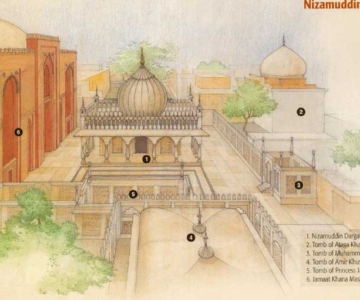
Delhi is not an ordinary South Asian metropolis. Its present day chaos cannot belittle its grand past, which created a civilisation and shaped the contours of Indo-Muslim identity, nourished the Urdu language, produced the finest verse in Hindustani and Urdu and fashioned a fabulous architectural legacy. This is why Delhi fascinates me endlessly. Each time I visit, I find a mohallah of the old dilli that concerns an important event or personality. Even better, another hitherto unknown monument is introduced to me; it is like a newly discovered continuation of an enjoyable book. One has only to casually drive around the city to find that it is dotted with monuments. I cannot complain that they are neglected in India; considering that Pakistan's mighty administrators erect Shaminaas on Mughal monuments for personal parties, how can one grumble about the infidel neighbours!