Archive for the ‘Poetry’ Category
Voices of the oppressed - Dalit literature
by K G Sankarapillai
‘Dalit’ means broken, oppressed, untouchable, downtrodden, and exploited. They come from the poor communities which under the Indian caste system used to be known as ‘untouchables’. They constitute nearly 16% of the Indian population.
The caste system, with a history of more than 3000 years in India, is a shameful system of social segregation, which works on the principle of purity and impurity. Purity is rich and white or whitish, impurity is poor and dark. Hidden powers of wealth can be easily traced in every feudal Brahmanical concept of the ideal. Material milieu of purity and beauty and prominence and command and comforts is also wealth. Economic division is reflected in the social classifications. But it should not be registered that caste is racial or economic. Dr. Ambedkar says that the caste system came into being long after the different races of India had commingled in blood and culture. To hold that distinctions of caste are really distinctions of race and to treat different castes as though they were so many different races is a gross perversion of the historical facts. Ambedkar asks: What affinity is there between the Untouchable of Bengal and the Untouchable of Madras? The Brahman of Punjab is racially the same stock as the Chamar of the Punjab and the Brahman of Madras is the same race as the Pariah of Madras. The caste system does not demarcate racial division. (Annihilation of caste – in writings and speeches vol.1 .p.49 Dr .B.R. Ambedkar) Read the rest of this entry »
MEDITATIONS AND MERCHANDISE
A Poem by M.I. Kuruwilla
Carry a message to your own people, my friend,
Which will be well understood by your people,
Not ours- the creed of the material, phenomental
World as an illusion, you call it, Maya, don’t you?
Concealing but also symbolically revealing
A deeper order of reality. Do I sound philosophical?
You must excuse me. I cannot help it.
This view of things with a deeper reality
At a deeper level is intriguing. I am myself affected
To the extent of thinking of blood and terror
As fantasies, symbols. Isn’t it intellectually
Consoling to think that violence, blood and terror
Are not real but only symbols of a deeper
Reality. Although I live in a firm word, I move
On two planes of reality- the mundane level,
And a deeper level of mystical yearnings and insights.
Yet the mystique of blood and terror is terrifying
Thing, not consoling at all. Passion and the craving
For power at a deeper level are murderous things.
Call it spirituality of blood and terror, if you
Like. But it is no joke to allow your face
To be blasted. No taking you first by the scruff
Of your neck even.
But I speak of none of those things here, the fear
And dread in the pursuit of Passion and Power.
Let them be. I would rather tell you of other mystical
Properties of violence and bloodletting. Although
We perpetuate violence to see an end to what we hate,
Violence is endless. Like Time. Though Time
Must have limit, time is endless, eternal.
Besides, our relationship with our enemies is
Of both love and hate, in which note a deeper
Dimension. Hatred is in the desire to exterminate
Our caemies. Our love for our enemies is in the care
We take for the continuance of violence……..
                                   2
Symbol and blood, blood and symbol. Why only
Symbols, you are asking. What about emblems?
You are right. They are there, when we often
Look at things horizontally, on the surface,
Not seeing the wood for the trees, if there is
Any wood to see. Look at the emblems of our culture
Which we are apt to overrate, but worth
Something, the surrogate and substitute fantasies,
The flotsam and jetsam of this our modern life.
Ponderous definitions! Let us have some model samples.
Yes the toothbrush, the sanitary towel- the tampon,
That covering for the female back under certain
Conditions. Don’t your Dakshina ladies in their
Shopping expeditions go in search of it – two
To three thousand miles? We may call them universal
Symbols, being so ubiquitous…. Nonsense!
We will stick to them as nothing but emblems.
But what is covered, is it at least universal…
Appetites are universal, passions urges aren’t
They? Possessing uniqueness, individually too?
What universality, uniqueness in a word
Of throw- away tampons and throw-away condoms!
Emblems will always be emblems, But in the rotund
World, baubles too have their place,
Looked at representationally.
All these- dilettantish nonsense! Commodity
Rules the world, someone truly said. The spilling
Of blood is profitable. Next of kin to blood
Is arms - for an orgiastic embrace, the buying and selling
Of which is profitable.
How we forget the realities of life!
Farewell, fantasy symbols and emblems. Yesterday’s
Shopkeepers are now the most expert gunmakers.
The descendants of those who stormed the Bastille
For the Brotherhood of Man are the manufacturers
Of deadly missiles. Three hurrahs for Gallic Socialism,
And four for their Socialist President. Thou shalt
No kill, said the great Jehovah to prophet
Moses. Thou shalt kill, kill and kill again
In Jordan and Gaza. That is the new dictum
Which replaces all of Hammurabi and Moses.
Christ and Gautama. Arms have to be sold,
Blood has to be spilt.
Look! Can great powers survive without arms
And arms-trade? And if they can’t survive,
If they collapse, what is the future of mankind?
And your terrorist gangs- call them guerrillas
Or freedom-fighters- where do they get their arms
From? From the sources controlled by us. We know
The extent of their sources and resources.
We have prescribed the rules and the game
As to who wins, who loses. But the game
Must go on. It is such fun-and so profitable. Read the rest of this entry »
Without clouds shedding tears
Without the eyes – two clouds – the lightning of the heart:
The fire of God’s threat, how could it be allayed?
How would the herbage grow of union, sweet to taste?
How would the fountains all gush forth with water pure?
How would the rosebed tell its secret to the meadow?
How would the violet make contracts with jasmine?
How would the plane tree lift its hands in prayer, say?
How would the trees’ heads toss free in the air of Love?
How would the blossoms shake their sleeves in days of
spring
To shed their lovely coins about the garden wide?
How would the tulip’s cheek be red like flames and blood?
How would the rose draw out its gold now from its purse?
How would the ringdoves call like seekers, “Where, oh
where?”
How would the stork repeat his laklak from his soul,
To say: “O Helper high, Thine is the kingdom, Thine!”
How would the dust reveal the secrets of its heart?
How would the sky become a garden full of light?
Rumi
Translation by Annemarie Schimmel
“I Am Wind, You are Fire”
Shambhala, 1992
Open the window of your heart
Do not worry if our harp breaks
thousands more will appear.
We have fallen in the arms of love where all is music.
If all the harps in the world were burned down,
still inside the heart
there will be hidden music playing.
Do not worry if all the candles in the world flicker and die
we have the spark that starts the fire.
The songs we sing
are like foam on the surface of the sea of being
while the precious gems lie deep beneath.
But the tenderness in our songs
is a reflection of what is hidden in the depths.
Stop the flow of your words,
open the window of your heart and
let the spirit speak.
– Translation by Azima Melita Kolin
and Maryam Mafi
“Rumi: Hidden Music”
HarperCollins Publishers Ltd, 2001
Other versions below Read the rest of this entry »
“The Whole Place Goes Up” - Rumi
Spring is here, friends.
Let’s stay in the garden
And be guests to the strangers of the green.
We’ll fly from one flower to the other,
Like bees making the six corners
Of this earth’s hives prosperous.
An envoy came from this fortress
And said, “Don’t beat the drum secretly.
With our yells, we would tear down the place
Where that Love’s drum is beating.”
Hear that voice which comes from the sky,
“Rise, all insane ones.
I sacrifice my Soul to the insane.
Let’s scatter our Soul today.”
Let’s break all the chains.
Every one of us is a blacksmith.
Let’s go to the fireplace where the pincers are.
Let’s fan the flame of the Heart’s fire
Like the furnace of blacksmiths.
So we can have iron Hearts
Under our control with breath.
We’ll put fire in this universe,
Incite riots in the sky,
Make his sober, resisting mind
Turn around, become dizzy like ours.
We are like a ball, without hands and feet,
Sometimes at the end
And sometimes at the beginning of the square.
Who told you we could do what we want?
Who told you we are independent?
No, no. We are like a club
In the hand of the Sultan.
We send hundreds of thousands of balls
To His feet.
Let’s be silent. Silence is made
With some material like craziness.
His mind is such a fire
That we hide this fire by wrapping it in cotton.
– Translation by Nevit O. Ergin
“Divan-i Kebir” — Meter 1
Walla Walla, Washington: Current, 1995.
Dear Che - A poem by K.G. Sankarapillai
A Poem by K.G. Sankarapillai
Dear Che
Dear Che,
you came to our university campus
in mid sixties
with a comrade and a modernist friend
with visuals of jungles past and present
with a vision of a new battle for justice.
Like a fresh wind of October
you joined us
moved us
renewed us
and smoothened our entry into history
with love, dreams and plans.
You told us about the sleeping rebel powers
of mountains and forests of the new minds;
quite often you talked of the day when
‘the Andes would become
the Sierra Maestra of America.’
Our modernist friend said:
you are the red star over the world
tarnished by America;
you are the future of the world
crippled by America;
you are the Jesus of the modern age
crucified by America.
Although you remained evergreen in us
showed us the exit to the oceans
from the lyrical ponds of our
post Independent Indian youth;
the exit to the storm from the water lily breeze
of our weeping romantic poems;
dear doctor, you redefined us
living with us
living for us
living in us
passing the confidence of torrents into our deserts
weaving sunlit paths into our prodigal nights.
You brought world into our words
and future into our past.
You opened blast-furnaces for our ore. Read the rest of this entry »
Two poems on justice -from Sri Lanka
Herat Hami
A poem by Wimalaratne Kumaragame (a translation)
Herat Hami who lived in Aliya Watunu Wawe*1
Even someone like me was more important than him
Though Harat Hami cut dead bodies*2
He was twenty, thirty times more decent than me
In the hospital of Aliya Watunu Wawe
He spent his time removing night soil
Though he lived happily with a monthly salary
Whenever I saw him I was moved with sadness
A hard, wiry body, handsome and thin
Not much of age, fresh and young
No wife as yet
I was perplexed by the job he did
Making someone like me sad
Each day he carried my excrement
If someone dies suddenly
Doctor comes
He cut the dead bodies in front of us
None from the farmer, worker or elite caste
Ever did such a job
No known disease of mind he had
He did no harm to any dwellers of the forest
He spread a docile smile
Every word of his spread ahimsa
Every evening he drank burning water
His heart overflowed with kindness
His sister was stabbed
Recalling her my eyes get wet
He did not cry the day his sister died
When she had a fever he wailed with tears in his eyes
When his younger sister died he went with a doctor
Her dead body was cut by Herat Hami
Though the villagers blamed him in harsh words for this
He did not care much about the world’s violent flesh
As he was not born in a rich mansion
He went to the temple at every Poya
He was a member of the newly built stupa
Even more than that he respected Iyyenayaka*3
Translation by Basil Fernando Read the rest of this entry »
As soon as you clear your hearing
the voice of a saviour
will shortly be heard
as soon as you
clear your hearing
don’t drink now
this polluted water
the elixir of life
will soon arrive
if you desire grace
lose your selfish self
till you can taste
the sweet essence
in the blackest
of your moments
wait with no fear
since the water of life
was found by the prophet
in the darkest caverns
Rumi
Translated by Nader Khalili
Rumi, Fountain of Fire
Burning Gate Press, Los Angeles, 1994.
The folded moment
Well, this evening I was bored with my writing. To amuse myself I assembled this little poem.
This was just another day
humdrum, ordinary, plain
save the few words
of assurance ..
nameless affections
and vacant moments.
So I picked up
a moment, casually
and put it away
in my silly pocket.
I am home now
looking for it;
and just found out
that the crumpled moment
has grown into a premonition
of things to happen
of words that could be said
or left unsaid.
So I have folded that moment
neatly and gently
and placed it in a book
that I intend to read
but might not actually read.
And yet, tomorrow
I want to see what happens to it.
Will it gaze at me,
with a sardonic smile
and inquire: “Are you looking for me”
Again?
Raza Rumi - April 18 - 11 pm
Faiz, a Peaceful Revolutionary
This is in continuation of the splendid translation series undertaken by Mr. Anis Zuberi and contributed by JZ for this blog. Earlier posts can be found here here and here.
Drawing on the Persian tradition, the subject of Urdu Ghazal has always been about earthly or heavenly love. With the rise in social consciousness Urdu poets started using the form of nazm to address such issues like injustice, poverty, uneven distribution of wealth, highhandedness of the privileged, tyranny of rulers, exploitation by priests, etc. However, Faiz introduced protest and dissent as a regular subject in ghazal. He did it by keeping the ghazal’s traditional format but giving the lexicon of ghazal a different meaning. This has had such a profound effect on Faiz’s poetry that at times it is hard to draw a line between his ghazal and nazm. For instance, Hum ke threy ajnabi itni madaaratuN ke baad though written in ghazal form is also a topical nazm titled “Dhaka se wapsi perâ€, reflecting his deep emotions after he visited Bangladesh (former East Pakistan) in 1974.
He also discovered that whispering is more powerful then screaming and that became his hallmark. Unlike Iqbal, Josh or many others who wrote poetry of protest like us khet ke her khousha’e gandum ko jalado or kakhe-umaraa ke dar-o-dewar hila do, Faiz does not confront injustice with hostility and anger. His protest is not direct, loud, thunderous, or deafening. He faces up to his tormentor by his moral strength, power of endurance and persistence. He believes in a soft and gradual revolution. He challenges the conscience of all human beings by showing his resolve and defiance when he says, aaj bazaar meiN pa-ba-julaN chalo or jo bache haiN sang samet lo. Even in moments of extreme anguish he avoids confrontation and invokes heavenly justice when he says lazim he ke hum bhee dekheN ge.
He captivates his audience by mixing traditional love with protest; lout jati hei udher ko bhi nazar kiya kije. It is amazing how Faiz has changed the traditional meaning of idioms used in ghazal for centuries. For example, love (ishq) is synonymous with struggle for justice (tohmat-e-ishq poshida kafi nahiN); his lover (aashiq, Qais, majnouN, Farhad) is a victim of oppression who is offering sacrifices while waging a struggle for justice; His rivals (raqib and adoo) are exploiters (Agar urooj pe hei ta’lae raqib to kiya).
Keeping the above background, I will attempt to translate and explain the meaning of the ghazal.
Woh buton ne dalay hain waswasay ke dilon se khauf-e-Khuda gaya
Woh parri hain roz qayamatain, kekhayal-e-roz-e-jaza gaya
(So much) cynicism (waswasa also means confusion; uncertainty) is created by the idols that fear of God has vanished from hearts.
(Because People) have gone through Armageddon daily the thought of the Day of Judgment is gone.
Here ButoN is not a metaphor for beloved, earthly gods or goddesses, but a symbol of brute authority. The word khauf in the second line also reinforces that meaning. The meaning of butuN in the above line is same as in the following couplet: Read the rest of this entry »
the world I do not need..Amir Khusrau
Amir Khusrau
I am a pagan (worshiper) of love: the creed (of Muslims) I do not need;
Every vein of mine has become (taut like a) wire; the (pagan) girdle I do not need.
Leave from my bedside, you ignorant physician!
The only cure for the patient of love is the sight of his beloved –
other than this no medicine does he need.
If there be no pilot on our ship, let there be none:
We have God in our midst: the pilot we do not need.
The people of the world say that Khusrau worships idols.
So I do, so I do; the people I do not need,
the world I do not need.
Wood for His Fire - Rumi
If you don’t have the Beloved
why aren’t you looking for Him?
If you have the Beloved
why aren’t you rejoicing?
If the Friend is truly your friend
Why not stay with Him?
If the rebec does not wail,
Why not teach it how to sing?
If someone bars you from the truth,
Why not fight him
and his brother as well?
You sit quietly and say to yourself,
“Something strange is going on.”
The only thing strange
is that your best friend is a stranger. Read the rest of this entry »
A poem of love and longing by Parveen Shakir
I rediscovered this exquisite poem by Parveen Shakir after years. This is an intense love poem of rare beauty. It is composite, taut and melodic. I have tried to translate it - however, the impossibility of a translation haunts me..
More so, the reality of days gone by, the visions lost haunts me even more..
Dedicated to those who stand by the sea of evening colours and moods and want to merge with their expanse. And, to someone who lives with time present and time past with equal ease..
yay haseen shaam apni
abhi jiss meiN ghul rahi hai
teray parahan kee khushboo
abhi jiss meiN khil rahay heiN
meray khawab kay shagoofay
zera dair ka hai manzar
zera dair meiN ufq par
khilay ga koi sitaara
teri simt daik kar woh
karay ga koi ishara
teray dil ko aayay ga phir
kissi yaad ka bullawa
koi qissa-ay judaaee, koi kaar-ay naamukamal
koi khawab-ay naa shagufta, koi baat kehnay wali
humeiN chaahiyay tha milna
kissi ahad-ay mehrbaaN meiN
kissi khawab kay yaqeeN meiN
kissi aur aasmaaN par
kissi aur sarzameeN meiN
humeiN chahiyay tha milna…
Here is the odd translation rendered by this blogger.
This melting evening of ours
Where everything dissolves
the scent of your clothes
the blossoming
sprouts of my dreams
All dissolves
A deferred vision, this is
In a little while,
a star will emerge on the horizon
To gaze at you
Meaningfully…!
Your heart shall then reminisce
the echo of a memory
The tale of a separation,
Of an unfinished moment
Of unblossomed dreams, things unsaid
We ought to have met
In times, considerate
In pursuit of attainable dreams
On a different sky
On a different earth
We ought to have met
Picture by Raza Rumi
Khusrau, Meera, Kabir: The Fluid Self
An essay contributed by the celebrated singer,writer and spiritualist Vidya Rao
I often ask myself the question why I choose, above all things, to sing, and then to sing a traditional gayaki like thumri. The images that are gleaned from its poetic texts are so often open to misunderstand: pining nayikas, heartless piyas, rakish Krishnas, divine Rams. I ask myself that question again today when ‘tradition’ is in danger of being smothered by sectarianism, communal violence and a whole culture lies bleeding.
I turn to the music itself for my answer. It has never failed me before—it does not fail me now. Read the rest of this entry »
Only you, know my pains - Rabba Meray Haal Da Mehrem Tu
“O God, you are my state of being” is what this Kafi of Shah Hussain loosely means. It is about the internal and external knowledge of Reality. I have been singing this Kafi for the last few days. Here is a translation (courtesy Shahidain) followed by an audio version and the Punjabi lyrics-
“O God, only You know all my pains.
You are within me and You are outside me( You are everywhere)
In every pore of mine (from top to toe) only you dwell.
You are the warp, You are the woof.
You are every thing for me.
Says Hussain, the Humble Faqir, I am nothing, You are everything”.
Interpretation by Naveed Siraj: Divine Love is ingrained in every fibre of ones’ self & this Love is overwhelming and ever-present. Like Pathanay Khan wailing “charkha bolay sain sainâ€; i.e., even the common household chores remind one of the Lord, so one loses the distinction between the begining of this love and its manifestation and its end. [this is why “andarâ€, “baharâ€, “room room vich toonh†captivates ones imagination]
And once again Abida Parveen sings it so beautifully: Read the rest of this entry »
Unveiling the mysteries - Bulleh Shah
Bulleh Shah discloses that the Lord pervades in everyone. He is not only to be found in Mansur, but also his executioner, as also the spectator.
Here is the Punjabi version followed by a crisp translation - a labour of love by Shahidain..
Â
“Behad Ramzaan dasda nee
Meyndaa Dholann maahee
Meem de Ohley wasdaa nee
Meyndaa Dholann maahee
Auliyaa mansoor kahaawey
Ramz anal-haq aap bataaway
Aapey aap noon soolee charhaaway
Te kol khaloke hasdaa nee
Meyndaa Dholann maahee
Behad Ramzaan dasda nee,
Meyndaa Dholann maahee
Boundless signs He reveals
My Beloved Lover
In [letter] ‘M’ His dwelling conceals*
My Beloved Lover
Â
As a saint Mansur gets Himself hailed
As the metaphor ‘I am Truth’ gets Himself hanged
On the gallows gets Himself impaled
Standing nearby with laughter He peals
My Beloved Lover
Â
Boundless signs He reveals
My Beloved Lover
In ‘m’ His dwelling conceals
My Beloved Lover ( Translation by Prof Muzaffar Ghaffaar)
* The letter meem phonetically M in English is a mystical letter and meant to contain Divine mysteries apparent only to the ones who develop the inner eye through mystical knowledge. Another verse speaks of Meem as the only difference between Ahad (Singularity of God) and Ahmad (another name for Prophet Mohammad- who accordint to some was the foremost mystic/Sufi in Islam)
Another translation follows - Read the rest of this entry »
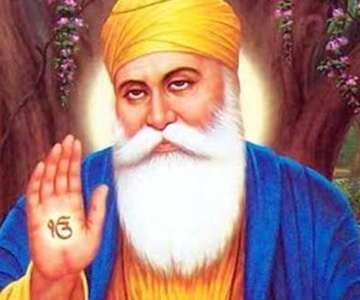
Real Naanak/Can prove dangerous to us
My friend Jasdeep Singh has shared his translation of a Punjabi poem Naanak by Jaswant Singh Zafar. I like the way poet brings out the essential side of Guru-Saint Naanak and his contemporaries from the Bhakti movement and alludes to the fact that how iconoclastic this was. Alas, all such movements and thoughts become boxed in rituals supervised by power hungry clergies..
Excuse Us
Its quite hard for us
To idolize real image of Naanak
Legs messed up with dust of the tiring paths
Cramped feet
rouged up beard by ..
eyes popping from the facial bone structure
dazzling renegade eyes
eyes –
which challenge
the family
the regime
and every ritual
Real Naanak
can prove dangerous to us
Naanak imitated in the paintings of Sobha Singh
is well suited for us
peaceful
spiritual
hand shown like Goddess Lakhsmi
and the generosity withering from the hand
eyes full of delicacy
clean sun silked beard
round fair cheeks
fair and lovely
rosy tipsy lips
soft gemini feet
delicate barbie hands
The walls of our home can only hold
Naanak imitated in the paintings of Sobha Singh
Naanak who challenged the paths traveled by others
That Dangerous Naanak’s real picture
is quite bulky for our walls..
Excuse us..
the homes we created with labour of blood,
we can’t afford ruining them,
kids we got with God’s grace,
we can’t afford losing them,
we can not idolize the real image of Naanak
Excuse us
Punjabi version in roman can be found below: Read the rest of this entry »