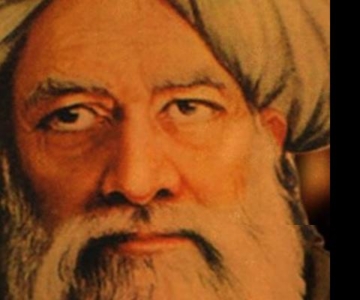
Jahane Rumi In search of the unsearchable: O, my soul! where would you find your house?

16Mar/100

Emperor Jahangir receiving his two sons, c1605-06

Succession intrigues:Emperor Jahangir receiving his two sons; an album painting in gouache on paper, c1605-06.

Read the related story here: Power, then as now, brings its own price. Neither life nor death was kind to this unfortunate son of Jehangir. AROON RAMAN recounts one of the most tragic yet inspiring stories to come out of Mughal India…

13Mar/100

Abr mi barad-o man shovm-e az yar-e judaa (The cloud weeps…)

Amir Khusrau's lofty couplet

Abr mi barad-o man shovm-e az yar-e judaa
Choon kunam dil becheneen roz zedildar judaa.
Abr baraan wa man-o yar satadah ba-widaa
Man judaa girya kunaan, abr judaa, yaar judaa

The cloud weeps, and I become separated from my friend -
How can I separate my heart from my heart's friend on such a day.
The cloud weeping, and I and the friend standing, bidding farewell -
I weeping separately, the clouds separately, the friend separately..

(trans. A. Schimmel)

Also see this

1Mar/107

In memoriam – Asim Butt (1978-2010)

He was a man, take him for all in all,

I shall not look upon his like again

(Hamlet, Shakespeare)

It is only when Asim has gone that one takes measure of the legacy he has left for his troubled and torn country. A decade long association was lost on the fateful day of January when we heard of his untimely exit from this world. For hours, I sat in my office, numb. Not that Asim’s suicide was a surprise, for he had warned us all many times of this inevitable dénouement to his dramatic life.

Five years ago, when I wrote a piece on the Pakistani poet Mustafa Zaidi and the romance with nurturing a death wish, Asim wrote to me and said that I had no clue what this was all about. His words were: “loved and was deeply moved by your piece on Zaidi... saw so much of myself in his life story, hoping I don’t die unsung and on the fringes, and wondering why you of all people would have a death wish.” Asim had suffered and struggled with his inner demons with an intensity that most of us will never appreciate. This was the first time that I knew about the seriousness of his other side: a dialectical dark side to his otherwise cheerful, loving and warm persona. Asim cannot be mourned; he can only be celebrated. He would have hated the melodramatic statements that I am inclined to write in this remembrance.

Two of my dearest friends were close to Asim in a way that is difficult to understand. Nearly a decade ago I met Asim at Ali Dayan Hasan’s home in Karachi. I was passing through on one of my occupational breaks from my assignment in Kosovo. Ali had returned from England and joined the monthly Herald and was piecing his life together. I met this lean and quiet young man who had big, bright eyes and a unique smile. We did not talk much except for a small argument over something, perhaps about a book, but I could not help being thoroughly impressed with his viewpoint. Since then I have had a series of exchanges, verbal and electronic, in which Asim was always animated, off-beat and extremely gifted with words and ideas. No wonder his art work and many of his writings are a formidable legacy for us all.

Born into a regular upper middle class family, Asim Butt was always an exception. He was different, as he would tell me. Rejecting convention, tradition and the confines of societal expectations was therefore something that started way too early with Asim. To be fair, he did pursue a path chosen for him. He attended the Li Po Chun United World College where his gift for painting became polished, and at some level he had chartered his future course. There was some meandering: a degree in the first batch of B.Sc. in Social Sciences earned from the Lahore University of Management Sciences; and later an unfinished PhD in History from the University of California, Davis. He returned to Pakistan, wrote for the Herald and other publications, and finally enrolled himself at the Indus Valley School of Art and Architecture.Not surprisingly, Butt graduated with distinction in 2006.

28Feb/100

Writing fiction

I loved Guardian's feature on Ten rules for writing fiction.

Elmore Leonard: Using adverbs is a mortal sin

1 Never open a book with weather. If it's only to create atmosphere, and not a character's reaction to the weather, you don't want to go on too long. The reader is apt to leaf ahead look ing for people. There are exceptions. If you happen to be Barry Lopez, who has more ways than an Eskimo to describe ice and snow in his book Arctic Dreams, you can do all the weather reporting you want.

2 Avoid prologues: they can be annoying, especially a prologue ­following an introduction that comes after a foreword. But these are ordinarily found in non-fiction. A prologue in a novel is backstory, and you can drop it in anywhere you want. There is a prologue in John Steinbeck's Sweet Thursday, but it's OK because a character in the book makes the point of what my rules are all about. He says: "I like a lot of talk in a book and I don't like to have nobody tell me what the guy that's talking looks like. I want to figure out what he looks like from the way he talks."

3 Never use a verb other than "said" to carry dialogue. The line of dialogue belongs to the character; the verb is the writer sticking his nose in. But "said" is far less intrusive than "grumbled", "gasped", "cautioned", "lied". I once noticed Mary McCarthy ending a line of dialogue with "she asseverated" and had to stop reading and go to the dictionary.

More here

27Feb/102

I become like a pen

Ghazal 2530 from the Diwan-e Shams, in a version by Coleman Barks, in translation by Annemarie Schimmel, and in translation by A.J. Arberry:
~~~~~~~~~~~~~~~~~~~~~~~~~~~~~~~~~~~~~~~~~
I become a pen in the Friend's hand,
tonight writing "say," tomorrow "ray."
He trims the pen for fine calligraphy.
The pen says, "I am here, but who am I?"
He blackens the pen's face.
He wipes it in his hair. He holds it upside down.
Now he begins to use it.
On one sheet he cancels everything.
On another he adds a dangerous conjunction.
The writing depends entirely on the scribe,
who knows how to split the head of the pen.
Galen knows what a patient needs.
The pen cannot speak for itself, or know what
to disapprove of in its own nature.
Whether I say "pen" or "flag", it is with this wonderful
conscious unconsciousness: the mind unable to include
its own description, composing blindly.
Held in a hand, yet free.
-- Version by Coleman Barks
(Based on the translation by A.J. Arberry)
"These Branching Moments"
Copper Beech Press, 1988
26Feb/104

Mystical Form of Islam Suits Sufis in Pakistan

A New York Times' piece where I was quoted.

By SABRINA TAVERNISE- LAHORE, Pakistan — For those who think Pakistan is all hard-liners, all the time, three activities at an annual festival here may come as a surprise.
Thousands of Muslim worshipers paid tribute to the patron saint of this eastern Pakistani city this month by dancing, drumming and smoking pot.
It is not an image one ordinarily associates with Pakistan, a country whose tormented western border region dominates the news. But it is an important part of how Islam is practiced here, a tradition that goes back a thousand years to Islam’s roots in South Asia.
21Feb/100

Sources of nourishment

The heart eats a particular food from every companion;
the heart receives a particular nourishment
from every single piece of knowledge.
~~~~~~~~~~~~~~~~~~~~~~
Del ze har yâri ghezâyi mi khvord
del ze har `elmi safâyi mi khvord
-- Mathnawi II: 1089
Version by Camille and Kabir Helminski
"Rumi: Daylight"
Threshold Books, 1994
Persian transliteration courtesy of Yahyá Monastra
19Feb/102

Rickshaw and truck poetry from Pakistan

My old friend Raza Bokhari sent me these golden lines used by our rickshaw & truck drivers to express their angst, emotion and sense of humour in a hostile environment. Before I post them, a little on the image on the right (borrowed from paklinks.com).
The rickshaw on the right has street poetry on love, trust, doubt, prayer and jealousy. There is a sale/discount incentive on the left. As a mark of respect, the Ustads (mentors who must have coached the driver or helped him procure the rickshaw are also mentioned on the bottom left and bottom right).
18Feb/10Off

Tau kiya yeh tay haye… (Gulbahar Bano singing)

A piece of Urdu poetry that has remained with me through seasons, years and all the vicissitudes...
This is an extraordinary ghazal (rhymed poem in Urdu composed in classical style). The poet is perhaps Saleem Kausar whose expression is subtle yet brutal. There is a sense of finality in the lyrics - a denouement that is being challenged and hence a dynamic is created that allows the tragedy of two people parting their ways to turn into a moment of absolute beauty. The sadness of the verse is augmented by Gulbahar Bano's unique voice that brings out the depth of meaning in the lines.

I can only translate the first couplet:
Tau kiya ye tay haye ke ab umr bhar nahee milna
Tau phir ye umr bhi kiyon, tum se gar nahee milna

Is it now agreed that we shall not meet for life
But what good would be living if I will not be with you

As I rendered this literal translation, I wanted to curse myself for being so inadequate with words.. Those who can understand Urdu or Hindi would know what exactly I am complaining about. I dedicate this to someone special who remains as close as time itself. In fact, I am grateful to this muse who sent it the other day bringing back the smell of summer heat, the shades of white and all the flowers that bloomed and were tucked into thick books.

Here is the ghazal

another version found on youtube:

17Feb/102

‘My life-achievement’ – karnama e hayat

What great lines

Mera karnama-e-zindagi
Meri hasraton kay siwa nahi
Yeh kiya nahi, woh hua nahi
Yeh mila nahi, woh raha nahi

The achievement of my life is nothing
But things that could not be done
I could not do it, [or] 'that did not happen'
Did not get that and what I got, did not stay with me

9Feb/103

Muslimness – shifting boundaries

Muslimness is an elusive state of being. There are watertight strictures of the theological identity defined by men, interpreted as the Sharia, on the one hand; and the broad political and cultural sense of the self, on the other. Identity, in any case, is a messy affair: shifty, shifting and eventually, imagined. While 9/11 placed Muslims at the centre stage of global politics, the broth had already been simmering in the cauldrons of biased academe and pop reality mirrored through the blood-thirsty lens of corporate media.

So what is it to be a Muslim? An inflexible bag of rituals? Or a cultural sense of belonging or a deeper dogma ingrained in young minds? I have never considered myself anything but a believer, a ‘practicing Muslim’. This has never been at variance with my secular and inclusive pretensions, despite the fact that the clergy in my country considers secularism akin to atheism, a sort of mirror image of the Pakistani political foundation. The clerics translate secular as la-deen , at best irreligious, and at worst, godless.

Ironical that this business of religious identity is articulated in a land that was the crucible of the secular Indus Valley civilization, non-militant Buddhism and a peculiar version of South Asian Islam that spread via the Sufi khanqahs and was a sort of amalgam of the Central Asian with the ancient South Asian. Even more ironical is the reality, neglected and veiled, that lived Islam is located around dargahs , tribal codes and customs which are irreligious in their own way. But who cares? Referred to as the world’s most dangerous country, Pakistan, according to the pundits of global opinion, is a haven for Islamic terrorists. Collateral damage, therefore, is kosher and a necessity to undo the unstated part of the ‘axis of evil’.

Labels and more labels. On the global shelves such products sell well and work in favour of a war machine hungry for energy resources, territory and blood.

6Feb/101

Eighteen years later…

It took eighteen years to locate a friend. Much like a star, the moon, a constellation and an ancient river my friend R has been mercurial, moody and elusive. Hiding one day and emerging the other week, and missing for years.

It is for the technology that enabled me to get reconnected. There is so much to ask and years to tell. A long night of oblivion that was - blissful ignorance but somewhere an image lingered, a memory refused to fade and a star never slept. Our meeting this year will be an unpaid debt to ourselves. We parted in such a hurry and matter-of-fact-ness. Little did I know that it would take eighteen years.

I am amazed at how strongly I have felt in the recent days - it has to do with nostalgia and the slowly diminishing youth..Adulthood has phases that can only be described through experience.

I will be there soon. In the city of neems, pipals and crazy auto-rickshaws.

R, please do not go away..

2Feb/102

Zolf bar baad – Mohsen Namjoo

Filed under: Iran, Music, Personal, video 2 Comments
22Jan/101

Farewell, Asim

Dear Asim: you left us in such a hurry - you will be missed, always..RIP

Asim Butt: A rebel from his conventional background, Butt continues to defy the conformist meanings of family, career, security, sexuality and that elusive bourgeois pursuit of happiness. Inspired by the Stuckism movement of art, Asim holds painting as a powerful medium of communication. This standpoint brings our young Pakistani Stuckist at odds with the skin-deep novelty and claimed nihilism of “conceptual” art and postmodernism. The pursuit of art in this worldview thus merges into an impulse for a renewal of spiritual values in art and society, or what is known as “re-modernism.” More here

17Dec/091

The tender tea house

I was quite pleased to read this piece. Aside from fact that it talks about me, the constant rememberance of Pak Tea House is a welcome sign. The memory is not fading, not yet..

From Partition onward, Nasir Khan writes, a dusty cafe was the centre of Lahore’s literary life.

Pak Tea House sits on Mall Road in Old Anarkali, nestled between tyre suppliers and motorcycle workshops. Before Partition it was the India Tea House, but 1947 and a quick paint job changed that. No one knows why it became – along with several similar shops on the same street – a favourite haunt of so many intellectuals. Maybe it was the cheap but good milky tea, or the extra-sweet biscuits. Perhaps it was the literary sensibility of the first post-Partition owners, two brothers from India. It might have been the radio on the counter that was constantly tuned to Lahore’s call-in request programme. And, for scores of struggling writers and poets, the availability of food on credit certainly had something to do with it.

29Oct/092

The Message of The Quran : By Leopold Weiss [Muhammad Asad]

‘The Message of The Qur'an’, has been acclaimed as one of the best, if
not the best, translations of the Quran into English. It is a
translation and brief commentary by ‘Leopold Weiss’ [Muhammad Asad] on
the Muslim holy book based on his own knowledge of classical Arabic
and on the authoritative classical commentaries. ,although it has been
criticised by some traditionalists for its Mutazilite leanings.
25Oct/090

Love God for something other than Him

Love God for something other than Him, in order
to be at all time part of His bounty;
O love God for Himself, for nothing else than Himself,
for fear of being estranged from Him.
Both quests and searches come from that same Source
where His heart ravishes hearts.
-- Mathnawi III, 4598-4600
Translated by Muriel Maufroy
Breathing Truth - Quotations from Jalaluddin Rumi
Sanyar Press - London, 1997
Filed under: Personal No Comments
24Oct/092

Dehumanized: When math and science rule the school.

Mark Slouka, Harper’s, September, 2009

Many years ago, my fiancée attempted to lend me a bit of respectability by introducing me to my would-be mother-in-law as a future Ph.D. in literature. From Columbia, I added, polishing the apple of my prospects. She wasn’t buying it. “A doctor of philosophy,” she said. “What’re you going to do, open a philosophy store?”

A spear is a spear—it doesn’t have to be original. Unable to come up with a quick response and unwilling to petition for a change of venue, I ducked into low-grade irony. More like a stand, I said. I was thinking of stocking Kafka quotes for the holidays, lines from Yeats for a buck-fifty.

And that was that. I married the girl anyway. It’s only now, recalling our exchange, that I can appreciate the significance—the poetry, really—of our little pas de deux. What we unconsciously acted out, in compressed, almost haiku-like form (A philosophy store? / I will have a stand / sell pieces of Auden at two bits a beat), was the essential drama of American education today.

Filed under: Personal Continue reading
13Oct/090

Was Hussaiyn bin Mansour Al Hallaj inspired by India?

by Akhilesh Mittal
In the third century of its advent Islam and its world were in ferment about forms of  polity such as the Caliphate and ideas like the relationship of man and God. The Caliph recognized by Shias  (Fatimid) held court in Egypt while the Sunni Caliph (Abbasid) functioned from Baghdad. Many splinter groups came up with each having its own separate and distinct interpretation of the Word.
Filed under: Personal Continue reading
7Oct/090

Discovering Five Dials

‘We’d love to have more people from Pakistan writing for and reading the magazine’

It was quite soothing to come across a delightful publication entitled Five Dials — a free, beautifully produced magazine. The current issue available at www.fivedials.com includes a piece by the young novelist Ali Sethi who has written a novel at an extraordinary age of 24. The piece delves into the reaction of author once he encounters the desolation at Shah Jamal’s shrine in Lahore.Shah Jamal’s shrine has also been associated with the great Pappu Sain dhol wala.
I am publishing the small post on Five Dials in its own voice to make the description of the magazine a little more familiar and immediate than a boring review. I am grateful to Craig Taylor for helping me in getting the introduction right.
Accessibility of Five Dials: As for new technology, Five Dials is a very lean and flexible entity. We do not need to worry about paper stock and production cost. Unlike Granta, we’re able to turn around issues
2Oct/09Off

Parveen Shakir – ‘coins of my truthfulness’

Parveen Shakir with her mentor Qasimi whom she called Ammu

Young Shakir at a mushaira

Fifteen years later Shakir remains intensely popular. Her poetry has been reinterpreted and critics who dismissed her as a poetic lightweight have realized that there was much more to Parveen's poetic vision than just henna-dyed hands

Parveen Shakir (1952-1994) has defined the sensibilities of several generations and beyond. At the relatively young age of 42 years, Parveen Shakir died on an empty Islamabad boulevard, as if this was an essential part of her romantic persona. But she had lived a full life where poetry and tragedy intersected each other and became inseparable from her being.

As a young student in high school, I was introduced to Shakir’s romantic poetry, which was best represented by her first collection of poetry ‘Khushbu’. I had won an essay writing competition in Urdu and a delightful award came in the form of this tender volume of poetry. Since then I have always returned to bits and pieces of Khushbu. It may not be according to the cannons of literary theory, but it is spontaneous, fresh and almost dreamlike. Shakir was bearly 24 years old when Khushbu was published and since its first edition, this book has been a best seller wherever Urdu poetry is read or appreciated.

Khushbu turned Shakir into a celebrity. Aside from mushairas, newspapers and public fora, she was ever-present on the Pakistan television, perhaps as its only saving grace during the rigid years of Zia-ul-Haq’s Martial Law. Shakir had a natural talent for public speaking, reciting poetry and just being herself. I remember one monsoon evening in Murree when we were hooked to her presentation on Pakistan’s Independence Day. There was a distinct tenderness in her voice that was in sharp contrast to the platitudes being churned out. Above all she was beautiful. I remember she would read verses from her own work and from the great masters of Urdu poetry with complete ease and immense refinement. In the short period of time that she lived as a poet, Parveen did rather well and was quite prolific. Her later collections comprised Sad Barg (marsh merrygold), Khud Kalami (conversing with one’self), Inkaar (refusal), Maah-e-Tamaam (full moon) and Kaf-e-Aaina (edge of the mirror).

Her raw romanticism runs through her poetry. For instance, yay haseen shaam apni is a love poem of rare beauty; and has always been a favourite of mine. It is composite, taut and melodic; and here is my translation.

This melting evening of ours

Where everything dissolves

The scent of your clothes

The blossoming sprouts of my dreams

A deferred vision, this is

In a little while,

A star will emerge on the horizon

To gaze at you meaningfully…!

Your heart shall then reminisce

The echo of a memory

The tale of a separation,

Of an unfinished moment

Of un-blossomed dreams, things unsaid

We ought to have met

In times, considerate

In pursuit of attainable dreams

On a different sky

On a different earth

We ought to have met

13Sep/090

The vanity of being quoted

A friend sent me these links and I am shamelessly posting them here:

My views on the IMF programme for Pakistan - Also here

On visiting Bangladesh as a Pakistani

My art review of Asim Butt's work

Ghalib in Benaras

On Qurratulain Hyder, the Urdu writer

Princess Zebunnissa

Inhospitable reception given to white women

On the stranded Pakistanis in Bangladesh

On the Asian News net

11Sep/090

Hanging Fire: Contemporary Art from Pakistan

A press release from Asia Society states the following:

Hanging Fire is the first U.S. museum exhibition to focus on contemporary art from Pakistan. Representing the current energy, vitality, and range of expression in Pakistan’s little-known yet thriving arts scene, the exhibition comprises nearly 50 works by 15 artists, and includes installation art, video, photography, painting, and sculpture. Curated by Salima Hashmi—one of the most influential and well-respected writers and curators in Pakistan—the exhibition presents a comprehensive look at recent and current trends in Pakistani art.

The exhibition begins with one of the last major works by the late artist Zahoor ul Akhlaq, considered the founder of modernism in Pakistan, who was tragically murdered in 1999 and whose work continues to influence younger artists. The recently established and distinctly Pakistani genre of contemporary miniature painting is examined through works by artists such as Mahreen Zuberi and Imran Qureshi, who skillfully manipulate the technical discipline and meaning of the hallowed illuminated Mughal manuscript tradition. Qureshi will also create a site-specific painting at Asia Society for the exhibition.

More here

10Sep/090

Walks around the World

I have loved these pieces by several authors who have written about their favourite walks as a collaboration between Orion and the online magazine for international literature, Words without Borders. The writers are  Tomas Espedal, Manik Datar, Homero Aridjis, Sa?t Fa?k Abasiyanik, and Yuri Rytkheu (Published in the September/October 2009 issue of Orion magazine)

EVERY WALK—whether urban or rural, real or imagined—features the movement of one or more persons on foot through a particular place and some manner of dialogue that unfolds either between characters or in the narrator’s own head. Beyond that, anything can happen. From an editorial perspective, the walk is a universal narrative device for exploring a diverse sampling of cultures and places, ideas and environments. Which is why Orion teamed up with Words without Borders to jointly commission and collaterally publish a collection of short pieces, each written in a language other than English and translated, about a walk taken, remembered, or invented. Five of these pieces appear here, in the pages of Orion. To read the balance of the selections, readers are directed to the September issue of Words without Borders, which can be found at wordswithoutborders.org/internationalwalks.

9Sep/092

A holiday cottage is what I need

I need a holiday and as I searched on the internet that great vortex of illusions, hopes and fears - I came across this site that has some excellent deals. They issue newsletters that are a great way to be informed of the best deals on offer. I intend to sign up today and be updated on idyllic holiday cottages. I have heard of the famous cornwall cottages and perhaps this site might get me some leads. Perhaps the idea of self catering holidays can be explored as well.

27Aug/090

Revisiting Faiz

Rakhshanda Jalil's review of Coming Back Home: Selected Articles, Editorials and Interviews of Faiz Ahmed Faiz,compiled by Sheema Majid

Compiled by Sheema Majeed, Introduction by Khalid Hasan, Oxford University Press, Karachi, 2008, pp 157, Rs 295.

‘Politics and history are interwoven, but not commensurate,’ said Lord Acton (1834-1902) in his inaugural lecture as Regius Professor at Cambridge in 1895. So also politics and prose, and, in the worst of times, politics and poetry. There can be no better example of this axiom in the twentieth century than the writings of the revolutionary Urdu poet, Faiz Ahmed Faiz. While most readers in South Asia are familiar with his poetry, few would have read his writings in English. Faiz wrote, prolifically and compellingly, on the events that shaped the destiny of the sub-continent.

Filed under: Personal Continue reading
25Aug/091

Salaam Pakhtunkhwa

Haligoli, (2001), a miniature by Saira Wasim – collection of
Robert Roder

Peshawar, a city destroyed
by terrorism

IDPs returning to their homes

Wherever I went to eat, there was a meat-fest in waiting. There comes a time in life when you want to give up meat forever and that moment arrived on a dark, load-shedded night in Peshawar

My piece published in The Friday Times (August 21 issue)-----
My recent weeks have been consumed by travels to the capital and to the grim frontiers of Paktunkhwa. As part of an unwieldy team undertaking a survey of the wretched internally displaced persons returning to their homes, I was in and out of Peshawar several times. Other than encountering the depressing stories of a people trapped by their history and geopolitics one had to struggle for a vegetarian meal in good old Peshawar. Wherever I went to eat, there was a meat-fest in waiting. There comes a time in life when you want to give up meat forever and that moment arrived on a dark, load-shedded night in a cloistered guest-house reeking of cigarette-smoke and untreated sewage. Thank God for my friend Ahsan, who like a good comrade humoured me and regurgitated the lessons of being patient and calm. I must not complain too much for I’m not an ungrateful wretch. There are many in the subcontinent who cannot even afford a basic meal, let alone pleasures of the flesh. But there has to be a limit to the carnivorous instinct that we are so given to in the Land of the Pure, Purists and Puritans.

As if a non-vegetarian diet was not enough, the scare of being smoked out by the Al-Qaeda goons was even more disturbing, dare I say, indigestible. A happy-go-lucky and overly-healthy host, as he drove us into the by-lanes of the old Peshawar that must have been beautiful once, gregariously referred to all the sites where bombs had erupted were a little disturbing. Not that I am scared of dangerous places, for I have braved a post-war Kosovo with a fair measure of bravado. But the hysterical “outsiders” ranting about how insecure we were in Peshawar was a little dampening for a Lahori soul. We do live in interesting times, made even more interesting by naïve security experts and people fed on Western media reporting on Pakistan being a truly dangerous pit-hole of the world. Sometimes the propaganda war does conquer your senses, I must confess.

So we visited the camps where thousands had been packed like sardines and where women recounted stories of bereavement and heavy-duty terror-mongering by the good Taliban as we are told that there is a clear distinction between the good and the bad Taliban. Now if the good Taliban, referred to as “patriots” not long ago, are such barbarians, I shudder to think what the bad Taliban might be like. The children at these camps were suffering even more. The heat could be unbearable and drinking water was not always available. And

22Aug/092

Pakistan’s Urdu Columnists Live in the La-La Land of Conspiracy Theories

I was most amused in a strange, tragic way as to what nonsense is churned out as ‘opinion’ and ‘analysis in Pakistan’s mainstream vernacular media. I had once written about it as well here. True to his incisive reputation, CM Naim’s piece is extraordinarily well written and revealing. Raza Rumi

By: C.M. Naim – For the past five or six months I’ve been reading fairly regularly the web pages of three Urdu newspapers from Pakistan: Jang, Nawa-i-Waqt and the Express. I glance at the headlines cursorily then immediately turn to the columnists. Most days, each of the three carries a minimum of six columnists. Some of them are big names; they frequently appear on TV shows, get regularly invited to the President’s residence, and travel with the Prime Minister on important trips. These gentlemen never let you forget all that. One or two even give details of the food served on such occasions—there is always plenty of food served, not just a cup of tea, when they visit with any dignitary.

Filed under: Personal 2 Comments
19Aug/093

Macca gaya gal mukdi naahi – Bulleh Shah

Macca gaya gal mukdi naahi, chaye soe soe jumay pad aai…..
Ganga gaya gal mukdi naahi, chaye soe soe gotay khai….
Bullay shah gal tahiyoe mukdi jadoe mainu dilo gawai…..

Filed under: Personal 3 Comments
9Aug/090

He has afflicted you…

He has afflicted you from every direction in order
to pull you back to the Directionless.

--Breathing Truth - Quotations from Jalaluddin Rumi
Selected and Translated by Muriel Maufroy
Sanyar Press - London, 1997

Filed under: Personal No Comments