Jahane Rumi

In search of the unsearchable: “…O, my soul! where would you find your house?”

Archive for the ‘Lahore’


Published April 23rd, 2008

Lahore Nama - A new blogspace devoted to the magical city

 I have been rather casually posting news, stories and comments on Lahore’s heritage and its current status on Lahore Nama. While blogging here I was always tempted to write about Lahore or post stuff by others on my beloved city. Noting that this would be rather obsessive, I have created an outlet for this obsession and a new blog is now on the block, as they say.

What differentiates Lahore Nama from other Lahore-centred blogs? Indeed, it is no way near the excellent Lahore metblog that is managed by a good team of motivated bloggers. My focus is on Lahore’s past and viewing the present in relation to that.

Luckily, Darwaish in Lahore has sent me some brilliant pieces and Ahmad Rafay Alam has agreed to the use of his incisive articles on urban planning; and Mayank Austen Soofi has also been contributing stories for cross-posting. In fact Soofi was most kind to announce the birth of Lahore Nama on The Delhi Walla. I quote from that story:

More than 60 years have passed since the creation of our two nations. 60 years should be but a blip in the life of great cities like Delhi and Lahore but meantime much has changed in their characters. And character is destiny. Both cities have continued to grow in ways that makes them very different from each other. Delhi lost its Muslim refinement. Lahore lost its Hindu heritage. Today there are three cities of Delhi and three cities of Lahore: what they used to be; what they are now; what they could have been.

So Lahore Nama is on the blog-horizon and without much effort on my part it is attracting a few hundred visitors each day.

Such is the pull of Lahore….

Published April 9th, 2008

Only you, know my pains - Rabba Meray Haal Da Mehrem Tu

“O God, you are my state of being” is what this Kafi of Shah Hussain loosely means. It is about the internal and external knowledge of Reality. I have been singing this Kafi for the last few days. Here is a translation (courtesy Shahidain) followed by an audio version and the Punjabi lyrics-

“O God, only You know all my pains.
You are within me and You are outside me( You are everywhere)
In every pore of mine (from top to toe) only you dwell.
You are the warp, You are the woof.
You are every thing for me.
Says Hussain, the Humble Faqir, I am nothing, You are everything”.

Interpretation by Naveed Siraj: Divine Love is ingrained in every fibre of ones’ self & this Love is overwhelming and ever-present. Like Pathanay Khan wailing “charkha bolay sain sain”; i.e., even the common household chores remind one of the Lord, so one loses the distinction between the begining of this love and its manifestation and its end. [this is why “andar”, “bahar”, “room room vich toonh” captivates ones imagination]

And once again Abida Parveen sings it so beautifully: (more…)

Published March 17th, 2008

Mian Mir’s 384th Urs

Mian Mir’s death anniversary celebrations are commencing today.

Mian Mir is regarded as one of the greatest Sufi saints of the Subcontinent. He belonged to the Qadiria order of the Sufis. He was famous for being a spiritual instructor to Dara Shikoh, the eldest son of Mughal Emperor Shah Jahan, who also held Mian Mir in great esteem. (more…)

Published February 26th, 2008

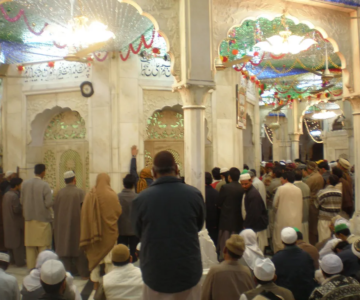
Data Darbar - the Urs begins


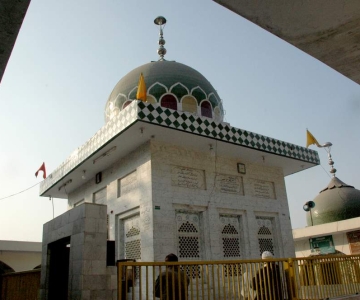
The shrine at night

Originally uploaded by Jahane Rumi
“The heart is the seat of knowledge and is more venerable than the Kaaba. Men are forever looking at the Kaaba but God looks towards the heart”; said Hazrat Usman Hajveri popularly known as Data Saheb of Lahore.

The shrine of Shaikh Ali Hajweri, Data Ganj Bakhsh, or Data Sahib is a landmark of sorts in the subcontinent. It has been a centre of inspiration since the eleventh century. He was both a scholar and a saint and author of the first treatise on Sufism in Persian language - Kashf al Mahjub (or “Unveiling the Veiled”). Originally from Ghazni, Afghanistan, Data Saheb spent a considerable portion of his life in Lahore. He loved it so much that settled there permanently.

After his reunion with the Creator in 1077 A.D, his shrine has attracted millions of people. It is still the busiest of places even after nearly ten centuries. Even the leader of Chistiya school of Sufism, Khawaja Moinuddin Chisti sought spiritual guidance at his shrine.

Wish I could have been there at the Urs (the death anniversary)-it is quite an event.

Please also see this story on Data Saheb.

Published August 24th, 2007

On Half truths - Guest Post by Ali Eteraz

Today, Jahane Rumi is publishing a guest post by Ali Eteraz who is well known in the blogopshere. Eteraz is a gifted, fiery writer based in the US. He maintains a blog Eteraz, writes for the Huffington Post  as well as for the Guardian’s blog. Ali also manages a web portal called Plural Politics. The views expressed below are solely those of the author.

Why is NYT’s India Editorial About Pakistan?

On August 15, 2007, presumably to mark India’s 60th birthday, the NYT published an op-ed by Ramachandra Guha, entitled “India’s Internal Partition.” At the outset it appeared to be a promising examination of Hindu-Muslim relations, in India. Guha started by discussing1990:

Bharatiya Janata leader Lal Krishna Advani journeyed for five weeks between Somnath and Ayodhya, making fiery speeches at towns and villages en route, denouncing the Indian government for “appeasing” the Muslims. In many places Mr. Advani visited, attacks on Muslims followed.In New Delhi, where I then lived, Mr. Advani’s march represented a grave threat to the inclusive, plural, secular and democratic idea of India.

Yet moving on from that passage the reader is not treated to any meaningful discussion about India’s “internal” matters whatsoever. In fact, as soon as the discussion about Indian-Muslims begins, Guha starts to discuss…Pakistan. It is depressing that 60 years on, a prominent Indian intellectual still has not managed to learn the simple fact that Indian Muslims are Indian and Pakistani Muslims are Pakistani (and not Indian). However, what makes Guha’s gaffe even more disappointing is that his views of Muslims, Indian and Pakistan both, are downright racist.

Though he is quick to invoke his friendship with Pakistani Tariq Banuri who was the first Muslim Guha ever became “close” with (even having dreams about Banuri during the Ayodha crisis), it would appear that the friendship did not leave any discernible positive residue.

When discussing Muslims in India, Guha simply states the oft-invoked trope that Muslims don’t do anything but films, saying “but in law, medicine, business and the upper echelons of public service, Hindus dominated.” An objective editorial about India’s “internal” partition might have inquired why Muslims in India do not make it to the “upper-echelons” of Indian society. But why would Mr. Guha waste time with trivialities, when, on the 60th anniversary of India, there is plenty of Pakistan bashing to be had. It comes soon enough.
The first episode discusses his Delhi’s landlords “all refugees from the Pakistani part of Punjab.” (emphasis added). Guha describes these individuals in excruciatingly materialist terms, making them appear greedy and crass, apparently they “hoarded diamonds and maintained Swiss bank accounts.” Then, to follow it up, he adds this wonderful nugget:
 
They also cheated their tenants. In six years in Delhi, my wife and I had four landlords, all refugees from the Pakistani part of Punjab. All four hooked their appliances to our electricity meter, and all kept our deposits when we left.
My question is very simple. If Guha’s article is evaluating India’s internal health, and he wishes to complain about Delhi’s landlords, why is there a need to invoke “the Pakistani part of Punjab.” After all, before 1947, there wasn’t even such a thing as a Pakistani Punjab to speak about! If these people are refugees who didn’t make it into Pakistan, then they aren’t really Pakistani to start with, are they? They are Indian, aren’t they? Yet that is the sinister racism of Guha’s piece. Veiled under his concern for India, he is lashing out against a) against Muslims, and b) rendering them all in some way connected to Pakistan.
This piece of subtle-racism continues in the next section when he discusses a visit to Badshahi Masjid:
Then I went across to the majestic Badshahi Mosque, built by the Mughal emperor Aurangzeb. It was Friday evening, and a large crowd of worshipers was coming out after the weekly prayers. Walking against the flow, I had to jostle my way through.
As I bumped into one worshiper, I was seized by panic. In one pocket of my kurta lay my wallet; in the other, an exquisite little statue of the Hindu god Ganesh, dancing. I am not a believer, but this was my mascot, a gift from my sister, carried whenever I was separated from my wife and little children. What if it now fell out and was seized upon by the crowd? How would that turn out — an infidel discovered in a Muslim shrine, an Indian visitor illegally in Lahore?
See the use of the terms “infidel” and “panic” and “seized upon by the crowd” (as if all Muslims crowd act as one), and the use of the term “shrine” to describe a mosque? Reality is that Guha is unwilling to accept that when he was in Pakistan, no one cared that he was a Hindu, or had a dancing god in his pocket, or that he was from the upper-echelons of Indian society. In India, by virtue of being Hindu, he’d at least have been able to feel better than Indian-Muslims. In Pakistan, deprived of recognition, and in desperate need for it, he resorted to a simpleton’s victimization-complex.
After all this racism, it is no surprise that he ends by predicting war between India and Pakistan.
Despite their shared culture, cuisine and love for the game of cricket, India and Pakistan have already fought four wars. And judging by the number of troops on their borders and the missiles and nuclear weapons to back them, they seem prepared to fight a fifth.
There is no mention of the peace-initiatives via Musharraf and cricket-diplomacy over the last seven years (during which time Indian visitors were celebrated by Karachites and Lahoris), or that for the first time in ages there hasn’t been any saber-rattling between India and Pakistan. Guha’s anti-Muslim attitude, in which all Muslims, even Indians, really are Pakistanis, leads to enmity between Hindu and Muslim. If anything, this editorial, entitled “India’s Internal Partition” reveals more about why Pakistan was necessary, and a good idea, than casting any positive impression of India.

Published August 22nd, 2007

Lahore - that was

Intizar Hussain, the eminent writer of Urdu, recently mused on the Lahore of yesteryears and the literary and intellectual atmosphere. I am posting a few excerpts from his heart-felt piece:

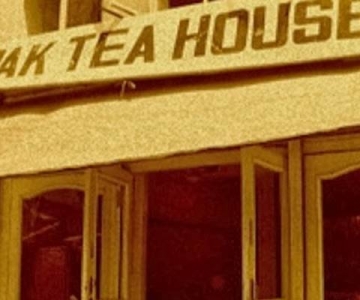
Not far from the coffeehouse there was the Pak Tea House which closed down recently. Even those who never cared to visit it were seen shocked at this cultural catastrophe. How earnestly they struggled for its restoration, but frankly speaking, even if restored it could no longer be the kind of teahouse that it once was. Times have changed; the city has lost its cultural character and opened its arms to commercialisation.

It was a different world when coffeehouses and teahouses flourished. They flourished in the background of a rich restaurant culture, which distinguished the Mall from other cultural spots of the city. Those sitting there were never seen in a hurry. They could afford to sit for long hours discussing ideas and ideologies over a cup of tea. Each literary theory had its protagonists, who when engaged in a discussion gave the impression of being the defender of a noble cause most dear to them. And it was not simply an intellectual exercise with them. What they discovered as truth in the process of their literary or intellectual thinking stayed as an article of faith with them.

Such were the devoted souls for whom ideas and ideologies meant more than worldly benefits. It was because of them that certain restaurants gained a cultural status. Now we are living in a different world. This world cannot afford to have such souls and such haunts within its fold. The age of coffeehouses and teahouses is gone. Food streets are now the hallmark of life in Lahore.

Yet there is hope - such as this intent by a well meaning intellectual on Pakistaniat.

picture credit

Published May 22nd, 2007

Selections from Shah Hussain’s poetry

“In the new Lahore lies buried Shah Husain and with him lies buried the myth of Lal Husain. Still, at least once a year we can hear the defused echoes of the myth. As the lights glimmer on the walls of Shalamar, the unsophisticated rhythms of swinging bodies and exulting voices curiously insist on being associated with Husain. This instance apparently defies explanation. But one is aware that an undertone of mockery pervades the air - released feet mocking the ancient sods of Shalamar and released voices mocking its ancient walls. Husain too, the myth tells us, danced a dance of mockery in the ancient streets of Lahore. Grandson of a convert weaver, he embarrassed every one by aspiring to the privilege of learning what he revered guardians of traditional knowledge claimed to teach. ” Full article here

 Here are a few Kafis with translations….

Ni Mai menoon Kherian di gal naa aakh
Ranjhan mera, main Ranjhan di, Kherian noon koori jhak
Lok janey Heer kamli hoi, Heeray da wer chak

Do not talk of the Kheras to me,
O mother, do not.
I belong to Ranjha and he belongs to me.
And the Kheras dream idle dreams.
Let the people say, “Heer is crazy; she has given her-self to the cowherd.” He alone knows what it all means.
O mother, he alone knows.
Please mother, do not talk to me of Kheras.

Sujjen bin raatan hoiyan wadyan
Ranjha jogi, main jogiani, kamli kar kar sadian
Mass jhurey jhur pinjer hoyya, karken lagiyan hadyan
Main ayani niyoonh ki janan, birhoon tannawan gadiyan
Kahe Husain faqeer sain da, larr tairay main lagiyaan

Nights swell and merge into each other as I stand a wait for him.
Since the day Ranjha became jogi, I have scarcely been my old self and people every where call me crazy. My young flesh crept into creases leaving my young bones a creaking skeleton. I was too young to know the ways of love; and now as the nights swell and merge into each other, I play host to that unkind guest - separation.

Main wi janan dhok Ranjhan di, naal mare koi challey
Pairan paindi, mintan kardi, janaan tan peya ukkaley
Neen wi dhoonghi, tilla purana, sheehan ney pattan malley
Ranjhan yaar tabeeb sadhendha, main tan dard awalley
Kahe Husain faqeer namana, sain senhurray ghalley

Travelers, I too have to go; I have to go to the solitary hut of Ranjha. Is there any one who will go with me? I have begged many to accompany me and now I set out alone. Travelers, is there no one who could go with me?

The River is deep and the shaky bridge creaks as people step on it. And the ferry is a known haunt of tigers. Will no one go with me to the lonely hut of Ranjha?

During long nights I have been tortured by my raw wounds. I have heard he in his lonely hut knows the sure remedy. Will no one come with me, travelers?

Courtesy - Najam Hosain Syed

Published May 20th, 2007

Amrita Shergil’s Lahore

Khalid Hasan writing for the Friday Times:

“Amrita Sher-Gil is one with the earth of Lahore. Is there no one in this city that she chose as home to build a memorial to her, or at least put a plaque at 23 Sir Ganga Ram Mansion in remembrance of a painter who has left her mark on the world in which she was not destined to live very long?”

Read the full article here that discusses her life and times in Lahore and also the little known relationship with Nehru.

Published April 17th, 2007

Public Sculptures of Lahore - cross posted at All Things Pakistan

I am glad that Adil Najam posted my piece on the public sculptures of Lahore on his blog - All Things Pakistan. It was good to read the comments as well. Full entry here >>

Published April 11th, 2007

Our endangered heritage

Delhi’s Red Fort was once a symbol of Mughal power and the myriad India was ruled for centuries from this fort. Full entry here >>

Published April 9th, 2007

Easter in Lahore

The local Christian community praying at an Easter service in Lahore, Pakistan.

Published April 4th, 2007

On infinite love - from Kashul Mahjub

Kashful Mahjub is one of the early treatises on Sufism and has shown light to many Sufis world-wide. Full entry here >>

Published March 29th, 2007

Mian Mir

Yesterday, devotees were lighting lamps at the shrine of Mian Mir in Lahore to commemorate the saint’s 383rd Urs (death anniversary). Full article here >>

Published March 27th, 2007

The new slave dynasty in South Asia?

“Writer Arundhati Roy said in an interview last week that at least India’s growing middle class was reared on a diet of radical consumerism and aggressive greed.

Full entry here >>

Published March 21st, 2007

More Images from Lahore by Artist Mahboob Ali

Mahboob Ali, the only woodcut artist of Pakistan has sent me more images of his works.

Full entry here >>

Published March 18th, 2007

These strange times

A great photo from the Lahore city court where the lawyers strike allows the support staff to play some cricket while our team struggles to stay in the World Cup competition.

Full entry here >>

Published March 14th, 2007

On Feryal Ali Gauhar

This piece was first published in The Friday Times 

Conversations with novelist, filmmaker, feline aficionado, and femme fatale, Feryal Ali Gauhar, as she prepares to launch her second novel

Who doesn’t know Feryal Ali Gauhar? A novel at the top of The New York Times international bestseller list, years of television appearances and a highly publicised marriage to Jamal Shah that became fodder for countless gab sessions, have caricatured and made famous her persona. Had I not known her personally, I too may have fallen for the half-imagined tales littering the drawing rooms of socialites in this land of the pure. But I have had the pleasure of Feryal’s acquaintance for years, and not a moment of our friendship has resembled the images painted by petty gossip and lazy misinformation.


Read full article here >>