Jahane Rumi

In search of the unsearchable: “…O, my soul! where would you find your house?”

Archive for the ‘Journalism’


Published August 20th, 2007

Healing the wounds of Partition ..

I read this interesting, albeit a little contentious, piece by  Ravinder Kaur  that examined the impact of partition on settling the communal question. The article states:

The sixtieth anniversary of the independence of Pakistan and India on 14-15 August 2007 has prompted official celebration in both countries, as well as an ocean of commemorative coverage in the world’s media. The terrible violence that accompanied the birthpangs of the two states from the ashes of empire is an inevitable theme in much commentary. What is being less addressed amid the profusion of human stories - and what this article considers - is whether the problems of communal division in the sub-continent were or are best addressed by the partition of territory.

The recent weeks have seen a splurge of such discussions in the media (including the new media) that attempt to re-examine and explore the partition of India. In particular, the sufferings of millions who crossed the line have yet again come to light.

Another reflective piece that I discovered is “pain of partition“ that recounted the sufferings of migrants on both the sides of the divide.

And today, Vidya Rao - a celebrated classical singer from India sent this petition that seeks to heal the wounds that still hurt our collective lives:

Apology Petition

Dear Victims of the Partition-related Violence in South Asia:

The mass murder, rape, pillage and suffering that accompanied the partition of British India in 1947, have left deep scars on the psyche of the people of India, Pakistan and Bangladesh, the former East Pakistan.

Tens of thousands were murdered, raped, and maimed, and millions were displaced in an immense human tragedy, that continues to poison our discourse, and feed mutual suspicions and hatreds.

Therefore, we, the members of the Association for Communal Harmony in Asia (ACHA), and others, who have signed below, believe that the time has come for all of us jointly to condemn, without distinction, the insane orgy of violence and intimidation that accompanied the great human divide of 1947.

On the 60th anniversary of the Independence of India and Pakistan, we recall that dark chapter in our history so as to ensure that these tragedies will not be forgotten, or repeated.

We hope that coming generations will learn from this man-made calamity, and turn away from divisions based on religion, ethnicity, language, national origin, caste, or creed.

Taking lessons from history, we undertake to shun the political use of religion and communalism.

We regret that our forebears, the colonial British administration, and the successor governments did not prevent the tragedy. They also failed to punish the perpetrators, and apologize to you and your families.

In the spirit of harmony and goodwill among the people of South Asia, and to help build a new South Asian present and future, we grieve for and with you. We offer our deepest sympathies and most solemn regrets to you and your families.

We are sorry!

This petition can be accessed here and those interested may like to sign it. I know the prevalent cynicism about such online petitions, but long journeys begin with small steps.

We have a barricaded road ahead - let’s aim to tread this difficult path.


Published August 19th, 2007

Darlymple on India and Pakistan

William Darlymple’s article published in the Guardian is an insightful piece that attempts to be unbiased and reflects on some pertinent issues that afflict Pakistan. The piece examines the media stereotype - successful India and failed Pakistan - a little deeper and identifies a creaky education system as one of the major issues with the country.

While this is no news for us Pakistanis, it nevertheless makes us think why this crucial issue is not highlighted by the opinion-makers in Pakistan. There are endless debates on national media on politics and government-opposition stand-off. Perhaps the Pakistani upwardly mobile classes are a little removed from this debate since they have long abandoned the state run education facilities and chosen the private sector services. Hence the disconnect.

Darlymple writes:

…its desperate education crisis. No problem in Pakistan casts such a long shadow over its future as the abject failure of the government to educate more than a fraction of its own people: at the moment, a mere 1.8% of Pakistan’s GDP is spent on government schools. The statistics are dire: 15% of these government schools are without a proper building; 52% without a boundary wall; 71% without electricity.

…. out of 162 million Pakistanis, 83 million adults of 15 years and above are illiterate. Among women the problem is worse still: 65% of all female adults are illiterate. As the population rockets, the problem gets worse.

It can be argued that improved political system and democratic governance is essential to overcome this state of affairs. However, this may not be enough. After all, Malaysia achieved amazing success in building human capital under authoritarian rule. I am not suggesting that democracy is irrelevant but I think there is a deeper cause somewhere locked in our social and cultural ethos that needs to be identified.

Education requires utmost attention and advocacy by all those who want to see Pakistan progress and flourish in the long term.

“The Poor Neighbour” by William Darlymple can be read here.

Update: just as I posted this, this article came as a little shock.

A REPORT in this newspaper last month tells us that a cleric, Maulana Fazlullah, has issued an edict (fatwa), holding that education of girls is un-Islamic, and urging people in the villages of Swat to withdraw their daughters from public schools. Several thousand parents have acted on his advice, and young girls are now playing on the street instead of attending their classes.

The writer however rejects the stance taken by the silly Mullah and presents an account of five great Muslim women and hopes that this might ‘remove “Maulana” Fazlullah’s ignorance, make him seek God’s forgiveness, and stop him from misleading his congregations’.

Published June 17th, 2007

Pakistani media - an alternative view

Themrise Khan sent me her provocative piece on Pakistani electronic media. It is a contested standpoint and will not be appreciated by all. But it earnestly attempts to revisit the role of media in a dispassionate manner avoiding the cliched media freedom versus censorship debates.

Full entry here >>

Published June 6th, 2007

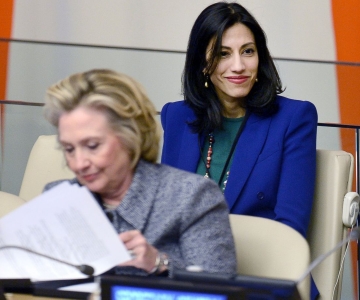
Hillary’s Mystery Woman - Huma Abedin

I am grateful to Nabeela Apa - our dear friend - for sending the link to this story published in the New York Observer. Apparently, Huma Abedin is an energetic and trusted associate of Hillary Clinton. She is media shy and works in the background to manage the campaign of the Presidential candidate. This is what the NY Observer had to say: Read it here >>

Published June 5th, 2007

Master strokes

“Perhaps Maqbool Fida Husain could take some solace in the knowledge that in his being lambasted for painting Hindu goddesses, he has joined the ranks of one of the greatest of Renaissance artists, Michelangelo, whose painting of the ceiling of the Sistine Chapel in the Vatican in 1512 left the world speechless with astonishment…” More here

Published May 11th, 2007

Why I love Pakistan?

I was asked to write about the top five reasons for loving Pakistan. I’d like to share this piece with the readers.

 Why I love Pakistan? Top 5 reasons

The Civilization

Pakistan is not a recent figment but a continuation of 5000 years of history: quite sheepishly, I admit, that I am an adherent of the view held by many historians that the Indus valley and the Indus man were always somewhat distinct from their brethren across the Indus. I do not wish to venture into this debate but I am proud as an inheritor of Harappa, Mohenjo-Daro and Mehrgarh (not strictly in this order) and this makes me feel rooted and connected to my soil as well as ancient human civilizations and cultures.

It also makes me happy that no matter how much the present-day media hysteria about Pakistan (and “natives” in general) diminishes my country and region, nothing can take away this heritage and high points of my ancestral culture. Pakistan is not just Indus civilization – it is a hybrid cultural ethos: the Greek, Gandhara, the central Asian, Persian, Aryan and the Islamic influences merge into this river and define my soul – how can I not be proud of this?

The People

I simply love the Pakistani people – they are resilient, diverse and most entrepreneurial. They have survived calamities, famines, upheavals, injustices and exploitation and yet, by and large, retain a sense of humour. I am not naïve to say that they are totally free of the various bondages of history but they display remarkable entrepreneurial and creative potential. Most of them are “real” and rooted and yet not averse to modernity.

There is an urban revolution taking place in parts of Punjab and Sindh and the drivers are neither the state nor external donors but the people themselves. The private sector has even contributed to build an airport. There is an ugly side as well: the absence or predatory activities of the state (e.g. Karachi) has also provided a breeding ground for mafias but this is not a unique Pakistani phenomenon. From LA to Jakarata, such groups operate within the folds of urbanization.

I am proud of my people who have proved themselves in all spheres and countries – whether it is Professor Abdus Salam, the Nobel Laureate or Shazia Sikander, the miniaturist of international fame or Mukhtaran Mai who has proved her mettle in giving a tough time to forces of oppression.

The Spirituality

There is an inordinate focus on Pakistani madrassahs, the pro-Taliban groups and the violent jihadis. How representative are these groups? Only Pakistanis know that such groups are marginal to the mainstream attachment to and practice of religion. The rural folk are still steeped in Sufi worldview and many versions of Islam exist within the same neighborhood. Of course there is manipulated curse of sectarian violence but that mercifully is not embedded despite the attempts of big external players and the octopus-like state agencies.

Ordinary Pakistanis, such as me, value their Islamic beliefs, are God fearing and follow what is essentially a continuation of the centuries old traditions of spirituality that survives in the folk idiom, in the kaafis of Bulleh Shah, and in the verses of Bhitai and Rahman Baba. Our proverbs, day-to-day beliefs are all mixed and laced with history, oral tradition, Sufi lore and of course Islamic simplicity. It is another matter that there are individuals who want to hijack this thread and impose their nonsense on us – but we as a people have resisted that and shall continue to do so. After all we inherited the confluence of ancient religions and practices.

Pakistan is where Buddha taught and Taxila shined, and where Nanak preached and the great saints – Usman Hajweri, Fariduddin Ganj Shakar, Bhitai and Sarmast - brought people into the fold of Islam. Despite the revisionist, constructed history by extremists in India, the sword had little to do with Islam’s rise in this region.

The Natural Beauty

Well the spirituality of my homeland is not just restricted to the intangible belief systems. It also reflects in the splendors of Mother Nature. From the pristine peaks in the north to the mangroves of the Indus delta, Pakistan blends climates, geographies, terrains in its melting pot. Within hours of leaving an arid zone, one enters into a fertile delta. And again a few more hours put you right in front of otherworldly mountains. The deserts of Cholistan radiate the moonlight and the surreal wildernesses of Balochistan are nothing but metaphors of spiritual beauty.

Where else can I experience the aroma of wet earth when the baked earth cracks up to embrace every droplet and where else can one find a Jamun tree with a Koel calling the gods? An everlasting impression on my being shall remain the majestic sunrise at the Fairy Meadows amid the Karakorams and the melting gold of Nanga Parbat peak. I love this country’s rivers, streams and the fields where farmers testify their existence with each stroke, each touch of earth. I cherish trees that are not just trees but signify Buddha’s seat or the ones in graveyards nourishing the seasonal blossoms.

The Cuisine

Yes, I love the aromas and myriad scents of Thai cooking, the subtlety of the French and Lebanese or the Turkish dishes but nothing compares to the Pakistani cuisine. Forget the high sounding stuff; ghar ka khana (homemade food) no matter which strata are you from is difficult to find elsewhere?.

Whether it is a simple Tandoor ki Roti with Achaar or Palak (in the Punjab) or the intricate Biryani with ingredients and spices of all hues, the food is out of this world. In my house, we were used to at least ten different rice dishes (steamed white rice/saada/green peas/vegetable/channa/choliya/potato Pilau), three types of Biryanis (Sindhi, Hyderabadi, Dilli or just our cook’s hybridized Punjabi version), and my grandmother’s recipe of Lambi Khichdee. The list continues.

In the Northern areas, there are Chinese-Pakistani concoctions, in the North West Frontier there is meat in its most tender and purest form. In Balochistan there is Sajji, meat grilled in earthenware at low heat until all the juices have transformed the steaks into a magic delight. And, the fruits and the sweets – the mangoes that come in dozens of varieties and colours, melons of different sizes, the pomegranates and the wild berries that still grow despite the pollution everywhere!

How could I not love this eclectic cuisine?

And Finally…

…the sum-total of all five: I love Pakistan as this is my identity – immutable and irreversible. Simple.

The genesis of this post:

I am averse to the ratings and rankings that characterize the junk-journalism of our times. Much like the embedded style of reporting such a view remains partial and often ignorant of the nuances and layers of subtext that are almost unachievable in the pop-view of the world.

Readers might question this apparent paradox as on the one hand I am participating in this top-five series and on the other I am also being critical. Well, well this is kosher from a South Asian perspective as we remain a mythical-modern bundle of contradictions.

The real reason for me to ‘submit’ my top 5 is the inquiring spirit of Mayank Austen Soofi whom I don’t know and have never met. But I am quite empathetic to his efforts at understanding Pakistan. At least he ventures into the ‘other’ territory and unlike the mainstream media and writers, does not view Pakistan as a threatening collage of burqa clad women, terrorism and gun toting radicals…

Published May 5th, 2007

Dhaka by degrees

How poor are they who have not patience! What wound did ever heal but by degrees.
-William Shakespeare

I grew up in the post-East Pakistan era, and my only exposure to Bangladesh was initially through textbooks that were at best sheepish about the events surrounding its liberation. History was suspended by the school narratives. As a young adult, I was exposed to the injustices once meted out to Pakistan’s largest wing by an outspoken history teacher. Later, when I blurted out those acquired facts in characteristic drawing room discussions, I sensed an unease; silence was advised by a discerning elder.

Such silence, unfortunately, haunted the post-1971 social and cultural milieu of Pakistan. Later in life when I met real Bangladeshis, as opposed to the fictional characters that existed in my mental landscape, I felt a strange affinity despite the fact that we came from contested histories and realities. At college in London I remember long discussions with Bangladeshi friends where we disagreed yet agreed that we had a common future.

Therefore, the recent visit to Dhaka, the very first non fleeting sojourn, was an Bengali flower sellers  overpowering experience. Dhaka airport is just another airport. Like home, there are long queues broken by the protocol brigades and immigration officers struggling with the advent of technology. In Dhaka, the warmth of the people overwhelms you.

While there I could not help but think of Faiz’s only poem written in 1974, Ham ke thehre ajnabi, about how close relations become estranged. (more…)

Published April 23rd, 2007

Kafka Country

“Indeed, the current drama, uncertainty and confusion seem to be extraordinary. But is it that unusual? History, if anything, has prepared us for the bizarre and the peculiar… “

Article here >>

Published April 21st, 2007

On Rumi, Iqbal and ‘Dynamic Sufism’

Pakistan celeberates Allama Iqbal’s death anniversary on April 21 with the usual lip-service. The key messages of Iqbal seem to have been lost in the maze of officialdom.

Full entry here >>

Published April 6th, 2007

Mohsin Hamid on Indo-Pak perceptions

Hamid thinks that India is more jingoistic than Pakistan. There were some interesting moments in the interview as the quote below indicates. Full entry here >>

Published March 27th, 2007

The new slave dynasty in South Asia?

“Writer Arundhati Roy said in an interview last week that at least India’s growing middle class was reared on a diet of radical consumerism and aggressive greed.

Full entry here >>

Published March 25th, 2007

Karachi - “Bright Lights”

Each time one visits Karachi the sprawling metropolis seems more run down. Crumbling infrastructure, notwithstanding the recent improvements, and a sense of neglect are apparent to any visitor.

Full entry here >>

Published March 14th, 2007

On Feryal Ali Gauhar

This piece was first published in The Friday Times 

Conversations with novelist, filmmaker, feline aficionado, and femme fatale, Feryal Ali Gauhar, as she prepares to launch her second novel

Who doesn’t know Feryal Ali Gauhar? A novel at the top of The New York Times international bestseller list, years of television appearances and a highly publicised marriage to Jamal Shah that became fodder for countless gab sessions, have caricatured and made famous her persona. Had I not known her personally, I too may have fallen for the half-imagined tales littering the drawing rooms of socialites in this land of the pure. But I have had the pleasure of Feryal’s acquaintance for years, and not a moment of our friendship has resembled the images painted by petty gossip and lazy misinformation.


Read full article here >>

Published February 24th, 2007

Surveys show that Pakistanis (and Muslims) reject “terrorism”

The Daily Times Pakistan has published a story on surveys carried out by various organizations. The results are quite revealing not least for Pakistan.

Pakistani liberals would need to change their view that it is a society heading towards extremism and the Jihad-flaunting Islamists would be upset that they are not supported by an overwhelming majority. Most importantly, the global media barons would also be left bewildered as their spin-doctors and experts have been, to a great degree, proven wrong!

Read more >>

Published February 23rd, 2007

Egyptian Blogger Sentenced

Blogosphere faces another question - is it “free” enough?

An Egyptian court has sentenced a blogger to four years’ prison for …. read here for more

Admittedly, Soliman was a little harsh in his verdicts on Al-Azhar and the President, but then neither are Divine and infalliable.

Published February 21st, 2007

“Seeds of peace on cricket field”


Saw this insightful piece by a Pakistani researcher in the Baltimore Sun.

Read more >>

Published February 21st, 2007

Lies, Half Truths and Deceit

There is talk of war again. There is a familiar web of lies, half-truths and deceit. As if the smouldering cities and dying civilians in Iraq were not enough to quench the blood-thirst, the global war machine now wants another victim. Full entry here >>