Pakistan: democratic governance is the only way forward
(Also published by The News) Given the average shelf life of any civilian government, it is almost miraculous that the incumbent government has survived and there are signs that its removal is not immediate. The longevity of civilian order has less to do with the inherent strengths of its style of governance or delivery of public goods that it had promised in its manifesto. The survival of this government is an outcome of the lack of options for the establishment as well as its international allies, notably the Western powers. Leaving the conspiracy theories and the excessive over-reliance of the analysts on the American factor, we can safely argue that the military establishment of Pakistan and its intelligence agencies has found themselves in a unique situation since the assumption of the presidency by Asif Ali Zardari.
The truth is that Pakistan People’s Party, an anathema to the civil-military bureaucracy, has assumed the most important and powerful offices that a civilian government can aspire for. Two years ago, when the Prime Minister Yousaf Raza Gillani was
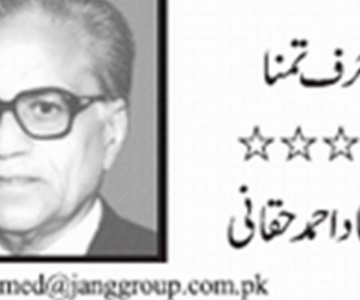
Farewell Haqqani Saheb – forgive your peers and colleagues
A personal favourite, Irshad Ahmad Haqqani is dead. This is a huge loss to Urdu journalism as he was the last of sane voices in the vernacular industry. I often disagreed with his centre-right views but his tone was measured and he remained a staunch supporter of democracy. May God bless his soul.
I stumbled on this post at Cafe Piyala that also talks about Haqqani but the best part of it was what Haqqani's peers and junior collegaues had to say about him. I think some of the comments were so shameful that I could not even laugh with an easy conscience. I am quoting the last part of that post here that also is quite a treat:
Whatever they might say about him, he did invent the modern Urdu column, which is half analytical drivel, half dinner menus. Only during the last week, for example, Jang columnist Haroon-ur-Rashid (according to his column) demanded and got desi murghi from the Azad Kashmir prime minister, and Hamid Mir (according to his column) discovered new insights into judicial activism over a Kashmiri dish. I forget the name of the dish but according to Jang / Geo’s brightest star, it is made of mooli and shaljam and served with rice. The host was the Lahore High Court Chief Justice Khwaja Sharif.
Is it just cricket? Indian team should have come to Pakistan
"The tour's cancellation means that terrorists have won; this is what they wanted to achieve."
I was quoted in a piece published by Hindustan Times
Cricket is not just a game. It is also a standard to measure the tense relationship between India and Pakistan at any given moment. With India's tour of Pakistan being called off, fans have been deprived of a rollicking good time. But not many players are complaining. The reason being the Mumbai terror attack.
national identity sans freedom
A few quotes from this article in the Hindustan Times - incidentally it also includes what I rambled....
Freedom means everything. But I’m not free. All these concepts are self-imposed imprisonments.—Roshan Seth, actor
Independence has provided me with a national identity but it hasn’t meant freedom. I find myself enslaved to narrow ideas of patriotism. I’m trying to break free. And writing a book on Delhi, the capital of the ‘enemy’ nation, is my first step.
—Raza Rumi, blogger
Personal freedom is crucial to my growth as an artist. ‘Independence Day’ is a distant celebration for me. Each year, as mid-August approaches I am conscious of a sense of loss — I wonder what could have been had the subcontinent not been splintered.
— Sehba Sarwar, poet
Being a (somewhat) responsible parent, I will share with my children the notion that today we remember our national heroes. And amidst the nationalistic pop nuggets being broadcast round the clock, I hope they hear Yeh watan tumhara hai, tum ho Pasban iss kay, yeh chaman tumhara hai, tum ho naghma khwan iss kay…
— Shandana Minhas, author
Guest Stars at the Long March
My article that appeared in Dawn. here.
THE enthusiasts for the long march towards Islamabad are justifiably feeling let down by the grand posturing, thundering rhetoric and the subsequent retreat from agitation outside the dreary citadels of power in Islamabad’s dark heart.
A Bastille, which was not meant to be? Interpretations abound and explanations are flowing in from the motley groups who ventured to change the contours of state-society relations. The lawyers’ movement is profoundly significant. It constitutes the finest historical ‘moment’ in our troubled history. However, many observers have hinted at its limitations and the problematic phase that the movement has now entered.
Unlike China, Pakistan’s long marches have been nefarious for their results. Orchestrated by political and non-political actors to undermine the democratic process, we are well aware of this stratagem. This time it was different, complex and refreshingly path-breaking alas with similar results: pressurise the beleaguered PPP government still trying to find the proverbial power-ground beneath its truncated legs. In that sense, the march was a roaring success. From the sloganeering against the much maligned Asif Zardari, to de-legitimising three decades of PPP’s valiant struggle against dictatorship culminating in the assassination of Benazir Bhutto.
Irony, that all is now a forgotten snippet of history. What is indeed more pressing, as we are told time and again, are the sacrifices made by the honourable judges. Indeed they have altered the parameters of the state and perhaps buried the subordination of the judiciary to the all powerful executive. Well, one may ask what about Asif Zardari and his eleven and a half years in jail without a single conviction? Therefore the vilification of Zardari by anti-Musharraf sections of the media and by the historical long march is symbolic. It is a testament to the deep-seated middle class trend of demonising politicians and party politics that are prerequisites for democracy and means to establish the ‘rule of law’.
The opportunism of individuals and groups jumping onto the lawyers’ bandwagon is also alarming. It is most convenient to have been all-powerful army chiefs, heads of the ISI and former honchos of the civilian bureaucratic monolith and once the party is over, re-christen yourself as firebrand democrats. The patriotic Hameed Guls, Aslam Begs and Faiz Ali Chishtis and the neo-constitutionalist Roedad Khans and right-wing ambassadors (who slept while Afghans were killed for strategic depth), must be questioned by the anti-Musharraf movement for it was their historical culpability that undermined civilian governance. Is it not important that circumspection be exercised while letting them be the spokespersons of the new vanguard? If Zardari has to be isolated then these dubious characters must also be questioned.
Delhi and Lahore – globalised fads and trends
This piece of mine appeared in the Hindustan Times yesterday. An accidental piece it was, written on the request of a friend during my recent stopover in Delhi.
Delhi-Lahore hip factor
Be it Khan Market or MM Alam Road, life for young guns in both Delhi and Lahore is a blend of cafe culture, cool music and retail nirvana
A Pakistani like me who is visiting Delhi cannot help but identify the commonalities between the Indian capital and Lahore. The climate, the predominant Punjabi influence, the urban chaos and indeed the quest for a good life are as shared as the centuries of mixed history.
In Delhi, these ingredients are packaged into a single space, loved and mourned in equal measure, the Khan Market. Its swanky cafes, retail outlets spell out a comfortable sense of the plentiful. A trip to Bahri Booksellers is essential to check on the new, profound and banal book titles. Step out of the book-zone, walk around and you see young men and women holding hands and out to buy a little dose of happiness from the upmarket retail stores. New frames for glasses, an array of pret-a-porter garments and of course cafes where one can lounge while sipping an exotic coffee brew with a fancy cake. Barista is a favourite of mine with its neo-modernity ambiance and an ample variety to select from. If Barista is crowded, one turns to Cafe Turtle. Wi-fi access is available in these places along with soft music and trendy customers, whose snazzy mobile telephones rest silently on clean little tables. Connectivity is another facet of the global search for fulfillment.
In Khan Market cafes, one reminisces about similar haunts in Lahore. The MM Alam Road there is now a bustling venue for stylish cafes and restaurants that are popular hangouts for the youth defying the silly stereotypes of Pakistan. Men and women converse in their designer jeans about the world, quite unaware of the residual violence of the war on terror on the Pak-Afghan border. The Coffee & Tea Company is hugely popular. Another joint, Massom, a pancake lounge, sells mouth-watering desserts with coffee brews and plays cool music as one plunges into leather sofas to chill. Places such as Cafe Zouk, Hobb-Nobbs, Jamin Java continue to lure the hip Lahorites.
Since globalisation's onslaught on Pakistan, Lahore's traditional love for eating out has transformed into a fusion culture bonanza. The Hot Spot Cafe, Little Italy, Cafe Aylanto and The Dish have emerged as havens of cross-continental culinary blending. Young women drive alone to meet up with friends at these places; and hordes of teens are seen flocking to the Pizza Huts, McDonalds and Kentucky Fried Chicken outlets.
While the affluent have these arenas, the underclass youth, both in Lahore and Delhi, finds its own recreational spaces in Carom and Snooker clubs, sleazy internet cafes with loads of porn, the weekly trips to parks; and the occasional sojourns to police lock ups. Life goes on. Globalization has something to offer to everyone.
No Shangri-La – Tibet revisited
Found this brilliant piece by Slavoj Žižek writing for the London Review of Books
The media imposes certain stories on us, and the one about Tibet goes like this. The People’s Republic of China, which, back in 1949, illegally occupied Tibet, has for decades engaged in the brutal and systematic destruction not only of the Tibetan religion, but of the Tibetans themselves. Recently, the Tibetans’ protests against Chinese occupation were again crushed by military force. Since China is hosting the 2008 Olympics, it is the duty of all of us who love democracy and freedom to put pressure on China to give back to the Tibetans what it stole from them. A country with such a dismal human rights record cannot be allowed to use the noble Olympic spectacle to whitewash its image. What will our governments do? Will they, as usual, cede to economic pragmatism, or will they summon the strength to put ethical and political values above short-term economic interests?
There are complications in this story of ‘good guys versus bad guys’. It is not the case that Tibet was an independent country until 1949, when it was suddenly occupied by China. The history of relations between Tibet and China is a long and complex one, in which China has often played the role of a protective overlord: the anti-Communist Kuomintang also insisted on Chinese sovereignty over Tibet. Before 1949, Tibet was no Shangri-la, but an extremely harsh feudal society, poor (life expectancy was barely over 30), corrupt and fractured by civil wars (the most recent one, between two monastic factions, took place in 1948, when the Red Army was already knocking at the door). Fearing social unrest and disintegration, the ruling elite prohibited industrial development, so that metal, for example, had to be imported from India.
Pakistan Suicide Bombings: The narratives of terror
An overwhelming majority of Pakistan's population finds itself hostage to narratives of terror that are either alien to its ethos or are constructed by its home-grown theologians and opinion-makers. This is not to say that the issue of suicide bombings is easy to define and understand. They are essentially complex and located in decades of Pakistan's evolution into a society that is difficult yet again to label: Islamic in name, struggling to be democratic and a republic it is not, well, not yet.
If we take the viewpoint of liberals, it is our war as much as a war of others. If we were to hear the west, it is about countering terror and preserving world peace; and if we listen to Pakistan's right it is someone else's battle fought on our land 'the land of the pure' lest we forget.
Where does this leave the confused, battered citizen who now has to strive for personal security among other daily struggles of existence? There are no clear answers and if one were to probe further, the questions are as murky as their geneses.
One thing is clear though: to identify the recurrent suicide bombings in the name of theological, tribal and imperial grievances is at best a half-truth. The genie is far more complex than a response to the reductionist narrative of âwar against terror and such other imperial phraseology. At the core of this phenomena, if one were to be rather blunt, lies an exclusive, bigoted ideology of a few men of holy intentions orchestrating a script written by others.
Pakistan’s media opinion – the column industry
On the flourishing 'column' industry despite the slow growth of readership
What is so peculiar about the Pakistani media opinion factories churning out problems and solutions products day after day? Frankly, they are self perpetuating oligarchies and boring at best. The slightly discerning mortals who browse the daily newspapers in English and vernacular languages or bother to engage with the electronic media discussions are struck by certain repetitive trends. Let me map them out before rambling any further. On a note of caution, there is no intention of making generalisations here. Exceptions, they say, prove the rule!
The curse of self-importance
Nowhere else would you find brazen references to the importance of a writers' opinion particularly among the Urdu language newspaper columnists. Despite the slow growth of readership, the 'kalam-navees' industry is flourishing. A few years ago, a new Urdu newspaper with a hefty advertising budget, ensured that a few big names in the column industry were under its wings.
The sad reality of Indo-Pak relations
The inimitable Khalid Hasan writes with veiled frustration:
"....the last six decades of India-Pakistan relations have proved the step-by-step approach to be a dismal failure. Whereas what is needed is a quantum jump, what New Delhi and Islamabad have opted for is a slow belly crawl. At the rate at which they are going, it will take a hundred years to get to where they say they want to be.
Ahmed Faraz wrote: Faraz sehn-e-chaman mein bahar ka mausum: Na Faiz dekh sakay thay, na hum hi daikhain gey (Faraz, the coming of spring in our little garden, Faiz did not live to see, nor will we).
For once, I hope and pray Ahmed Faraz is wrong.
Indeed, we all hope that Faraz Saheb is wrong this time.
Of old-journalism, new media and myopia
Three quotes from this story covering the Project for Excellence in Journalism's annual State of the News Media report struck me:
It was believed at one point that the Net would democratize the media, offering many new voices, stories and perspectives. Yet the news agenda actually seems to be narrowing, with many Web sites primarily packaging news that is produced elsewhere...., Two stories - the war in Iraq and the 2008 presidential election campaign - represented more than a quarter of the stories in newspapers, on television and online last year, the project found.
Lahore blasts and the Jihad industry
My city Lahore was attacked yet again by the pusillanimous attackers pretending to be brave and honourable. There is no justification and no excuse for this modus operandi. And it should not be tolerated by the state and the people. Any excuse would legitimise this reign of terror..
I am posting this excellent piece by the wise Khalid Hasan (Daily Times) that makes some excellent points on the menace of Jihad and how unholy it is -
 Leaders of Salafi-jihadist organisations hypocritically preach about the benefits of martyrdom, but rarely, if ever, conduct suicide operations themselves, or send their loved ones on such missions. It is a fact that Al Qaeda and associated groups offer no vision for Muslims other than perennial jihad, hardly an appealing prospect
Jihad is now an industry among scholars, including those who masquerade as scholars but are actually in the service of more shadowy outfits, and those who believe that by blowing up people praying in mosques or families out shopping, they will not only serve God but win a point-to-point ticket to the pastures of heaven where seventy-two swooning virgins await their arrival.
How I met Dr. Shreekant Gupta
That the conservative and often skin-deep Economist published the story - "The world's most dangerous place" - was not surprising. The publication sings an imperial tune, praises occupations and invasions in the name of free markets and democracy; and sells the commodification of the poor. And, above all, it can be shamelessly biased when it comes to countries such as Pakistan.
However, what truly surprised me was a letter to the editor that appeared a few weeks later. By chance I read it and was amazed by its sheer empathy and directness. The writer was one Dr. Shreekant Gupta, a visiting senior research fellow at the Institute of South Asian Studies in Singapore.
SIR -- The title of your leader on Pakistan ("The world's most dangerous place", January 5th) confirms the old adage in journalism: when it bleeds it leads. Yes, Pakistan is going through trying times, but it is far from being the world's most dangerous country. Having just returned from Pakistan, which I traversed without let or hindrance with my Indian passport and Hindu name, I can say emphatically that its people are warm and friendly and passionate about democracy and the forthcoming elections.
Parts of my own country (and Nepal and Sri Lanka) are racked by Maoist guerrilla warfare and violent separatist movements. I do not recall you designating India as the world's most dangerous place when Rajiv Gandhi was assassinated during electioneering, or Indira Gandhi for that matter. The latter's killing was followed by a brutal and murderous pogrom against Sikhs and Delhi burned for days. The truth always contains shades of grey.
I made a note of it but never remembered to follow up. And, what a delight it was when I found out that Dr Gupta had visited Jahane Rumi and left a comment. We corresponded and developed the cyber-friendship that now constitutes regular communication and exchange of ideas, stories and anecdotes.
It is such a pleasure to have met Dr Gupta through the cyberspace and with little effort. My email to him, after he sent the above letter, stated: "What a small world ... I had read your letter in the Economist. And, wanted to write to you how impressed I was not just as a Pakistani but as a South Asian. That was a proud challenge to the Western media and a testament to your intellectual honesty... strange are the ways of this world... My stars are well-aligned these days!!"
Dr Gupta has sent the full text of the letter (reproduced below) that he had mailed to the Economist. For a change, the cynical, vulnerable to the soft brainwashing of the international media, should read it. This is what a genuine scholarly mindset is: an application of logic, reason and knowledge without pre-conceived notions and personal biases.
In Dr Gupta, I have found a friend but more importantly my country has another well wisher in the neighbourhood.
In Benazir’s death
It was in the dargah compound of Ajmer when our phones started buzzing with friends and relatives wanting to share grief on the loss of a woman who was both loved and hated but never ignored. This was the typical winter dusk and we were returning from a soulful traditional dua-i-roshnayee (pre-sunset prayer) where candles are lit in remembrance of the much revered Khawaja. Amidst frantic phone calls from grieving friends, the shock was cushioned in the mystical atmosphere as one reaffirmed that God's will was above everything. But the aching sense of loss for Pakistan haunted us despite the calming effect of Ajmer.
A paranoid, abhorrent obsession
It was a pleasure to have read Pankaj Mishra in the Guardian:
Last week Ayaan Hirsi Ali, the Somali-Dutch polemicist, spoke to a gathering of what The Spectator called "Britain's biggest brains - politicians, editors, academics". She told them that they were "actually at war, not just with Islamism, but with Islam itself". Apparently, a good Muslim has no choice but to strive "to establish Sharia law". Martin Amis, too, has recently informed us that moderate Muslims, if they ever existed, have lost out to radicals in Islam's civil war. In any case, Islam is "totalist": "There is no individual; there is only the umma - the community of believers."
Never perhaps in history has so much nonsense been so confidently peddled about a population as large and diverse as this planet's billion-plus Muslims. Within the past decade an Islamic movement has led Indonesia towards democracy, while market reforms in Turkey have created a new and religious middle class that now challenges the power of a secular elite.
Each one of the national realities Muslims inhabit is prodigiously complex and ceaselessly evolving, shaped as much by geopolitics - imperial conquest, the cold war, the war on terror - as by internal conflicts of class, religion and ethnicity. Closely examined, Muslim societies briskly dissolve our complacent, parochial notions about religion, democracy, secularism and capitalism. They expose, too, the notion of a monolithic Islam pressing down uniformly on all believers everywhere as a crude caricature.
Read the full article here
Pakistan diaspora and the politics of the Hijab
The suggestion of violent disputes between a 16-year-old girl in Mississauga and her father over her desire to show her hair and live a "normal" lifestyle raises questions about tensions between parents and children in the Muslim community...But members of the community particularly young Muslim women say the tension can exist both ways.
...research into the readership of her publication shows that the decision to wear the hijab, the traditional Muslim headscarf is almost always a choice the girl makes on her own.
Text from here
Complex, sordid and tragic. And, I wonder what would the head honcho of Al-Huda (these days based in Canada) has to say on the sad story of a girl who died at 16? What is this obsession with the Hijab when you live in a non-Islamic country. There is no consensus on this within Islamic jurisprudence. As my friend Asma (who sent this story) said: "Is this more important than hayya - the inner modesty; and the ability to discern the right from the wrong?"
Fukuyama defends his Neocon legacy…
 This is a good review of After the Neocons: America at the Crossroads by Francis Fukuyama.
‘There are none so deaf as those who don’t want to hear’
Liked this excellent editorial from The News:
Ramzan – A month of Piety
Contributed by Sadia Dehlvi
As children we aimed our eyes at the horizon trying to spot the small sliver and once the Ramzan moon was sighted we went around the house greeting all the elders with “Ramzan Mubarak’. The house would soon be filled with Pheniyan , khajla, dates and other Ramzan specific delicacies for sehri (pre dawn meal) and iftaar. The radio was locked in the cupboard and the television was veiled with a cloth only to be unveiled on Eid. Going to the movies was simply out of question, a childhood rule I still obey. When we were too young to fast, the elders said we could observe ek daad ka roza†(one jaw fast) so we eat carefully through the day from one side of the mouth. When one of the children reached the age of ten or eleven, the first fast was observed with festivities. There was a rozakushai ceremony and friends and family were invited for iftaar, a tradition is still observed in most Muslim families.We were a God fearing family and almost everyone in the family fasted in Ramzan. Those who did not fast pretended to and eat behind closed doors. The dining table in our house was pushed to one side of the room and we kept the traditional floor seating for the special month. Minutes before sunset which is iftar time, every member of the family would sit with their heads covered and hands folded in prayer. We were told that this was the time God would answer our prayers.
The Islamic months also called Lunar months are based on the sighting of the moon. The Islamic calendar known as the Hijri began when Mohammed (pbuh) did hijrat(migrated) to Medina from Mecca. Ramzan is the ninth Hijri month , the month when the miracle of the Quran was revealed by God through Gabriel.
Islam is built upon five pillars: that you worship none else but Allah and accepting Prophet Mohammad as the seal of prophethood, establishing regular prayers, giving of zakat( charity), performing the pilgrimage to Mecca and fasting in the month of Ramzan. Fasting is a Quranic order “O ye who believe! Fasting is prescribed to you as it was prescribed to those before you, that ye may (learn) self-restraint.â€(2:183).
It is known that Prophet Mohammad was the most generous of people, and in Ramzan he was even more generous. His companions described him as a wind that bears gifts. The Prophet said that the best charity in Ramzan is setting things right between people who are in conflict and those who harbour hatred for each other. Another tradition quotes the prophet saying that fasting is half of patience. He also said that patience was half of imaan. (faith). The Messenger of God swore that the breath of a fasting person was more pleasing to God than the fragrance of Musk.
Harbouring suspicion, rancour or negative opinions about others is specially noxious in Ramzan. The same goes for all forms of cheating, vanity and irrational anger. Islamic scholars have said that in order to get the most from Ramzan, one should not engage in excessive speech and be vigilant with the tongue. The sacred month is a time to examine shortcomings and build resolves to rectify them. Another objective of fasting is a way of experiencing hunger and developing compassion for the less fortunate.
 We grew up being taught that fasting was a believers shield which protects from the gameplan of Satan. It is a time when the gates of paradise are open, the devils locked up and the doors of hell closed. Ramzan is marked with iftaar dinners and some lighter moments. I am reminded about an anecdote about Ghalib, the poet. It was the month of Ramzan and Ghalib was sitting alone in a room sipping his wine. One of his students arrived and seeing him in a state of intoxication commented that he thought Satan was chained in Ramzan. Ghalib known for his wit remarked, “Indeed he is. It is this room he is locked inâ€.
Through the ages, Muslim scholars have written of the bounties of Ramzan and how good deeds are multiplied over and over again in the eyes of God. Love of the world is what is weaned in Ramzan by voulantary deprivations of food, drink and sexual intimacy. It is a month for the remembrance of God and gaining position and status with Him. Each year Ramzan comes and passes before our eyes until it again upon us. The first days of fasting seem long and stretched but after that the days dash by. Ramzan presents an exceptional  opportunity for purifying oneself and shedding the maladies of the heart, to increase ones faith through the power of abstinence and patience.
This piece was published yesterday by the Hindustan Times
fair and accurate journalism
A friend asks:
Are we going to see this article splattered all over the front pages of major American newspapers? I highly doubt it. That happens only if the woman was from an Arab/Muslim country, highlighting the oppression "all" Muslim women face.
The headlines from the UK paper, The Guardian, reads: Six arrested after black woman is held captive and tortured. The Guardian included the word "black" in the article heading, whereas the San Francisco Chronicle did not even bother to state the race of the woman. Welcome to fair and accurate journalism, American style.
Access the news report here
On the “death of Pakistani culture”
Khaled Ahmed is the endangered variety of writers. A true man of letters proficient in world languages, histories and cultures, he is a journalist who does not refrain from confronting the truth. There are very few individuals like him who advance the traditions of seeking knowledge and pontificating in a classical sense. I have been an admirer of his writings since my teens when I would read the Frontier Post (yes it was a thoughtful publication and a refreshing alternative to semi-controlled media in Zia days).
In his recent article published in the The Friday Times (that he also edits), he argues that "because of the death of Pakistani culture, normalisation with India has become more crucial than most of us realise".
After 60 years Pakistan is helplessly witnessing the destruction of its culture by elements arising from within its society. The mission of purifying society to make it a fit vehicle for Islam has passed from the state. This process has been incremental, but after Talibanisation, the culture-destroying process has accelerated. The state seems to be getting cold feet over something it did earnestly since 1947 in the name of its ‘purifying’ ideology. Now worried about its global image, it is face to face with religious anarchy and wants society to become ‘tolerant’ and ‘moderate’, which is the function of culture.Â
Read the full article here.
The concluding paragraph is pretty grim -
Before 1947, Muslims offended with the fahashi (obscenity) of Saadat Hasan Manto took him repeatedly to court, only to hear the Muslim judges under British Raj say that what Manto wrote was high culture, not obscenity. After 1947, every time he was dragged before the court for obscenity, he was convicted! The judge in Karachi gave him tea in the evening and told him he was the country’s greatest short story writer, but convicted him for obscenity in the morning. Now the state wants to stop killing culture, but it is too late.
“Expanding the Potential of Experiencing Life”
The death of Qurratulain Hyder has generated a spate of comment, obituaries and tributes. Each day I receive several emails, find new posts and articles on the internet and of course sweet little discoveries.
SG has again discovered and promptly forwarded me this interview with BBC Urdu- a nearly half an hour audio-clip. I had posted the link to another interview that was recorded in the early 1990s. This one was recorded nearly a decade later. One can hear Hyder's  weak voice after the stroke she suffered. Hyder also laments that she has difficulty in writing and now she dictates to students. She adds that it is not a pleasurable process as the 'relationship with pen and paper' is lost.
In this interview, we hear of her childhood, her short stay in the Andaman Islands, the imprints of British imperialism, the pre-partition culture of tolerance and how things changed in India and Pakistan.
Ainee's love for travel and exploring new places and meeting people also comes out clearly from this interview. We can assume that she received much inspiration by travelling. We hear all about her books as the interviewer discusses her works in some detail.
However, the interviewer is careful not to praise her too much as she was known to get irritated by an over-dose of compliments. But he does mention that by writing Kare Jahan Daraaz Hai Ainee had established a new trend of a creative and realistic autobiography as opposed to exaggerated sense of the self that many writers display in Urdu literature.
After years, I picked up the 2001 edition of Kare Jahan and started reading it again last night. As the literary critic C. M. Naim said, this book expands the "potential of experiencing life. What more can a reader ask of his author?"
Kare Jahan is a family chronicle, an autobiography, a creative journal and a novel at the same time! Navigating through its interconnected stories, social commentary and ambiance, the reader, slowly, becomes a part of the narrative; and starts viewing the world in a different perspective. I have yet to read another book that so effortlessly blends disparate genre of writing with such abandon.
Ainee's interview in this audio clip should not be missed.
Postscript. Also read this moving tribute by Azra Raza at 3 quarksdaily:
Aini Apa’s memory was extraordinary and flawless, her intelligence was dazzling, her knowledge of Urdu, Hindi, and English literature, archeology, dance, classical music, (her last book is a biography of Ustad Baray Ghulam Ali Khan), painting, etymology and history was astonishing. I never heard her utter a platitude in all the times I have spent with her, and she was equally brilliant in both Urdu and English. Aini Apa was a fantastic mimic and could adopt a series of perfectly authentic regional accents. She thoroughly enjoyed a good joke, especially if it involved her.
And, this beautiful letter written by her nephew, Saif Hyder Hasan that talks of the personal loss faced by Ainee Apa's family:
That was you. Absolutely uncomplicated, childlike, not at all worldly wise, generous, self-effacing and full of the ability to laugh at yourself. You couldn’t tolerate fools. And you couldn’t tolerate charlatans.
Lastly, Sheela Reddy at the Outlook again:
Fame also played cupid—for a bit. K.A. Abbas, journalist, author, film producer, began to correspond with the London-based novelist. Love happened, and a tryst. But it was a disaster. Abbas, the story goes, turned up in a bright blue suit. Qurratulain, always particular about appearances, took an instant dislike to the suit, and the man. "I can't marry a man who doesn't know how to dress," was her now legendary response.
Azra Raza rightly said: "Aini Apa, Zindabaad!"
On Half truths – Guest Post by Ali Eteraz
Today, Jahane Rumi is publishing a guest post by Ali Eteraz who is well known in the blogopshere. Eteraz is a gifted, fiery writer based in the US. He maintains a blog Eteraz, writes for the Huffington Post as well as for the Guardian’s blog. Ali also manages a web portal called Plural Politics. The views expressed below are solely those of the author.
Why is NYT's India Editorial About Pakistan?
On August 15, 2007, presumably to mark India's 60th birthday, the NYT published an op-ed by Ramachandra Guha, entitled "India's Internal Partition." At the outset it appeared to be a promising examination of Hindu-Muslim relations, in India. Guha started by discussing1990:
Bharatiya Janata leader Lal Krishna Advani journeyed for five weeks between Somnath and Ayodhya, making fiery speeches at towns and villages en route, denouncing the Indian government for "appeasing" the Muslims. In many places Mr. Advani visited, attacks on Muslims followed.In New Delhi, where I then lived, Mr. Advani's march represented a grave threat to the inclusive, plural, secular and democratic idea of India.
Though he is quick to invoke his friendship with Pakistani Tariq Banuri who was the first Muslim Guha ever became "close" with (even having dreams about Banuri during the Ayodha crisis), it would appear that the friendship did not leave any discernible positive residue.
When discussing Muslims in India, Guha simply states the oft-invoked trope that Muslims don't do anything but films, saying "but in law, medicine, business and the upper echelons of public service, Hindus dominated." An objective editorial about India's "internal" partition might have inquired why Muslims in India do not make it to the "upper-echelons" of Indian society. But why would Mr. Guha waste time with trivialities, when, on the 60th anniversary of India, there is plenty of Pakistan bashing to be had. It comes soon enough.Â
They also cheated their tenants. In six years in Delhi, my wife and I had four landlords, all refugees from the Pakistani part of Punjab. All four hooked their appliances to our electricity meter, and all kept our deposits when we left.
Then I went across to the majestic Badshahi Mosque, built by the Mughal emperor Aurangzeb. It was Friday evening, and a large crowd of worshipers was coming out after the weekly prayers. Walking against the flow, I had to jostle my way through.
As I bumped into one worshiper, I was seized by panic. In one pocket of my kurta lay my wallet; in the other, an exquisite little statue of the Hindu god Ganesh, dancing. I am not a believer, but this was my mascot, a gift from my sister, carried whenever I was separated from my wife and little children. What if it now fell out and was seized upon by the crowd? How would that turn out — an infidel discovered in a Muslim shrine, an Indian visitor illegally in Lahore?
Despite their shared culture, cuisine and love for the game of cricket, India and Pakistan have already fought four wars. And judging by the number of troops on their borders and the missiles and nuclear weapons to back them, they seem prepared to fight a fifth.
Healing the wounds of Partition ..
I read this interesting, albeit a little contentious, piece by Ravinder Kaur  that examined the impact of partition on settling the communal question. The article states:
The sixtieth anniversary of the independence of Pakistan and India on 14-15 August 2007 has prompted official celebration in both countries, as well as an ocean of commemorative coverage in the world's media. The terrible violence that accompanied the birthpangs of the two states from the ashes of empire is an inevitable theme in much commentary. What is being less addressed amid the profusion of human stories - and what this article considers - is whether the problems of communal division in the sub-continent were or are best addressed by the partition of territory.
The recent weeks have seen a splurge of such discussions in the media (including the new media) that attempt to re-examine and explore the partition of India. In particular, the sufferings of millions who crossed the line have yet again come to light.
Another reflective piece that I discovered is "pain of partition" that recounted the sufferings of migrants on both the sides of the divide.
And today, Vidya Rao - a celebrated classical singer from India sent this petition that seeks to heal the wounds that still hurt our collective lives:
Apology Petition
Dear Victims of the Partition-related Violence in South Asia:
The mass murder, rape, pillage and suffering that accompanied the partition of British India in 1947, have left deep scars on the psyche of the people of India, Pakistan and Bangladesh, the former East Pakistan.
Tens of thousands were murdered, raped, and maimed, and millions were displaced in an immense human tragedy, that continues to poison our discourse, and feed mutual suspicions and hatreds.
Therefore, we, the members of the Association for Communal Harmony in Asia (ACHA), and others, who have signed below, believe that the time has come for all of us jointly to condemn, without distinction, the insane orgy of violence and intimidation that accompanied the great human divide of 1947.
On the 60th anniversary of the Independence of India and Pakistan, we recall that dark chapter in our history so as to ensure that these tragedies will not be forgotten, or repeated.
We hope that coming generations will learn from this man-made calamity, and turn away from divisions based on religion, ethnicity, language, national origin, caste, or creed.
Taking lessons from history, we undertake to shun the political use of religion and communalism.
We regret that our forebears, the colonial British administration, and the successor governments did not prevent the tragedy. They also failed to punish the perpetrators, and apologize to you and your families.
In the spirit of harmony and goodwill among the people of South Asia, and to help build a new South Asian present and future, we grieve for and with you. We offer our deepest sympathies and most solemn regrets to you and your families.
We are sorry!
This petition can be accessed here and those interested may like to sign it. I know the prevalent cynicism about such online petitions, but long journeys begin with small steps.
We have a barricaded road ahead - let's aim to tread this difficult path.
Â
Darlymple on India and Pakistan
William Darlymple's article published in the Guardian is an insightful piece that attempts to be unbiased and reflects on some pertinent issues that afflict Pakistan. The piece examines the media stereotype - successful India and failed Pakistan - a little deeper and identifies a creaky education system as one of the major issues with the country.
While this is no news for us Pakistanis, it nevertheless makes us think why this crucial issue is not highlighted by the opinion-makers in Pakistan. There are endless debates on national media on politics and government-opposition stand-off. Perhaps the Pakistani upwardly mobile classes are a little removed from this debate since they have long abandoned the state run education facilities and chosen the private sector services. Hence the disconnect.
Darlymple writes:
...its desperate education crisis. No problem in Pakistan casts such a long shadow over its future as the abject failure of the government to educate more than a fraction of its own people: at the moment, a mere 1.8% of Pakistan's GDP is spent on government schools. The statistics are dire: 15% of these government schools are without a proper building; 52% without a boundary wall; 71% without electricity.
.... out of 162 million Pakistanis, 83 million adults of 15 years and above are illiterate. Among women the problem is worse still: 65% of all female adults are illiterate. As the population rockets, the problem gets worse.
It can be argued that improved political system and democratic governance is essential to overcome this state of affairs. However, this may not be enough. After all, Malaysia achieved amazing success in building human capital under authoritarian rule. I am not suggesting that democracy is irrelevant but I think there is a deeper cause somewhere locked in our social and cultural ethos that needs to be identified.
Education requires utmost attention and advocacy by all those who want to see Pakistan progress and flourish in the long term.
"The Poor Neighbour" by William Darlymple can be read here.
Update: just as I posted this, this article came as a little shock.
A REPORT in this newspaper last month tells us that a cleric, Maulana Fazlullah, has issued an edict (fatwa), holding that education of girls is un-Islamic, and urging people in the villages of Swat to withdraw their daughters from public schools. Several thousand parents have acted on his advice, and young girls are now playing on the street instead of attending their classes.
The writer however rejects the stance taken by the silly Mullah and presents an account of five great Muslim women and hopes that this might 'remove “Maulana†Fazlullah’s ignorance, make him seek God’s forgiveness, and stop him from misleading his congregations'.
Pakistani media – an alternative view
Themrise Khan sent me her provocative piece on Pakistani electronic media. It is a contested standpoint and will not be appreciated by all. But it earnestly attempts to revisit the role of media in a dispassionate manner avoiding the cliched media freedom versus censorship debates.
Hillary’s Mystery Woman – Huma Abedin
I am grateful to Nabeela Apa - our dear friend - for sending the link to this story published in the New York Observer. Apparently, Huma Abedin is an energetic and trusted associate of Hillary Clinton. She is media shy and works in the background to manage the campaign of the Presidential candidate. This is what the NY Observer had to say: Read it here >>
Master strokes
"Perhaps Maqbool Fida Husain could take some solace in the knowledge that in his being lambasted for painting Hindu goddesses, he has joined the ranks of one of the greatest of Renaissance artists, Michelangelo, whose painting of the ceiling of the Sistine Chapel in the Vatican in 1512 left the world speechless with astonishment..." More here
Why I love Pakistan?
I was asked to write about the top five reasons for loving Pakistan. I'd like to share this piece with the readers.
 Why I love Pakistan? Top 5 reasons
The Civilization
Pakistan is not a recent figment but a continuation of 5000 years of history: quite sheepishly, I admit, that I am an adherent of the view held by many historians that the Indus valley and the Indus man were always somewhat distinct from their brethren across the Indus. I do not wish to venture into this debate but I am proud as an inheritor of Harappa, Mohenjo-Daro and Mehrgarh (not strictly in this order) and this makes me feel rooted and connected to my soil as well as ancient human civilizations and cultures.
It also makes me happy that no matter how much the present-day media hysteria about Pakistan (and “natives†in general) diminishes my country and region, nothing can take away this heritage and high points of my ancestral culture. Pakistan is not just Indus civilization – it is a hybrid cultural ethos: the Greek, Gandhara, the central Asian, Persian, Aryan and the Islamic influences merge into this river and define my soul – how can I not be proud of this?
The People
I simply love the Pakistani people – they are resilient, diverse and most entrepreneurial. They have survived calamities, famines, upheavals, injustices and exploitation and yet, by and large, retain a sense of humour. I am not naïve to say that they are totally free of the various bondages of history but they display remarkable entrepreneurial and creative potential. Most of them are “real†and rooted and yet not averse to modernity.
There is an urban revolution taking place in parts of Punjab and Sindh and the drivers are neither the state nor external donors but the people themselves. The private sector has even contributed to build an airport. There is an ugly side as well: the absence or predatory activities of the state (e.g. Karachi) has also provided a breeding ground for mafias but this is not a unique Pakistani phenomenon. From LA to Jakarata, such groups operate within the folds of urbanization.
I am proud of my people who have proved themselves in all spheres and countries – whether it is Professor Abdus Salam, the Nobel Laureate or Shazia Sikander, the miniaturist of international fame or Mukhtaran Mai who has proved her mettle in giving a tough time to forces of oppression.
The Spirituality
There is an inordinate focus on Pakistani madrassahs, the pro-Taliban groups and the violent jihadis. How representative are these groups? Only Pakistanis know that such groups are marginal to the mainstream attachment to and practice of religion. The rural folk are still steeped in Sufi worldview and many versions of Islam exist within the same neighborhood. Of course there is manipulated curse of sectarian violence but that mercifully is not embedded despite the attempts of big external players and the octopus-like state agencies.
Ordinary Pakistanis, such as me, value their Islamic beliefs, are God fearing and follow what is essentially a continuation of the centuries old traditions of spirituality that survives in the folk idiom, in the kaafis of Bulleh Shah, and in the verses of Bhitai and Rahman Baba. Our proverbs, day-to-day beliefs are all mixed and laced with history, oral tradition, Sufi lore and of course Islamic simplicity. It is another matter that there are individuals who want to hijack this thread and impose their nonsense on us – but we as a people have resisted that and shall continue to do so. After all we inherited the confluence of ancient religions and practices.
Pakistan is where Buddha taught and Taxila shined, and where Nanak preached and the great saints – Usman Hajweri, Fariduddin Ganj Shakar, Bhitai and Sarmast - brought people into the fold of Islam. Despite the revisionist, constructed history by extremists in India, the sword had little to do with Islam’s rise in this region.
The Natural Beauty
Well the spirituality of my homeland is not just restricted to the intangible belief systems. It also reflects in the splendors of Mother Nature. From the pristine peaks in the north to the mangroves of the Indus delta, Pakistan blends climates, geographies, terrains in its melting pot. Within hours of leaving an arid zone, one enters into a fertile delta. And again a few more hours put you right in front of otherworldly mountains. The deserts of Cholistan radiate the moonlight and the surreal wildernesses of Balochistan are nothing but metaphors of spiritual beauty.
Where else can I experience the aroma of wet earth when the baked earth cracks up to embrace every droplet and where else can one find a Jamun tree with a Koel calling the gods? An everlasting impression on my being shall remain the majestic sunrise at the Fairy Meadows amid the Karakorams and the melting gold of Nanga Parbat peak. I love this country’s rivers, streams and the fields where farmers testify their existence with each stroke, each touch of earth. I cherish trees that are not just trees but signify Buddha’s seat or the ones in graveyards nourishing the seasonal blossoms.
The Cuisine
Yes, I love the aromas and myriad scents of Thai cooking, the subtlety of the French and Lebanese or the Turkish dishes but nothing compares to the Pakistani cuisine. Forget the high sounding stuff; ghar ka khana (homemade food) no matter which strata are you from is difficult to find elsewhere?.
Whether it is a simple Tandoor ki Roti with Achaar or Palak (in the Punjab) or the intricate Biryani with ingredients and spices of all hues, the food is out of this world. In my house, we were used to at least ten different rice dishes (steamed white rice/saada/green peas/vegetable/channa/choliya/potato Pilau), three types of Biryanis (Sindhi, Hyderabadi, Dilli or just our cook’s hybridized Punjabi version), and my grandmother’s recipe of Lambi Khichdee. The list continues.
In the Northern areas, there are Chinese-Pakistani concoctions, in the North West Frontier there is meat in its most tender and purest form. In Balochistan there is Sajji, meat grilled in earthenware at low heat until all the juices have transformed the steaks into a magic delight. And, the fruits and the sweets – the mangoes that come in dozens of varieties and colours, melons of different sizes, the pomegranates and the wild berries that still grow despite the pollution everywhere!
How could I not love this eclectic cuisine?
And Finally…
…the sum-total of all five: I love Pakistan as this is my identity – immutable and irreversible. Simple.
The genesis of this post:
I am averse to the ratings and rankings that characterize the junk-journalism of our times. Much like the embedded style of reporting such a view remains partial and often ignorant of the nuances and layers of subtext that are almost unachievable in the pop-view of the world.
Readers might question this apparent paradox as on the one hand I am participating in this top-five series and on the other I am also being critical. Well, well this is kosher from a South Asian perspective as we remain a mythical-modern bundle of contradictions.
The real reason for me to ‘submit’ my top 5 is the inquiring spirit of Mayank Austen Soofi whom I don’t know and have never met. But I am quite empathetic to his efforts at understanding Pakistan. At least he ventures into the ‘other’ territory and unlike the mainstream media and writers, does not view Pakistan as a threatening collage of burqa clad women, terrorism and gun toting radicals...

Bharatiya Janata leader Lal Krishna Advani journeyed for five weeks between Somnath and Ayodhya, making fiery speeches at towns and villages en route, denouncing the Indian government for "appeasing" the Muslims. In many places Mr. Advani visited, attacks on Muslims followed.In New Delhi, where I then lived, Mr. Advani's march represented a grave threat to the inclusive, plural, secular and democratic idea of India.
As I bumped into one worshiper, I was seized by panic. In one pocket of my kurta lay my wallet; in the other, an exquisite little statue of the Hindu god Ganesh, dancing. I am not a believer, but this was my mascot, a gift from my sister, carried whenever I was separated from my wife and little children. What if it now fell out and was seized upon by the crowd? How would that turn out — an infidel discovered in a Muslim shrine, an Indian visitor illegally in Lahore?