India

Erasing memory to deal with loss – Pakistan, Bangladesh and India

1 February 2012

An op-ed that was published in The Hindu on December 16, 2011.

For Pakistan, the worst fallout of the 1971 debacle was excessive militarism resulting from the deep insecurity of the state.

Forty years ago, South Asia underwent another traumatic experience with the Bengali separatist movement in East Pakistan, the India-Pakistan war and the eventual creation of Bangladesh. South Asians are a strange lot. In 1947, the political elites refused to accommodate each other and a hurried, bloody Partition was imposed on millions. Instead of working to undo the harmful effects of 1947, India and Pakistan found themselves entangled in yet another battle. Again this time it was the intransigence of West Pakistani elites to accede to the Bengali demand for autonomy, and India’s short-sighted decision to momentarily ‘benefit’ from its neighbour-enemy’s woes. The jury is still out on whether 1947, and 1971, were avoidable or at least could have been handled in a manner that involved less suffering, and bloodshed.

Lessons for three countries: (Left) Prime Minister Indira Gandhi<br />
with her Pakistani counterpart Zulfiqar Ali Bhutto, and (right) Indira<br />
Gandhi meeting a group of refugees from East Bengal at the Kaliganji<br />
camp, Assam, in June 1971. Photos: AP, The Hindu Photo Library
Lessons for three countries: (Left) Prime Minister Indira Gandhi with her Pakistani counterpart Zulfiqar Ali Bhutto, and (right) Indira Gandhi meeting a group of refugees from East Bengal at the Kaliganji camp, Assam, in June 1971. Photos: AP, The Hindu Photo Library
Tailor-made histories

What has however happened is that three nation states (some say state-nations) now exist with three standing armies, nationalist discourses, honour and of course tailor-made histories.

In Pakistan, a child grows up learning that it was an Indian conspiracy, woven through the Hindu teachers of “East Pakistan” that led to the separatism of the Bangladeshis. For instance, here is a passage from a secondary school textbook: “There were a large number of Hindus in East Pakistan. They had never really accepted Pakistan. A large number of them were teachers in schools and colleges. They continued creating a negative impression among the students. No importance was attached to explaining the ideology of Pakistan to the younger generation. The Hindus sent a substantial part of their earnings to Bharat, thus adversely affecting the economy of the province.” (more…)

Heart to Heart: Remembering Naina Devi

15 January 2012


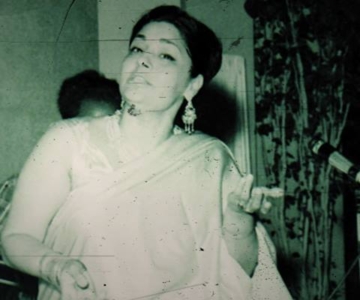
My dear friend Vidya Rao’s labour of love is finally out. She has been working on this project for quite a while. Her book Heart to Heart: Remembering  Naina Devi is a tribute to her teacher, Guru and inspiration who trained Rao as a singer..

Legendary singer, Naina Devi  was born into a Bengali Brahmo Samaj reformist family in the early years of the twentieth century. A childhood replete with music, dance, theatre and social reform gave way to the grandeur and seclusion of the life of a young queen of the Kapurthala royal family of Punjab. Despite seventeen  years of silence necess
itated by the norms of a royal household, she came back to music and a glorious career as a singer, arts-administrator, teacher and patron,  after the tragic death of her husband.

Heart to Heart, traces Naina Devi’s incredible story as she told it to her foremost disciple, Vidya Rao. Naina Devi’s  story traces the changes in the world of Indian classical music, women singers and women in Indian society  over the last century.  Learning seena-ba-seena, heart to heart, in a seamless blend of music and life-lessons,  Rao imbibed not
just a knowledge of her chosen form, Thumri,  but a sense of the very being of her teacher.

The evocative  narrative weaves back and forth between history  and memory,  past and present, and between Naina Devi’s voice and Rao’s own, to illuminate the power  and beauty of music, the lives of these two women and of many others,  of courage, pain, joy and love, and  of the deep bond between Rao and her beloved Guru.

Here’s a detailed review published here (more…)

Pakistan’s foreign policy: Escaping India?

17 October 2011

By Raza Rumi:

As Pakistan negotiates with a critical moment of its 64-year-old existence, there is nothing more urgent than to review its foreign policy goals and the assumptions that define them. It is an open secret that the unelected institutions of Pakistan for decades have designed controlled and implemented its foreign policy, often at variance with Pakistan’s own pragmatic self-interest. Such have been the contours of Pakistan’s foreign policy perspective, that the institutional interests of its all-powerful military and the allied intelligence complex dominate the definition and outcome of an imagined “national-interest”. Considering how Pakistan finds itself locked in a battle of nerves with the United States since the strike on Osama bin Laden’s compound in the garrison town of Abottabad, on May 2, 2011, there is perhaps no better time for its elites to review and redefine what passes for foreign policy. (more…)

Sahir Ludhianvi’s poem composed on Ghalib’s centenary celebrations

9 October 2011

 Sahir Ludhianvi laments the way Urdu was treated by Indian nation-state as it became alien overnight.


Ikees baras guzray aazadi-i-kaamil ko

Tab ja kay kahi’n hum ko Ghalib ka khayaal aaya

Turbat hai kaha’n us ki, maskan tha kaha’n uska

Ab apnay sukhan-parvar zahno’n may sawaal aaya


(more…)

More on the Pakistan Wikileaks- US Operations Constrained by India-Pakistan Relations

16 June 2011

My interview which has appeared on Wikileaks Central.

Pak-Usa

The Dawn Media Group in partnership with WikiLeaks has been releasing the “Pakistan Papers.” Thus far, some of the revelations include the following: US was concerned that Pakistan would oppose its policies at the United Nations; US was worried Pakistan would purchase oil from Iran, allowing them to get a foothold in Pakistan; Pakistan’s government was upset with US funding for the Pakistan military, which led to increased civil-military tensions; Pakistan’s military asked for continued drone coverage; the US has had troops deployed on Pakistan soil; Saudi Arabia and the UAE have been financing jihadist groups in Pakistan and the US did not provide Benazir Bhutto with proper security. (more…)

The trajectory of peace

11 May 2011

By Raza Rumi

The dramatic events of the past few days have far-reaching repercussions on the future of global terrorism and US policy in Afghanistan and West Asia.

Osama bin Laden may have been removed from the scene, but Al Qaeda lives as a hybrid conglomerate with formidable allies in Pakistan and elsewhere.

Whilst a plethora of questions on Bin Laden’s capture and death remains unanswered, Pakistan has, once again, come under global scrutiny admittedly for the right reasons.

Most Pakistanis are dumbfounded by the sudden discovery of Bin Laden virtually under the nose of the military and the mysterious way in which Operation Geronimo was carried out by the United States.

Despite the hard talk, it is clear that the US-Pakistan relationship is not going to be majorly affected by the recent turn of events.

After US President Barack Obama’s acknowledgement of Pakistan’s assistance, US secretary of state Hillary Clinton has argued that Pakistan should not be unfairly pressured. The British Prime Minister has more or less taken the same line. (more…)

Trade with India is a rational policy choice

28 November 2010

China and Taiwan are sworn enemies. In 2009, the total volume of their trade was 110 billion dollars. India’s trade is expanding with China, and the current volume is nearly 60 billion dollars per annum. On the other hand, the total volume of formal trade between India and Pakistan is around a billion dollars. What does this say about keeping rational economic interest over emotional narratives of nationalism and politics? The politics and troubled past has ruined South Asia’s present and potentially its future. It is time to review the situation and reverse this trend.

True, we have unresolved issues with India. It is also well-known that India has not respected the United Nations’ resolutions on Kashmir. But our mercurial rulers have not been consistent in their stance either. The last of our long list of dictators, General Musharraf announced his willingness to forego our conventional position on Kashmir. However, due to various factors he could not translate his statements into action. The Indian side also displayed its lack of foresight in engaging further with Musharraf and preferred pandering to the shrill hate-and-crush-Pakistan domestic lobbies.

This is why granting of Most Favoured Nation (MFN) status is more of a political and national security issue than a clear cut economic choice that a sensible country makes while choosing its development trajectory. Trade between India and Pakistan is a joke compared to trade between India and its other global partners. There is a consensus that India-Pakistan trade is a win-win situation for the two countries only if the Indian and Pakistani states were to find a mechanism where effective dialogue takes place and the politics of bickering gives way to a rational discourse.

The SAARC member countries including Pakistan and India concluded the South Asian Free Trade Area (SAFTA) treaty in 2004 which allowed for freer trade and aimed to reduce trade barriers and tariffs in two phases. The World Bank studies also estimated that both Pakistan and India by entering into a ‘preferential trade system’ like SAFTA were likely to gain. But the conflict and political differences have prevented from this to happen. Despite the limits trade has been increasing due to sheer necessity.

For centuries trade has taken place in the region. Today the routes between the two Punjab[s], between Karachi and Mumbai and from Rajasthan and Gujarat into rural Sindh are still valid. Asad Sayeed, a reputed economist based in Karachi states that if normal trade resumes, “regional economic benefits that can accrue on either side will have a multiplier effect.” In fact informal trade that takes place is unknown but quite significant. Yasir Khan writing for The News (July 10, 2010) also highlighted the World Bank estimates of 2002 whereby Indo-Pak trade could expand Pakistan’s Gross National Product by 1.8%. Khan also quoted a study by Peterson Institute of International Economics which estimated informal trade between two countries in the range of $3 billion per annum. The potential therefore is immense.

India will also gain as Pakistan will provide a viable land route for its trade with Central Asia. Most importantly, given India’s energy deficits, normal trade will meet its energy demands and Pakistan can make impressive gains in foreign revenues through rents. It has already been estimated some years ago by the State Bank of Pakistan that the proposed gas pipeline to India could make us earn upto 700 millions dollars per annum.

The exaggerated fears of Indian domination are now a matter of history. Pakistan is already a dumping ground for Chinese goods. Uncompetitive sectors of our economy are already closing down. Pakistan’s private sector is also ready for improved trade relations. During the 1990s, the Karachi Chamber of Commerce and Industry formally supported the granting of MFN status to India. In the previous decade, increased interaction between the business lobbies has resulted in a strong articulation of normal and economically feasible trade with India. Nearly all political parties and prominent voices from the civil society are also in favour of trading with India. Rarely has there been such a consensus in the domestic framework of Pakistan’s mainstream politics.

This brings us to the well known variable – the national security apparatus – which remains dominant in terms of policy process. Many voices in the mainstream media have urged a paradigm shift. For instance, Khaled Ahmad’s recent op-ed published in the Daily Express-Tribune (November 14, 2010) states: “It is time we changed the paradigm of defence in Pakistan and returned to the normalcy of trade and trade routes. Pakistan’s revisionism vis-à-vis India must give way to compulsions of self-correction; and Pakistan must become open to international finance as an important adjunct to South Asia’s rising economy.” This is not a lone voice anymore. Big business of Pakistan is also backing such a demand. Similarly, Indian business lobbies are also ready to make profits given the low transportation costs. A huge market for our exporters, technological gains (such as textile design innovations) and cost saving for consumers and producers are potential gains that Pakistan’s policy makers need to debate.

Public discussions in Pakistan unfortunately are hostage to the half-truths that we follow like parrots. On the other side, the debate is hostage to the terrorism mantra and finding a scapegoat for misgovernance by the post-colonial state. Thus we are locked between two states that have now created populist Frankenstein[s] of public imagination. An imaginary enemy is vital for the realisation of nationhood.

Pakistan is facing an unprecedented crisis: Its state is at war and stagflation is likely to escalate social unrest. The recent floods have resulted in losses of over 10 billion dollars. Our high growth rates, which we prided ourselves for under military regimes, are tales of bygone eras. We need immediate and feasible solutions. Increased trade with India will boost our light engineering and small scale manufacturing sectors and also generate employment. We have to seriously think of this route and not solely depend on the life support systems devised by international finance institutions.

By trading with the enemy, we will not be compromising our principled stand on Kashmir (we could very well have a more reasoned dialogue in a congenial environment) nor give up on our demands with respect to water or the Siachen issue. Political negotiations can continue. But we have to join the South Asian economic progress and share the gains made with millions of Pakistanis.

It is therefore critical that our political parties instead of playing petty politics consider the serious issues of economic recovery and forge a consensus that the security establishment cannot ignore. In any case, dialogue is required between the civil and military institutions where the short term strategy should be conditioned by our long term interests. For this to happen, the civilian democratic forces need to be united. If they have been able to work together on the 18th Amendment, then they are capable of resolving issues and taking joint positions.

Most importantly, Pakistan Army’s survival and strength are linked to a vibrant and growing economy. Long term reforms will take five to ten years to bear fruit. But trade can happen within months provided there is a shift in the policy and a willingness to learn from the China-Taiwan or India-China examples.

India will also need to reassess its over-use of the terrorism card. Pakistan is suffering due to internal conflict and global war in its neighbourhood. Pakistan’s civil and military leadership can only operate out of the box if the Indian bureaucracy allows its political class to make bold strides. The two countries as a start must continue the dialogue even if does not meet the sensational standards of the corporate media.

It would be naïve to expect that the trade-issue will be resolved overnight. However, capitulation to irrational and self-defeating policy paradigm is even worse. We need to take a leap forward simply in our own national interest.

First published in The Friday Times (November 19  2010)

Media and mobs – Arundhati Roy versus the terrorists

2 November 2010

Arundhati Roy is the conscience of India. Her treatment by a greedy media playing the tunes of fundamentalists is deplorable and condemnable. Roy’s statement issued a day before says it all. As she writes, RSS is trying to deflect attention from the terrorists who attempted to blow up the shrine at Ajmer Sharif. What is wrong with these psychotic militants across South Asia. Sufis were hardly contested in the worst of times but we are living in an age where any message of peace, pluralism and tolerance is a threat to exclusivist ideologies. We cannot be silent about it.

A mob of about a hundred people arrived at my house at 11 this morning (Sunday October 31st 2010.) They broke through the gate and vandalized property. They shouted slogans against me for my views on Kashmir, and threatened to teach me a lesson.

The OB Vans of NDTV, Times Now and News 24 were already in place ostensibly to cover the event live. TV reports say that the mob consisted largely of members of the BJP’s Mahila Morcha (Women’s wing). (more…)

Travelogue (final) Entangled destinies

16 September 2010

In the final part of this series, Raza Rumi recounts the last few days of the media expedition to India

Pakistani media persons landed back in Delhi after a whirlwind tour of Mumbai and Bangalore. Once back at the Maurya Sheraton, we had the last few days of the tour planned well in advance. A sizeable number of the visitors were taken to the ephemeral Taj. Thankfully this was not mandatory, as some of us wanted to stay back in Delhi, especially those who had seen the Taj during their earlier visits.

Pakistan’s High Commissioner, Mr. Shahid Malik invited us for lunch, and this was my first visit to our stunning High Commission located in Chanakyapuri, New Delhi’s diplomatic enclave. The sumptuous lunch cooked with much aplomb was preceded by a lively discussion about our trip and our impressions regarding the possibility of peace.

Pakistan’s diplomatic haven is a well-designed building merging Islamic, Indian and Western sensibilities. The blue-domed structure merges well with Delhi’s vista of monuments, some well- kept and others neglected. This is an irony, at its best! Nevertheless, this was familiar territory. (more…)

Travelogue (Part III): India’s Silicon Valley

15 September 2010

In Part 3 of the series, Raza Rumi visits Bangalore, city of gardens and high tech

After our sojourns in Delhi and Mumbai, the Pakistani media representatives were afforded the opportunity to visit the fulcrum of shining India i.e. Bangalore, now rechristened as Bengaluru, its original name in Kannada. It was not difficult to guess why Bangalore is loved by so many across the globe. Its weather makes it a most unique city, somehow free of South Asian extremes in temperature. Weather aside, even the nature of its residents is fascinating, for it is palpably different from their North Indian counterparts. As we were to find out later, the distant conflicts of belligerent North India matter far less in the tropical climes of this congested yet verdant metropolis.

We were greeted at the airport by a contingent of security apparatchiks and the state police. The Bharatiya Janata Party (BJP) had planned country-wide protests over the increased fuel prices that were supposedly causing inflation and misery for the poor. The Pakistani delegation found itself amid a historical moment when the BJP was being backed by the communist parties of India in protesting over the reduction of state subsidies to keep the price of oil low. Hence, the tight security. As Karnataka is ruled by the BJP and regional parties, the strike was a great success, and we found the streets of Bangalore deserted.

The ITC Royal Gardenia Hotel where we stayed was simply stupendous. It had been recently built and was touted as a green haven for its adherence to environmental standards. Designed with an open plan sensibility, it had a feel of expanse and splendour. Special purpose vertical gardens had been created to augment the ambience and blend nature with standard hotel architecture. However, life presents its little ironies, and one could not help notice the ITC (Indian Tobacco Company) ownership of this hotel chain. The corporate world knows well how to whitewash its minor sins and major profits.

Bangalore, lovingly nurtured as an archetypal British cantonment, has always been referred to as the City of Gardens. Its ecology helps create green spaces with plenty of rainfall per annum. However, Bangalore has also transformed over the years due to its emergence as an information technology (IT) hub. In many ways, the Indian IT success story, central to the India-shining narrative, is intertwined with Bangalore and its eminently hospitable mores. Among others, Infosys, a global giant conglomerate, grew and evolved in Bangalore. But there are other hubs too which make Bangalore a success story of contemporary India. (more…)

Travelogue (Part II) – Yeh hai Bombay meri jaan

14 September 2010

Part I of the series can be accessed here

In Part II of this series, Raza Rumi travels to India’s thriving megapolis with a media delegation

After a whirlwind Delhi tour, the Pakistani media persons set off for a fleeting visit to Mumbai. If I am not mistaken, ours was the first big delegation to this megapolis that crossed the contemporary fault line between India and Pakistan. Less than a dozen zealot-mercenaries terrorized Mumbai twenty months ago, and now the issue of terrorism has derailed the formal Indo-Pakistan talks.

This was not a very comfortable journey. Not that we were not looked after by our hosts. It was a well-organized tour. But the overdose of Mumbai mantra in Delhi had rattled some of us. What happened there in November 2008 was ghastly and inhuman; and Ajmal Kasab’s nationality stirred public opinion like never before. Thanks to a belligerent media and live telecast of terrorism (almost to the point of glorifying it) the result was what the jihadis had hoped for. Jingoism flourishes in such odd climes and the Mumbai hangover, as we all found, is a potent reality in India.

Within the delegation, I underwent a strange sensation – of a remote, awkward connectedness with the place. Twenty years ago, as an apolitical and naive student I had arrived in Bombay to see my friends from the London School of Economics. This was a ten day long trip, which I shall not forget for many reasons. I found a cosmopolitan buzz, abject poverty and immense human bonding then. I stayed in a building where Bollywood’s long-lasting diva Helen lived, and met scores of young men and women who looked the same but adhered to a different lifestyle. (more…)

Manmohan Singh’s ignorance

18 August 2010

Manmohan Singh whom I have always held in high regard, disappointed millions in South Asia with his distastefully ill-timed hard talk during his Independence day address. As if Pakistan’s current misery was a time to blow India’s trumpet. He surely was also unaware of what his patriotic Indian poet, Ali Sardar Jafri had written years ago -Dialogue Souldn’t Cease. Here is an Urdu version with a full translation. Perhaps, someone should pass a copy of this poem to the exalted Prime Minister of India.

GUFTGOO BAnD NA HO
BAAT SE BAAT CHALEY
SUBH TAK SHAAM-E-MULAAQAAT CHALEY
HUM PE HAnSTI HUEE
YE TAAROn BHARI RAAT CHALEY (more…)

Redefining national interest

26 July 2010

Raza Rumi

The elusive quest for peace between India and Pakistan remains hostage to the military-industrial complex at both the global and regional levels. Such is the dynamic unleashed by two imagined “nations” that their existence as states is dependent on a perpetual state of confrontation. More so for Pakistan, given its deeply embedded paranoia, which has assumed a reality of its own. Sixty-two years ago, it was hardly envisioned that the two states would erect an iron-curtain and fight forever. From actual wars to propaganda campaigns the task seems complete now. The oft-repeated phrase ‘trust deficit’ is a natural culmination of this ugly process. Of late, another dimension has been added, i.e. information-deficit as India had marched towards a new phase of its economic development, it has stopped taking interest in transitional Pakistani society and kept the time-warped framework of understanding Pakistan. However, the situation cannot remain static. Policymakers are slow to catch up on both the sides.

Mumbai factor: Twenty months ago, the Mumbai attacks changed the atmosphere created by President Zardari’s unprecedented offers of peace, dialogue and cooperation. The day Zardari made his remarks in a conclave organised by the Hindustan Times in 2008, many observers saw a Mumbai coming. The jihadis of Pakistan and perhaps their counterparts in India were quick to stop this process. Ironic that PPP, a party fed on the Pakistani nationalist rhetoric, thirty years down the road had read the writing on the wall. Pakistan’s future and survival is dependent on a reduction of hostilities with India. More importantly, this also holds the key to correcting the endemic civil-military imbalance. (more…)

No alternative to peace with India

14 July 2010

My op-ed today for Express-Tribune

Once again, the fragile peace process between India and Pakistan has commenced. It is too early to say whether it will lead to an amicable settlement of seemingly intractable issues. What is clear is that the peoples of the two countries want peace, security and progress. The elites, which agreed on the messy Partition and raised nation-states and huge militaries, have surely flourished at the expense of people. A causal look at India’s poverty and Pakistan’s social indicators proves this point.

As a confidence building measure, a group of Pakistani journalists visited Delhi, Mumbai and Bangalore to meet their counterparts, think tanks and selected top-level officials. This was a timely and fruitful visit and reminded us that there is a formidable peace constituency in India. After the Indian home minister it is the turn of the Indian foreign minister to visit Islamabad from today for a three-day tour. Regardless of the outcome, sensible neighbours must continue to talk. (more…)

A beatific vision – Nizamuddin Auliya

12 July 2010

There is something unique, almost magical about this place. Otherwise a tiny space in the sprawl of urban Delhi, Nizamuddin’s shrine means a lot to me. My five years old relationship with this corner of a tumultuous globe is source of strength, peace and a connection with a bygone age.
The sad part is that I never get enough time to be there – just to sit and muse – do nothing. Even taking pictures is such a burden in a place where you want to let go – and be yourself, without any need, ambition, desire or a deadline.
When will I visit next? A question that lingers in my mind each time I am leaving this place. Wish the visa hassles were not there. But they are real and so am I.

Next Page »