Archive for the ‘History’
Published
May 2nd, 2008
Category
History, Peace, India, All My Posts, On Pakistan, Indo Pak peace, India-Pakistan History |
3 Comments »
Nirmila Deshpande is dead. She will be remembered for her invaluable services for peace in the region. This statement from the Asian Human Rights Commission says it all:
“Nirmila Deshpande, a well known peace crusader of India, died on May 1, 2008, after a long period of illness. She was 79-years-old and left behind so many followers who like her, wanted peace. From her early years she was a Gandhian and an enlightened person whose only aim in life was to work for the cause of humanity. Nirmila was the one by whose efforts the bus service between different cities of India and Pakistan particularly, between the Kashmiri people of both sides, were started. She worked extensively all her life for peace among various religious and linguistic communities in India and to achieve this cause she undertook a 40,000-km padyatra (long march) across India to carry Mahatma Gandhi’s message of Gram Swaraj. She firmly believed that although it was difficult to practice Gandhian principles, it was the only way towards a truly democratic society.
At the time of her death she was Chairperson of the Pakistan India People’s Forum for Peace and Democracy, an organization with chapters all over India and Pakistan that works for peace in the region. (more…)
Published
April 30th, 2008
Category
History, heritage, All My Posts, Sufism, Turkey |
2 Comments »

Sufi Cuisine, a book combining culinary history with over one hundred sumptuous recipes inspired by the teachings of Sufism.
Sufi Cuisine takes the reader on a sensuous journey of earthly and spiritual delights. As Nevin Halici explains in her introduction, the eating and preparation of food is at the heart of Sufi religious practices and beliefs, and the truly inspiring array of dishes - from preserved rose petals and snow helva, to baklava prepared with water in which oak ashes have been soaked overnight - illustrates this beautifully. Full of charming anecdotes, poetry from the great Sufi mystic, Mevlana, and delightful recipes, Sufi Cuisine is a rare treat.
Source: www.saqibooks.com - reached us via this blog.
Published
April 19th, 2008
Category
Religion, History, India, Arts & Culture, All My Posts, India-Pakistan History, Pakistani Art, Research |
1 Comment »
This piece entitled, My Name is Green, published in the weekly Outlook India traces how “forged in the cultural ferment of a century ago, Islamic poster art in India thrived on the frontiers of taboo.” The author is Shruti Ravindran, who has obviously undertaken a lot of research and also published some great samples of such posters. That Islam in South Asia acquired and adapted the local flavour and modes of social and spiritual interaction is well known.
While reading this piece, I also recalled seeing similar eclectic posters in Pakistan in my childhood before the puritanism of General Zia ul Haq engulfed the country and Wahabi variant of an exclusive and suspicious man made ‘faith’ deepened its presence, well at least in the public domain of representation.
This piece looks at some of these aspects through the popular art form. Read and enjoy - full text has been posted below courtesy the intelligent Outlook. (more…)
Published
April 18th, 2008
Category
Politics, History, India, All My Posts |
1 Comment »
Prabhat Patnaik’s “The Communists and the Building of Capitalism“, evidently an ideological and polemic-ridden article, makes some interesting points particularly in the context of the debates about espousing of capitalist principles by Communist governments in India. This would be relevant to the situation in Nepal as the Maoists have clearly won the recent election. Similar dilemmas of ‘democracy’ exist elsewhere too.
Does the fact of communist-led state governments operating within a capitalist system and hence playing host to private investment, necessarily entail that the communists have abandoned socialism? The media reactions to statements by some West Bengal communist leaders would suggest that the answer is a clear “yes”. But this is a non-sequitur. It is worth examining the issue theoretically, even if it involves restating certain bread-and-butter theoretical propositions. (more…)
Published
April 15th, 2008
Category
Islam, History, Random musings, Rumi, Arts & Culture, All My Posts, World Writers, World Literature, Sufism, Knowledge |
4 Comments »
Last year, I came across a Charles Homer Haskins lecture that Dr Annemarie Schimmel delivered in 1993. Aside from the amazing events and milestones of her life, what struck me was her immersion in an infinite ‘learning’ cycle. I am reproducing some lines from the lecture and a dazzling poem of hers below. Dr Schimmel left this world in 2003 for another voyage. As an extra-ordinary scholar (over 150 publications to her credit), a Rumi disciple and an odd Sufi herself, the world is not the same place without her.

However, her erudite and passionate writings will continue to warm our hearts. Sang-i-Meel Publishers (http://www.sang-e-meel.com/) in Pakistan have done a huge favour by re-printing selected titles for the Pakistani audience. (more…)
Published
April 13th, 2008
Category
Poetry, History, heritage, Arts & Culture, All My Posts, World Writers, South Asian Literature, Sufi poetry, India-Pakistan History, Sufism |
2 Comments »
An essay contributed by the celebrated singer,writer and spiritualist Vidya Rao
I often ask myself the question why I choose, above all things, to sing, and then to sing a traditional gayaki like thumri. The images that are gleaned from its poetic texts are so often open to misunderstand: pining nayikas, heartless piyas, rakish Krishnas, divine Rams. I ask myself that question again today when ‘tradition’ is in danger of being smothered by sectarianism, communal violence and a whole culture lies bleeding.
I turn to the music itself for my answer. It has never failed me before—it does not fail me now. (more…)
Published
April 2nd, 2008
Category
History, heritage, Arts & Culture, All My Posts, On Pakistan, Pakistani Art |
3 Comments »
Found a well researched article on Mehrgarh at Chowk:
Mehrgarh is the centre of the first known developed place of civilization in its advanced form in the world as compared to the contemporary and the predecessor human settlement areas of the world. The town of Jericho has, not got the level of sophistication and developmental level attained at that in Mehrgarh. The symbolic artifacts retrieved from Mehrgarh are far more advance d and more developed as compared to the artifacts retrieved from Turkish sites and Middle Eastern sites especially Jericho.
It is interesting to note, however, that the male figurines have turbans — much like those worn by the inhabitants of Baluchistan today. These turbans are not only found in Baluchistan, they are still worn in the rural areas of Punjab.
One of the most unique discoveries of the Mehrgarh is the first known origin of the dental surgery and related medicinal activities in the Mehrgarh areas. This medicinal and different aspect of the Mehrgarh shows great innovation and developmental level of the people of the area about 9000 years ago.
Published
March 31st, 2008
Category
Cinema, History, India, All My Posts, India-Pakistan History, Published in The Friday Times |
5 Comments »
The challenge of translating a historical era into a cinematic endeavour is daunting, especially when it concerns historically contested subjects such as the fabled love between 16th century Mughal Emperor Akbar and Jodha Bai, the legendary princess from Rajputana who later ruled India as Empress and symbolised the Hindu-Muslim accord of the times. However, it is not historical accuracy, or lack thereof, which defines the rather exasperating cinematic narrative of an otherwise glorious period of the subcontinent’s history. It is the facile treatment of history, its interpretative variants and its actors that makes the Bollywood film Jodhaa-Akbar a disappointment.
Akbar’s reign symbolised the zenith of the Mughal Empire and also some of its unique attributes. Whether it was the secular, tolerant governance based on the Sulah-i-Kul (peace with all) policy, opening up the frontiers of theological discussion, effective administrative systems or promotion of Indo-Mughal art forms, Akbar was a pioneer in most respects.
Jodhaa-Akbar attempts to capture the essence of that particular moment: the Indianisaton of the Mughal court and most importantly, the royal household. Whether it is to do with the grafting of a temple within the Agra fort or the introduction of vegetarian meals, these were significant markers for centuries to come, enabling a tiny Muslim minority to rule the non-Muslim majority. But the film fails to handle this momentous phase of history appropriately and instead churns out a masala mix that, despite the massive budget, results in mediocre film-making.
This is not to say that the film is without merit. It is visually stunning in places and A R Rehman’s music is outstanding. The two stars – Ashwariya Rai and Hrithik Roshan – provide glamour and unreal beauty. The settings are competently improvised and yes, the feel of the whole cinematic experience does convey the clichéd Mughal aura of splendour, excess and a hybrid aesthetic. Rai and Roshan exude that enigmatic chemistry which makes them an attractive pair on screen.
But it is the treatment of the subject, characters and nuances that disappoints, especially when one remembers director/producer Ashutosh Gowariker’s earthy and under-your-skin rendition in Swades . In the pursuit of commercial success, Ashutosh relies on soft plagiarism. The battle scenes remind one of the Hollywood blockbuster Troy; the inanimate army contingents resemble those in Gladiator; and the sword fighting sequences re-enact the visual tricks of Crouching Tiger, Hidden Dragon . But these are all still pardonable. (more…)
Published
March 28th, 2008
Category
Politics, History, India, Punjab, All My Posts, India-Pakistan History |
5 Comments »
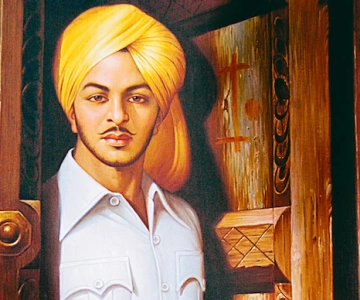
A few days ago, Irfan Habib, a noted researcher and author of TO MAKE THE DEAF HEAR — Ideology and Programme of Bhagat Singh and His Comrades sent his thoughtful piece on the legendary Bhagat Singh.
Incidentally, Bhagat Singh was hanged on Pakistan’s Republic Day - March 23 though nine years prior to that - in Lahore - thereby adding another dimension to the symbolism of March 23 for Pakistanis. Bhagat Singh for his principles, struggle for just causes and valour is a shared hero.
I am quoting some of the passages from Habib’s article below. Citing a Tamil newspaper editorial of 1931, Habib writes:
One of the most articulate and strong reaction was seen in far away Tamil Weekly called Kudi Arasu, where Periyar E.V. Ramasami wrote an editorial on March 29, 1931. Besides being critical of Gandhi and the Congress for failing to save him, Periyar saw in young Bhagat Singh an ally who stood for rationalism and spoke against caste oppression. He began by writing “there is no one who has not condoled the death of Mr. Bhagat Singh by hanging. There is none who has not condemned the government for hanging him.” The above lines reflect the widespread acceptance of Bhagat Singh as a national hero, much beyond the limits of Punjab, and more significantly, within this short political life. There is no reason to believe that his persona was created by scholars through their exploration and interpretation of historical records.
Habib concludes with these words- (more…)
Published
March 22nd, 2008
Category
Religion, History, heritage, Arts & Culture, All My Posts |
9 Comments »
Found brilliant post written by Yousuf Saeed
Holi, being celebrated across India, may be the most colourful Hindu festival but it has a Muslim history as well.
Sufi saints like Hazrat Nizamuddin Aulia and Amir Khusrau in their chaste Persian and Hindi loved the festival. Emperor Bahadur Shah Zafar, whose Holi ‘phags’ (songs) are relished even today, allowed his Hindu ministers to tinge his forehead with ‘gulal’ during Holi festival each year. (more…)
Published
March 22nd, 2008
Category
books, Islam, History, Islamophobia, All My Posts |
3 Comments »
Tehelka magazine has this story on how magic and adventure render the Hamzanama the most popular oral epic of the Islamic world.
WILLIAM DALRYMPLE tracks its mad energy in its first-ever compilation in English
IN JUNE 2002, as Pentagon strategists were making their plans for the invasion of Iraq, a short distance away down Washington’s National Mall, the Freer- Sackler Galleries at the Smithsonian were showing one of the most interesting exhibitions of Islamic art seen in the US for years. Ironically, the show was made up of illustrations of a story largely set in the very Iraqi cities which were shortly to find themselves as targets for the Pentagon’s munitions. (more…)
Published
March 15th, 2008
Category
History, India, All My Posts, South Asian Literature, India-Pakistan History, Guest Writer, fiction |
17 Comments »
By Vidya Rao
The streets of some cities, they say, are paved with gold. This city’s streets are paved with stories. Doubtless, they were also paved with gold once, but this would have been before the British pounced upon it and shook its pagoda tree. Which was how they referred to the looting of India that each ‘nabob’ of the East India Company systematically carried out. Though, to give the devil his due, it was the British that are considered to have founded the city. (more…)
Published
March 7th, 2008
Category
History, India, heritage, Arts & Culture, All My Posts, South Asian Art, Mughal, India-Pakistan History, Guest Writer |
7 Comments »

by Sadia Dehlvi
Jama Masjid, the last significant and glorious monuments of the Mughal period now faces a threat of extinction in the garb of development. If the Delhi government has its way, glitzy swanky malls underground malls will be constructed just fifteen metres from the steps of the monument. The proposed plan shows disregard and insensitivity to history and the culture of the people living in the area.
To create the four layered basement the ground will have to be dug at least eighty feet which will causes severe stress to buildings within five hundred meters. In the year 2005 there was a high court order in favour of beautifying the area around the Jama Masjid with open green spaces for community interaction. The MCD had commissioned such a plan which was presented and approved by the court. Instead of this well integrated plan we suddenly hear the horror story of a new MCD plan converting the area into a commercial mall venture.
As a rule, the archeological survey of India does not permit any construction within a hundred metres of a protected monument. The Jama Masjid is a functioning mosque and is therefore not officially protected by the ASI as it belongs to the Muslim community. The Waqf Board is the custodian of the mosque as pronounced by the Delhi High court. However, does that mean we should strip it off from a heritage status and allow the builders and adventures of the state to threaten its survival? If the Masjid collapses, so will India’s secular legacy as represented by the adjoining mausoleum of Maulana Azad and the tomb of the Sufis Sarmad Shaheed, who challenged the orthodoxy of Aurangzeb resulting in his execution on the steps of the Jama Masjid. (more…)
Published
February 20th, 2008
Category
Cinema, History, Arts & Culture, All My Posts, India-Pakistan History |
7 Comments »
My blogger friend, Manasvi wrote this reviewof Jodha Akbar and I am glad that the film is good.
Jodha Akbar brings to cinema an epic love story that even if imagined is just too wonderful.
There have been controversies about the fact that recorded history has little evidence on the character of Jodha Bai. My simple question is: what about the oral histories of the subcontinent. Why must we always remain beholden to court historians and foreign travellers - why not respect what generations have believed over time? (more…)
Published
February 16th, 2008
Category
History, heritage, Buddhist, Arts & Culture, All My Posts, On Pakistan, My paintings, fundamentalism, Central Asia |
8 Comments »
I have been working on this composition for quite a while. I was angered, rather revolted by what the Taliban were doing in the pristine Swat valley that has recently undergone full scale war. What has the peaceful and serene Buddha to do with the war on terror and US imperialism in Afghanistan? I have friends who try and explain that the regrouped and re-energised Taliban represent the angst against the US occupation of the Pashtun lands. Perhaps there is some truth in this. But my Gautam, what was his fault? He only talked of peace in this region and only asked us to traverse and preserve our humanity.
Who are these butchers of culture? What Islam they follow? They have no religion except barbarity and tribal notions of revenge and blood-letting. There is no excuse for the vandalism against our vital heritage - Pakistan will be a poorer place if these mad, roving fundamentalists would remove all the signs of our pre-Islamic heritage and ancient cultures.
So this painting evolved in those days of anguish. I remembered a broken Buddha head that was discovered from Swat decades ago and thanks to my useful library I got the picture. So I took the Taliban flag background, which is tri-coloured (that should be black in my not so humble opinion); and transposed the Buddha on top and to indicate my fears, I painted the star and the crescent on the green portion to represent the Muslim part of the Pakistani flag.
So this is the little story that led to the painting above. My partner likes it and a few friends who saw it, also appreciated it. I have to thank my art teacher for guiding me through the shades and shadows with little [master] strokes here and there..
I plan to do a series on it. But I will have to travel to Swat; and I am not sure when will situation normalise there. In the meantime, I plan to rely on my Gandhara books and twopence imagination.
First published here
Published
February 3rd, 2008
Category
Religion, Islam, History, All My Posts |
9 Comments »
Moharram reminds us of the Kerbala tragedy; and Imam Hussain’s (AS) refusal to submit to the autocracy of Yazid. This episode is laden with deep symbolism. Imam Husain and his faithful companions preferred to die on the banks of river Euphrates but did not submit to what was wrong.And what was wrong beyond the theological discourses. Hussain (AS) raised the voice of dissent against the emergence of the Empire and the Church in Islam. Hussain (AS) offered his life and that of his family and associates to resist the confiscation of the right of the Muslims to select their leader, to resist the emergence of the Empire and preserve Islam’s tribal egalitarianism against an emergent iniquitous economy.
My piece published in Today’s NEWS (more…)
Published
January 27th, 2008
Category
History, heritage, Arts & Culture, All My Posts, Central Asia |
5 Comments »
Bamiyan is no ordinary location. This was the place where the giant Buddhas that stood for centuries with their message of peace were destroyed by the Taliban. And, now this startling revelation. There is tragedy laced with irony here.
Forget Renaissance Europe. The world’s first oil paintings go back nearly 14 centuries to murals in Afghanistan’s Bamiyan caves, a Japanese researcher says.
Buddhist images painted in the central Afghan region, dated to around 650 AD, are the earliest examples of oil used in art history, says Yoko Taniguchi, an expert at Japan’s National Research Institute for Cultural Properties. (more…)