Jahane Rumi

In search of the unsearchable: “…O, my soul! where would you find your house?”

Archive for the ‘Guest Writer’


Published March 15th, 2008

Fiction: City of Stories

By Vidya Rao

The streets of some cities, they say, are paved with gold. This city’s streets are paved with stories. Doubtless, they were also paved with gold once, but this would have been before the British pounced upon it and shook its pagoda tree. Which was how they referred to the looting of India that each ‘nabob’ of the East India Company systematically carried out. Though, to give the devil his due, it was the British that are considered to have founded the city. (more…)

Published March 7th, 2008

Jama Masjid Delhi: The Real Estate Hunt and the State

by Sadia Dehlvi

Jama Masjid, the last significant and glorious monuments of the Mughal period now faces a threat of extinction in the garb of development. If the Delhi government has its way, glitzy swanky malls underground malls will be constructed just fifteen metres from the steps of the monument. The proposed plan shows disregard and insensitivity to history and the culture of the people living in the area.

To create the four layered basement the ground will have to be dug at least eighty feet which will causes severe stress to buildings within five hundred meters. In the year 2005 there was a high court order in favour of beautifying the area around the Jama Masjid with open green spaces for community interaction. The MCD had commissioned such a plan which was presented and approved by the court. Instead of this well integrated plan we suddenly hear the horror story of a new MCD plan converting the area into a commercial mall venture.

As a rule, the archeological survey of India does not permit any construction within a hundred metres of a protected monument. The Jama Masjid is a functioning mosque and is therefore not officially protected by the ASI as it belongs to the Muslim community. The Waqf Board is the custodian of the mosque as pronounced by the Delhi High court. However, does that mean we should strip it off from a heritage status and allow the builders and adventures of the state to threaten its survival? If the Masjid collapses, so will India’s secular legacy as represented by the adjoining mausoleum of Maulana Azad and the tomb of the Sufis Sarmad Shaheed, who challenged the orthodoxy of Aurangzeb resulting in his execution on the steps of the Jama Masjid. (more…)

Published February 2nd, 2008

Two poems from Spain

A Spanish friend with Sufi leanings, Ignacio de Miguel Díaz, has sent two of his poems that are true from his heart and I would like to share them with other readers here.

Ignacio wrote this to me before he sent the poems:

I am interestesd mainly in mystical traditions (but not limited to religion.. I think it to be a personal thing and not a credence with hierarchical institutional organizations) and culture all over the world, trying to respect the spirit that Buddhism expresses as ‘my inner Budha recognises your inner Budha’, a communication based on empathy and comprehension of the other.I believe that’s the only way to live together and enjoy life, don’t you think? (more…)

Published January 23rd, 2008

Imam Hussain: The Beloved of the Beloved

by Syed Salman Chishty

Shah Ast Hussain …

“Among the Belivers are Men ,who delivered their promise to Allah”

(Ayah 23/ Surah Al-Ahzab)

On the 10th of Muharram, 61 after Hijrah (680 AD) Hz.Imam Hussain was martyred by the army of Yazid. This tragedy shook the Muslim world and continues to be remembered by those who love the Prophet (saw) and his family. The death of Hz.Imam Hussain , his struggle for truth, justice and the greatness of Islam is still remembered and commemorated today. (more…)

Published January 20th, 2008

A few notes on the 10th of Muharram

God’s wisdom is beyond comprehension.

The 10th of Muharram is simultaneously the most celebrated day in the Islamic Calendar, and simultaneously the most sorrowful day of the Islamic Calendar.

It celebrates the day that God saved the Prophet Moses -p- and his people from the clutches of the Pharaoh.

It mourns the day that God allowed the grandson of the Prophet Muhammad -p- and his people to be slaughtered by the clutches of Yazid. (more…)

Published January 10th, 2008

Dholaks drowning gunfire

by Shreekant Gupta

During a recent visit to Delhi I mentioned to my aunt that I planned to visit Rawalpindi next week for a wedding. Her expression changed to one of worried concern. “But beta is it safe to go there?” she asked. I assured her that if there was one country in the world where I could blend and not feel out of place and where I was welcomed with open arms it was Pakistan. Having been there on four previous occasions once with a group of students from the Delhi School of Economics traversing the country for two weeks, I had ample experience of the legendary Pakistani hospitality and warmth to assuage her fears. But her comment set me thinking. Why is Pakistan attracting such bad press these days? It is often dubbed as the most dangerous place in the world. Certainly there are parts of the country that are seriously troubled and occasionally the violence spills over into the major cities. (more…)

Published December 18th, 2007

Spare the Animal and Show Your Piety: Eid ul Adha, 2007

I am cross-posting this thoughtful post by temporal that was published at the Pak Tea House

Eid ul Adha is on or around December 19-22, 2007 depending on where you are. Have a safe and happy holiday with your family.

Spare the poor goat or lamb’s life. For those who want to sacrifice the writer please scroll down and read Chapter 22, Verse 37 as translated by Marmaduke, Yusufali, Asad and Usmani: or pick your own copy of the holy Qur’an.

They all talk about your devotion, piety, God-consciousness and taqwa that reaches Him.

Please pause and think. (more…)

Published November 18th, 2007

Singing of youth and beauty, life and death

by Vidya Rao

 I was fortunate to be one of the women invited to the first meeting of the Grandmothers’ University at Bija Vidyapeeth early this year. (more…)

Published October 30th, 2007

Ecstasy and Order - Salman Chishty on Rumi

My young friend, Salman Chishty, from Ajmer (India) wrote this piece for the HT on the eve of Rumi’s birth anniversary. (more…)

Published October 6th, 2007

“Religion’s Role in Politics” from the TPS blog

This is a thought-provoking piece published by The Pakistani Spectator (TPS) that brings together multiple views and voices on Pakistan.

I believe there are four questions to ask, when considering the virtues and costs of a connection between religion and government:

1. How useful is the connection to the country’s people (who should be the government’s interest)?
2. How useful is the connection to the religion?
3. How useful is the connection to the country’s leaders?
4. How useful is the connection to the religion’s leaders?

Do check out TPS for more analyses and comments.

Published September 9th, 2007

Vidya Rao on Vrindavan

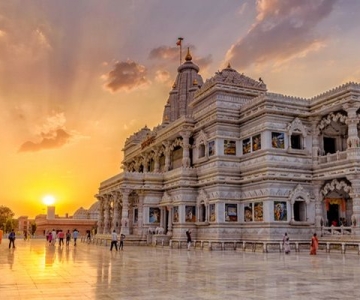
India’s eminent singer Vidya Rao has contributed this piece for Jahane Rumi. In this personal account she writes about her recent visit to Vrindavan, near Mathura, which is a major place of pilgrimage for Hindus. It is said that this area had the woods where Krishna frolicked with the gopis and tenderly wooed Radha.

Vrindavan is always a moment of pure magic. This time too.
 
This time, after the morning darshan, Acharya Shrivatsa Goswami took  those who stayed and had the time to smell the flowers, about 10 people— to the site of the old temple where Radha Raman ji had manifested–in a basket of shaligrams– in 1542. He was lovingly brought by Gopal Bhatt to a tiny temple where He lived for several years–in fact till 1861.In that year, He moved to the present larger temple built for him by Kundan Lal and Phundan Lal, courtiers and sons of Shah Bihari Lal, lately of the court of the deposed nawab of Avadh,Wajid Ali Shah, and now seeking shelter in Vrindavan in– as Shrivatsa ji put it– the court of the greatest king. What is interesting and moving about the tiny old temple is the small room (actually the largest space in that temple) that is the kitchen,  which houses the eternal fire. This fire was lit in 1542 to cook the deity’s first meal after He moved here, and the same fire burns today too. It has never been extinguished. When Shrivatsa ji said this, when I looked at the glowing embers of that ancient fire, I thought of the arani sticks. Going in search of these eternal fire sticks, Yudhishthira met and answered the riddles posed to him  by Dharma (his father, lord of justice and of death) in the guise of a yaksha.  What is the riddle that I must answer as I stand here in search of this unextinguished fire? What is this fire? The fire of nurture? Of passion? Of creation? Of destruction? Of transformation ? Of the energy that keeps the universe spinning? All of these? None of these?

The kitchen is still in use in 2007 and it is here that, even today, Radha Raman ji’s meals (8 in all– for each seva) are lovingly cooked by the priests (Shrivatsa ji and his sons and nephews). Surely this cooking is the manifestation of vatsalya bhava– the emotional universe of the mother and her love for her child. The meals are cooked in huge gleaming kansa vessels that are coated with a  thick layer of clay to slow down the process of cooking, to retain heat, to impart flavour– and perhaps to remind us that all is contained in the womb of muddy matter.These meals of course are the juthan, the prasad, that is shared with hundreds of pilgims every day. (Yummy, I might add.) Lightly cooked, steamed vegetables, dal fragrant with the most delicate spices, perfect fluffy phulkas and steaming hot pearls of rice. Dahi, of course and kheer  too, fresh ghee and butter, straight from His mouth. Now we who eat the prasad are experiencing vatsalya bhava– which mother had not picked up her child’s half-eaten plate of food and made a meal of those leavings?

There is something so incredible happening here. The recieving of food from ‘the mouths of babes’(!), so food as Truth? The world made ’streemay’, feminised, by these burly (and burly they are) priests as they take on the womanly tasks of cooking for, and feeding the child-God, and for the child-God manifest as the world and every person in it. The priests also clean the kitchen, wash the cooking vessels, again feminine tasks, tasks that bring to my mind a beautiful poem in the tamilpillai poetic tradition, where the all-too-human baby girl-child, rocking to and fro on her mother’s lap, is addressed as Meenakshi, Queen and Mother of the universe, lovely bride of the beautiful bridegroom (Kalyana Sundaram is Shiva’s name in Madurai) who is here just a little girl playing house- house with the universe.

The poem says (and I translate badly) Little girl, playing  house-house — you take Mount Meru and make it the pillar of your toy house, spread over it the canopy of the sky. You pin to that canopy the twinkling lamps of sun and moon and stars. You wash the soiled vesels of the worlds in the crashing flood-waters of the pralay-deluge, and you neatly stack them, lovingly, in your home. Then that madman, your husband, comes dancing into your courtyard and overturns your work, messes it all up. You don’t say a word– only smile and pick up the pieces and begin all over again. 

 Are the priests, washing the vessels of the worlds, sweeping the kitchen of creation, mirroring Meenakshi? Who is human here– who is divine? Who is man/woman/child?

Shrivatsa ji spoke of the daily seva for this child-lover god. He is a rasik, Shrivatsa ji said, a lover of all things beautiful, so we dress him in beautiful clothes and jewellery and we sing for him, we please him. Those who are his lovers sing for him.

I remember what musicians say– ‘Raga, rasoi, pagri, kabhi kabhi bante hain” (Perfect music, that special taste to one’s cooking, the perfectly tied turban– these happen but sometimes). Raga, rasoi, pagri– these echo the nitya seva of raga, bhog, shringar (music, food and ornamentation/clothes/also love, devotion, bhakti) that is offered every day, eight times a day to the Beloved.

And I understand too why the word for kitchen (and by extension, for cooking) in Hindi is rasoi– this is the place of rasa, taste, yes, but also enjoyment, immersion in the essence of all aesthetic delight.

What a strange and powerful experience that was to be there before that 500-year old fire, with those muscular, feminised men, to know the temple as the kitchen of the universe  (and so to also know the kitchen as the temple of the self) from where (as my dear friend Ramu Gandhi had put it in  when speaking of Sita ki rasoi– “Sita’s Kitchen”) every creature in the universe receives nourishment– “sab ko khurak milta hai”.

And that this ‘khurak’ is only apparently bread– the same bread of which Jesus had said “man does not live by bread alone, but by every word that comes from the mouth of God”. In Radha Raman’s old temple-kitchen I realise again, powerfully, that  Life, Truth IS bread, khurak,  that nourishes us so deeply– physically and spiritually; and that bread, my humble sookhi roti IS– none other– every word that proceeds from that baby mouth, every kiss of that Dark Beloved’s lips.

Mealtimes will never be the same again!

Published August 31st, 2007

Finally some filmi cooperation..

Interesting developments in Pakistani cinema: first the release and accolades that a newly released Khuda Ke Liye (In the name of God) received and now the screening of a Mahesh Bhatt film in Pakistan defying conventional wisdom and using innovative ways of selling it to officialdom. Himal magazine has published a report entitled Filmi cooperation. Here is an excerpt:

The release on 13 July of Indian director Mahesh Bhatt’s film Awarapan (roughly translated as ‘Wanderlust’) in 22 cities in Pakistan was no ordinary event. There had been little hope that the Censor Board of Pakistan would issue a certificate to the film’s co-producer, Sohail Khan, to allow the film’s public screening. Even once that certificate was obtained, religious fundamentalist forces and associations of local film directors and producers issued multiple warnings against Awarapan’s Pakistan release.

Shahzada Irfan Ahmad says that the issue is more of economy rather than ideology.

Read the full entry here.

I had seen the movie a month ago. Awarapan as a film has its weaknesses - the plot in part is stereotypical, there is unnecessary violence, the “secular” cliche of Hindu boy falling for a Muslim girl is re-invoked; and it is a wee bit long. But it deals with the issue of human trafficking, portrays Islam and Muslims in a sensitive manner (unlike the hysteria on terror and terror-plots) and develops the protagonist’s character rather well. Our hero Imran Hashmi was better known for his intimate encounters on the cinema than his acting skills. He is a protege of the Bhatts and this time they have made an actor out of him.

Not a bad effort, on balance!

Published August 24th, 2007

On Half truths - Guest Post by Ali Eteraz

Today, Jahane Rumi is publishing a guest post by Ali Eteraz who is well known in the blogopshere. Eteraz is a gifted, fiery writer based in the US. He maintains a blog Eteraz, writes for the Huffington Post  as well as for the Guardian’s blog. Ali also manages a web portal called Plural Politics. The views expressed below are solely those of the author.

Why is NYT’s India Editorial About Pakistan?

On August 15, 2007, presumably to mark India’s 60th birthday, the NYT published an op-ed by Ramachandra Guha, entitled “India’s Internal Partition.” At the outset it appeared to be a promising examination of Hindu-Muslim relations, in India. Guha started by discussing1990:

Bharatiya Janata leader Lal Krishna Advani journeyed for five weeks between Somnath and Ayodhya, making fiery speeches at towns and villages en route, denouncing the Indian government for “appeasing” the Muslims. In many places Mr. Advani visited, attacks on Muslims followed.In New Delhi, where I then lived, Mr. Advani’s march represented a grave threat to the inclusive, plural, secular and democratic idea of India.

Yet moving on from that passage the reader is not treated to any meaningful discussion about India’s “internal” matters whatsoever. In fact, as soon as the discussion about Indian-Muslims begins, Guha starts to discuss…Pakistan. It is depressing that 60 years on, a prominent Indian intellectual still has not managed to learn the simple fact that Indian Muslims are Indian and Pakistani Muslims are Pakistani (and not Indian). However, what makes Guha’s gaffe even more disappointing is that his views of Muslims, Indian and Pakistan both, are downright racist.

Though he is quick to invoke his friendship with Pakistani Tariq Banuri who was the first Muslim Guha ever became “close” with (even having dreams about Banuri during the Ayodha crisis), it would appear that the friendship did not leave any discernible positive residue.

When discussing Muslims in India, Guha simply states the oft-invoked trope that Muslims don’t do anything but films, saying “but in law, medicine, business and the upper echelons of public service, Hindus dominated.” An objective editorial about India’s “internal” partition might have inquired why Muslims in India do not make it to the “upper-echelons” of Indian society. But why would Mr. Guha waste time with trivialities, when, on the 60th anniversary of India, there is plenty of Pakistan bashing to be had. It comes soon enough.
The first episode discusses his Delhi’s landlords “all refugees from the Pakistani part of Punjab.” (emphasis added). Guha describes these individuals in excruciatingly materialist terms, making them appear greedy and crass, apparently they “hoarded diamonds and maintained Swiss bank accounts.” Then, to follow it up, he adds this wonderful nugget:
 
They also cheated their tenants. In six years in Delhi, my wife and I had four landlords, all refugees from the Pakistani part of Punjab. All four hooked their appliances to our electricity meter, and all kept our deposits when we left.
My question is very simple. If Guha’s article is evaluating India’s internal health, and he wishes to complain about Delhi’s landlords, why is there a need to invoke “the Pakistani part of Punjab.” After all, before 1947, there wasn’t even such a thing as a Pakistani Punjab to speak about! If these people are refugees who didn’t make it into Pakistan, then they aren’t really Pakistani to start with, are they? They are Indian, aren’t they? Yet that is the sinister racism of Guha’s piece. Veiled under his concern for India, he is lashing out against a) against Muslims, and b) rendering them all in some way connected to Pakistan.
This piece of subtle-racism continues in the next section when he discusses a visit to Badshahi Masjid:
Then I went across to the majestic Badshahi Mosque, built by the Mughal emperor Aurangzeb. It was Friday evening, and a large crowd of worshipers was coming out after the weekly prayers. Walking against the flow, I had to jostle my way through.
As I bumped into one worshiper, I was seized by panic. In one pocket of my kurta lay my wallet; in the other, an exquisite little statue of the Hindu god Ganesh, dancing. I am not a believer, but this was my mascot, a gift from my sister, carried whenever I was separated from my wife and little children. What if it now fell out and was seized upon by the crowd? How would that turn out — an infidel discovered in a Muslim shrine, an Indian visitor illegally in Lahore?
See the use of the terms “infidel” and “panic” and “seized upon by the crowd” (as if all Muslims crowd act as one), and the use of the term “shrine” to describe a mosque? Reality is that Guha is unwilling to accept that when he was in Pakistan, no one cared that he was a Hindu, or had a dancing god in his pocket, or that he was from the upper-echelons of Indian society. In India, by virtue of being Hindu, he’d at least have been able to feel better than Indian-Muslims. In Pakistan, deprived of recognition, and in desperate need for it, he resorted to a simpleton’s victimization-complex.
After all this racism, it is no surprise that he ends by predicting war between India and Pakistan.
Despite their shared culture, cuisine and love for the game of cricket, India and Pakistan have already fought four wars. And judging by the number of troops on their borders and the missiles and nuclear weapons to back them, they seem prepared to fight a fifth.
There is no mention of the peace-initiatives via Musharraf and cricket-diplomacy over the last seven years (during which time Indian visitors were celebrated by Karachites and Lahoris), or that for the first time in ages there hasn’t been any saber-rattling between India and Pakistan. Guha’s anti-Muslim attitude, in which all Muslims, even Indians, really are Pakistanis, leads to enmity between Hindu and Muslim. If anything, this editorial, entitled “India’s Internal Partition” reveals more about why Pakistan was necessary, and a good idea, than casting any positive impression of India.

Published June 25th, 2007

Fresh translations of Faiz

Poem here >>

Published June 23rd, 2007

I thought I must give up on life..

Solomon Marni has contributed this beautiful poem for JR. 

I thought I must give up on life
And turn into a stone;
The desert wind quite suited me:
No heart, no mind–just bone.
I thought it would be dumb to try
To want something again;
Wanting turns to need, and then
Transmogrifies to pain.

I laughed at people still in love
Who trusted someone’s word;
To make my happiness depend
On faith seemed quite absurd.

I lay alone and wonder-struck,
Sleepless in my bed,
Still numb, still dumb, still ice, ice cold,
Not knowing I was dead.

And then you came and shone upon
My meadow full of snow,
And saw the flowers only love
Could recognize and grow;

And made me feel so beautiful
I shed my cold, cold skin,
And opened up my heart to you,
And, fearful, let you in.

And now, my dear, I am in love,
With all that I’ve been through.
I know the worst of all the world,
And I believe in you

Published June 17th, 2007

Pakistani media - an alternative view

Themrise Khan sent me her provocative piece on Pakistani electronic media. It is a contested standpoint and will not be appreciated by all. But it earnestly attempts to revisit the role of media in a dispassionate manner avoiding the cliched media freedom versus censorship debates.

Full entry here >>