Jahane Rumi

In search of the unsearchable: “…O, my soul! where would you find your house?”

Archive for the ‘books’


Published August 23rd, 2007

The tributes continue - remembering Qurratalain Hyder

The literati in India and Pakistan are grappling with the larger question of Qurratulain Hyder’s stature in Urdu, and some would say, World literature.  The Daily Times, Pakistan has published an appropriately titled editorial, Quratulain Hyder, Urdu’s greatest novelist. This paragraph struck me:

…her view of culture was intensely pluralistic, explaining Muslim culture too in a “transmigratory” technique in her big novel Aag Ka Darya. The Pakistani public paid her a back-handed compliment by making her books bestsellers in Pakistan; but most of them were pirated, meaning that someone other than her got rich selling them. She was always a chronicler, a kind of Tolstoy in Urdu that our critics have ignored. When someone asked her in Bombay to write about the Iran-Iraq war she naturally began with the Arab conquest at Qadissiya.

Outlook India had to say this:

Only a few days back, to mark the 60 years of Independence, when we asked an eminent jury to pick out 60 Great Indians in 60 years of our Republic, the name of Qurratulain Hyder was introduced prominently as Urdu’s Marquez.”Through her novels and short stories, this prolific writer gave Urdu fiction a brave and endlessly inventive new voice,” we wrote, and quoted the London Times: “Her magnum opus, Aag Ka Darya (River of Fire), is to Urdu fiction what A Hundred Years of Solitude is to Hispanic literature 

In C M Naim’s piece, published in the Outlook:

What counts, for her, is the human spirit and the relationships it generates and nurtures. That is where the linearity of time seems to curve into a spiral, urging us to recognize a past that never quite disappears…..What, then, is our choice as individuals? Here it may be worthwhile to recall the characteristically modest, even self-mocking, remarks that Hyder made in 1991 in her acceptance speech at the Jnanpith Award function: “My concern for civililzational values about which I continue writing may sound naive, wooly-headed and simplistic. But then, perhaps, I am like that little bird which foolishly puts up its claws, hoping that it will stop the sky from falling.

and he concludes with this superb analysis:

…what Hyder tacitly offers us is nothing but that wise Candidean response: even in the best of all possible worlds, it is best not to neglect to tend our garden. Certainly, through the several thousand pages of her writings, she has shown herself to be an eloquent witness to that truth.

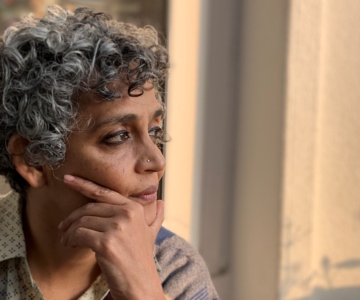
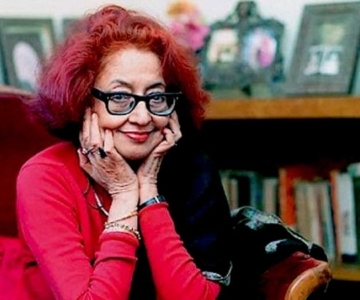
(photo left- Gauri Gill 2005)  The Indian Prime Minister Manmohan Singh also expressed the sense of loss: “..In her unfortunate passing away the country especially Urdu literature has lost a towering literary figure. She will be truly missed in literary circles in the country.’

Read Jawed Naqvi’s piece in the DAWN; and reactions of various writers in the daily NEWS . Rediff has published an article entitled, She was one of a Kind.  Javed Akhtar, the eminent Indian lyricist has paid this grand tribute and held that she was a true genius and rightly said that he felt sorry for those people who read fiction but had not read Hyder:

“When I say that it is a great loss, it’s not only to Urdu literature, not only to Indian literature, but to the word literature. I am not exaggerating at all.. the years to come, Haider’s novels will reach everywhere.”

“The kind of work she has done… its only because she was born in a third world country and wrote in a language that is not of the imperialistic powers, her novels have not reached everywhere. I am sure the time will come when they will reach..”. 

The blogosphere is also remembering Ainee Apa with great respect. Desicritics published An Enigmatic Icon, Adnan wrote a lovely piece on Ainee Apa and her books entitled A legend passes away and 3 Quarks Daily also remembered her. Urdu India has a brilliant post here and another tribute can be found here. Pakistaniat carried my post - click here to see the comments. And the best was from Delhi Walla, who went to the Jamia graveyard and took some great photos.

This will continue given the sad traditions of our literature - the literary and civilizational merits of authors and poets have often been discovered after they left this world. Having said that Ainee had established herself given her powerful voice and unique style of writing. But her real stature as Javed Akhtar says is yet to be discovered.

About the photo (top left): Gauri Gill in the Outlook writes

Qurratulain Hyder was first photographed by Prashant Panjiar in what was a coup of sorts, everyone talked of how elusive and difficult she could be. When I met her last week to persuade her, she said, ‘Tell the magazine I’m a difficult woman.’ I told her that was her reputation anyway. For the first time that afternoon she cracked a grin. She seemed flattered.

Published August 21st, 2007

A voice that shall remain

A body shall disappear into dust but a voice shall remain.

 Here is an audio recording of Qurratulain Hyder reading “Daalan vala” in her characteristic style. This recording was found on this site

Published August 15th, 2007

60 “Best” Books from India

To celebrate the Indian Independence day, Hindustan Times has published a rather interesting list of 60 best books from India. From the list, my favourites are:

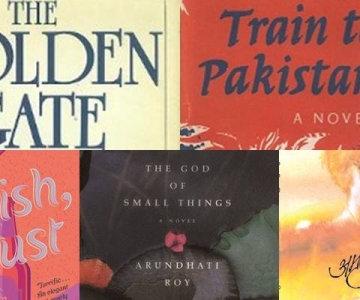
Aag Ka Dariya:Qurratulain Hyder’s generation was divided by Partition. But she refused to make an irrevocable choice and instead found home in both India and Pakistan. In this magnum opus spanning centuries, she narrates the tragedy of being forced into such a choice.

Train to Pakistan: in a far cry from his usual lighthearted and witty style, Khushwant Singh somberly etches out the agony of a village brutally torn apart at independence.

Rasidi Ticket:this autobiography of the popular Punjabi poetess Amrita Pritam created controversy when it came out, which was predictable given her unconventional life lived very much in the public eye.

English August:Upamanyu Chatterjee’s fresh and quirky take on the dilemmas of a young civil servant who finds himself ill at ease in small town India.

God of Small Things:mix a fractured family from southern India and a gifted author. Result: a Booker-winning gem from Arundhati Roy.

Golden Gate:690 wonderful sonnets describing the life, love and times of San Francisco’s young professionals by Vikram Seth.

Tamas:this powerful Bhisham Sahni novel captured the country’s imagination when Govind Nihalini turned it into an equally forceful telefilm. Sahni drew upon his experiences as a relief worker during Partition to write this anti-communalist saga.

Terhi Lakeer:Ismat Chugtai’s magnum opus centres on the rebellious affirmation of female desire: “A woman’s heart has so many chambers, a mother’s love residing in one, love for her husband in another, for her beloved in a third. Then Shaman tried to peep into her own heart.”

Published June 28th, 2007

Qurratulain Hyder

Sometimes a little discovery can be so delightful. The other day I was shown an old book authored by Qurratulain Hyder. The book called “The Exiles” is author’s translation of her novelette in Urdu. The book was presented to Agha Bashir Ahmad, another forgotten cultural icon from Lahore. Full article here >>

Published June 21st, 2007

Shaming Literature - ‘Sir’ Salman Rushdie

The current controversy on Rushdie’s knighthood has several dimensions. Amid the knee-jerk reactions alluding to the grand-conspiracy-against-Islam, it brings out various layers and levels of literature’s role and position in societies and now in the globalized world.

I was once a fan of Rushdie and avidly devoured his books with great admiration. From Grimus to The Moor’s Last Sigh, I marveled at his playfulness with the english language and its idiom which undoubtedly he has enriched. The collection of essays titled Imaginary Homelands was a combination of disparate but original writings. Somewhere during this process came the ridiculous Satanic Verses which other than its blasphemous content and brazen disrespect for a vast majority of Muslims was a bad piece of writing!

The decline of Rushdie as a writer, finally, was confirmed by the trashy “Ground Beneath Her Feet“. Thereafter, one read strange, ignorant pieces of his non-fiction in the Western mainstream media that needed his stature to find a rationale for the imperial projects in Afghanistan and Iraq.

Shalimar the Clown, his recent novel was even worse as it proved to be bereft of subtlety and re-invoked all the crappy, soul-destroying images and cliches of our times. In a non-serious piece, published in the Friday Times (Pakistan) in December 2005, I wrote:

Salman Rushdie’s new novel, Shalimar the Clown, is enough to add to one’s misery. I finished browsing it; what else can you do with such stuff posing as quality fiction? As if the name of the central character “Shalimar” was not enough to offend a native reader such as I, the heroine “India Ophuls” changing her name to “Kashmira” was the ultimate illustration of cheap exoticism and a hackneyed dive into passé magical realism. Alas, Rushdie has started believing in his own mantra and the twisting of historical narrative. It simply does not work now. He is more of a bard for the ascendancy of the global tide against Islamism and perhaps he should stick to that. Better if he were to provide some intellectual depth to Fox News, or even better, if he started writing scripts for his young wife’s tele-plays. Shalimar successfully completes the trilogy of Rushdie’s worst novels, the other two being The Ground Beneath Her Feet and Fury . Aijaz Ahmad, a US-based academic, argued a long time ago that Rushdie and Naipul were avatars of ‘oriental’ consciousness. Small wonder that they are reviewed, exalted and globally hyped.

Much to my delight, a friend – an aspiring critic – sent me the review by Theo Tait of the London Review of Books: Noting what Rushdie’s style produces in the novel, Tait writes that it “ .. . is a cross between a piece of magic realism which displays all the worst vices of the style, and the contemporary international thriller. It is passionate, well-informed and sometimes interesting; but also hackneyed, simplistic and often very, very silly…”

Today, I read this brilliant article published in the Guardian written by a noted academic, Priyamvada Gopal that essentially is a lament of all that Rushdie and his new writings stand for:

Sir Salman, on the other hand, is partly the creation of the fatwa that played its role in strengthening the self-fulfilling “clash of civilisations” that both Bush and Osama bin Laden find so handy. Driven underground and into despair by zealotry, Rushdie finally emerged blinking into New York sunshine shortly before the towers came tumbling down. Those formidable literary powers would now be deployed not against, but in the service of, an American regime that had declared its own fundamentalist monopoly on the meanings of “freedom” and “liberation”. The Sir Salman recognised for his services to literature is certainly no neocon but is iconic of a more pernicious trend: liberal literati who have assented to the notion that humane values, tolerance and freedom are fundamentally western ideas that have to be defended as such.

Vociferously supporting the invasions of Afghanistan and Iraq on “humane” grounds, condemning criticism of the war on terror as “petulant anti-Americanism” and above all, aligning tyranny and violence solely with Islam, Rushdie has abdicated his own understanding of the novelist’s task as “giving the lie to official facts”. Now he recalls his own creation Baal, the talented poet who becomes a giggling hack coralled into attacking his ruler’s enemies. Denuded of texture and complexity, it is no accident that this fiction since the early 90s has disappeared into a critical wasteland. The mutation of this relevant and stentorian writer into a pallid chorister is a tragic allegory of our benighted times, of the kind he once narrated so vividly.

In any case, Ali Eteraz is right when he states that what’s there is a colonial siege of the minds in this whole issue. 

 And, please also see a sensible editorial by the Pakistani newspaper DAWN here.

This dubious honour is yet another endeavour to reward the constructed clash of civilizations. The fact that Rushdie has accepted it, further confirms his degeneration as another script writer of this “theory”. Meanwhile, the protests in Iran and Pakistan only reinforce this vicious cycle of neo-orientalism .

Shameful indeed.

Published June 17th, 2007

A recent Book on Faiz Ahmed Faiz

The monthly Herald has published my review of Khalid Hasan’s book - “O City of Lights” in its June issue. It is a comprehensive selection with some gems such as translated versions of Faiz’sinterviews and conversations. Khalid Hasan is a well known Pakistani writer and journalist now based in the US. He was a close friend of Faiz and has this particular advantage as a biographer and a translator. He has translated more poetry and this is a welcome step to introduce and popularize Urdu poetry to non-urdu readers.

Full entry here >>

Published June 8th, 2007

Against Forgetting and No Poem is Mine

Found these translations of two Hindi poems on Annie Zaidi’s blog. These poems were published in a collection of poetry in entitled ‘Das Baras - Hindi Kavita Ayodhya Ke Baad’.

Read poem here >>

Published May 23rd, 2007

The Reluctant Fundamentalist - Book Review

Mohsin Hamid’s second novel is out. It has made to several bestsellers’ lists and invokes a theme central to our times. I am posting a well written review by Mahi here that in spite of its subjectivity expresses the viewpoint of an intelligent and informed reader. This review was written exclusively for Jahane Rumi and therefore I am grateful to Mahi for this special gesture. Hope he continues to contribute here!

Book Review By Mahipal Reddy* 

The title, with a play on the word Fundamentalist, is the high point of this book. The protagonist, Changez, earns a living in New York assessing fundamentals of companies, which he is increasingly reluctant to do, compelled by a growing affinity for his homeland Pakistan and under-attack neighbor, Afghanistan, in the aftermath of 9/11. The reluctance eventually prompts a return to Pakistan, where
Changez recounts his adult life to an American visitor.

The style of narration - a monologue - is a clever choice and one with the potential for a novel, satisfying reader experience. But the portrayal of the American man through quick references within the monologue exposes the limitations of this format. Additionally, the man is made visible only though stereo-typical cultural differences and tourist apprehensions, which lends a tone of condescension to the narrative. It may have been intentional, but seemed unnecessary.

The book suffers from an underlying lack of depth. The seminal phases of the story - Changez’s acceptance of American undergraduate life and the American dream, the slipping away of his never-truly-started love life with an American girl, his rapid disenchantment with America and its foreign policy excursions and his choice to move away from that life to Pakistan - take place without triggering a reflective commentary or insight from the author. In other words, the book remains a superficial story, even while the reader is expecting something more fundamental all the while. Is that the reader’s fault? Perhaps not.

Having approached the book with excited expectations, partly due to the title and partly the author’s background, I was disappointed. The title promised an insightful dance on the difficult subject of fundamentalism, with a certain gravitas, but it faltered to achieve this goal. In fact, one felt that the author did not attempt to delve further into the intent of the book’s catchy title. There are many specific instances of disappointment in addition to the overall reaction of one, but the one that qualifies for mention is the ending. Throughout the book, the author builds a theme of some impending finale/disaster, which never materializes. Clearly the author conveyed something in his mind, but it leaves the reader lost and wondering if the author pulled a prank.

To me this actually captures the essence of the book - promising much but delivering a insipid tale.

Language-wise, the book is obviously written in competent English, but one cannot say more. It is not a book you read to enjoy the medium, the skill of expression.

* Mahi set sail in India and is adrift in the US. He has traveled a little, lamented that he isn’t from Japan but hopes to get back to India in the near future. He likes to read but reads little. Enlightenment he waits for, convinced God can move faster than him.

Published April 22nd, 2007

Standing Alone in Mecca

“In a charming personal narrative, Nomani navigates  through a crisis of faith brought upon by the murder of close friend Daniel Pearl by Islamic militants…”

Full entry here >>

Published April 9th, 2007

What happened to reading?

Ilona Yusuf, a poet muses about the demise of the reading culture. Read article here >>

Published April 4th, 2007

On infinite love - from Kashul Mahjub

Kashful Mahjub is one of the early treatises on Sufism and has shown light to many Sufis world-wide. Full entry here >>

Published September 10th, 2006

Iran - Navigating the labyrinth

By Ammar Ali Qureshi

In the West, experts on Iran can be divided into two broad categories: academics/scholars and journalists. Nikki Keddie (academic) and Robin Wright (journalist) in the United States, Giles Kepel and Olivier Roy (both research scholars) in France, and Fred Halliday (academic) and Dilip Hiro (journalist) in London are the most prominent and highly regarded specialists on Iran.
After Keddie, Hiro is the most prolific writer on the subject - his recent book The Iranian Labyrinth: Journeys through Theocratic Iran and its Furies being the fifth on Iran, 14th on Middle East history (including a popular trilogy on Iraq after 9/11), and 28th (five fiction and 23 non-fiction) overall.
Born in Larkana before partition, Hiro was educated in New Delhi and the United States, before settling down as a journalist in Britain in the mid-1960s. Two of his previous books on Iran, Iran Under the Ayatollahs and The Longest War: The Iran-Iraq Military Conflict, were widely read - the latter regarded as the definitive history of an under-reported war. Drawing heavily on his previous works, Hiro’s The Iranian Labyrinth is an important contribution to informed and dispassionate analysis on Iran, something in short supply in today’s politically polarised and emotionally charged environment.
Divided into 10 chapters, this concise book, a mixture of ‘travelogue, history, and socio-political analysis’, covers the essential episodes in Iran’s turbulent and tumultuous history since early 1900s. (The book was published last year before President Ahmednijad’s surprise election). A frequent traveller to Iran, Hiro navigates the labyrinth: hijab-wearing women are the majority at the universities, Iranian films win prizes at international festivals, and human rights lawyer Shirin Ebadi is a Nobel peace laureate, a rising number of intellectuals, women, youth and journalists protest the socio-political restrictions imposed by the Islamic regime.
Iran, Hiro asserts, is probably the most strategically important country in the world, with a uniquely distinctive history. It was the first country in the Middle East to find oil in commercial quantities; to experience a constitutional revolution (1905-11) resulting in the first parliament (called Majlis) in the region in 1907; to evolve into a constitutional monarchy with a multiparty system in 1941 - till 1953 when a coup masterminded by the CIA of US re-imposed royal dictatorship; to challenge Western economic imperialism (well before Nasser’s nationalisation of Suez) by nationalising Anglo-Iranian Oil Company in 1951; to become a victim of CIA’s machinations against a legitimate democratic government (headed by charismatic and nationalist prime minister Mossadegh) in 1953; and to experience a genuine revolution, in which millions participated, but which was primarily inspired by religion and spearheaded by religious figures, an unprecedented phenomenon in modern history.


The United States, for the first time, developed a taste for ‘regime change’ in 1953: Far from spreading the gospel of democracy, CIA orchestrated a coup against Iran’s most popular, secular and democratically-elected prime minister Mossadegh and brought back the Shah - a corrupt, inept, and autocratic megalomaniac - to the Peacock Throne.
In return, the Shah leased the rights and management of Iranian oil, for the next 25 years, to Western oil giants, who exported 24 billion barrels of oil during the next 20 years for just $1.80 per barrel. (At the time of Shah’s departure, oil prices spiked up to $31 per barrel). The most successful/lucrative operation in its history, CIA developed it into a “template for overthrowing progressive, nationalist regimes throughout the Third Word”.
Iranians termed it as the “biggest heist in history” and later regarded President Carter’s electoral defeat in 1980, due to the Iran hostage crisis, as an instance of ‘poetic justice’ - Ayatollah Khomeini became the first foreign leader to determine a US presidential election outcome.
Iran’s landmark Islamic revolution in 1979, post-revolutionary xenophobia, and anti-imperialism are all firmly rooted in its historical experience during the last century. Other important factors that determined the course of the revolution and its post-revolutionary behaviour include the critical nexus between bazaar merchants and clergy, economics of oil, the peculiar characteristics of Shia Islam (special emphasis on opposition to tyranny), and the cardinal role of Ayatollahs/senior clerics in Shia Islam.

Senior clerics (Mujtahids/Ayatollahs or Grand Ayatollahs) in the Shia world have always commanded the reverence of their followers for three primary reasons: superior religious knowledge based on a strong tradition of ijtihad, personal piety and moral leadership. From 1964-1979, Ayatollah Khomeini, in exile, assumed the leading role and mobilised the masses against the Shah, from abroad, through the network of mosques and seminaries and coupled with the active participation of intellectuals, merchants, and students.
Recently this phenomenon of extreme influence exercised by a senior Shia cleric has been demonstrated in Iraq, where Grand Ayatollah Ali Al Sistani, an Iranian national who speaks Arabic with a Persian accent and is ineligible to vote in Iraq’s elections, is the most important man determining the destiny of that nation.
Hiro’s knowledge of Iran’s political system is very impressive. Contrary to the prevalent view in the West of an authoritarian regime in Tehran, the Iranian constitution has more checks and balances than many of its Western counterparts. He discusses the five primary centres of power (leader, president, Majlis, assembly of experts, and judiciary) and two secondary ones (Council of Guardians and Expediency Council) and asserts that Iran, given the multiple centres of power, resembles more the United States than China.
The opponents of Iran’s Islamic democracy find Islam and democracy incompatible and argue that the present system is authoritarian and beyond redemption. Proponents believe that the conservative-reformist struggle is the dynamic of Islamic democracy, the first attempt of its kind, which can serve as a working model (left-right political divide or two party system) for the rest of the Muslim world.

In 1991, Graham Fuller, an American scholar at the prestigious RAND and author of The Future of Political Islam, titled his book on Iran as Centre of the Universe (translation of one of Shah’s many titles!). Given the current brinkmanship and standoff over its nuclear program, Iran is likely to be the centre of the world’s attention, if not the universe, at least for the next few years. Hiro’s informative and illuminating book is a must read for all those who want to understand this important, unique, and complex country.
 
 
First Published in Daily Times in February 2006