Archive for the ‘Arts & Culture’ Category

Khusrau, Meera, Kabir: The Fluid Self

An essay contributed by the celebrated singer,writer and spiritualist Vidya Rao

I often ask myself the question why I choose, above all things, to sing, and then to sing a traditional gayaki like thumri. The images that are gleaned from its poetic texts are so often open to misunderstand: pining nayikas, heartless piyas, rakish Krishnas, divine Rams. I ask myself that question again today when ‘tradition’ is in danger of being smothered by sectarianism, communal violence and a whole culture lies bleeding.
I turn to the music itself for my answer. It has never failed me before—it does not fail me now. Read the rest of this entry »

Myth of Channan Peer

Earlier I posted on Khowaja Ghulam Fareed, the Sufi poet from Cholistan. A famous festival takes place each year attracting thousands of people in the vast desert that Cholistan is. About this mela or gathering I found this charming piece by Zia Zaidi. Read the rest of this entry »

Unveiling the mysteries - Bulleh Shah

Bulleh Shah discloses that the Lord pervades in everyone. He is not only to be found in Mansur, but also his executioner, as also the spectator.

Here is the Punjabi version followed by a crisp translation - a labour of love by Shahidain..
 
“Behad Ramzaan dasda nee
Meyndaa Dholann maahee
Meem de Ohley wasdaa nee
Meyndaa Dholann maahee

Auliyaa mansoor kahaawey
Ramz anal-haq aap bataaway
Aapey aap noon soolee charhaaway
Te kol khaloke hasdaa nee
Meyndaa Dholann maahee

Behad Ramzaan dasda nee,
Meyndaa Dholann maahee

Boundless signs He reveals
My Beloved Lover
In [letter] ‘M’ His dwelling conceals*
My Beloved Lover
 
As a saint Mansur gets Himself hailed
As the metaphor ‘I am Truth’ gets Himself hanged
On the gallows gets Himself impaled
Standing nearby with laughter He peals
My Beloved Lover
 
Boundless signs He reveals
My Beloved Lover
In ‘m’ His dwelling conceals
My Beloved Lover
( Translation by Prof Muzaffar Ghaffaar)

* The letter meem phonetically M in English is a mystical letter and meant to contain Divine mysteries apparent only to the ones who develop the inner eye through mystical knowledge. Another verse speaks of Meem as the only difference between Ahad (Singularity of God) and Ahmad (another name for Prophet Mohammad- who accordint to some was the foremost mystic/Sufi in Islam)

Another translation follows - Read the rest of this entry »

Bulleh Shah - I long for you, what can be done?

Contribution by Shahidain

In this kafi, the Sufi poet Bulleh Shah reveals the unbearble pain of seperation from his Beloved. He can not give up love and the seperation makes him restless and unable to sleep. So he hangs between life and death. Please find below the Punjabi version followed by English translations (from here).

Ab lagan lagi ki kariye?
Na ji sakiye te na mariye.
Tum suno hamaari baena,
Mohe raat diney nahi chaena,
Hun pi bin palak na sariye,
Ab lagan lagi ki kariye?
Eh agan birhon di jaari.
Koi hamari peedd nivaari.
Bin darshan kaise tariye?
Ab lagan lagi ki kariye?
Bulle payi musibat bhaari,
Koi kare hamaari kaari,
Ik ajihe dukh kaise jariye.
Ab lagan lagi ki kariye?

“I long for you, what can be done?
I cannot live, I cannot die.
I long for you.

Listen to my plea,
Night or day, I have no peace.
Not another moment can I exist without you.
I long for you, what can be done?

This separation-torment is unending!
Does anyone have a cure for it?
If I do not see him, how will I live?
I long for you, what can be done?

Says Bulha, I am in great distress,
O please find a remedy.
How can I endure such pain?
I long for you, what can be done?”
(Translation By Suman Kashyap)

Another translation that might make the meaning a little clearer Read the rest of this entry »

Amir Khusrau - O soul of mine come to me

by Amir Khusrau

Bashguft gulha dar chaman, aye gulsitan e man bia
Sarv istada muntazar sarv e ravan e man bia

Flowers are blooming everywhere, O flower of mine come to me
Conifers await you night and day, my graceful pine come to me

Az girya e man her taraf pur lala o gul shud zamin
Waqtey ba gulgasht aey sanam der gulsitan e man bia

Thanks to my overflowing tears, tulips and roses are fresh and young
Strolling along the garden walk, my lily divine come to me

Haif ast didan bay rukhat der bostan akhir gahey
aey gul, nihan az baghban, der bostan e man bia

Without you darling, gardens all are in the grip of doom and gloom
So shining brightly in the dark, o my sunshine come to me

Her turra e to afatey, her nargis e to fitnaey
Garcheh bala e aalami, az behr e jan e man bia

Your braids are trying to chain me dear, your eyes are out to charm
So if you want to captivate, my valentine come to me

Talkhey keh goei neest an az talkhi e hijrat fazoon
Ba inhama talkhi e khud, shakkarfishan e man bia

You may be tart and pungent but your abscence is much worse
So bearing all your pungency, my vintage wine come to me

Dani keh hastam der jahan, man khusrav e shirin zaban
Gar naie az behr e dilam, behr e zaban e man bia

Without you I, your Khusro, am tongue-tied and confused
To give me wit and fluency, O soul of mine come to me

translation by Khalid Hameed Shaida, MD

Mehrgarh - Pakistan’s glorious, ancient past

Found a well researched article on Mehrgarh at Chowk:

Mehrgarh is the centre of the first known developed place of civilization in its advanced form in the world as compared to the contemporary and the predecessor human settlement areas of the world. The town of Jericho has, not got the level of sophistication and developmental level attained at that in Mehrgarh. The symbolic artifacts retrieved from Mehrgarh are far more advance d and more developed as compared to the artifacts retrieved from Turkish sites and Middle Eastern sites especially Jericho.

It is interesting to note, however, that the male figurines have turbans — much like those worn by the inhabitants of Baluchistan today. These turbans are not only found in Baluchistan, they are still worn in the rural areas of Punjab.

One of the most unique discoveries of the Mehrgarh is the first known origin of the dental surgery and related medicinal activities in the Mehrgarh areas. This medicinal and different aspect of the Mehrgarh shows great innovation and developmental level of the people of the area about 9000 years ago.

Khowaja Fareed - the mystical voice of Southern Punjab

A friend, for the lack of a better term (why are we always hankering after labels and identities for some associations that lie beyond the act of defining), wrote this piece for Jahane Rumi. She is a follower of the Sufi creed and this is what created a bond between us that refuses to go away despite the different paths and lives we have led. The connection has stood the winds of time. There is an audio-link at the end as well.

Recently while going through some of my late grandfather’s books, I was struck by a feeble looking Deewan of Khowaja Fareed. Feeble because it bore the date of 1964 for its inclusion in his impressive book collection. Expressing the thrill of holding a book which had travelled 44 years in time to reach me is beyond words. Needless to say with what intensity the book’s contents kept me immersed in them for almost two hours with un -interrupted focus which is a rare event in an ever-reaching-out-to-meet-a-target kind of life style we are used to. Read the rest of this entry »

Holi has a Muslim History too

Found brilliant post written by Yousuf Saeed 

Holi, being celebrated across India, may be the most colourful Hindu festival but it has a Muslim history as well.

Sufi saints like Hazrat Nizamuddin Aulia and Amir Khusrau in their chaste Persian and Hindi loved the festival. Emperor Bahadur Shah Zafar, whose Holi ‘phags’ (songs) are relished even today, allowed his Hindu ministers to tinge his forehead with ‘gulal’ during Holi festival each year. Read the rest of this entry »

Nusrat Fateh Ali Khan sings Bulleh Shah

I had earlier posted a video of Abida Parveen singing Bulleh Shah. While that is an all time favourite, the global voice of Nusrat Fateh Ali Khan has also rendered Bulleh Shah with great ease and soulfulness. I am grateful to Cubano for opening the doors into this magical world of music. No words can capture the sheer beauty of this music. Videos are posted below Read the rest of this entry »

Jama Masjid Delhi: The Real Estate Hunt and the State

by Sadia Dehlvi

Jama Masjid, the last significant and glorious monuments of the Mughal period now faces a threat of extinction in the garb of development. If the Delhi government has its way, glitzy swanky malls underground malls will be constructed just fifteen metres from the steps of the monument. The proposed plan shows disregard and insensitivity to history and the culture of the people living in the area.

To create the four layered basement the ground will have to be dug at least eighty feet which will causes severe stress to buildings within five hundred meters. In the year 2005 there was a high court order in favour of beautifying the area around the Jama Masjid with open green spaces for community interaction. The MCD had commissioned such a plan which was presented and approved by the court. Instead of this well integrated plan we suddenly hear the horror story of a new MCD plan converting the area into a commercial mall venture.

As a rule, the archeological survey of India does not permit any construction within a hundred metres of a protected monument. The Jama Masjid is a functioning mosque and is therefore not officially protected by the ASI as it belongs to the Muslim community. The Waqf Board is the custodian of the mosque as pronounced by the Delhi High court. However, does that mean we should strip it off from a heritage status and allow the builders and adventures of the state to threaten its survival? If the Masjid collapses, so will India’s secular legacy as represented by the adjoining mausoleum of Maulana Azad and the tomb of the Sufis Sarmad Shaheed, who challenged the orthodoxy of Aurangzeb resulting in his execution on the steps of the Jama Masjid. Read the rest of this entry »

Bulleh Shah and Nukta - In a dot the whole mystery is solved

Nukta is difficult to decipher -My personal interpretation has to do with the nukta of Being - like the letter Alif that is Single and a Whole. So we, the created are not different from the Creator. We the lovers and not separate from the Beloved. It is this unity of being and existence that is one and can be reduced to one little nukta - a dot - that has all the answers and comforts we spend our lifetimes attaining.

The Point or Dot is the starting point of anything or everthing.The Dot explodes with Big Bang. And becomes universe. the explosion’s effects are dynamics. The Universe continues to expand. In this universe there are microcosms the earth. man his spirit, etc… All emanates from one point.

“aik nokthe vich gul mukdee”’ -Here is a translation by Suman

At this one point, all talk ends.
Hold tight to this point, forget your calculations,
Leave the miserable state of unbelief,
Do not torment yourself with the fear of death and hell,
For these are imaginary fears.
Only into such a house will truth the enter.
At this one point, all talk ends.


For no reason you abrade your forehead on the ground,
You display your reverence at the mehraab,
You recite the kalma to impress a listener,
But knowledge does not enter your heart.


Can the truth stay hidden?
At this one point, all talk ends.


Many return from Mecca as hajjis,
With blue shawls across their shoulders.
They profit from Hajj ,
Who can admire such behavior?
Can the truth stay hidden?
At this one point, all talk ends.


Some withdraw to the forest,
Eat a single grain a day.
They exhaust their bodies foolishly,
And return home in bad shape,
Their life sucked dry with useless fasting and prayer.
At this one point, all talk ends.


Hold fast to your murshid,
Become a devotee of all creation,
Intoxicated, carefree,
Without desire, indifferent to the world,
Let your heart be fully clean.
Says Bulha, can the truth then be stopped?


At this one point, all talk ends.

It has many layers of meaning and can be read in more than one way. On one point the matter ends. (Muzaffar Ghaffar); In a dot the whole mystery is solved (Saeed Ahmad); It’s all in one contained ( K S Duggal);Wisdom is contained in a single point!( J R Puri)

Public Art from Karachi

Amina Baig writes for the NEWS:

When driving through the jungle of buildings, complicated maze of cars and billboards mushrooming around the Karachi skyline; randomly spurted words and images often catch one’s eye. Karachi’s version of graffiti is usually just writing on the wall announcing which teeny-bopper gang is at odds with whom, who sucks, who rocks and so on. Every now and then though, something that can actually be considered art because of its visual or conceptual value crops up. (top right- Asim Butt)

Over the last few months, a symbol that has now become part of the Karachiite visual vocabulary has been creeping across almost any and everything in the city. A red triangle upon a rectangle – an eject sign, which according to Asim Butt, artist and stenciller of many of these signs is “multivalent.”

Asim’s graffiti was spurred on by the imposition of emergency in Pakistan in November 2007. However the message was not singular, nor was it a reaction to a single event. Read the rest of this entry »

On Buddha, Silence and Impermanence

The celebrated artiste Vidya Rao from Delhi has sent this tender and profound letter after reading my post on destruction of Buddhas in Swat (and the painting that was inspired by the vandalism). I am reproducing this letter with her permission as it adds to the debate and brings in a multi-religious and multicultural perspective that is close to my heart. Her words can be so moving:

But who can silence Silence? Who can erase Emptiness? The Buddha is, and yet is not, in the stone or metal representations of him. Nor is the truth of Islam contained within the structures of a mosque. It is not the Buddha or Islam or anything such that is destroyed. What is destroyed is the connection to the inner Buddha, the inner light. We are all the poorer for this, because form, the beauty of form, gives joy and love to our lives. The task is to both mourn, work in whatever way to prevent such destruction– but also to see this as yet another teaching on impermanence.

Here is the full text of the letter:

Read the rest of this entry »

Raza Rumi was in Delhi

Raza Rumi – A Pakistani About Town

A budding writer from Lahore visits the city of his beloved author.

I was [pleasantly -why lie] surprised this morning to discover a story on yours truly with the byline -Raza Rumi, A Pakistani About Town. It is a well written piece - not because that it concerns me but it sort of collates the various things I said and did during my recent visit and twists them into an engaging narrative. Never mind the less flattering description as a “cliched tourist”. My delusions about being a traveller were sort of questioned.

I still have to write about that visit earlier this month when I stayed at the Jamia Millia Islamia to attend a seminar on Qurratulain Hyder, the towering Urdu littérateur. During this visit, I met a number of interesting people and participated in some lively sessions that brought me much closer to the intellectual core of Delhi. My friend Mayank Austen Soofi, whom I finally saw after all the blog exchanges, attended the seminar at Jamia and later accompanied me to the Nizamuddin dergah. Of course Sadia Dehlvi was there as always - walking me through the chaotic moods of Delhi.

All I can say is that one has to be careful with bloggers and journos. Who knows when mundane conversations turn into eloquent posts and stories, only to unexpectedly appear in your inbox a few days later.

When I get my act together I will write about what I had to say about Qurratulain Hyder’s dual belonging.

While I continue to overcome my indolence, please read this accountby The Delhi Walla.

Read the rest of this entry »

Jodha Akbar - this is no ordinary film

My blogger friend, Manasvi wrote this reviewof Jodha Akbar and I am glad that the film is good.

Jodha Akbar brings to cinema an epic love story that even if imagined is just too wonderful.

There have been controversies about the fact that recorded history has little evidence on the character of Jodha Bai. My simple question is: what about the oral histories of the subcontinent. Why must we always remain beholden to court historians and foreign travellers - why not respect what generations have believed over time? Read the rest of this entry »

Buddha, the Taliban and Pakistan-

I have been working on this composition for quite a while. I was angered, rather revolted by what the Taliban were doing in the pristine Swat valley that has recently undergone full scale war. What has the peaceful and serene Buddha to do with the war on terror and US imperialism in Afghanistan? I have friends who try and explain that the regrouped and re-energised Taliban represent the angst against the US occupation of the Pashtun lands. Perhaps there is some truth in this. But my Gautam, what was his fault? He only talked of peace in this region and only asked us to traverse and preserve our humanity.

Who are these butchers of culture? What Islam they follow? They have no religion except barbarity and tribal notions of revenge and blood-letting. There is no excuse for the vandalism against our vital heritage - Pakistan will be a poorer place if these mad, roving fundamentalists would remove all the signs of our pre-Islamic heritage and ancient cultures.

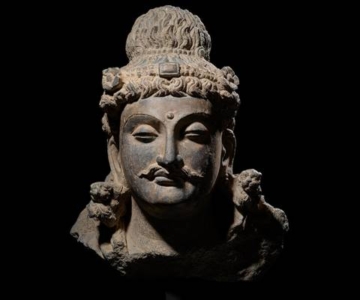
So this painting evolved in those days of anguish. I remembered a broken Buddha head that was discovered from Swat decades ago and thanks to my useful library I got the picture. So I took the Taliban flag background, which is tri-coloured (that should be black in my not so humble opinion); and transposed the Buddha on top and to indicate my fears, I painted the star and the crescent on the green portion to represent the Muslim part of the Pakistani flag.

So this is the little story that led to the painting above. My partner likes it and a few friends who saw it, also appreciated it. I have to thank my art teacher for guiding me through the shades and shadows with little [master] strokes here and there..

I plan to do a series on it. But I will have to travel to Swat; and I am not sure when will situation normalise there. In the meantime, I plan to rely on my Gandhara books and twopence imagination.

First published here

Mystical Music at one place…

Mystica Music contacted me and introduced their website that sells amazing music. I am not promoting their sales nor do I have any mandate to do so; but the range of titles is impressive and most significantly (for me at least) they have a few selections on mystical music.

One I liked a lot is called Zikr - Call of a Sufi. The artist is Anandmurti Gurumaa and it is in Hindi/Urdu.This is what the website had to say about the CD:

Zikr is a beautiful Sufi meditation cd which weaves together very intoxicating and invigorating meditation techniques with the Sufi art of whirling and worship. Listening to the tracks intently with utter mindfulness can open the door to the divine for a seeker, at any moment.
Enjoy the magical experience and offering of Zikr, from the unblemished hands of beloved Gurumaaji herself .

Call of the Heart
This opening track calls for utmost attention of the listeners as this can be the beginning on the path for those who are drunk with Love. Allah’s grace is being sought, as one who surrenders to the Lord will receive the bountiful shower of Bliss. While listening to it, pray that your heart opens up and hidden mysteries get revealed.

Read the rest of this entry »

An outstanding painting by Lapata

I am grateful to Minos for sending me the link to this brilliant painting by Lapata. This is a fine composition with a dream-like quality depicting the three unfortunate but towering politicians of our times. And, this also brings together the South Asian dynastic hubris in a neutral, no-politics-in-your-face manner.

Wish I could get this one - hate this consumerist urge; but the struggle is pretty engaging as well. Let me also reproduce the few lines that introduce our accomplished artist:

Lapata (pronounced ‘láh-putt-áh’), the artist’s takhallus, or alias, is Urdu for “missing,” or “absconded,” as in “my luggage is missing,” or “the bandits have absconded.She also writes for the blog Chapati Mysteryand posts many of her paintings there. Lapata grew up in a family of artists in western Massachusetts, some whose work adorns the surfaces of chinaware and brightens up the waiting rooms of dentists’ offices, and others whose artistic output has found more select audiences.

Remembering Gulgee in different voices

It was Gulgee’s bad luck that he was murdered shortly before the country’s most popular leader Benazir Bhutto was assassinated. His sad end somehow receded in the memory of his compatriots, more so because the tragic death of BB was followed by a reign of looting and destruction. But all said, Abdul Ismail Gulgee, one of the very few titanic figures in this country’s history of visual arts, certainly doesn’t deserve to be forgotten even for a while. Read the rest of this entry »

Siavash Mahvis - Artist from Iran

“Siavash Mahvis” is a contemporary Iranian artist and a university professor. He owes his acquaintance with the world of line and design to realist artists. “Daumier”, the great French designer, has had a great influence on his mind.

He is fascinated by the bitter social humor and black, white, and gray relationships between the figures of Daumier’s design works. Daumier’s quick etching with a few sharp lines and powerful spots excite him a lot.

Read the rest of this entry »