Archive for the ‘Arts & Culture’
Published
May 2nd, 2008
Category
Personal, Arts & Culture, All My Posts, South Asian Art, My paintings, Sufism |
3 Comments »

Rahim & Karim - Acrylic on canvas - 12″ x 18″
This is a small painting that I created in December 2007. I wanted to paint the names of Allah also used in Sufi Zikr (or Dhikr) - Ar-Raheem (the Merciful), Al-Kareem (the Generous). I did not follow any particular style. In the first place I am not a trained calligraphist and secondly I just wanted to be myself - in expressing the particular reverence for these chants.
There are many other names of God among the ninety nine that are also painted across the canvas in light hues. Yes they have an amateur style but then I wanted to make them a part of the composition. Now I could not have given up the idea just because I am not skilled enough with the Arabic script. Lame? No.
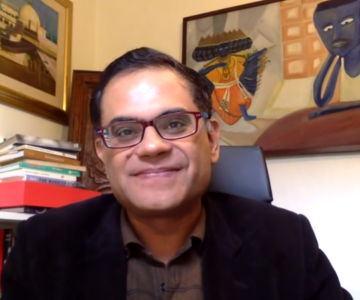
In the picture above, the painting is held by Sadia Dehlvi who is writing a book on Sufism these days. And, this little composition was meant to give her the strength and act as good luck charm too.
For an earlier Zikr inspired painting of mine click here.
Published
April 30th, 2008
Category
Music, Arts & Culture, All My Posts, South Asian Art, Sufi poetry, Sufism |
2 Comments »
Sadi has written a wonderful post here - I am cross posting it here.
Couple of nights back (24, April, 08) came an unanticipated opportunity to watch and listen to two of great contemporary pakistani sufi Qawwali singers at famous UCLA Royce Hall. The concert was titled, Qawwali Music of Pakistan: Sufi devotional music.Among the audience was both americans and sub-continental audience. What was striking, is Qawwali’s ability to transcend language with its sheer power and captivating devotion. The nature of improvisation makes each Qawwali, even if its sung by the same group of singers, very unique and every new listening is a new experience.Sometime the depth of the verses, fused with the presentation takes audience to an otherly high which was felt last night too. At times there were goosebumps and surges with the strong emotion that is created in Qawwali performance. The Sufi Qawwalis are considered as zikr or Divine remembrance if listened with spiritual understanding and depth.:: What is Sufi Qawwali? | Qawwali is derived from the Arabic word qaul, literally meaning “saying” but has taken on the meaning of “belief”or “credo” in South Asian languages. Qawwali is spiritual in essence; it is the devotional music of the Sufis to attain trance and mystical experience - originating in the 10th century and blossoming into its present form from the 13th century onwards. (more…)
Published
April 29th, 2008
Category
Poetry, Rumi, Arts & Culture, All My Posts, Sufi poetry, Sufism |
1 Comment »
Do not worry if our harp breaks
thousands more will appear.
We have fallen in the arms of love where all is music.
If all the harps in the world were burned down,
still inside the heart
there will be hidden music playing.
Do not worry if all the candles in the world flicker and die
we have the spark that starts the fire.
The songs we sing
are like foam on the surface of the sea of being
while the precious gems lie deep beneath.
But the tenderness in our songs
is a reflection of what is hidden in the depths.
Stop the flow of your words,
open the window of your heart and
let the spirit speak.
– Translation by Azima Melita Kolin
and Maryam Mafi
“Rumi: Hidden Music”
HarperCollins Publishers Ltd, 2001
Other versions below (more…)
Published
April 28th, 2008
Category
Politics, Arts & Culture, Punjab, All My Posts, On Pakistan, Sufism |
1 Comment »
In a story entitled Punjab grants ‘divine man’ obscene rights, Hamid Asghar of DAWN had written this report about the way the Sufi descendants of today can use their influence. I had saved the story and forgot where I had saved it. Today, I stumbled upon it. And, here it is - this is why the Sufis and their shrines are a target of negative comments.
GUJAR KHAN: That a “divine man” wants to drive in style in our VIP culture would not surprise many, but that the government helps him in the obscenity would.
That is how the local traffic police felt when it stopped a car for travelling with hooter blaring and blue light flashing on its roof and was confronted with a carte blanche in the form of an official letter addressed “To Whom It May Concern”.
The flashing light was just one sign that the car belonged to Badshah Ghosia Qalandar Baba Sarkar. His eminence were also proclaimed through a green flag, with Kalima on it, flying from the bonnet and Allah-o-Akbar and “786” emblazoned on either side of the personalised “Ghospak” green number plate. (more…)
Published
April 25th, 2008
Category
Politics, Poetry, Peace, human rights, India, Arts & Culture, All My Posts, World Writers, South Asian Literature, World Literature |
4 Comments »
A Poem by K.G. Sankarapillai
Dear Che
Dear Che,
you came to our university campus
in mid sixties
with a comrade and a modernist friend
with visuals of jungles past and present
with a vision of a new battle for justice.
Like a fresh wind of October
you joined us
moved us
renewed us
and smoothened our entry into history
with love, dreams and plans.
You told us about the sleeping rebel powers
of mountains and forests of the new minds;
quite often you talked of the day when
‘the Andes would become
the Sierra Maestra of America.’
Our modernist friend said:
you are the red star over the world
tarnished by America;
you are the future of the world
crippled by America;
you are the Jesus of the modern age
crucified by America.
Although you remained evergreen in us
showed us the exit to the oceans
from the lyrical ponds of our
post Independent Indian youth;
the exit to the storm from the water lily breeze
of our weeping romantic poems;
dear doctor, you redefined us
living with us
living for us
living in us
passing the confidence of torrents into our deserts
weaving sunlit paths into our prodigal nights.
You brought world into our words
and future into our past.
You opened blast-furnaces for our ore. (more…)
Published
April 24th, 2008
Category
Poetry, Peace, War, Arts & Culture, All My Posts, World Writers, South Asian Literature, World Literature |
1 Comment »
Herat Hami
A poem by Wimalaratne Kumaragame (a translation)
Herat Hami who lived in Aliya Watunu Wawe*1
Even someone like me was more important than him
Though Harat Hami cut dead bodies*2
He was twenty, thirty times more decent than me
In the hospital of Aliya Watunu Wawe
He spent his time removing night soil
Though he lived happily with a monthly salary
Whenever I saw him I was moved with sadness
A hard, wiry body, handsome and thin
Not much of age, fresh and young
No wife as yet
I was perplexed by the job he did
Making someone like me sad
Each day he carried my excrement
If someone dies suddenly
Doctor comes
He cut the dead bodies in front of us
None from the farmer, worker or elite caste
Ever did such a job
No known disease of mind he had
He did no harm to any dwellers of the forest
He spread a docile smile
Every word of his spread ahimsa
Every evening he drank burning water
His heart overflowed with kindness
His sister was stabbed
Recalling her my eyes get wet
He did not cry the day his sister died
When she had a fever he wailed with tears in his eyes
When his younger sister died he went with a doctor
Her dead body was cut by Herat Hami
Though the villagers blamed him in harsh words for this
He did not care much about the world’s violent flesh
As he was not born in a rich mansion
He went to the temple at every Poya
He was a member of the newly built stupa
Even more than that he respected Iyyenayaka*3
Translation by Basil Fernando (more…)
Published
April 24th, 2008
Category
Arts & Culture, All My Posts, Sufism |
1 Comment »

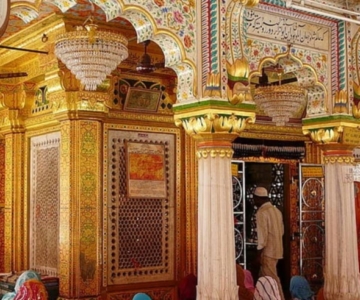
Nizamuddin’s shrine and the dergah complex is a source of comfort. Each time I have been there, I have felt uncanny sense of comfort and solace. Found this terrific image here -
Published
April 19th, 2008
Category
Religion, History, India, Arts & Culture, All My Posts, India-Pakistan History, Pakistani Art, Research |
1 Comment »
This piece entitled, My Name is Green, published in the weekly Outlook India traces how “forged in the cultural ferment of a century ago, Islamic poster art in India thrived on the frontiers of taboo.” The author is Shruti Ravindran, who has obviously undertaken a lot of research and also published some great samples of such posters. That Islam in South Asia acquired and adapted the local flavour and modes of social and spiritual interaction is well known.
While reading this piece, I also recalled seeing similar eclectic posters in Pakistan in my childhood before the puritanism of General Zia ul Haq engulfed the country and Wahabi variant of an exclusive and suspicious man made ‘faith’ deepened its presence, well at least in the public domain of representation.
This piece looks at some of these aspects through the popular art form. Read and enjoy - full text has been posted below courtesy the intelligent Outlook. (more…)
Published
April 18th, 2008
Category
Personal, Poetry, Love, Arts & Culture, All My Posts |
6 Comments »
Well, this evening I was bored with my writing. To amuse myself I assembled this little poem.
This was just another day
humdrum, ordinary, plain
save the few words
of assurance ..
nameless affections
and vacant moments.
So I picked up
a moment, casually
and put it away
in my silly pocket.
I am home now
looking for it;
and just found out
that the crumpled moment
has grown into a premonition
of things to happen
of words that could be said
or left unsaid.
So I have folded that moment
neatly and gently
and placed it in a book
that I intend to read
but might not actually read.
And yet, tomorrow
I want to see what happens to it.
Will it gaze at me,
with a sardonic smile
and inquire: “Are you looking for me”
Again?
Raza Rumi - April 18 - 11 pm
Published
April 16th, 2008
Category
Personal, Religion, Poetry, Peace, India, Love, Soul, heritage, Arts & Culture, All My Posts, World Writers, Sufi poetry, India-Pakistan History, Sufism |
2 Comments »
Amir Khusrau
I am a pagan (worshiper) of love: the creed (of Muslims) I do not need;
Every vein of mine has become (taut like a) wire; the (pagan) girdle I do not need.
Leave from my bedside, you ignorant physician!
The only cure for the patient of love is the sight of his beloved –
other than this no medicine does he need.
If there be no pilot on our ship, let there be none:
We have God in our midst: the pilot we do not need.
The people of the world say that Khusrau worships idols.
So I do, so I do; the people I do not need,
the world I do not need.
Published
April 15th, 2008
Category
Islam, History, Random musings, Rumi, Arts & Culture, All My Posts, World Writers, World Literature, Sufism, Knowledge |
4 Comments »
Last year, I came across a Charles Homer Haskins lecture that Dr Annemarie Schimmel delivered in 1993. Aside from the amazing events and milestones of her life, what struck me was her immersion in an infinite ‘learning’ cycle. I am reproducing some lines from the lecture and a dazzling poem of hers below. Dr Schimmel left this world in 2003 for another voyage. As an extra-ordinary scholar (over 150 publications to her credit), a Rumi disciple and an odd Sufi herself, the world is not the same place without her.

However, her erudite and passionate writings will continue to warm our hearts. Sang-i-Meel Publishers (http://www.sang-e-meel.com/) in Pakistan have done a huge favour by re-printing selected titles for the Pakistani audience. (more…)
Published
April 14th, 2008
Category
Personal, Poetry, Random musings, Love, Urdu, Arts & Culture, All My Posts, Urdu Literature, Translations |
7 Comments »
I rediscovered this exquisite poem by Parveen Shakir after years. This is an intense love poem of rare beauty. It is composite, taut and melodic. I have tried to translate it - however, the impossibility of a translation haunts me..
More so, the reality of days gone by, the visions lost haunts me even more..
Dedicated to those who stand by the sea of evening colours and moods and want to merge with their expanse. And, to someone who lives with time present and time past with equal ease..
yay haseen shaam apni
abhi jiss meiN ghul rahi hai
teray parahan kee khushboo
abhi jiss meiN khil rahay heiN
meray khawab kay shagoofay
zera dair ka hai manzar
zera dair meiN ufq par
khilay ga koi sitaara
teri simt daik kar woh
karay ga koi ishara
teray dil ko aayay ga phir
kissi yaad ka bullawa
koi qissa-ay judaaee, koi kaar-ay naamukamal
koi khawab-ay naa shagufta, koi baat kehnay wali
humeiN chaahiyay tha milna
kissi ahad-ay mehrbaaN meiN
kissi khawab kay yaqeeN meiN
kissi aur aasmaaN par
kissi aur sarzameeN meiN
humeiN chahiyay tha milna…
Here is the odd translation rendered by this blogger.
This melting evening of ours
Where everything dissolves
the scent of your clothes
the blossoming
sprouts of my dreams
All dissolves
A deferred vision, this is
In a little while,
a star will emerge on the horizon
To gaze at you
Meaningfully…!
Your heart shall then reminisce
the echo of a memory
The tale of a separation,
Of an unfinished moment
Of unblossomed dreams, things unsaid
We ought to have met
In times, considerate
In pursuit of attainable dreams
On a different sky
On a different earth
We ought to have met
Picture by Raza Rumi
Published
April 13th, 2008
Category
Poetry, History, heritage, Arts & Culture, All My Posts, World Writers, South Asian Literature, Sufi poetry, India-Pakistan History, Sufism |
2 Comments »
An essay contributed by the celebrated singer,writer and spiritualist Vidya Rao
I often ask myself the question why I choose, above all things, to sing, and then to sing a traditional gayaki like thumri. The images that are gleaned from its poetic texts are so often open to misunderstand: pining nayikas, heartless piyas, rakish Krishnas, divine Rams. I ask myself that question again today when ‘tradition’ is in danger of being smothered by sectarianism, communal violence and a whole culture lies bleeding.
I turn to the music itself for my answer. It has never failed me before—it does not fail me now. (more…)
Published
April 9th, 2008
Category
Arts & Culture, Punjab, All My Posts, South Asian Art, India-Pakistan History |
No Comments »
Earlier I posted on Khowaja Ghulam Fareed, the Sufi poet from Cholistan. A famous festival takes place each year attracting thousands of people in the vast desert that Cholistan is. About this mela or gathering I found this charming piece by Zia Zaidi. (more…)
Published
April 8th, 2008
Category
Religion, Poetry, Arts & Culture, Punjab, All My Posts, Sufi poetry, Sufism, Translations |
4 Comments »
Bulleh Shah discloses that the Lord pervades in everyone. He is not only to be found in Mansur, but also his executioner, as also the spectator.
Here is the Punjabi version followed by a crisp translation - a labour of love by Shahidain..
“Behad Ramzaan dasda nee
Meyndaa Dholann maahee
Meem de Ohley wasdaa nee
Meyndaa Dholann maahee
Auliyaa mansoor kahaawey
Ramz anal-haq aap bataaway
Aapey aap noon soolee charhaaway
Te kol khaloke hasdaa nee
Meyndaa Dholann maahee
Behad Ramzaan dasda nee,
Meyndaa Dholann maahee
Boundless signs He reveals
My Beloved Lover
In [letter] ‘M’ His dwelling conceals*
My Beloved Lover
As a saint Mansur gets Himself hailed
As the metaphor ‘I am Truth’ gets Himself hanged
On the gallows gets Himself impaled
Standing nearby with laughter He peals
My Beloved Lover
Boundless signs He reveals
My Beloved Lover
In ‘m’ His dwelling conceals
My Beloved Lover ( Translation by Prof Muzaffar Ghaffaar)
* The letter meem phonetically M in English is a mystical letter and meant to contain Divine mysteries apparent only to the ones who develop the inner eye through mystical knowledge. Another verse speaks of Meem as the only difference between Ahad (Singularity of God) and Ahmad (another name for Prophet Mohammad- who accordint to some was the foremost mystic/Sufi in Islam)
Another translation follows - (more…)
Published
April 5th, 2008
Category
Poetry, Arts & Culture, Punjab, All My Posts, Sufi poetry, India-Pakistan History, Sufism |
2 Comments »
Contribution by Shahidain
In this kafi, the Sufi poet Bulleh Shah reveals the unbearble pain of seperation from his Beloved. He can not give up love and the seperation makes him restless and unable to sleep. So he hangs between life and death. Please find below the Punjabi version followed by English translations (from here).
Ab lagan lagi ki kariye?
Na ji sakiye te na mariye.
Tum suno hamaari baena,
Mohe raat diney nahi chaena,
Hun pi bin palak na sariye,
Ab lagan lagi ki kariye?
Eh agan birhon di jaari.
Koi hamari peedd nivaari.
Bin darshan kaise tariye?
Ab lagan lagi ki kariye?
Bulle payi musibat bhaari,
Koi kare hamaari kaari,
Ik ajihe dukh kaise jariye.
Ab lagan lagi ki kariye?
“I long for you, what can be done?
I cannot live, I cannot die.
I long for you.
Listen to my plea,
Night or day, I have no peace.
Not another moment can I exist without you.
I long for you, what can be done?
This separation-torment is unending!
Does anyone have a cure for it?
If I do not see him, how will I live?
I long for you, what can be done?
Says Bulha, I am in great distress,
O please find a remedy.
How can I endure such pain?
I long for you, what can be done?” (Translation By Suman Kashyap)
Another translation that might make the meaning a little clearer (more…)
Published
April 4th, 2008
Category
Poetry, Arts & Culture, All My Posts, Sufi poetry, World Literature, Sufism |
2 Comments »
by Amir Khusrau
Bashguft gulha dar chaman, aye gulsitan e man bia
Sarv istada muntazar sarv e ravan e man bia
Flowers are blooming everywhere, O flower of mine come to me
Conifers await you night and day, my graceful pine come to me
Az girya e man her taraf pur lala o gul shud zamin
Waqtey ba gulgasht aey sanam der gulsitan e man bia
Thanks to my overflowing tears, tulips and roses are fresh and young
Strolling along the garden walk, my lily divine come to me
Haif ast didan bay rukhat der bostan akhir gahey
aey gul, nihan az baghban, der bostan e man bia
Without you darling, gardens all are in the grip of doom and gloom
So shining brightly in the dark, o my sunshine come to me
Her turra e to afatey, her nargis e to fitnaey
Garcheh bala e aalami, az behr e jan e man bia
Your braids are trying to chain me dear, your eyes are out to charm
So if you want to captivate, my valentine come to me
Talkhey keh goei neest an az talkhi e hijrat fazoon
Ba inhama talkhi e khud, shakkarfishan e man bia
You may be tart and pungent but your abscence is much worse
So bearing all your pungency, my vintage wine come to me
Dani keh hastam der jahan, man khusrav e shirin zaban
Gar naie az behr e dilam, behr e zaban e man bia
Without you I, your Khusro, am tongue-tied and confused
To give me wit and fluency, O soul of mine come to me
translation by Khalid Hameed Shaida, MD