Monthly Archives: September 2010

Mehdi Hasan: The Man & His Music

30 September 2010
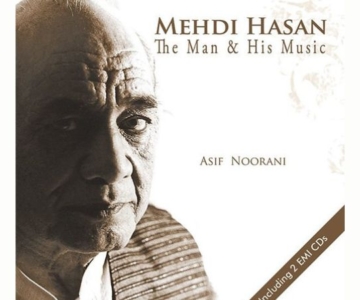
A new book on Mehdi Hasan, originally uploaded by Jahane Rumi.

My essay on Mehdi Hasan has been published in this book compiled by Asif Noorani Saheb. This is a memorable collection of essays, reminisces and two CDs of choicest music from Mehdi Hasan. The greatest of Pakistan music icons deserves much more but this little offering brought tears to his eyes. Here is an excerpt from the essay which I will post after a permission from the publishers:

“But this has been our tragic tradition. Our greatest artists, singers, poets and intellectuals have suffered at the hands of a conformist society and state captured by puritans especially since late 1970s. It is never too late for the intelligentsia of this country to mobilise public pressure on the state machinery so that it learns to respect cultural diversity and the imperative to nurture a creative, healthy and civilised society.
Tansen taught us how music is a route to immortality. An ailing Mehdi Hasan in 2010 is fighting with death. His longevity is ensured. Tansen must be proud of his new age prodigy. “

My painting as a magazine cover

28 September 2010

KIndle Magazine , originally uploaded by Jahane Rumi.

Kindle magazine has printed an excerpt from my forthcoming travel book. I has sent them a painting of mine to be used with the text but it was a pleasant surprise to see it as a cover for the magazine. It is an impression of Sarmad’s dargah from inside.

My contribution on Dara and Sarmad can be read here at the magazine website.

Collapsing Local Governance

27 September 2010

By Raza Rumi

Recent floods have exposed the capacity of the state to govern, especially at the local level. The disintegration of local state is not a recent phenomenon. The continued experimentation with and frequent strangulation of local governance arrangements have led to a situation that Pakistan’s burgeoning population is now without a representative, accountable local state.

Erosion of state writ: Three historical trends are noticeable for their impact on the overall governance and the writ of the state. First, centralisation is a tendency that is most attractive to those who govern Pakistan at the federal and provincial levels. The post-colonial Pakistani state has retained the official obsession of controlling power and patronage at the top and denuding the local space for democratic development and sound mechanisms of accountability. Secondly, granting local autonomy has, by and large, been a smokescreen for powerful military governments to bypass provincial politics and control the levers of state and society from above. Thus, we have an established pattern: local government experiments flourish under authoritarian regimes and get undermined whenever democracy, a la Pakistani variety, returns. Finally, the constant denial of a responsive state at the local level has led to erosion of state legitimacy and the void has been filled in by mafias, politico-criminal gangs and militant non-state actors.
(more…)

Failed prescriptions for a failing state

19 September 2010

The cat is finally out of the bag. The MQM chief has issued a statement on how the country needs to be saved from corrupt politicians. This was followed by his arch-foe Imran Khan who assured the military of his support should they choose to rescue the country. The PPP has issued muted condemnation of this statement while the PML-N has been categorical in rejecting any extra-constitutional intervention. The ISPR has been silent (unlike its vociferous denunciation of the Kerry-Lugar Bill) and so has the apex court that is usually prompt in taking suo motu notice. Overzealous TV anchors have had a field day in proving how terrible the current ‘system’ of democracy is without indicating what the alternative is.

Several wise commentators have also pointed out public frustration over the alleged mismanagement of the floods by the civilians as a genuine reason for a no-confidence in the system of governance. Pakistan’s chatterati, especially its depoliticised, affluent classes, have perfected such an ahistorical discourse to an art form. There seems to be amnesia about the fact that although all military interventions were sought to get rid of the ‘corrupt politicians’ each of these autocratic spells weakened Pakistan. Furthermore, centralised military rule is incompatible with federalism. Pakistan’s existence was, and remains, a compact between its constituent provinces. (more…)

From “Listening to Grass Hoppers” by Arundhati Roy

18 September 2010

We too will learn, like the ordinary citizen’s of Hitler’s Germany, to recognize revulsion in the gaze of our fellow human beings. We too will find ourselves unable to look our own children in the eye, for the shame of what we did and didn’t do. For the shame of what we allowed to happen. (Page: 21)

At a time when opportunism is everything, when hope seems lost, when everything boil down to a cynical business deal, we must find the courage to dream. To reclaim romance. The romance of believing in justice, in freedom, and in dignity. (Page: 40)

The NGO-ization of civil society initiative is taking us in exactly the opposite direction. It’s depoliticizing us. Making us dependent on aid and handouts. We need to re-imagine the meaning of civil disobedience. (Page: 41)

Fascism will thrive for a short while and then self-annihilate because of its inherent stupidity. (Page: 17)

Travelogue (final) Entangled destinies

16 September 2010

In the final part of this series, Raza Rumi recounts the last few days of the media expedition to India

Pakistani media persons landed back in Delhi after a whirlwind tour of Mumbai and Bangalore. Once back at the Maurya Sheraton, we had the last few days of the tour planned well in advance. A sizeable number of the visitors were taken to the ephemeral Taj. Thankfully this was not mandatory, as some of us wanted to stay back in Delhi, especially those who had seen the Taj during their earlier visits.

Pakistan’s High Commissioner, Mr. Shahid Malik invited us for lunch, and this was my first visit to our stunning High Commission located in Chanakyapuri, New Delhi’s diplomatic enclave. The sumptuous lunch cooked with much aplomb was preceded by a lively discussion about our trip and our impressions regarding the possibility of peace.

Pakistan’s diplomatic haven is a well-designed building merging Islamic, Indian and Western sensibilities. The blue-domed structure merges well with Delhi’s vista of monuments, some well- kept and others neglected. This is an irony, at its best! Nevertheless, this was familiar territory. (more…)

Travelogue (Part III): India’s Silicon Valley

15 September 2010

In Part 3 of the series, Raza Rumi visits Bangalore, city of gardens and high tech

After our sojourns in Delhi and Mumbai, the Pakistani media representatives were afforded the opportunity to visit the fulcrum of shining India i.e. Bangalore, now rechristened as Bengaluru, its original name in Kannada. It was not difficult to guess why Bangalore is loved by so many across the globe. Its weather makes it a most unique city, somehow free of South Asian extremes in temperature. Weather aside, even the nature of its residents is fascinating, for it is palpably different from their North Indian counterparts. As we were to find out later, the distant conflicts of belligerent North India matter far less in the tropical climes of this congested yet verdant metropolis.

We were greeted at the airport by a contingent of security apparatchiks and the state police. The Bharatiya Janata Party (BJP) had planned country-wide protests over the increased fuel prices that were supposedly causing inflation and misery for the poor. The Pakistani delegation found itself amid a historical moment when the BJP was being backed by the communist parties of India in protesting over the reduction of state subsidies to keep the price of oil low. Hence, the tight security. As Karnataka is ruled by the BJP and regional parties, the strike was a great success, and we found the streets of Bangalore deserted.

The ITC Royal Gardenia Hotel where we stayed was simply stupendous. It had been recently built and was touted as a green haven for its adherence to environmental standards. Designed with an open plan sensibility, it had a feel of expanse and splendour. Special purpose vertical gardens had been created to augment the ambience and blend nature with standard hotel architecture. However, life presents its little ironies, and one could not help notice the ITC (Indian Tobacco Company) ownership of this hotel chain. The corporate world knows well how to whitewash its minor sins and major profits.

Bangalore, lovingly nurtured as an archetypal British cantonment, has always been referred to as the City of Gardens. Its ecology helps create green spaces with plenty of rainfall per annum. However, Bangalore has also transformed over the years due to its emergence as an information technology (IT) hub. In many ways, the Indian IT success story, central to the India-shining narrative, is intertwined with Bangalore and its eminently hospitable mores. Among others, Infosys, a global giant conglomerate, grew and evolved in Bangalore. But there are other hubs too which make Bangalore a success story of contemporary India. (more…)

Travelogue (Part II) – Yeh hai Bombay meri jaan

14 September 2010

Part I of the series can be accessed here

In Part II of this series, Raza Rumi travels to India’s thriving megapolis with a media delegation

After a whirlwind Delhi tour, the Pakistani media persons set off for a fleeting visit to Mumbai. If I am not mistaken, ours was the first big delegation to this megapolis that crossed the contemporary fault line between India and Pakistan. Less than a dozen zealot-mercenaries terrorized Mumbai twenty months ago, and now the issue of terrorism has derailed the formal Indo-Pakistan talks.

This was not a very comfortable journey. Not that we were not looked after by our hosts. It was a well-organized tour. But the overdose of Mumbai mantra in Delhi had rattled some of us. What happened there in November 2008 was ghastly and inhuman; and Ajmal Kasab’s nationality stirred public opinion like never before. Thanks to a belligerent media and live telecast of terrorism (almost to the point of glorifying it) the result was what the jihadis had hoped for. Jingoism flourishes in such odd climes and the Mumbai hangover, as we all found, is a potent reality in India.

Within the delegation, I underwent a strange sensation – of a remote, awkward connectedness with the place. Twenty years ago, as an apolitical and naive student I had arrived in Bombay to see my friends from the London School of Economics. This was a ten day long trip, which I shall not forget for many reasons. I found a cosmopolitan buzz, abject poverty and immense human bonding then. I stayed in a building where Bollywood’s long-lasting diva Helen lived, and met scores of young men and women who looked the same but adhered to a different lifestyle. (more…)

Future of a crisis

11 September 2010

My latest piece on Pakistan’s incredible calamity and its after-effects

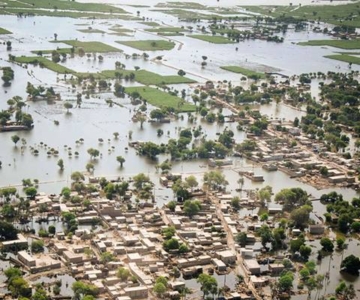
Pakistan’s devastating floods have opened up a Pandora’s Box of governance dysfunctions and historical distortions that have plagued the polity since independence. It remains to be seen what will be the outcome of the greatest calamity in our recent history. Various estimates show that the floods have affected 18-20 million people. The death toll has crossed the figure of 2000 while 2 million houses have been damaged or destroyed. Floodwaters are receding in many areas, and though there are concerns about standing water that remains in Punjab and other areas, the worst of the current flooding is taking place in Sindh.

The disaster is still not over but the fissures within Pakistan have started to erupt and once again proving how vulnerable the state is and how fractured the Pakistani society has become. Five key crises have emerged, some old and some new. However, they point to the fact that our continuous refusal to address structural problems remains a key challenge.

Martial state syndrome: Pakistan’s history is an uninterrupted tale of direct and indirect military rule and centralisation. Each time there is a crisis there is a need to resort to the de facto, real governance paradigm: the military rule. Therefore, Altaf Hussain of the Muttahida Qaumi Movement (MQM) and Imran Khan of the Pakistan Tehreek-e-Insaaf (PTI) are not saying anything new. The perennial search for a Messiah, rooted in the religious ideology that the state and education system have cultivated, is back in full force. This time the media and other discordant voices are calling for another phase of direct military rule. (more…)

State accountability – all is not that bleak

6 September 2010

Raza Rumi

Earlier, I had written a piece on citizen accountability and Jhang model innovated by a bureaucrat – Zubair Bhatti – who ironically resigned from the civil service. I am posting a video of his talk for the visitors here.

(more…)

A nation determined to be innocent

6 September 2010

Pakistanis feel angry and betrayed by their cricketers, whose behaviour has become a depressing metaphor for all the ills besetting the country  is what I had to say to Amanda Hodge whose report for The Australian (September 04, 2010) is reproduced below:

ON Monday the brutal treatment meted out to a cluster of hapless donkeys paraded as proxy cricketers through the streets of Lahore seemed an ominous sign of the fate awaiting Pakistan’s tainted players. (more…)

Post-floods: Pakistan must embrace a comprehensive reform agenda

4 September 2010

Pakistan’s recent disaster has exposed the long standing crisis of statehood. It would be a cliché to state that even the best prepared country would have been swamped by the scale of the floods. However, the flood also exposed our failing state and never before have we witnessed such radical damage wreaked on the governance institutions in the country.

Beyond the early recovery phase: The enormity of the humanitarian crisis requires concerted planning and a seamless transition into the rehabilitation and reconstruction phase. A key reason for the skepticism of citizens and the international community relates to the obvious challenges of governing Pakistan and ensuring that the state delivers on its inherent mandates. Humanitarian assistance has been forthcoming and the pundits’ credibility-deficit argument has been trashed by the world as it made pledges of over 600 million dollars. However, resources for the post-relief phase are uncertain. The usual recipe of the international economic order through IFI loans seems to be the only solution in sight unless the world wakes up to the potential long term consequences of this disaster and finds other ways than to increase its debt.

Financing challenges: A bigger challenge that faces Pakistan’s crumbling governance is related to financing the disaster-management. Already, competition between the Pakistani state agencies and the United Nations system seems to be apparent. The intentions of the UN notwithstanding, its inefficiencies (such as high administration costs) are all too well known. Similarly, the funding tensions between the federal and provincial governments will also come to light as and when assistance arrives. The criteria are unclear – Punjab wants it according to the damage while the smaller provinces are already talking about the state of ‘relative devastation’ and losses. This is something that the national council of common interest will have to resolve, lest it creates more fissures and becomes another pretext for an extra constitutional upheaval. (more…)