Monthly Archives: May 2010

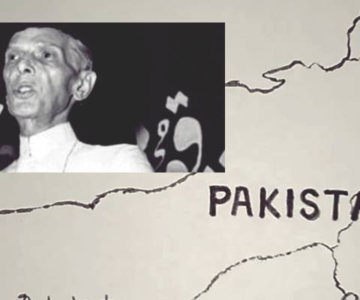
Is this Jinnah’s Pakistan?

30 May 2010

Published today by Express Tribune

The massacre of Ahmadis in Lahore has once again exposed the inner fissures of our society. As if treating them like second class citizens was not enough, the attacks on their private space of worship has confirmed that militant Islamism is now an embedded reality. Those who have been denying the presence of Punjabi Taliban will have to construct another web of denial and disbelief. We saw signs of that after the fateful tragedy. Instead of constituting investigation teams and ensuring that all necessary leads are collated, senior officials of the Punjab government made a direct reference to RAW, the infamous Indian intelligence agency.

That the terrorists can attack anyone and anywhere is now an established reality. The fact that they chose Lahore and a vulnerable community is a clear message. Indeed, Pakistan as a state should reconsider its goals and strategy of survival. The symbolism of the day chosen for the heinous mass murders is also significant. It was Yaum-i-Takbeer when Pakistan’s atomic prowess was proved on the global stage. Perhaps the greatest delusion of the state’s might and invincibility seems to have been blown to bits. The process of bigotry that started in the 1950s culminated in Zulfikar Bhutto’s tragic action of declaring Ahmadis as non- Muslims in 1974. The Zia years deepened this culture of intolerance. Whilst we may have secured our ‘external defence’ through the much touted nuclear deterrence, internally Pakistan and its hapless citizens are more vulnerable than ever. Fundamentalism is a cancer that has widely spread in the body politic. Yet few wish to tackle it. For the past two years, get-Zardari debates have dominated Pakistan’s public discourse punctuated by the anti-Americanism of the right. The interior minister has been portrayed by the media Taliban as a corrupt nincompoop; and blood thirst for him is evident from the news pages and TV screens. Taliban apologists cannot confront the military establishment directly but the truth is the fight against the Taliban requires political stability and a domestic consensus. The right of Ahmadis to worship and lead a normal life according to the Constitution of Pakistan has been violated. What should a community do when the state and non-state actors are all geared to hound them? Is this Jinnah’s Pakistan? No. (more…)

Lahore – a nightmare that is still not over

29 May 2010

Updated: my quotes in Tehran Times

Today’s events in Lahore have shaken the entire country. The zealots and the bigots aside, an ordinary Pakistani is baffled at the scale and impunity of the violence. A terrorist has been captured – perhaps more as events unfold. But will they be punished or we will find more lame excuses that the Ahmedis by worshipping in their mosques were provoking the believers.

The Taliban want to eliminate all diversity and pluralism from Pakistan. The process alas started in the 1950s and Bhutto’s tragic actions and Zia years have planted bigotry and intolerance. Fundamentalism is now a cancer that has widely spread in the body politic. Yet, no one wants to tackle it. For the past two years, get Zardari debates have dominated Pakistan’s public discourse punctuated by the anti-Americanism of the Right. (more…)

Lahore’s now the latest target of Taliban

29 May 2010

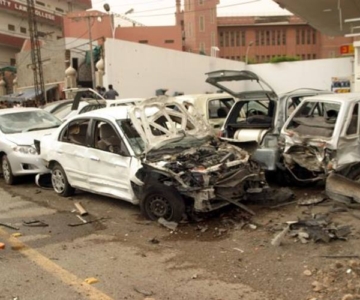
Once again the terrorists have hit Lahore. But this time they have chosen the favourite target of the fundamentalists – the Ahmedis who were declared as non-Muslims in 1974. Two places of worship have been attacked and innocent people have died. This is unacceptable and outrageous. It means that the state policy of exclusion has finally turned the country into a nightmare – a polity where freedom to worship, profess religious orientation and expression is not only curtailed by simply denied.

The resolve of the Government and the Army must be now strengthened after these tragedies. We condemn the state excesses and also the this heinous act of terrorism.

It is almost surreal to see what is happening in Lahore – there is no law and order, no law enforcement worth its name and hapless citizens witnessing the crumbling of a society. It is time to wake up – complacency will not do.

We have to fight terror and the enemy within and not blame the external forces time and again.

As I write these lines, I am petrified as a very dear friend’s father is trapped in the Model Town mosque. may God protect him.

Al-Jazeera: Deaths in Pakistan mosques raids

29 May 2010
The attack sparked a gun battle between security forces and the attackers in Garhi Shahu [AFP]
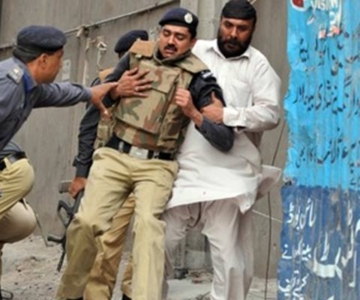
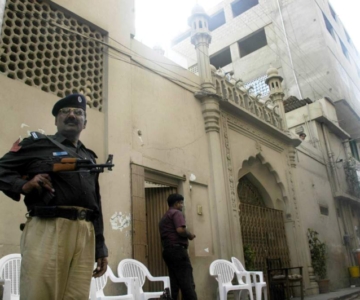
Assailants with guns and grenades have attacked two mosques in the eastern Pakistani city of Lahore, killing at least 80 people.
The co-ordinated assaults on mosques of the minority Ahmadi sect wounded scores more in different residential neighbourhoods of the city shortly after Friday prayers, police said.
The armed men, including three suicide bombers, stormed into the prayer halls firing guns, throwing grenades and reportedly taking hostages, police said.
Sajjad Bhutta, the deputy commissioner of Lahore, said the twin attacks took place on mosques in Garhi Shahu and Model Town. (more…)

Pakistan’s crumbling institutions

25 May 2010

Published in The News (Sunday)

Pakistan’s instability is a cliché, almost a self-fulfilling prophecy. All the theoretical ingredients for stability are there: an elected government, a strengthened Parliament, working relationship between the government and the opposition and above all a free media and an independent judiciary. Despite such a promising milieu, there is chaos, misgovernance and instability all around. The paranoid conspiracy theorists would of course blame the enemies of Pakistan which range from India to Israel and from the United States to the Qadianis. Whilst the astrologers would say that Pakistan was created under a negative cosmic spell. However, the answer to the conundrum of Pakistan’s instability lies in the way its state was fashioned or rather sustained at 1947.

True, the civil-military relationship has been a problem from the very start and using Islamism as a tool for the legitimisation of unaccountable governance. But the fundamental nature of institutions that have wielded and distributed power has remained unchanged for decades. It is only with the assertion of the judiciary and a relatively free media that Pakistan’s political culture is changing and it remains to be seen how long it would be before the ancien regime tries to regain its ascendancy. (more…)

Whatever happened to Kerry-Lugar?

24 May 2010

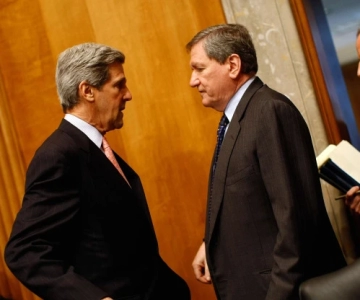
Pakistan’s dire fiscal situation has resulted in the reduction of development spending by 40 per cent. This does not bode well for the citizens who have been tormented by an energy crisis, persistent food inflation and rampant unemployment. In these circumstances, the development assistance under the Kerry-Lugar Bill (KLB) is much needed. Pakistan’s civilian government braved a media onslaught and the ire of the security establishment for tacitly supporting the US legislation. Other than the rhetoric around the ‘conditions’ drafted in Washington, there was an unstated agreement that the development assistance was welcome.

Months have elapsed and Pakistanis have yet to witness the roll out of the KLB. Global recession and political uncertainty at home underlie the tough days for Pakistanis especially the poor. It was expected that given the urgency of the situation, USAID was going to kickstart the delivery of its interventions. Well, the progress so far has been disappointing.

First, there seems to be no public sign of a consensus within the US bureaucratic machine how the aid under KLB will be delivered. Unconfirmed media reports suggest that the political versus the bureaucratic channels are not on the same page. The ‘political’ administration is ostensibly managing USAID systems and processes. There may be strategic reasons for that but the net result is that things are delayed. Not long ago, Pakistani government’s procedures were thought to be a problem but the trajectory of US bureaucracy only proves that public sector ailments are common. (more…)

Pakistan loses young Facebook friends

22 May 2010
Raza Rumi was quoted by the Australian here:
The Lahore High Court banned access to the social networking site on Wednesday after conservative Islamic lawyers argued the Everybody Draw Mohammed Day page was blasphemous. Hours later the state extended the ban to YouTube and by Thursday morning BlackBerry services had been pulled as fusty bureaucrats got wise to its Facebook application.
Before the end of the day BlackBerry services were restored under pressure from corporate and political heavyweights who, notwithstanding their religious devotion, drew the line at interference with business.
“Text messaging and Facebook are incredibly important in Pakistan because they are the only way many young people can keep in touch and form relationships,” said Lahore-based blogger and TV producer Farzana Fiaz. “There are no clubs or pubs here. Socially it’s very segregated and if you’re seen talking to a boy neighbours will talk and it could get you into a lot of trouble.”
Ms Fiaz, a British-born Pakistani, said she was torn. “I have seen on Facebook (she has found a way around the ban) that a lot of my younger, more liberal friends are totally opposed to the ban and see it as an infringement of their civil liberties and even their human rights,” she said.
Raza Rumi, editor of liberal Friday Times and founder of the e-zine Pakistan Tea House, described the ban as “ludicrous”. He had no argument that the Everybody Draw Mohammed Day campaign – reportedly a response to death threats against the South Park TV show creators for depicting Mohammed in a bear suit – was offensive to Muslims. (more…)

Pakistan seethes on Twitter, Blackberry ban

22 May 2010

I was quoted here , here and here

Islamabad :  Pakistanis are hopping mad following the ban on social networking sites Facebook and Twitter and the blocking of Blackberry services in the wake of a controversy over a contest featuring blasphemous caricatures of Prophet Mohammed.

Raza Rumi, the editor of a popular ezine, described the banning of Blackberry services as “absolute madness”.

However, on the other hand, the hardline Islamists are out in the streets protesting the anti-Prophet Mohammed cartoons competition that is denigrating their religion, they say. (more…)

Music sans frontiers

14 May 2010

by GEETA NANDAKUMAR

Song of the soul Farida Khanum

‘Aaj jaane ki zid na karo, haaye mar jaayenge ham to lut jaaenge, aisii baatein kiyaa na karo’.
Strains of her most popular ghazal in all the grandeur of her voice wafted all over the room. Rehearsing for a concert organised by the Indian Council for Cultural Relations and the NGO ‘Routes to Roots’ at the FICCI auditorium in New Delhi this week, Pakistan’s legendary ghazal icon Farida Khanum, looked svelte and poised even in her 70s. She was busy chiding the tabla accompanist, asking him to tone down the percussion. “Flow gently with the music,” she told him. Turning to me with a welcoming smile and immense warmth, she said, “There is too much cacophony and too little mellifluous music these days. Often, I am completely put off by the raucous play of percussion and refuse to sing even in Pakistan.” The irritation was palpable. The rehearsal continued as I soaked in the rich voice. Music that is manna! Age has only added to the infinite variety of her music. Finally, she broke off and asked for another percussionist. (more…)

UK Election: Yasmin Qureshi, MP

12 May 2010

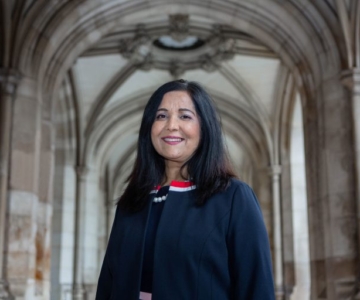
Yasmin Qureshi, a barrister in the UK, is one of the few Muslim women of Pakistani origin to have entered the British Parliament. Despite the overall inconclusive results of the election, Qureshi’s election is most delightful.

YQ has been an old friend and colleague in the United Nations. Her integrity and competence were well-recognised across . This time the constituents of Bolton East have noted that by voting her in as their representative. I remember that YQ was also outspoken, confident and quite passionate about her beliefs.

Well done YQ and viva democracy – even in times of terror and Islamophobia, democratic process has the ability to undo and trash the media cultivated myths.

This is why we need more democracy in Pakistan to correct the ills of the current electoral system.

Step across this Line

11 May 2010

Quite a readable piece published by CARAVAN- thanks to Fizza Ishaq for sending me the link

AS MUCH AS SHE MAY HAVE wanted to, Bani Abidi couldn’t be there for the opening of Resemble Reassemble, the exhibition of contemporary Pakistani art on display at the Devi Art Foundation in Gurgaon. In fact, the Delhi-based Pakistani artist could possibly be arrested if she were caught entering the region. Though barely a 40-minute ride from Delhi, Gurgaon is in Haryana, forbidden territory for many like Abidi. Current visa regulations grant her entry into only one state. (more…)

Pakistan: A failing society?

8 May 2010

My recent op-ed:

A couple of weeks ago a conference at the Lahore School of Economics allowed me to pontificate on how Pakistan is fast turning into a failing society. The context was how fractured federalism and an unstable political system had resulted in the social exclusion of a majority of the population.

The net result has been that we are a society that is divisive with embedded violence all around. Much has been said about Pakistan as a failing or failed state. Such prognoses have been manufactured in the dominant capitals of the West. True, such claims are exaggerated and self-serving for they provide a tailored worldview that Pakistan is a place that needs to be ‘fixed’.

While we are cognisant of such imperatives, let us not be blind to our deeply iniquitous and un-just society that needs major healing, reconciliation and perhaps surgery. Pakistan from 1947 to 1971 could not become a cohesive society, as the cultural-political identity of the Eastern Wing, now Bangladesh, was never accepted. Efforts to create a uniform identity failed and ultimately our majority province severed all ties with us. Ironically, this was a province at the forefront of the Pakistan movement. (more…)

Two poems from the work of Faiz Ahmed Faiz

5 May 2010
A Prison Evening

Each star a rung,
night comes down the spiral
staircase of the evening.
The breeze passes by so very close
as if someone just happened to speak of love.
In the courtyard,
the trees are absorbed refugees
embroidering maps of return on the sky.
On the roof,
the moon – lovingly, generously -
is turning the stars
into a dust of sheen.
From every corner, dark-green shadows,
in ripples, come towards me.
At any moment they may break over me,
like the waves of pain each time I remember
this separation from my lover.
This thought keeps consoling me:
though tyrants may command that lamps be smashed
in rooms where lovers are destined to meet,
they cannot snuff out the moon, so today,
nor tomorrow, no tyranny will succeed,
no poison of torture make me bitter,
if just one evening in prison
can be so strangely sweet,
if just one moment anywhere on this earth.
English Translation by Agha Shahid Ali (more…)

Divide or perish: creating new provinces in Pakistan

4 May 2010
My piece published in TFT
Since 1947, two characteristics of the Pakistani state have continued to haunt its legitimacy and survival. The first relates to the lopsidedness of its federal framework; and the second pertains to the dysfunctional citizen-state compact. Prior to 1971, the efforts to achieve parity between the eastern and western wings remained a constant struggle eventually culminating in the break-up of the country. Nationalist narratives insist on the Indian intervention in 1971 rather than acknowledging that the governance arrangements for the two wings through a powerful Centre in Karachi and later Islamabad were inherently biased and unworkable. In the post-1971 context, the lopsidedness did not end as the Punjab continued to dominate the way country works and how power is distributed between the various federating units. How can a federation work when one province will always be the most populous, resourceful and hold keys to state power through the civil-military bureaucracy?
The second unfortunate legacy of the colonial governance arrangements i.e., an over-developed state operating through central rule and diktat , is now facing the greatest crisis of legitimacy. It is now commonly recognized that state legitimacy is a function of how effective a state is in delivering services, ensuring entitlements (such as security) and negotiating plural identities and competing demands for resources and power. Pakistan’s dominant classes have always been averse to address this endemic issue until the recent political consensus that has been achieved through the passage of the 18th Amendment. While the political elites are clear on the future roadmap it remains to be seen whether the unelected institutions of the state are on board with the new provincial autonomy arrangements. Perhaps the recent violence in response to the renaming of the erstwhile North West Frontier Province to Khyber-Pakhtunkhwa was allegedly orchestrated by the Kings’ party known for its servility to the establishment.
The debate on creating new provinces from different corners of the countries is a healthy sign and a direct result of a democratic phase, howsoever uncertain it might be. (more…)