Monthly Archives: August 2008

Beyond Borders – with Shubha Mudgal and Tina Sani

30 August 2008

My article published in the Friday Times (Aug11-18)

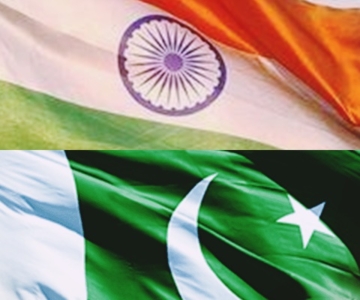
Days after the recent skirmishes at the Line of Control, when the composite dialogue between India and Pakistan was threatened, an alternative reconciliation was underway in Lahore. Music became the metaphor of shared ground between the two countries, challenging divides between them that can become violent.

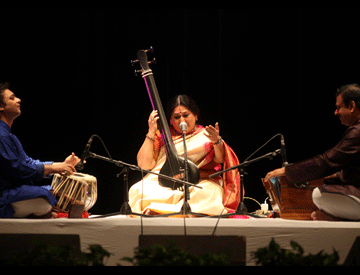
Lahore hosted the legendary vocalist Shubha Mudgal for a few days. The crusade launched by Beyond Borders Television, a production house and sister company of The Friday Times and Good Times, is a unique development in Pakistan’s media world. It is Beyond Borders’ mission statement to produce programming for regional channels that promotes understanding between peoples. Undaunted by visa restrictions and overcoming official barriers, Beyond Borders organised Mudgal’s visit to Lahore to record a tripartite discussion between Mudgal, Tina Sani and Jugnu Moshin, the compere.

The night before the recording, there was a get-together at the home of Jugnu Mohsin and Najam Sethi. It was a typical July evening, marked by the promising stillness of the monsoon. The fragrance of tuberoses, motia and lillies had made the atmosphere surreal and when the power breakdown happened, and candles were lit, it was like a slice out of some previous age. (more…)

Miniatures make for a commentary on the Sufi spirit

29 August 2008

Nicholas Cranfield considers work that draws deeply on traditional Islamic art

FATIMA ZAHRA HASSAN has been teaching in London for more than a decade, and is an accomplished artist. Dr Hassan’s little show of some 17 works happily fits the commercial gallery in St John’s, Notting Hill, in London, where the blank white walls draw the eye by their rich palette. (more…)

Opium City:The Making of Early Victorian Bombay

28 August 2008

Courtesy Three Essays Collective, I found this book review on an important yet less known facet of South Asian History:

Opium City
The Making of Early Victorian Bombay

By Amar Farooqui

REVIEW in ‘Mid-Day’

MUMBAI’S OPIUM PAST
by Mahmood Farooqui
December 23, 2005

It sometimes appears, from the nature of current historical debates, as if the British empire in India was purely an orientalising mission whose discourses generated a politics of identity but that it was little more than an ideological apparatus that hegemonised us. It is difficult therefore to connect back to the earliest nationalists who decried the drain of wealth from India, who lamented India’s deindustrialisation and the economic exploitation of our people by foreign occupiers.

It is easy, in the miasma of post-colonialisms emanating from American universities, to forget that the Empire came into being and remained in force as an economic entity, that it was instituted by traders, that there was also something called economic imperialism.

Amar Farooqui’s Opium City — The Making of Colonial Bombay is welcome because it reorients us to the fundamentals of how and why we were colonised by the East India Company. It is a new title by the Three Essays Press, a Delhi-based outfit, which has been publishing tracts in the form, as its name implies, of three essays in slim volumes by renowned and radical academics in a style and on subjects that are of general interest. (more…)

Capital shock

27 August 2008

My op-ed published in the NEWS. This was also posted at ATP and a robust discussion took place there.

A week long sojourn in Islamabad just came to an end. It was not the Islamabad that I had lived in or the one that my memory was intimate with. It has changed and perhaps forever.

I have been an accidental resident of Islamabad as I was thrown into the sleepy folds of the capital by imperatives of securing a livelihood. Lahoris can never be content with any other city. But Islamabad’s serenity as a stark contrast to the urban mess of Pakistan was most endearing to say the least. Even its cultural wastelands were forgivable for the communion with Nature was a splendid alternative to civilisation. Thus the sprawling greenbelts of Islamabad and its wild foliage became a source of inspiration and muse. I left the city three years ago with fond memories. (more…)

Urs of Bulleh Shah in Kasur

26 August 2008

The annual Urs of Bulleh Shah, the Punjabi mystic poet, commenced yesterday in Kasur yesterday. Bulleh’s poetry reflected his rejection of orthodox hold of mullahs over Islam, the nexus between the clergy and the rulers and all the trappings of formal religion that created a gulf between man and his Creator. A common theme of his poetry is the pursuit of self-knowledge that is essential for the mystical union with the Beloved. Among Bulleh’s timeless verse, I love this one (more…)

Lal Shahbaz Qalander of Sindh

24 August 2008
Shahbaz Qalandar was born in Marwand to a dervish, Syed Ibrahim Kabiruddin whose ancestors migrated from Iraq and settled down in Mashhad, a center of learning and civilization, before migrating again to Marwand. (more…)

Kabir, Bulleh and Lalon – Petals of a mystic lotus

21 August 2008

Also published in the Weekly Friday Times July 24 issue

The subcontinent during the 15th century witnessed the coming of age of a process that started brewing with the arrival of Central Asian Sufis, those eternal travellers who arrived in India with a message of Islam and mystic love. When Sufi thought, an off-shore spiritual undercurrent to the rise of Islam, met its local hosts, the results were terrific. There was no shortage of fundamentalists and communalists in that cultural landscape; and the gulf between alien rulers and the native subjects was a stark reality as well.

Nevertheless, a synthesis of sorts was navigated by hundreds of yogis, Sufis and poets of South Asia. Very much a people’s movement from below, the Bhakti movement articulated a powerful vision of tolerance, amity and co-existence that remains relevant today. This is many centuries before the suave, Western-educated intelligentsia coined the “people-to-people” contact campaigns. Yes, much has been lost in the tumultuous 20th century and perhaps these histories are irreversible. But a vast and complex common ground was nurtured by mystic poets of northern India, now comprising India, Pakistan and Bangladesh. (more…)

national identity sans freedom

20 August 2008

A few quotes from this article in the Hindustan Times – incidentally it also includes what I rambled….

Freedom means everything. But I’m not free. All these concepts are self-imposed imprisonments.—Roshan Seth, actor

Independence has provided me with a national identity but it hasn’t meant freedom. I find myself enslaved to narrow ideas of patriotism. I’m trying to break free. And writing a book on Delhi, the capital of the ‘enemy’ nation, is my first step.
Raza Rumi, blogger

Personal freedom is crucial to my growth as an artist. ‘Independence Day’ is a distant celebration for me. Each year, as mid-August approaches I am conscious of a sense of loss — I wonder what could have been had the subcontinent not been splintered.
Sehba Sarwar, poet

Being a (somewhat) responsible parent, I will share with my children the notion that today we remember our national heroes. And amidst the nationalistic pop nuggets being broadcast round the clock, I hope they hear Yeh watan tumhara hai, tum ho Pasban iss kay, yeh chaman tumhara hai, tum ho naghma khwan iss kay…
Shandana Minhas, author

More here

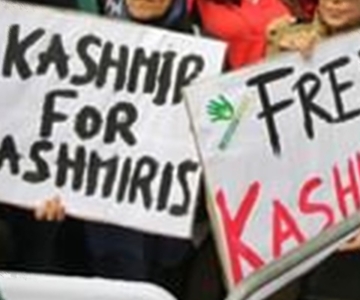
Kashmir,Azadi and Arundhati Roy

19 August 2008

UPDATE from SAJA Forum, articles, news and comments here

UPDATE: Arundhati’s brutally frank piece where she asks this question:

The unimaginable sums of public money that are needed to keep the military occupation of Kashmir going is money that ought by right to be spent on schools and hospitals and food for an impoverished, malnutritioned population in India. What kind of government can possibly believe that it has the right to spend it on more weapons, more concertina wire and more prisons in Kashmir?

India needs azadi from Kashmir as much as Kashmir needs azadi from India.(more…)

Sab Thath pada reh jaye ga…(When the gypsy-headman leaves)

18 August 2008

These pithy Urdu verses by Nazeer Akbarabadi lament that all will be abandoned when the Banjara (gypsy), the headman or Naik in the folklore, [or at a general level the life-traveller] will leave his temporal abode. (more…)

Visit to Sindh, Udero Lal (the story of the Dalits in Pakistan)

18 August 2008

Yoginder Sikand writing at DNA

South-central Sindh isn’t quite a favourite holiday destination, but I spent a fortnight there while on a vacation in Pakistan. My host was the amiable, 70 year-old Khurshid Khan Kaimkhani, a noted leftist activist, author of the only book on Pakistan’s almost 3 million Dalits. Along with a friend, he edits the only Dalit magazine in the entire country.

Khurshid met me at the railway station in Hyderabad, Sindh’s largest city after Karachi. We drove to his small farm, on the outskirts of his hometown of Tando Allah Yar, a two hour bus-ride ahead. Several Bhil families live on the farm. “They are like my own family,” Khurshid says as Baluji, a tall, handsome Bhil man, manager of the farm, welcomes us in with a tight embrace. (more…)

Sir Salman Rushdie’s fatwa against freedom of expression

17 August 2008

BY SHAJAHAN MADAMPAT

SIR Salman Rushdie, that beloved symbol of freedom of expression, has now turned Khomeini, so to speak, exposing, in an ironic twist of tale, the hypocrisy and double standards that marked the entire liberal case for unqualified and unrestrained freedom of representation.

The man, in whose defence the world’s intelligentsia mounted an intellectual blitzkrieg against the alleged medievalism of the Muslim masses, has threatened to sue the publishers of a book about him by a former police officer, Ron Evans. In his forthcoming book, On Her Majesty’s Service: My Incredible Life in the World’s Most Dangerous Close Protection Squad, Evans dares to paint a rather unflattering portrait of the writer, whose unflattering ways stirred up controversies ever since he began to write. Rushdie alleges that the book “destroys his character” and “presents wholly made up incidents as facts.” (more…)

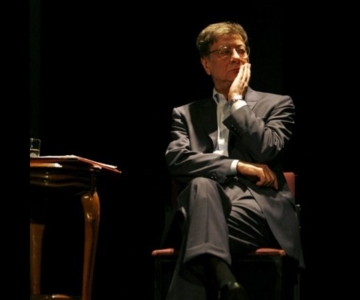
Adieu Mahmoud Darwaish

17 August 2008

Courtesy AHRC

I come from there

I come from there and I have memories
Born as mortals are, I have a mother
And a house with many windows,
I have brothers, friends,
And a prison cell with a cold window.
Mine is the wave, snatched by sea-gulls,
I have my own view,
And an extra blade of grass.
Mine is the moon at the far edge of the words,
And the bounty of birds,
And the immortal olive tree.
I walked this land before the swords
Turned its living body into a laden table.

I come from there. I render the sky unto her mother
When the sky weeps for her mother.
And I weep to make myself known
To a returning cloud.
I learnt all the words worthy of the court of blood
So that I could break the rule.
I learnt all the words and broke them up
To make a single word: Homeland…..

*****************

Identity Card

Record!
I am an Arab
And my identity card is number fifty thousand
I have eight children
And the nineth is coming after a summer
Will you be angry? (more…)

Aurangzeb as he was according to Mughal Records

16 August 2008
Found these amazing images on a deeply problematic exhibition on the Mughal Emperor Aurangzeb here
Exhibit No. 2: Prince Dara Shukoh translating the Upanishads.

Prince Dara Shukoh, the eldest son of Emperor Shah Jahan, was like his great ancestor Akbar, a very liberal and enlightened Musalman and a true seeker of truth. Akbar respected all religions – Islam, Hinduism, Christianity, Zoroastrianism, Jainism, Sikhism, etc., and gave their votaries complete religious freedom. He was ever keen to discuss and understand their religious beliefs, practices and philosophy and, in order to make the Musalmans familiar with the culture, and universal values, philosophy and traditions of India, he had the great epics of India – Ramayana and Mahabharat – translated into Persian. He also arranged for the translation of the Atharvaveda. (more…)

recollections of Annemarie Schimmel

13 August 2008

Rehana Hyder writing for the Friday Times

My first recollection of Annemarie Schimmel was as a teenager in Delhi in 1969, in the year of the Ghalib Centenary celebrations, when my mother sent me to her hotel room with a single long-stemmed rose and a note with “ sher o shairi, ” the usual mode of communication between the two literary ladies. I remember her as striking and sparkling, tall and blonde, always wearing something reminiscent of strawberries, sunshine and cream. She had probably even seen me as a toddler during my parents’ previous posting in India. The only person I know who has known her longer is my old friend Anadil Rashidi, whom Annemarie Schimmel blessed like the proverbial Fairy Godmother at her birth in the sacred, Sufi land of Sindh, her favourite part of Pakistan.

Thereafter, Annemarie Apa was woven into the fabric of my life, and intricately so when we lived in her country of origin, Germany, in the early 1970s. I learnt with wonder how, in Saxony as a girl, she had written and painted the Orient, East and South Asia in particular, under the encouraging eyes of her enlightened “eltern.” Her Mother, whom we all came to call “Mama,” and she resided in an old, spacious, light-filled apartment, Lennestrasse 42, overlooking a tree-lined avenue near the University in Bonn. (more…)

Next Page »