Archive for January, 2008
Naanak’s wisdom
A little over fifty years ago our Persian teacher, a pious maulana in the old mould, was explaining the exemplary character of the Holy Prophet (pbuh). He quoted lines from Baaba Naanak to explain his point ‘Ek ne keh di ek ne maani’. This was not uncommon. From great Punjabi poet Hafiz Burkhurdar (17th century) to a common Punjabi villager, everyone quoted Naanak. Now they teach no Naanak at Punjab University Lahore, because Naanak was a non-Muslim.
However in Muzaffar Ghaffar’s series on Punjabi classic poetry, you get an insight into the great wisdom and beauty of Naanak’s poetry. Muzaffar is a great cultural asset and in presenting a selection of Naanak after seven volumes in this remarkable series on Sufi poetry of Shah Husayn, Bulleh Shah, Sachal Sarmast and Khawaja Farid, he has excelled himself in this one. His series presenting all the major poets of Punjabi language in English is a work unique not only in the subcontinent but among world literature. In no other language are all the major poets of a language explained so comprehensively and competently by one author. Punjabi has a very rich heritage and Muzaffar has done justice to this colossal undertaking. Read the rest of this entry »
Noor Jehan singing
This soulful poem by Faiz (??) was rendered by Madame Noor Jehan in her early, melodious years. Manto has also mentioned this rendition in his biography of the great Noor Jehan.
What an effortless and grand effort. Read the rest of this entry »
Afghan Madhouse (Book Review - No Space for Further Burials)
Decades of imperialism have left Afghanistan and its people devastated. But the fall of the Taliban, and the much touted ‘liberation’ of Afghanistan, has produced a new spate of novels, films and other artistic media dealing with the ‘Afghan victim’.
And when I say ‘Afghan victim,’ I mean a nauseating overdose of burqa-oppression, Taliban brutality and other Oriental tragedies. Not only are these subjects sexy they tie into the global imperatives of terror and Islamism but they also artfully exonerate the aggressor, whether it is the Soviets, US imperialism or NATO. As such, the bulk of this new subgenre of fiction addresses the Western, English-speaking world; writing about reluctant and not-so-reluctant fundamentalists sells ‘Over There’. Meanwhile, literature is turning into a grand extravaganza of marketing, prizes, commoditization and short-lived shelf lives.
Feryal Ali Gauhar’s second novel, No Space for Further Burials, attempts to break free of many of these stereotypes. A trained economist, filmmaker and former UN Goodwill Ambassador, Gauhar opts to publish her book in India , not a Western outlet. More importantly, No Space inverts the oft-hackneyed themes of displacement, war, America and the suffering Afghans, ultimately treating these grim motifs by focusing on the sanity and insanity implicit within personal narrative. Read the rest of this entry »
A few poems by Bulleh Shah
Recently, I was asked to help a friend with the original text of Bulleh Shah’s Hindu na Na heen Musalmaan. I found the original Punjabi and also found two other pieces that I am posting here.
Bulleh Shah’s poetry addresses most maladies that we face in this day and age.
——————————
HiNdu na naheeN musalmaan,
Baheeye tiranjan taj abhimaan.
Sunni na naheeN ham sheeya
Sulha kuhl ka maarag leeya.
Bhookhe na naheeN ham rahje,
NaNge na naheeN ham kahje.
RoNde na naheeN ham hasde
UjaRe na naheeN ham vasde.
Paapi na sudharmi na,
Paap pun ki raah na jaanaaN.
Bulhe Shah jo hari chit laage,
Hindu turak doojan tiyaage
Neither Hindu nor Muslim,
Sacrificing pride, let us sit together.
Neither Sunni nor Shia,
Let us walk the road of peace.
We are neither hungry nor replete,
Neither naked nor covered up.
Neither weeping nor laughing,
Neither ruined nor settled,
We are not sinners or pure and virtuous,
What is sin and what is virtue, this I do not know.
Says Bulhe Shah, one who attaches his self with the lord.
Gives up both hindu and muslim. Read the rest of this entry »
“Muslims in Germany†study- State-propagated racism under the guise of science
Muslims in Germany are completely alienated politically and also have to cope with a racist witch-hunt, which has increased continually ever since the September 11 terror attacks in New York and Washington. Muslims as a whole are routinely associated with the enforced wearing of headscarves, honour killings, arranged marriages and violent criminality.The ruling elite in the worlds of politics, the media and academia are systematically attempting to divert attention away from the social crisis and class tensions, instead expounding on a “war of cultures.†This could be seen in the article by historian Hans-Ulrich Wehler in the Die Zeit newsweekly about a “Turkish problem,†due to the fact that the “Muslim minority has proven itself incapable of assimilation.†Writer Botho Strauß warned in Der Spiegel of the “Islamification of the West†and implicitly called for a crusade and fight against Muslim minorities in Western countries.The study “Muslims in Germany†has now given new impetus to this demagogy. Even though the authors have subsequently called for a more differentiated view to be taken on the results of their study, they are nevertheless directly responsible for the fact that the study has provided new fuel to the likes of Koch and Schäuble. This Muslim-baiting has since been joined by the interior ministers of Lower Saxony, Uwe Schünemann (CDU), and of Bavaria, Joachim Herrmann (Christian Social Union), who demand that all Muslims living in Germany must sign a “declaration renouncing violence.â€
Full article can be read here
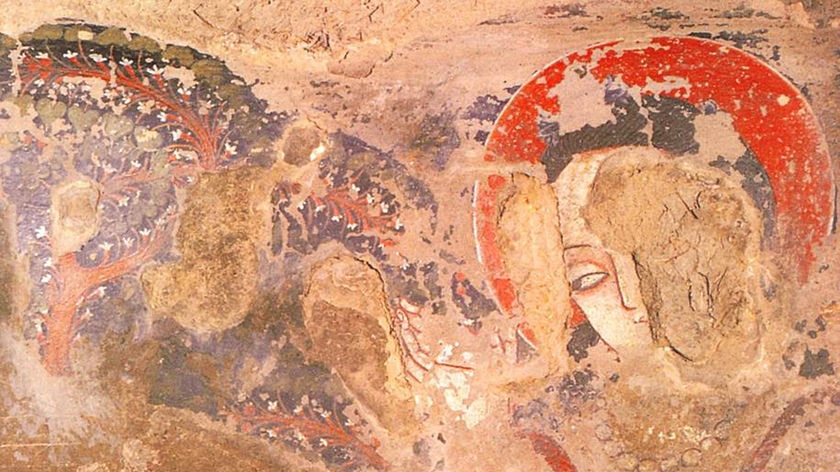
World’s first oil paintings found in Afghan caves
Bamiyan is no ordinary location. This was the place where the giant Buddhas that stood for centuries with their message of peace were destroyed by the Taliban. And, now this startling revelation. There is tragedy laced with irony here.Â
 Forget Renaissance Europe. The world’s first oil paintings go back nearly 14 centuries to murals in Afghanistan’s Bamiyan caves, a Japanese researcher says.
Buddhist images painted in the central Afghan region, dated to around 650 AD, are the earliest examples of oil used in art history, says Yoko Taniguchi, an expert at Japan’s National Research Institute for Cultural Properties.
Loving or Hating Arundhati Roy?
Cross-posted from drunkonink blog. Soniah Kamal’s thoughtful write-up is worth sharing here:
Saba Bhaumik’s opinion piece in Outlook India once again attempts to explain why Indians may not be madly in love with Arundhati Roy while the West supposedly is but Bhaumik doesn’t say anything that hasn’t already been said a million times: Indian males are envious coz Roy is smart, the women are confused by her outspokeness and, while Roy’s hair styles challenge beauty norms, her sense of style sets dressing trends.
The Indic civilisation
Ishtiaq Ahmed writing here
Today’s article coincides with India’s declaration as a republic in 1950. The civilisational roots of modern India are always worth discussing, because despite all the odds against it — the caste system, poverty and hunger, illiteracy and other such debilitating factors — it became a democracy and has remained so.
Civilisation denotes a complex society with distinct cultural and ideational features that takes shape in the long, historical process through the division of labour and a concomitant social hierarchy. Therefore, civilisations cannot be understood only in contemporaneous terms; historical antecedents and legacy weigh heavily in forming the present. On the other hand, civilisations are also dynamic and change, adjust and transform, while retaining links with the past. Read the rest of this entry »
“Husn-e-Haqiqi†by Arieb Azhar
I discovered this video courtesy a blog at Naqsh.
This is a soulful rendition of powerful lyrics by Khawaja Ghulam Farid; and the images are pretty innovative as well. Read the rest of this entry »
Go, knock at the door of your own heart
 There’s a basket full of loaves on your head,
yet you’re begging for crusts of bread from door to door.
Pay attention to your own head, abandon giddiness.
Why are you knocking at every other door?
Go, knock at the door of your own heart. Read the rest of this entry »
The other side of Emperor Babar
Babar, the founder of Mughal dynasty in India was an unusual character of his times. A poet, writer and a free soul, he was so modern and some would say post-modern in an era otherwise categorised as medieval. I was delighted to find this piece authored by Ashfaque Naqvi.
An interesting book has landed at my table. As the title, Zaheeruddin Muhammad Babar, is about the person who laid the foundations of the Mughal Empire in the sub-continent. Written by the eminent Indian educationist, Qamar Rais, it gives a different picture of the man from what we gather about him from his self-written, Tozak-i-Babri…..
As Prof Qamar Rais says in the foreword, he had for long been studying the works of Ali Sher Nawai and such other classical poets of Uzbekistan but realized during his stay in that country that those people revered Babar more for being an intellectual and a lyrical poet. In fact, even during the Soviet era, he saw Babar’s pictures hung in most homes showing him holding a book and sunk in deep thought. As a consequence, he directed his studies in that field.
… even today, Babar is held in esteem and considered a hero both in Afghanistan and Uzbekistan. He even quotes Pandit Nehru as having said that the greatness of Babar lay not in capturing India but in capturing the hearts of Indians.
Oh, Lucknow!
ONE fine morning under the programme of Sahitya Academy I found myself in Lucknow, and wondered if it was the Lucknow I had earnestly desired to get a glimpse of. When after partition Attiya Husain wrote her novel depicting the Lucknow of good old days, she chose to present it under the title Sunlight on the broken column. Now the broken column is very much there, but sunlight has long faded away. The novel had been dubbed as decadence by the maulvis, reformists and the progressives alike, and as a flourishing of fine arts and culture by the liberals. Prof Anis Ashfaq, who was kind enough to host me and sensing my keenness to have a glimpse of that sunshine, led me to Imambara Asifiya. What a splendid structure. One was left wondering at high, spacious roof with no columns to support it. The upper story has a bhoolbhulliyan, a maze. It provides added attraction to visitors. Read the rest of this entry »
Imam Hussain: The Beloved of the Beloved
by Syed Salman Chishty
Shah Ast Hussain …
“Among the Belivers are Men ,who delivered their promise to Allahâ€
(Ayah 23/ Surah Al-Ahzab)
On the 10th of Muharram, 61 after Hijrah (680 AD) Hz.Imam Hussain was martyred by the army of Yazid. This tragedy shook the Muslim world and continues to be remembered by those who love the Prophet (saw) and his family. The death of Hz.Imam Hussain , his struggle for truth, justice and the greatness of Islam is still remembered and commemorated today. Read the rest of this entry »
Finding a long lost friend
KM and I have known each other for ages. There were days when we were at school and the height of excitement of pre-globalized Lahore was visiting friends. So we would plan our visits and then sit for hours and talk. Random, intelligent and human stuff.
And, then our lives expanded so to speak when we arrived in London as undergraduate students, lost and a little disoriented in a college with thousands of students. I remember that we watched “The Unbearable Lightness of Being” together and few other alternative films. KM was a little shocked at the Kundera’s hedonism. There was one that KM did not find too exciting. Perhaps it was Greenway’s “The Cook, The Thief, His Wife and Her Lover“. Of course we were growing up and finding our little paths and dealing with our demons and gods. Read the rest of this entry »
Indonesia’s green madrassas
Rather than harping on the divisive rhetoric of tribe, sect and political persuasion, we have a theological and teleological imperative to “green our societyâ€
In a remote part of Central Java, Indonesia’s most populous island, there is a rather unusual form of environmentalism taking root. Shadowed by the great Merapi volcano and surrounded by fertile fields of rice and sugarcane, a small school is graduating environmentalists whose commitment to the earth is not based on Western conservation texts but rather predicated in values derived from Islam. The head of the school, Nasruddin Anshari, frequently uses the refrain “one earth, for allâ€, just as much as he does the usual Islamic invocation of Allah-u Akbar (God is Great). Read the rest of this entry »
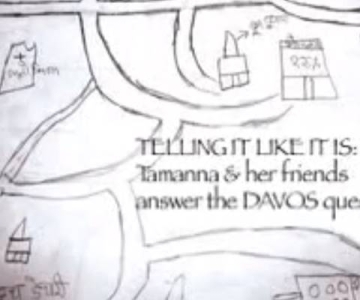
Watch this Video: Tamanna & her friends tell it like it is
Please watch this evocative video that Going to School - a media organization based in New Delhi - has put together for the girls from Gole Kuan, an urban slum on the periphery of an industrial suburb in New Delhi.
This video attempts to address a question posed by the DAVOS economic forum -
“What one thing do you think that countries, companies or individuals must do to make the world a better place in 2008?” Read the rest of this entry »
A few notes on the 10th of Muharram
God’s wisdom is beyond comprehension.
The 10th of Muharram is simultaneously the most celebrated day in the Islamic Calendar, and simultaneously the most sorrowful day of the Islamic Calendar.
It celebrates the day that God saved the Prophet Moses -p- and his people from the clutches of the Pharaoh.
It mourns the day that God allowed the grandson of the Prophet Muhammad -p- and his people to be slaughtered by the clutches of Yazid.
The Battle of Karbala (Mir Anis)
 Mir Anis is a classical master of Urdu poetry whose elegies on the struggles between Imam Hussain, prophet’s grandson and the usurper, callous monarch Yazid are immortal. Today is the 10th of Muharram signifying the epic Karbala battle and the martyrdom of Imam Hussain. The mourning for Hussain and his family is not complete without a reference to Anis and his peer Dabeer. Luckily I found a Marthiyaa of Anis, that has been translated into English David Matthews, published by Rupa Co. Read the rest of this entry »
By: AKHLAQUE
I come across your website while searching some material on sufiism….I must say its a great contribution by you towards promoting what we people used to be and what we should be. May Allah guide you for the best.
Regards,
AKHLAQUE
Shah Ast Hussain
Khawaja Ghareeb Nawaz’s immortal verses on the status of Hazrat Imam Hussain (AS)
Shah ast Hussain, Badshah ast Hussain
Deen ast Hussain, Deen Panah ast Hussain
Sardad na dad dast, dar dast-e-yazeed,
Haqaa key binaey La ila ast HussainAnd a rough translation -
Ruler is Hussain, Emperor is Hussain,
Faith is Hussain , guardian of faith is Hussain .
Offered his head and not the hand to Yazid.
‘Indeed, Hussain is the foundation of La-ilah Read the rest of this entry »


An interesting book has landed at my table. As the title, Zaheeruddin Muhammad Babar, is about the person who laid the foundations of the Mughal Empire in the sub-continent. Written by the eminent Indian educationist, Qamar Rais, it gives a different picture of the man from what we gather about him from his self-written, Tozak-i-Babri…..