Archive for June, 2007
How the British Raj took roots in India
Reading about the critical battle of Plassey, the betrayal by local nobles, indifference of the natives, I wondered how history spells out some clear lessons that we choose to ignore.Â
“step into the tavern of ruins..”
Qurratulain Hyder
Sometimes a little discovery can be so delightful. The other day I was shown an old book authored by Qurratulain Hyder. The book called “The Exiles” is author’s translation of her novelette in Urdu. The book was presented to Agha Bashir Ahmad, another forgotten cultural icon from Lahore. Full article here >>
Welcome Hatshepsut
Amazing how the past continues to interact with the present. Hatshepsut was an ancient Egyptian queen who declared herself as the king and ruled Egypt amid revolts, external threats. But as long as she ruled, she held the fort. Article here >>
No Tolerance for Richistans - Obscene Wealth is not victimless!
Writing in the Guardian, Madeline Bunting laments the growing inequities in Britain. Her powerful critique is not jut applicable to the British society…
Fresh translations of Faiz
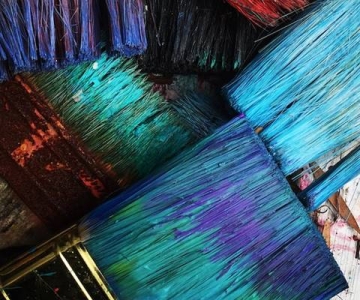
Another accidental painting
This weekend was remarkable: visions and confusions found their way on a plain canvas and before long I was in a strange dialogue with the canvas - here is the result of this dialogue: Full entry here >>
I thought I must give up on life..
Solomon Marni has contributed this beautiful poem for JR.Â
I thought I must give up on life
And turn into a stone;
The desert wind quite suited me:
No heart, no mind–just bone.
I thought it would be dumb to try
To want something again;
Wanting turns to need, and then
Transmogrifies to pain.
I laughed at people still in love
Who trusted someone’s word;
To make my happiness depend
On faith seemed quite absurd.
I lay alone and wonder-struck,
Sleepless in my bed,
Still numb, still dumb, still ice, ice cold,
Not knowing I was dead.
And then you came and shone upon
My meadow full of snow,
And saw the flowers only love
Could recognize and grow;
And made me feel so beautiful
I shed my cold, cold skin,
And opened up my heart to you,
And, fearful, let you in.
And now, my dear, I am in love,
With all that I’ve been through.
I know the worst of all the world,
And I believe in you
I wasn’t like this before….
believe me
i wasn’t always like this
lacking common sense
or looking insane
like you
i used to be clever
in my days
never like this
totally enraptured
totally gone
like sharp shooters
i used to be
a hunter of hearts
not like today
with my own heart
drowning in its blood
nonstop asking and
searching for answers
that was then
but now
so deeply enchanted
so deeply enthralled
always pushing
to be ahead and above
since i was not yet hunted down
by this
ever-increasing love
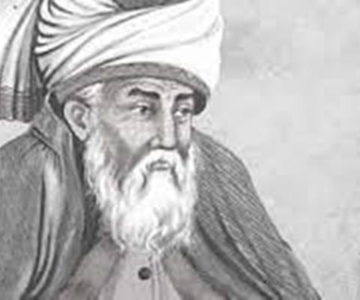
RumiÂ
– Translation by Nader Khalili
“Rumi, Fountain of Fire”
Cal-Earth Press, 1991
Courtesy Sunlight
Shaming Literature - ‘Sir’ Salman Rushdie
The current controversy on Rushdie’s knighthood has several dimensions. Amid the knee-jerk reactions alluding to the grand-conspiracy-against-Islam, it brings out various layers and levels of literature’s role and position in societies and now in the globalized world.
I was once a fan of Rushdie and avidly devoured his books with great admiration. From Grimus to The Moor’s Last Sigh, I marveled at his playfulness with the english language and its idiom which undoubtedly he has enriched. The collection of essays titled Imaginary Homelands was a combination of disparate but original writings. Somewhere during this process came the ridiculous Satanic Verses which other than its blasphemous content and brazen disrespect for a vast majority of Muslims was a bad piece of writing!
The decline of Rushdie as a writer, finally, was confirmed by the trashy “Ground Beneath Her Feet“. Thereafter, one read strange, ignorant pieces of his non-fiction in the Western mainstream media that needed his stature to find a rationale for the imperial projects in Afghanistan and Iraq.
Shalimar the Clown, his recent novel was even worse as it proved to be bereft of subtlety and re-invoked all the crappy, soul-destroying images and cliches of our times. In a non-serious piece, published in the Friday Times (Pakistan) in December 2005, I wrote:
Salman Rushdie’s new novel, Shalimar the Clown, is enough to add to one’s misery. I finished browsing it; what else can you do with such stuff posing as quality fiction? As if the name of the central character “Shalimar†was not enough to offend a native reader such as I, the heroine “India Ophuls†changing her name to “Kashmira†was the ultimate illustration of cheap exoticism and a hackneyed dive into passé magical realism. Alas, Rushdie has started believing in his own mantra and the twisting of historical narrative. It simply does not work now. He is more of a bard for the ascendancy of the global tide against Islamism and perhaps he should stick to that. Better if he were to provide some intellectual depth to Fox News, or even better, if he started writing scripts for his young wife’s tele-plays. Shalimar successfully completes the trilogy of Rushdie’s worst novels, the other two being The Ground Beneath Her Feet and Fury . Aijaz Ahmad, a US-based academic, argued a long time ago that Rushdie and Naipul were avatars of ‘oriental’ consciousness. Small wonder that they are reviewed, exalted and globally hyped.
Much to my delight, a friend – an aspiring critic – sent me the review by Theo Tait of the London Review of Books: Noting what Rushdie’s style produces in the novel, Tait writes that it “ .. . is a cross between a piece of magic realism which displays all the worst vices of the style, and the contemporary international thriller. It is passionate, well-informed and sometimes interesting; but also hackneyed, simplistic and often very, very silly…”
Today, I read this brilliant article published in the Guardian written by a noted academic, Priyamvada Gopal that essentially is a lament of all that Rushdie and his new writings stand for:
Sir Salman, on the other hand, is partly the creation of the fatwa that played its role in strengthening the self-fulfilling “clash of civilisations” that both Bush and Osama bin Laden find so handy. Driven underground and into despair by zealotry, Rushdie finally emerged blinking into New York sunshine shortly before the towers came tumbling down. Those formidable literary powers would now be deployed not against, but in the service of, an American regime that had declared its own fundamentalist monopoly on the meanings of “freedom” and “liberation”. The Sir Salman recognised for his services to literature is certainly no neocon but is iconic of a more pernicious trend: liberal literati who have assented to the notion that humane values, tolerance and freedom are fundamentally western ideas that have to be defended as such.
Vociferously supporting the invasions of Afghanistan and Iraq on “humane” grounds, condemning criticism of the war on terror as “petulant anti-Americanism” and above all, aligning tyranny and violence solely with Islam, Rushdie has abdicated his own understanding of the novelist’s task as “giving the lie to official facts”. Now he recalls his own creation Baal, the talented poet who becomes a giggling hack coralled into attacking his ruler’s enemies. Denuded of texture and complexity, it is no accident that this fiction since the early 90s has disappeared into a critical wasteland. The mutation of this relevant and stentorian writer into a pallid chorister is a tragic allegory of our benighted times, of the kind he once narrated so vividly.
In any case, Ali Eteraz is right when he states that what’s there is a colonial siege of the minds in this whole issue.Â
 And, please also see a sensible editorial by the Pakistani newspaper DAWN here.
This dubious honour is yet another endeavour to reward the constructed clash of civilizations. The fact that Rushdie has accepted it, further confirms his degeneration as another script writer of this “theory”. Meanwhile, the protests in Iran and Pakistan only reinforce this vicious cycle of neo-orientalism .
Shameful indeed.
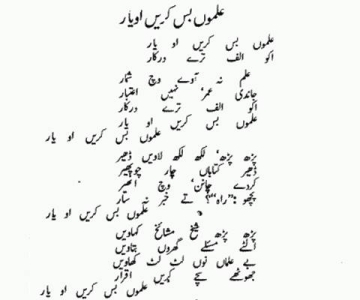
Enough of learning, my friend! - Bulleh Shah
Enough of learning, my friend!
To it there is never an end
An alphabet should do for you,
It’s enough to help you fend.
You’ve amassed much learning around,
The Quran and its commentaries profound.
There is darkness amidst lighted ground.
Without the guide you remain unsound.
Learning makes you a Sheikh or his minion,
And thus you create problems trillion.
You exploit others who know not what,
Misleading them with wild opinion.
You meditate and you say your prayers
You go and shout at the top of the stairs.
Your cry reaching the high skies,
Its your avarice which ever belies.
The day I learnt love’s lesson,
I plunged into the river of divine passion;
An overwhelming gale, I was confounded and lost
When Shah Inayat cruised me across.
Source: here
More on Bulleh Shah here and here
A Beautiful Veil
I am grateful to Ahmer for sending me the link to “The Art of Integration Exhibition: Islam in Britain’s Green and Pleasant Lands“.
The photograph on the left titled A Beautiful Veil is a creation of Zarah Hussain, Geometrist who has a lovely explanation for this: ‘I have always been fascinated by Islamic patterns, the interlocking geometry with its flowing shapes, stars and rosettes. They captured my eyes, heart and mind. The contemplation of these ’spider webs of God’ mold my soul and briefly enable me to escape the preoccupations of everyday life.’
Ghufran has an interesting post on Islamic architecture here.
Shah Abdul Latif Bhitai
If you are seeking AllahÂ
Â
If you are seeking Allah,
Then keep clear of religious formalities.
Those who have seen Allah
Are away from all religions!
Those who do not see Allah here,
How will they see Him beyond?
Let us go the land of Kak
Where love flows in abundance,
There are no entrances, no exits,
Every one can see the Lord!
There is no light nor day
Every one can see the Lord!
Those who love the Lord
The world cannot hold them.
Palaces do not attract them,
Nor women nor servants
Nothing binds them:
The renouncers leave everything behind.
A message came from the Lord:
A full moon shone
Darkness disappeared
A new message came from the Lord:
It does not matter what caste you are
Whoever come, are accepted.
Where shall I take my camel,
All is Light…
Inside there is Kak, mountain and valley,
The Lord and the Lord: there is nothing but the Lord.
Â
 (translated from Sindhi by D. H. Butani)
Legacy of Shah Latif is a recent book on Bhitai’s life and works. In a recent book review, Anwar Abro writes:
“Two and a half centuries after his death, the celebrated Sindhi philosopher-poet Shah Abdul Latif Bhittai (1689-1752 AD) continues to inspire and influence the lives and activities of the peace-loving mystic souls of Sindh. Intellectual activities, social, political or ideological discourses are considered meaningless without the recitation of his poetry. Shah Latif has become an essential part of the day-to-day life of the people of Sindh so much so that everyone wants to find out more about his life, his principles and beliefs and discover the true interpretation of his mesmerisingly meaningful poetry…”
read more here
Picture above right is courtesy Himal Magazine
Pakistani media - an alternative view
Themrise Khan sent me her provocative piece on Pakistani electronic media. It is a contested standpoint and will not be appreciated by all. But it earnestly attempts to revisit the role of media in a dispassionate manner avoiding the cliched media freedom versus censorship debates.
A recent Book on Faiz Ahmed Faiz
The monthly Herald has published my review of Khalid Hasan’s book - “O City of Lights” in its June issue. It is a comprehensive selection with some gems such as translated versions of Faiz’sinterviews and conversations. Khalid Hasan is a well known Pakistani writer and journalist now based in the US. He was a close friend of Faiz and has this particular advantage as a biographer and a translator. He has translated more poetry and this is a welcome step to introduce and popularize Urdu poetry to non-urdu readers.
By: william
Against Forgetting - Manglesh Dabraal
I also found this translation on the site you mention - I find the poem moving and profound. Do you know if any more of Manglesh Dabraal’s poetry is available on the internet in translation into English ? Is there a collection or anthology of similar poetry published in English?
Kind Regards
William
I finally moved here - “You lack a foot to travel?”
Moving from the wordpress blog is proving to be more excruciating than I had thought. In addition, being technically challenged does not help either. Nevertheless, I have moved with my bags, posts and dreams. The site is still under construction and polishing it will take time. Let’s hope I can keep up with the techncial demands and the urge to post more.